
What Is a Security Deposit? The Ultimate Landlord's Guide
- Sarah Porter

- Feb 15
- 14 min read
Updated: Mar 10
Think of a security deposit as your financial peace of mind. It’s a fixed amount of money, usually about one month's rent, that a new tenant pays you before they get the keys. This isn't just extra cash in your pocket; it’s a refundable fund you hold in trust.
If the tenant upholds their end of the lease, they get it all back. But if they leave behind a mess, unpaid bills, or significant damage, this deposit is your safety net to cover those costs.
What Is a Security Deposit in Simple Terms

Let's break it down. A security deposit is essentially a promise, backed by cash, that a tenant will treat your property with respect. It’s a separate payment from rent, collected upfront to protect you from specific financial losses. Its job is to cover things like holes punched in the wall, broken appliances, or a final month of skipped rent—not the small scuffs and faded paint that happen over time.
Getting this distinction right is crucial. A security deposit is not the tenant’s last month's rent in advance, unless your lease or local laws explicitly state that. Its real purpose is to make you whole if the tenant returns the property in a state that’s worse than when they moved in, minus any normal wear and tear.
One of the biggest mistakes I see new landlords make is thinking the deposit is a slush fund for general maintenance. Legally, you can only use it for tenant-caused problems, not for the routine painting or carpet cleaning you’d do for any turnover.
Core Functions and Legal Limits
Every landlord needs to know that security deposits aren't the Wild West. Your ability to collect, hold, and use this money is strictly regulated by state and sometimes even city laws. These rules are designed to be fair to both you and the tenant by setting clear boundaries.
For example, most states put a cap on how much you can ask for. A common limit is one to one-and-a-half times the monthly rent, which keeps rentals accessible while still giving you a reasonable buffer.
To put it all into perspective, here’s a quick summary of what a security deposit does and the typical limits you’ll encounter.
Security Deposit at a Glance
This table breaks down the main jobs of a security deposit and the common legal guardrails you’ll need to follow.
Primary Purpose | What It Protects Against | Typical Amount Limit |
|---|---|---|
Financial Protection | Damage beyond normal wear and tear | One to two months' rent |
Lease Enforcement | Unpaid rent or lease violations | Varies by state law |
Property Restoration | Significant cleaning costs | Set at lease signing |
Ultimately, understanding these rules isn’t just about compliance—it’s about running your rental business professionally and avoiding costly disputes down the road.
Why Security Deposits Are a Landlord's Best Friend
Let's be clear: a security deposit isn't just another box to check when signing a lease. For any property owner, it's one of the most essential risk management tools you have. Think of it as your first line of financial defense against the common headaches that can easily eat into your profits.
When a tenant has their own money on the line, their perspective changes. Suddenly, they have a real incentive to take care of your property, report maintenance issues before they spiral, and generally stick to the lease terms. Without that deposit, you're the one left holding all the financial risk.
It's a simple, proactive step that separates savvy investors from those who leave themselves wide open to preventable, and often expensive, problems.
Covering Costly Tenant-Caused Damages
The most obvious job of a security deposit is to cover property damage that goes beyond normal wear and tear. A few scuffs on the paint or some light carpet wear after a few years? That's part of the business. A gaping hole in the drywall is another story entirely.
A security deposit gives you immediate access to funds for fixing these bigger issues. We're talking about things like:
Big holes punched in walls that need to be professionally patched and repainted.
Deep gouges or burn marks on hardwood floors that require sanding and refinishing.
Cracked windows or broken doors due to carelessness.
Unauthorized paint jobs—especially dark or unusual colors that will take multiple coats of primer and paint to fix.
Without that deposit, every cent for those repairs comes straight out of your pocket. A single incident like this can wipe out your cash flow for the month, or even longer.
A Buffer Against Unpaid Rent and Evictions
A security deposit also serves as a critical financial cushion if a tenant stops paying rent. The eviction process can be a slow, costly grind, often dragging on for months. All the while, you're not seeing a dime of rental income, but the mortgage, insurance, and property tax bills keep showing up.
A security deposit provides an immediate financial backstop. It might not cover all the lost rent from a drawn-out eviction, but it can make a huge difference in covering your immediate holding costs, legal fees, and other expenses.
This buffer is especially crucial for independent landlords. If you don't have deep cash reserves, one bad tenancy can seriously threaten your entire investment. The deposit helps ensure that doesn't happen.
Paying for Excessive Cleaning Costs
Finally, the deposit protects you when a tenant leaves your property a complete mess. You're expected to handle a standard turnover clean between residents, of course. But you are not responsible for footing the bill for deep cleaning that results from serious neglect.
This is for those nightmare scenarios: bags of trash left behind, carpets ruined by pet stains, or kitchens and bathrooms so grimy they require a professional cleaning crew. The deposit gives you the funds to hire the help you need to get the unit back into rentable shape, without you having to absorb the full cost of that tenant's irresponsibility. It gets your property back on the market faster, which means a new, paying tenant moves in sooner.
Understanding Security Deposit Laws and Regulations
Navigating the legal maze of security deposits isn't just a good idea—it's an absolute must for any landlord. Think of a security deposit less as your money and more as a fund you're holding in trust for your tenant. It’s governed by a complex web of state, and sometimes city-specific, laws that dictate every single step, from how much you can collect to how and when you must return it.
Getting this wrong can be a costly mistake. If you fail to follow these rules to the letter, you could face severe financial penalties, like being forced to pay the tenant double or even triple the original deposit amount. Honestly, understanding your local obligations is one of the most important things you can do to protect your investment and run a professional, compliant rental business.
State-Mandated Limits on Deposit Amounts
The very first rule you'll run into is a cap on how much you can charge. Most states stop landlords from demanding an excessive amount, which helps keep rental housing accessible. The most common limit is one to two months' rent, but this varies quite a bit from place to place.
For example, some states might let you charge a little extra for a pet deposit, while others have one strict, all-inclusive limit. While security deposits are a standard part of rental agreements worldwide, the regulations change drastically depending on the market. In New York City, landlords are legally barred from collecting more than one month's rent. Most U.S. states cap deposits at one or two months' rent and require the funds to be held in separate accounts, with return deadlines falling between 14 and 60 days after a lease ends.
Rules for Holding and Returning Funds
Once that deposit is in your hands, the law gets very specific about how you must store it. You can't just drop it into your personal checking account and mix it with your own money. Many states require you to hold the funds in a separate, non-commingled bank account.
Some jurisdictions take it a step further, mandating that the money be held in an interest-bearing account, with any interest earned belonging to the tenant. These rules are all about one thing: protecting the tenant’s money and making sure it's ready for a full refund if they leave the property in great shape.
Now for the most critical—and often most contentious—part of the whole process: the return. Every single state has a strict deadline by which you must either return the full deposit or provide a detailed, itemized list of any deductions you're making.
Key Takeaway: Missing the legal deadline to return a security deposit, even by a single day, can mean you forfeit your right to make any deductions and could expose you to significant financial penalties.
These timelines are not suggestions; they're absolute. For a deeper look at these critical deadlines, check out our guide on security deposit return timelines.
The Importance of Local Compliance
It's absolutely crucial to remember that laws can differ not just from state to state, but also from city to city. A rule that applies in one part of your state might be completely different just one county over. This patchwork of regulations means you have to roll up your sleeves and research the specific laws for your property's exact location.
When things get complicated, or if you find yourself in a dispute, it’s often smart to think about consulting a landlord-tenant attorney. Ultimately, staying informed and compliant is your best defense against legal headaches and the foundation for a professional, positive relationship with your tenants.
How to Handle and Document Security Deposit Funds
When it comes to tenant disputes, solid documentation isn't just a good idea—it's your best defense. Managing a security deposit with precision and transparency is more than just good business; it’s a legal necessity that shields you from headaches and costly penalties.
Think of it as building a clear, indisputable financial story for that deposit. Every action you take, from issuing a receipt to conducting a meticulous move-in inspection, adds a new chapter. This detailed record becomes your primary evidence if you ever need to justify withholding a single dollar.
Collection and Initial Documentation
The moment a tenant hands you that security deposit, a legal clock starts ticking. Your very first move? Provide a written receipt. It’s simple, but it’s crucial. This document needs to confirm the amount paid, the date, the property address, and your signature, establishing a clean financial trail right from the start.
Next up is the move-in inspection, arguably the most critical step in the entire process. This isn't just a casual walkthrough. It's a detailed assessment where you document the property's exact condition before the tenant moves a single box in. Use a comprehensive checklist, and don't be shy with your camera—take plenty of photos and even videos of every room, making sure to zoom in on any existing wear and tear. This baseline evidence is priceless when it's time to assess damages at move-out.
To stay on the right side of the law, you have to get the fundamentals right. This simple flowchart breaks down the three core compliance steps every landlord needs to master.
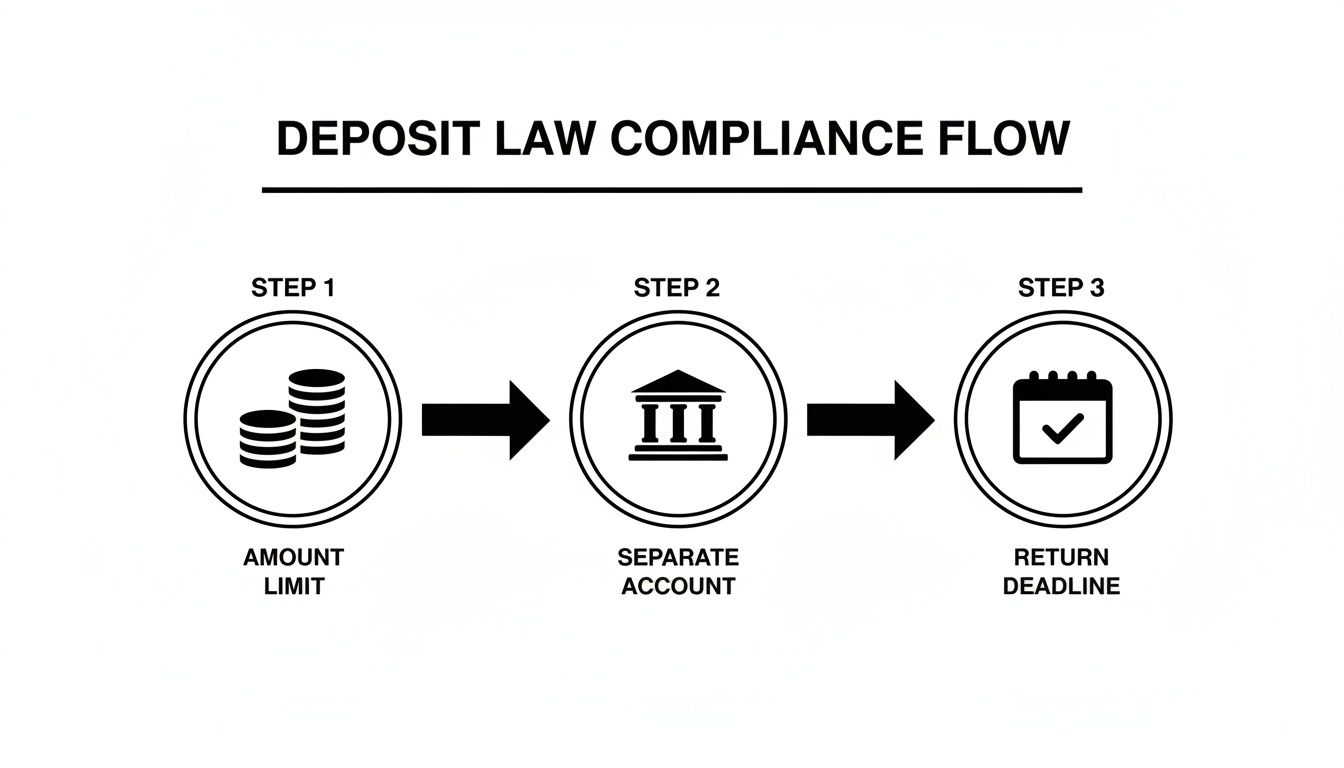
As you can see, it boils down to three non-negotiable stages: respecting the legal limit on the amount, keeping the funds in a separate account, and hitting your return deadline without fail.
Storing Funds and Creating Records
Once you have the deposit, you can’t just drop it into your personal checking account. Most states strictly require landlords to hold security deposits in a separate, designated bank account. Mixing it with your own operating funds is called commingling, and it's a major legal misstep that can lead to serious penalties.
Crucial Reminder: The security deposit is not your money. It belongs to the tenant until you have a legal, documented reason to claim a portion of it. Holding it in a separate account reinforces this fact and prevents you from accidentally spending funds that aren't yours.
From start to finish, the entire security deposit process demands a structured approach. Following a consistent checklist ensures you meet every legal requirement and maintain flawless records.
The Essential Security Deposit Checklist
This checklist walks you through every phase of handling a security deposit, from the moment you receive the funds to the day you return them.
Phase | Action Item | Why It Matters |
|---|---|---|
Collection | Provide an immediate written receipt. | Creates a clear paper trail from day one and confirms receipt of funds. |
Collection | Conduct a detailed move-in inspection with photos/video. | Establishes a baseline for the property's condition to prevent future disputes. |
Holding | Deposit funds into a separate, designated bank account. | Prevents illegal commingling and protects the tenant's money as required by law. |
Holding | Notify the tenant in writing where the deposit is held. | Many states require this disclosure; it builds transparency and trust. |
Move-Out | Perform a thorough move-out inspection, comparing it to the move-in report. | Provides clear evidence for any legitimate damage claims beyond normal wear and tear. |
Return | Create an itemized statement of any deductions. | Legally required to justify why you are not returning the full amount. |
Return | Return the deposit balance and statement within the state-mandated deadline. | Failure to meet the deadline can result in penalties, often forcing you to return the full deposit. |
Sticking to these steps will not only keep you compliant but will also make the entire process smoother and less confrontational for everyone involved.
Of course, maintaining organized records goes beyond just the deposit. For a deeper dive, check out our landlord’s guide to rental property bookkeeping to get your entire financial house in order.
Finally, if you do need to make deductions, you must send the tenant an itemized statement of deductions. This isn't a vague summary; it needs to clearly list each charge (e.g., "$150 for drywall repair in the living room" or "$75 for removing abandoned trash"). This statement must be sent along with any remaining deposit balance within your state's legal timeframe.
Making Lawful Deductions from a Security Deposit
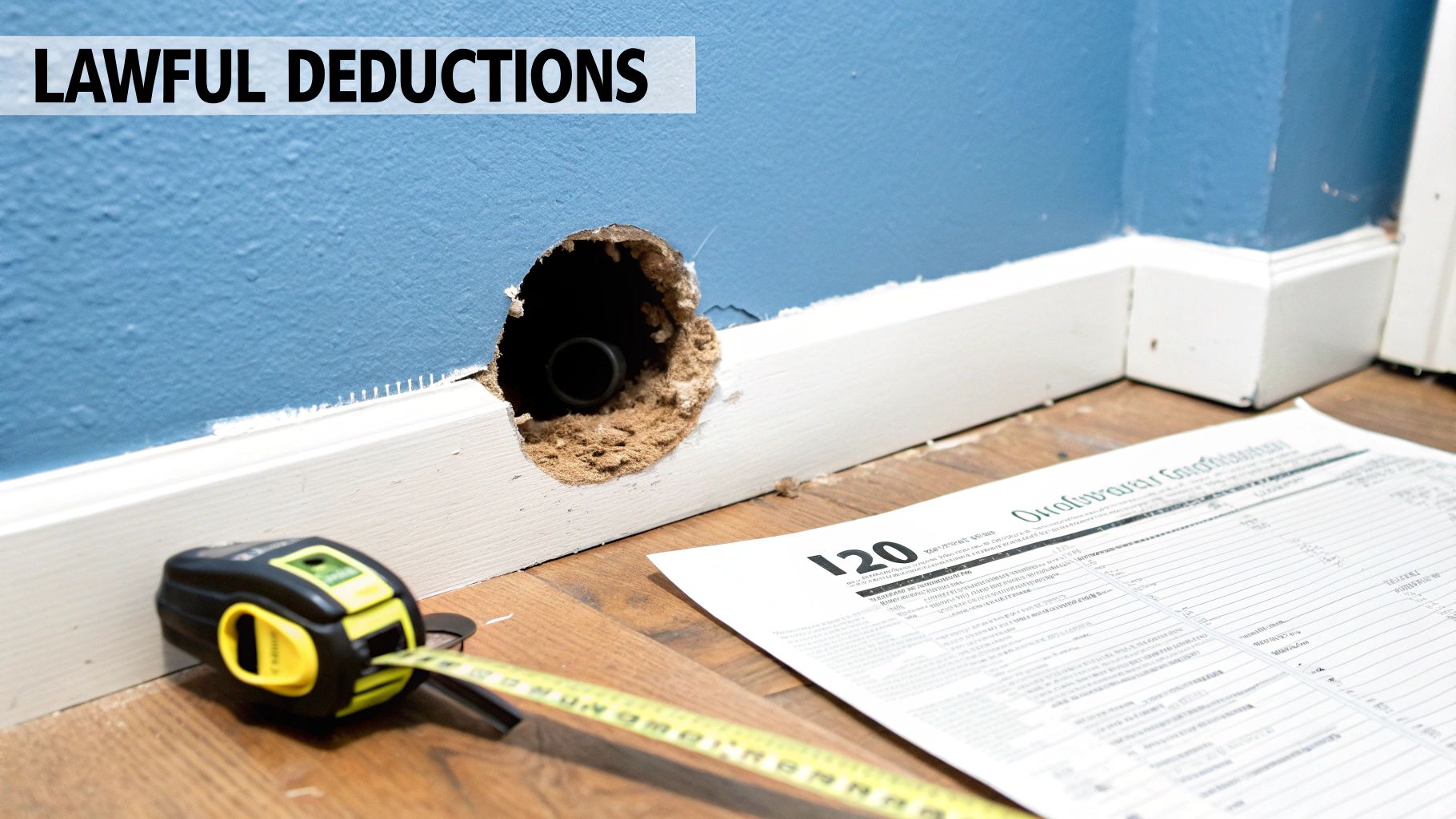
This is where the rubber meets the road. Knowing what you can legally deduct from a security deposit is one of the most critical—and often contentious—parts of being a landlord. You have to draw a hard line between "normal wear and tear" and actual "damage."
Think of it like this: normal wear and tear is the cost of doing business. It's the paint that fades a bit over a few years or the carpet in the main hallway that looks a little trodden. You can't charge a tenant for these expected signs of life. Damage, on the other hand, is the tenant's responsibility. That includes things like a giant, fist-sized hole in the drywall or pet stains that have soaked through the carpet and into the subfloor.
Getting this right is absolutely essential for ending a tenancy on good terms and protecting your investment without getting into legal hot water.
Defining Damage vs. Normal Wear and Tear
At its core, any lawful deduction hinges on your ability to prove an issue goes beyond what’s expected from normal, everyday living. Courts usually consider how long the tenant lived there and the specific problem. A few scuff marks on the wall after a five-year tenancy? That’s probably wear and tear. A broken window? That's damage.
Here are the main categories where deductions are almost always allowed:
Unpaid Rent: This one's the most straightforward. If a tenant moves out owing you rent, you can use their deposit to cover that balance.
Property Damage: This covers the cost of fixing things the tenant (or their guests) broke. We’re talking about damaged appliances, deep scratches gouged into hardwood floors, or unauthorized paint jobs you now have to fix.
Excessive Cleaning Costs: You can't charge for a routine cleaning between tenants. But if the place is left filthy—requiring serious deep cleaning for things like a grease-caked kitchen or heavily stained carpets—you can absolutely deduct for that extra labor and cost.
The bottom line for justifying any deduction is having undeniable proof. Your best friends here are the move-in and move-out inspection reports, complete with time-stamped photos and videos that create a clear "before and after" picture of the property's condition.
The Power of Meticulous Record-Keeping
Let’s be blunt: without documentation, any deduction is just your word against the tenant's. And in that situation, a judge will almost always side with the tenant. Your records are what turn a potential argument into a simple, non-negotiable business transaction.
Your "proof file" for every tenancy should include:
Receipts and Invoices: Always keep itemized receipts for any repairs or cleaning services. A vague line item like "$300 for repairs" won't fly. An invoice for "$300 to patch and repaint a 12x12 section of drywall in the master bedroom" absolutely will.
Photos and Videos: Visuals are king. Take clear pictures and videos of the damage, and be ready to show them alongside your move-in documentation for a direct comparison.
Written Communication: Save copies of all emails or texts with the tenant about the damages or other issues that led to the deduction.
One of the most common reasons for deductions is that the tenant simply didn't clean well enough when they left. Pointing tenants toward a helpful renter's guide to end of lease carpet cleaning can set clear expectations and prevent headaches. For a deeper dive into the specifics, check out our full guide on key rules for security deposit deductions.
The Rise of Security Deposit Alternatives
Let's be honest, the traditional cash security deposit has been the go-to for landlords forever. But the rental world is changing, and so are tenant expectations. With move-in costs getting steeper, savvy landlords are starting to look at modern alternatives that can give them a serious competitive edge.
These new options swap out that big, one-time cash payment for something much more manageable for the tenant, like a small fee or a monthly premium. This simple shift can make your property instantly more attractive to a wider group of qualified renters, and it can even cut down on the headache of arguing over deductions when they move out.
How Deposit Alternatives Work
So how do these things actually work? Most fall into one of two buckets: security deposit insurance or surety bonds. In both cases, instead of handing you a check for a full month's rent, your tenant pays a smaller, non-refundable amount to an outside company. That company then protects you against damages or unpaid rent, just like a traditional deposit would.
Security Deposit Insurance: This works a bit like any other insurance. The tenant pays a small monthly premium or a one-time fee, which buys you a policy that covers potential losses up to a certain amount.
Surety Bonds: With a surety bond, the tenant pays a one-time premium to a bond company. That company is essentially guaranteeing that they will pay you for any valid claims you have after the tenant leaves.
The core idea is simple: shift the financial hurdle from a huge upfront payment to a small, affordable fee. This can be a game-changer for great tenants who just don't have a few thousand dollars sitting in the bank for move-in costs.
The whole landscape of what is a security deposit is evolving. Some of these programs are even built right into the monthly rent payment. The results speak for themselves—properties that offer these alternatives are reporting 36% faster lease conversions. And when given the option, an overwhelming 93% of tenants choose it.
Even though you aren't holding the cash yourself, you're still protected. Better yet, if you do need to make a claim, the insurance or bond company typically handles the collections process. That saves you time, energy, and a whole lot of potential stress. It's a modern solution for a modern market.
Frequently Asked Questions About Security Deposits
Even after years in the business, landlords run into head-scratching situations that the lease doesn't spell out. Here are some quick, clear answers to the most common questions we get about security deposits.
Can I Charge a Separate Pet Deposit?
This is a classic "it depends" scenario, and the answer is always in your state and local laws. Some states absolutely allow a separate, non-refundable pet fee or an additional refundable pet deposit on top of what you already collected.
On the other hand, some jurisdictions lump pets into the general security deposit, meaning you can't exceed the overall limit. The key takeaway? Always double-check your local statutes before adding any pet-specific charges to your lease.
What Happens If I Sell the Property?
When you sell a tenanted property, the security deposits are part of the deal. You are legally obligated to transfer all deposit funds, including any interest they've earned, to the new owner.
You also have to send a written notice to your tenants letting them know what's happened. This notice should clearly state that their deposit has been transferred and provide the new owner's name and address. From that point on, the new owner is fully responsible for handling and eventually returning the deposit.
A common misconception is that the seller can just return the deposit to the tenant and call it a day. That’s incorrect. The deposit is tied to the lease and must be passed to the new owner, who is stepping into your shoes as the landlord.
Can I Increase the Security Deposit Mid-Lease?
In almost all cases, the answer is no. The security deposit is a fixed term of the lease agreement that both you and the tenant agreed to from the start. You can’t just decide to increase it halfway through the lease term.
The only real opportunity to do this is when the lease is up for renewal. At that point, you can offer a new lease with new terms, including a higher deposit—as long as the new amount still falls within your state's legal limits.
Managing a rental property is full of moving parts, but you don't have to juggle them all yourself. At Keshman Property Management, we bring over 20 years of boots-on-the-ground experience to make owning property profitable and hassle-free.
Find out how our transparent, owner-focused approach can maximize your investment. Learn more about our services at mypropertymanaged.com.


Comments