
Should I Hire a Property Manager? A Landlord's Guide

Updated: Sep 13
Every landlord eventually faces the big question: should I keep managing my property myself, or is it time to hire a professional? It’s a classic trade-off, pitting your money against your time and sanity. There's no single right answer, but if late-night calls and endless paperwork are starting to burn you out, it's time to think of a property manager as a strategic investment, not just another bill to pay.
The Landlord's Dilemma When to Consider a Property Manager
Picture this: It's 10 PM on a Saturday. You should be relaxing, but instead, you're on the phone with a frantic tenant because a faucet has just sprung a massive leak. Once you’ve dealt with that, you spend the next hour chasing down late rent and trying to make sense of the latest landlord-tenant laws. This isn't a hypothetical; it's the reality for many DIY landlords, where a smart investment quickly turns into a stressful, all-consuming second job.

The core question—should I hire a property manager?—goes far beyond just offloading tasks. It’s about protecting your asset, making sure it’s performing at its peak, and maybe most importantly, getting your peace of mind back. When you start seeing professional management as an investment in your property's future, the perspective shifts from cost to value. A great manager doesn't just collect checks; they actively work to boost your property's profitability and ensure its long-term health.
Self-Management vs Professional Management
First things first, let's break down the fundamental difference between going it alone and bringing in an expert. At its heart, the choice is about who handles the day-to-day grind of your rental property.
When you self-manage, you have complete control. That's the upside. The downside is that it demands a huge amount of your time, energy, and expertise. On the other hand, hiring a professional manager means tapping into proven systems and freeing yourself up to focus on, well, your life. The logic is similar to the real-world benefits of outsourcing other specialized tasks—you let an expert handle what they do best.
To make this clearer, let's look at a side-by-side comparison.
Self-Management vs Professional Management at a Glance
This table breaks down how common landlord duties are handled in each scenario.
Responsibility | Self-Management Approach | Professional Management Approach |
|---|---|---|
Tenant Screening | You write the ads, show the unit on your own time, and try to vet applicants yourself. | An expert team markets the vacancy, conducts professional showings, and uses a proven screening system. |
Maintenance | You’re the one getting emergency calls 24/7 and scrambling to find reliable vendors. | A dedicated system handles every request and dispatches vetted, trusted professionals from an established network. |
Rent Collection | You have to personally chase down payments and have those awkward late-rent conversations. | Automated systems collect rent on time, manage all the accounting, and enforce lease terms firmly but fairly. |
Legal Compliance | You are personally responsible for keeping up with all federal, state, and local housing laws. | Experts ensure your property stays fully compliant with all regulations, minimizing your legal risk. |
Looking at it this way, the choice becomes a lot clearer. It’s about deciding which approach truly fits your financial goals and, just as importantly, your lifestyle.
Ultimately, this guide will give you a straightforward framework to figure out which path is right for you. If you want to dig deeper into the financial side of things, check out our detailed guide on whether hiring a property manager is worth it. (https://www.mypropertymanaged.com/post/is-property-management-worth-it-a-landlord-s-guide)
What a Property Manager Actually Does for You
Most landlords think a property manager’s job is just to collect the rent. While that’s certainly part of it, it's a bit like saying a chef’s job is just to boil water. The reality is that a great property manager acts as the COO for your real estate investment, handling all the complex, time-consuming, and often stressful operations you’d rather not deal with yourself.
Their role isn't one single task but a whole collection of specialized duties. It’s all designed to protect your asset, boost its return, and give you back your time. To really get a handle on their value, it helps to break down their responsibilities into a few key areas.
Financial and Administrative Management
First and foremost, a property manager is your financial steward. Their goal is to make sure your investment runs like a well-oiled business, not a chaotic side hustle. This goes way beyond just cashing a check on the first of the month.
This financial oversight is pretty comprehensive:
Strategic Rent Setting: They don’t just pull a number out of thin air. They dive into market data, look at comparable properties, and analyze local vacancy rates to land on the perfect rent price—one that attracts great tenants without leaving money on the table.
Diligent Rent Collection: They have systems for a reason. By implementing things like automated payments and consistent reminders, they make sure rent comes in on time, every time. It completely removes the awkwardness of you having to chase down late payments yourself.
Detailed Financial Reporting: Forget shoeboxes full of receipts. You’ll get crystal-clear monthly statements that lay out all the income and expenses, which makes bookkeeping a breeze and tax season a whole lot less painful.
A property manager’s job is to turn your real estate asset into a predictable, passive income stream. They achieve this by applying professional systems to tasks that often overwhelm individual landlords, from accounting to legal compliance.
Tenant and Vacancy Management
Finding and keeping great tenants is probably the single most important part of owning a successful rental. One bad tenant can cost you thousands in lost rent, legal fees, and property damage. This is where a professional manager's expertise really shines.
They manage the entire tenant lifecycle from start to finish:
Comprehensive Marketing: A vacant property is a liability, plain and simple. Managers use a multi-channel marketing strategy to get the word out fast, using professional photos, virtual tours, and listings on all the top rental sites to keep those vacancy periods short.
Rigorous Tenant Screening: They run thorough background checks that include credit reports, employment verification, and past rental history. This systematic process is your best defense against problems, ensuring you get reliable tenants who pay on time and take care of your property.
Lease Enforcement and Communication: They act as the professional buffer between you and your tenants. That means they handle all the communication, enforce the terms of the lease, and mediate any issues that pop up.
Maintenance and Risk Management
Think of a property manager as your first line of defense against both physical and legal risks. They help you shift from a reactive "fix-it-when-it-breaks" mindset to a proactive strategy that protects your investment’s value for the long haul.
This involves coordinating all maintenance, from the routine tune-ups to those dreaded 3 AM emergency calls about a burst pipe. They already have a network of vetted, insured, and reasonably priced vendors, saving you the nightmare of trying to find a good plumber on a holiday weekend.
Even more importantly, they manage your legal risk. Landlord-tenant law can be a minefield of confusing federal, state, and local regulations. A professional manager stays on top of all these laws, ensuring your property is compliant with everything from fair housing rules to proper eviction procedures. This dramatically reduces your liability.
To get a better sense of how this works, it can be helpful to see how professional property management companies structure their services. When you decide to hire a property manager, you’re not just offloading tasks; you're outsourcing expertise, systems, and most importantly, peace of mind.
The Financial Breakdown: Uncovering Your True ROI
It almost always comes down to the numbers, doesn't it? Deciding to hire a property manager feels like a big expense, but the real question is whether not hiring one is costing you more. To get a real answer, you have to look past the monthly management fee and do a proper cost-benefit analysis.
Let's move past the theory and get into the practical math, uncovering the hidden costs of doing it all yourself.
The first step is understanding what a manager actually charges. Fees can vary, so you want a partner who is completely transparent. We break down all the common fee structures in our complete guide on property management costs.
The Hidden Costs of Self-Management
Most landlords I talk to seriously underestimate the financial drain of self-management. The biggest hidden cost? Your time. Seriously, what is an hour of your time worth? Now multiply that by all the hours you spend every month on late-night tenant calls, coordinating repairs, and wrestling with paperwork. The final number is often a shock.
But your time is just the beginning. Think about these other costs that quietly eat away at your profits:
Vacancy Costs: Every single day your property sits empty, it's costing you money. A professional manager has a proven marketing engine to fill vacancies fast, often cutting down those empty, profitless periods by weeks.
Suboptimal Rent Pricing: Are you positive you're charging the right rent? Go too low, and you're leaving cash on the table every month. Go too high, and your property sits vacant for longer. Managers use real-time market data—not guesswork—to hit that sweet spot.
The Cost of a Bad Tenant: It only takes one nightmare tenant to cause thousands in legal fees, property damage, and months of lost rent. Rigorous, professional tenant screening isn't just a process; it's your best financial defense.
The visual below breaks down the core duties a manager juggles to protect your investment.
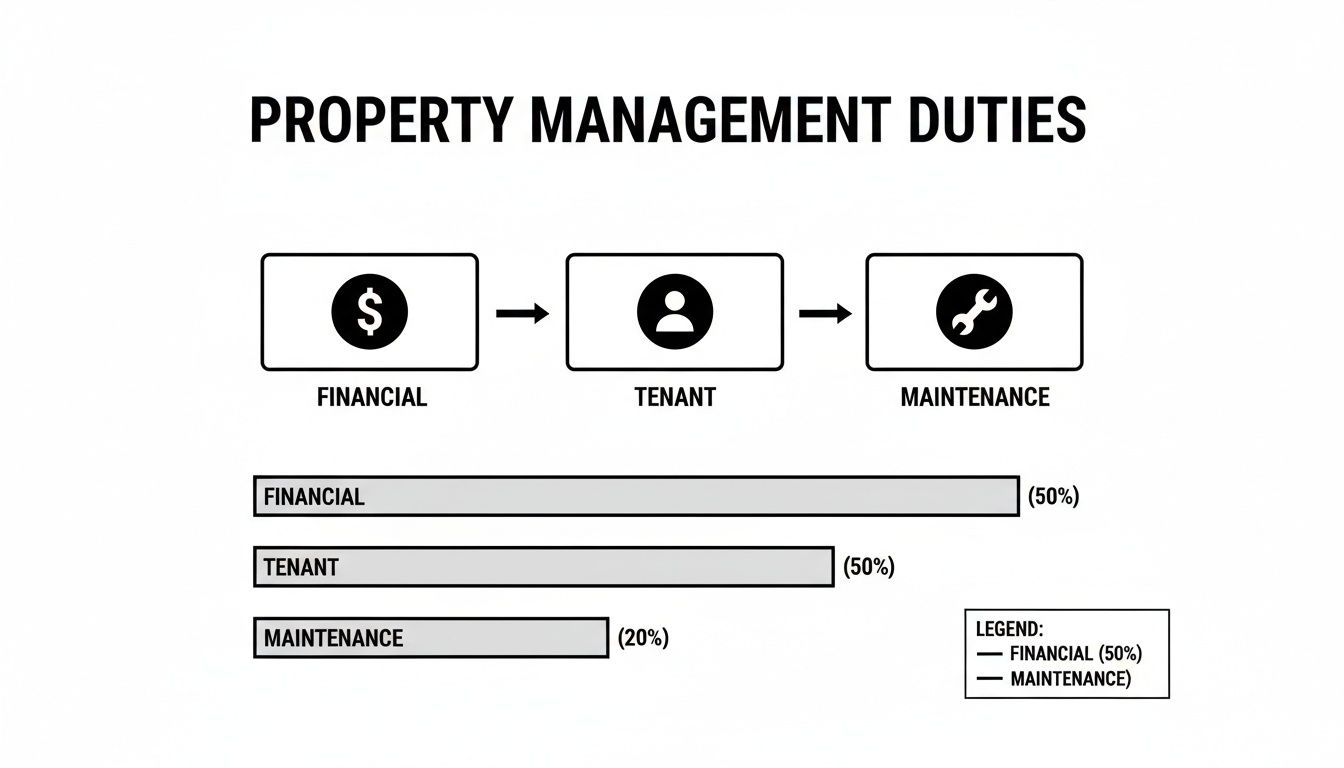
It’s a constant balancing act between financial stewardship, tenant relations, and maintaining the physical property—and every single one of those areas directly impacts your bottom line.
A Practical Tool for Your Decision
To make this tangible, let's put some numbers to these concepts. The table below is a simple worksheet to help you see the real financial picture. Grab your recent expense reports and a calculator, and fill in the blanks with your own estimates.
Cost-Benefit Analysis: Self-Management vs. Professional PM
Cost/Benefit Factor | Estimated Self-Management Cost | Professional Management Impact |
|---|---|---|
Your Time (Monthly) | My Hours/Month: ____ x $____/hr = $ | Frees up your time for other priorities (work, family, finding more deals). |
Vacancy Costs (Annual) | ____ Days Vacant x Daily Rent of $____ = $ | Can reduce vacancy by 25-50% with professional marketing & leasing. |
Maintenance & Repairs (Annual) | Total Spent Last Year: $ | Vendor relationships can save 10-15% on invoices, offsetting fees. |
Suboptimal Rent | (Market Rent - My Rent) x 12 = $ | Data-driven pricing ensures you're maximizing monthly income. |
Risk of a Bad Tenant | Potential Legal/Damage Costs: $5,000+ | Professional screening significantly lowers the risk of evictions and damages. |
Your Stress & Peace of Mind | Value: Priceless | Eliminates late-night calls and emergency headaches. |
Once you've run the numbers, you start to see that a good property manager isn't just an expense—they're a partner in profitability. The fee you pay is often covered, and then some, by the savings and increased income they generate.
Seven Signs You Need a Property Manager
Knowing when to switch from being a DIY landlord to hiring a professional isn't always a clear-cut decision. It's usually not a single "aha!" moment, but a slow burn—a growing feeling that the headaches of property ownership are starting to overshadow the rewards.
If you’re asking yourself, "Should I hire a property manager?" you're already on the right track. The next step is to take an honest look at your situation. Below are seven signs it might be time to hand over the keys and let an expert take the lead. Think of it less as giving up control and more as making a smart, strategic move to protect your investment and get your life back.

1. Your Portfolio Is Growing
Juggling one or two properties? You can probably handle it. But as you add more doors to your portfolio, the complexity doesn't just add up—it multiplies. Every new unit means another tenant to manage, another potential for a late-night maintenance call, and another pile of paperwork.
Once you hit three, four, or five properties, those little tasks snowball into a full-time job. A good property manager steps in to centralize everything, using proven systems to keep it all running like clockwork so you can focus on finding that next great deal.
2. You Live Too Far Away
Trying to manage a rental from another city, or even just an hour down the road, is a recipe for disaster. What's your plan when a pipe bursts on a holiday weekend? How do you realistically show the unit to potential renters or pop by for a routine inspection?
Crossing your fingers and hoping tenants will handle things (or bugging friends for favors) just isn't a sustainable plan. A local property manager is your boots on the ground, handling emergencies and keeping a close eye on your investment when you physically can't be there.
3. You Simply Do Not Have the Time
Let's be honest: being a landlord is rarely a "passive" activity. Between your actual job, your family, and trying to have a life, the hours it takes to properly manage a property can become a massive drain.
When you find yourself screening tenant applications during family dinner or trying to coordinate a plumbing repair from your office, your investment is no longer serving you—you are serving it.
Hiring a manager frees you from that daily grind. They take the late-night calls and the constant back-and-forth so you can get back your most valuable asset: your time.
4. You Struggle with Finding Quality Tenants
Placing the wrong tenant is one of the single most expensive mistakes a landlord can make. One bad apple can cost you thousands in lost rent, property damage, and legal fees. Finding good tenants is a skill, and it takes a lot more than just a gut feeling.
If you're constantly dealing with high turnover or lease violations, it's a huge red flag that your screening process is broken. Property managers have this down to a science with a rigorous, legally-compliant system. They handle:
Comprehensive Background Checks: Verifying credit scores, criminal history, and past evictions.
Employment and Income Verification: Making sure the applicant can actually afford the rent.
Previous Landlord References: Getting the real story on their rental history.
5. You Are Not an Expert in Landlord-Tenant Law
The rules governing landlords and tenants are a tangled web of federal, state, and local laws that are always changing. One wrong move—whether it's with a security deposit, an eviction notice, or a fair housing issue—can land you in serious legal and financial trouble. Pleading ignorance won't hold up in court.
A professional manager lives and breathes this stuff. They are your compliance experts, ensuring your leases are ironclad and your actions are always by the book, which significantly lowers your risk of a costly lawsuit.
6. The Stress Is Becoming Unmanageable
The constant low-grade anxiety can really wear you down. Worrying about late rent, upcoming vacancies, or what might break next can impact your health and peace of mind. If your stomach drops every time you see a call coming in from your tenant, that's a clear sign the emotional cost is just too high.
7. You Want a Truly Passive Investment
Most people get into real estate for passive income and long-term financial freedom. But as we've seen, self-management is anything but passive.
If your goal was to build a portfolio that makes you money without demanding all your attention, hiring a property manager isn't a luxury—it's essential. They are the key to turning your active second job back into the passive investment you dreamed it would be.
Choosing the Right Partner: How to Vet a Property Manager
Alright, so you've decided that bringing in a property manager is the next logical step for your investment. That's a huge decision, but the next one is even more critical: finding the right partner.
This isn't like hiring someone to mow your lawn. You're entrusting a significant financial asset to a business partner. The goal here is to cut through the slick sales pitches and find a company whose real-world expertise, communication style, and core values truly line up with yours.
Think of the vetting process as your superpower. It’s what allows you to separate the companies that just fill vacancies from the true partners who will protect and grow your investment for years to come.
Asking the Right Questions
The quality of your partnership will be a direct reflection of the quality of your interview. You need to ask questions that peel back the curtain and show you how a company really operates, especially when things go wrong. Generic questions will only get you generic, rehearsed answers.
It’s time to dig in with specific, scenario-based questions that reveal their actual processes.
Emergency Protocols: "It's 2 AM on a Sunday, and a tenant calls with a burst pipe. Walk me through your exact process, step-by-step." This question instantly tells you about their after-hours system and whether their vendor network is ready to roll at a moment's notice.
Financial Transparency: "Could I see a sample monthly owner's statement? How do you track and document repair costs before billing them to me?" This is all about understanding their accounting, communication, and how you’ll get paid.
Legal Scenarios: "Tell me about a difficult eviction you had to manage. What specific steps did you take to ensure you were fully compliant with the law?" Their answer here will reveal their practical knowledge of landlord-tenant law, which is absolutely non-negotiable.
A great property manager won't hesitate. They'll answer these questions with confidence and detail. Vague, hand-wavy responses are a massive red flag—it often means they don't have proven systems in place to protect your property when it counts.
For a deeper dive into this crucial selection process, check out our detailed guide on how to find the right property management partner.
Evaluating Their Technology and Tenant Experience
Let's be clear: in today's rental market, technology isn't just a nice-to-have, it's a must-have. It's how you attract and keep the best tenants. Modern renters simply expect a seamless, digital experience when it comes to their home.
The numbers don't lie. 80% of renters prefer to pay their rent online, and 72% want digital communication with their landlord. A professional management company uses technology to meet these expectations head-on, giving them a serious edge over a self-managing landlord trying to juggle everything manually. You can see how tech is changing the game and discover other insightful property management statistics that paint a clear picture.
When you're interviewing potential managers, make sure these questions are on your list:
Do you provide an online portal for both owners and tenants? This should be standard practice. It’s the central hub for communication, maintenance requests, and seeing your financial reports.
How do you leverage technology to market vacant units? You want to hear about things like professional photos, virtual tours, seamless online applications, and syndicated listings across all the major rental sites.
What's your system for collecting rent electronically? This is fundamental for tenant convenience and, more importantly, for ensuring you get paid on time.
Picking a manager who has already invested in modern tools shows they understand what today's best tenants are looking for. That commitment translates directly into lower vacancy rates and a healthier bottom line for you.
So, What's the Right Move for You?
Deciding whether to hire a property manager isn't just a numbers game; it’s a lifestyle decision. We've walked through the daily grind of management, crunched the numbers, and highlighted the tell-tale signs that it might be time to bring in a professional. In the end, it really comes down to weighing the management fee against the priceless return of getting your time back, slashing your stress levels, and seeing your property truly perform at its peak.
This is about a fundamental shift in how you view your investment. It’s moving from seeing property management as just another bill to pay, and instead, recognizing it as a strategic investment in your asset's future and your own peace of mind.
It’s Not a Cost, It’s a Partnership
Here’s the thing: successful real estate investing is rarely a one-person show. A great property manager is more than just a vendor; they're your partner on the ground, handling all the nitty-gritty details so you can pull back and focus on the bigger picture. Maybe that's scouting your next deal, or maybe it's just enjoying a quiet Saturday morning. The question stops being about cost and starts being about value.
What’s it worth to you to get your weekends back? What’s the value of knowing an expert is navigating tricky tenant laws and handling those late-night emergency calls? For most successful investors, that kind of certainty is invaluable.
Think back to those clear signals we talked about. Do any of these sound familiar?
You have more properties than you have hours in the day.
You live too far away to pop over when a pipe bursts or a tenant locks themselves out.
The constant firefighting and problem-solving are burning you out.
You’re ready for your "passive" investment to actually be passive again.
If you found yourself nodding along, that’s a pretty strong sign that it’s time to take the next step. Bringing on a partner like Keshman Property Management isn’t about losing control. It's about gaining a powerful advantage, making sure your investment is working for you—not the other way around.
Frequently Asked Questions
Even after weighing the pros and cons, you probably still have a few questions rolling around in your head. That’s completely normal. Handing over the keys to your investment property is a huge decision, and it’s smart to have concerns about costs, control, and whether it’s even the right fit for your specific rental. Let’s tackle those common questions head-on.
How Much Do Property Managers Typically Charge?
This is usually the first question on everyone's mind. While there's no single, universal rate, property management fees are pretty straightforward. Most companies charge a monthly fee that’s a percentage of the rent they collect for you, typically somewhere between 8% and 12%.
I want to emphasize the "collected rent" part. This is a crucial detail because it means their success is tied directly to yours. If you don't get paid, they don't get paid. It keeps everyone on the same team.
On top of the monthly fee, some managers also have a separate, one-time leasing fee when they place a new tenant. This covers all the upfront work: marketing your property, showing it to prospective renters, and running a thorough background and credit check. The key here is transparency. A good partner will lay out every single fee in plain English, so there are no surprises down the road.
Will I Lose Control Over My Property?
This is probably the biggest fear I hear from landlords, but it’s a total misconception. Bringing on a property manager means you’re delegating the day-to-day grind, not signing away your authority. Think of yourself as the CEO of your investment. Your manager is the Chief Operating Officer, handling the daily operations while you steer the overall strategy.
Your management agreement should clearly spell out what they can and can’t do without your say-so. You always have the final word on the big stuff, like:
Approving the final tenant after they’ve been screened.
Setting or changing the monthly rent.
Authorizing any repair or improvement that costs more than a pre-agreed amount.
A great manager is your strategic partner. They keep you in the loop and give you professional recommendations, but you’re always the one making the key decisions.
The goal of a property manager isn't to take control from you, but to give you control over your time. They handle the operational headaches so you can make informed, stress-free decisions about your asset.
What Types of Properties Do Managers Handle?
You don’t need to own a massive apartment complex to benefit from professional management. In reality, a huge number of the properties we and other firms manage are everyday single-family homes and small multi-unit buildings. An experienced company is built to handle a whole range of residential properties and knows the unique quirks of each.
This includes just about everything:
Single-Family Homes
Condominiums and Townhouses
Duplexes, Triplexes, and other small Multifamily Dwellings
Small-to-mid-sized Apartment Buildings
A versatile manager gives the same level of attention to a single condo as they do to a 20-unit building. They use the same proven systems for marketing, screening tenants, and handling maintenance to make sure every property is performing at its absolute best.
Ready to turn your rental property into a truly passive investment? The team at Keshman Property Management has over 20 years of hands-on experience helping owners maximize their returns and reclaim their peace of mind. Learn more about our transparent, owner-focused services today.


Comments