
A Landlord's Guide to Rental Property Bookkeeping

Updated: Sep 13
When you boil it down, rental property bookkeeping is simply the act of tracking every dollar that flows in and out of your investment properties. But a solid system for doing this is so much more—it's your roadmap to monitoring cash flow, squeezing every last drop out of your tax deductions, and making smart decisions that actually grow your portfolio.
Why Smart Bookkeeping Is Your Most Valuable Asset

Let's be honest. For most landlords, bookkeeping feels like a chore, something you begrudgingly squeeze in between dealing with tenant calls and scheduling repairs. But what if you started seeing it as the single most powerful tool you have for boosting your rental profits? This guide is all about reframing bookkeeping from a necessary evil into your greatest strategic advantage.
We're going to move past the classic landlord headaches—the frantic search for receipts at tax time, the fuzzy understanding of where your cash is really going, and the nagging feeling you're leaving money on the table. A reliable system brings total financial clarity, and that clarity is what separates an average rental from a truly high-performing investment.
The True Cost of Disorganized Finances
In the fast-paced world of real estate, keeping clean books isn't just a good habit; it's the foundation of a successful business. The U.S. property management industry is a massive field, hitting $136.9 billion in revenue, which shows just how much is at stake.
For individual owners like you, messy books can be disastrous. Think about the tax deductions you might be missing—experts estimate landlords can overlook 20-30% of their rightful deductions each year. A disorganized system doesn't just create stress; it actively eats into your profits. Without clear records, you can't accurately gauge a property's performance, spot opportunities to cut costs, or plan your next investment with any real confidence.
Key Takeaway: Effective bookkeeping isn't just about staying out of trouble with the IRS. It’s about building a predictable, profitable business that gives you financial freedom and genuine peace of mind.
Gain Control and Maximize Your Returns
This guide is packed with practical, actionable advice designed to help you get a firm grip on your finances. The goal is simple: make owning property more profitable and a lot less stressful. When you manage the numbers effectively, you can:
Make Data-Driven Decisions: Finally know, without a doubt, which properties are your winners and why.
Simplify Tax Season: Walk into your accountant's office with organized, audit-proof records ready to go.
Improve Cash Flow: Truly understand your income and expense cycles to sidestep those painful financial shortfalls.
As your portfolio grows, consider delegating the administrative and financial grind to a specialized short-term rental virtual assistant. Getting those routine tasks off your plate frees you up to focus on the big picture—strategy, growth, and your next big move.
Building Your Financial Foundation with a Chart of Accounts
Before you can track a single dollar of income or expense, you need a system. In the world of bookkeeping, that system is called a Chart of Accounts (COA), and it’s the single most important document you'll create for your rental business. Think of it as the digital filing cabinet for all your finances—every transaction gets its own specific, logical home.
Without a well-organized COA, your financial records can quickly become a tangled mess of uncategorized transactions. This makes it nearly impossible to generate accurate reports, truly understand your profitability, or confidently file your taxes. A solid COA brings order to the chaos from day one.
So, What Exactly Is a Chart of Accounts?
At its core, a Chart of Accounts is simply a master list of all the categories you'll use to sort your business's transactions. It’s typically broken down into five main types: Assets, Liabilities, Equity, Income, and Expenses. For a real estate investor, this structure is perfectly suited to the unique financial flow of owning rental property.
For instance, you might assign numbers in the 1000s for Assets (like your bank account and the property itself) and the 4000s for Income (like monthly rent). This numerical organization isn't just for accountants; it makes your records universally understandable and helps you scale as your portfolio grows.
My Two Cents: Don't overcomplicate it. A classic mistake I see is creating way too many specific accounts right out of the gate. This just makes bookkeeping a chore. Start with broad categories and only add more detail if you find a specific expense is large or frequent enough to warrant its own line item.
Sample Chart of Accounts for a Small Rental Portfolio
Here’s a practical template to get you started. This covers the essential accounts nearly every landlord will need to track. Think of it as a solid starting point you can customize for your own properties.
Account Type | Account Name | Example Description |
|---|---|---|
Income | Rental Income | Primary account for all monthly rent payments. |
Income | Late Fee Income | Fees charged to tenants for overdue rent. |
Income | Other Income | Pet fees, laundry revenue, application fees, etc. |
Expense | Repairs & Maintenance | Plumbing fixes, appliance repairs, landscaping, paint. |
Expense | Property Management Fees | Fees paid to a property management company. |
Expense | Insurance | Landlord liability and property insurance premiums. |
Expense | Property Taxes | Local and state property taxes paid on the rental. |
Expense | Mortgage Interest | The interest portion of your mortgage payment (not principal). |
Expense | Utilities | Any utilities you cover (water, trash, common area electric). |
Asset | Business Checking Account | The dedicated bank account for all rental activity. |
Asset | Property Value | The original purchase price of the property. |
Liability | Mortgage Loan Payable | The outstanding principal balance of your property loan. |
Liability | Security Deposits Held | Tenant security deposits (this is a liability, not income!). |
Setting up this framework from the beginning creates a powerful system that turns raw transaction data into valuable business insight.
Essential Accounts for Every Landlord
Your COA should absolutely be tailored to your specific portfolio, but some accounts are non-negotiable. Let's break down the most critical categories with some real-world examples.
Income Accounts
This is where you track all the money coming in. It's often more than just the rent check.
Rental Income: The main bucket for all monthly rent payments.
Late Fee Income: Essential for tracking fees charged for overdue rent.
Application Fee Income: For logging any non-refundable fees from prospective tenants.
Other Income: A catch-all for things like pet fees, laundry machine revenue, or even forfeited security deposit funds used to cover unpaid rent.
Expense Accounts
This will likely be your largest and most detailed section. Getting this right is absolutely key for maximizing your tax deductions.
Repairs & Maintenance: For all the routine upkeep—plumbing fixes, appliance repairs, new paint, or landscaping.
Property Management Fees: If you hire a professional, this is where their fees go.
Insurance: This includes landlord liability and property insurance premiums.
Property Taxes: For the local and state property taxes you pay annually or semi-annually.
Mortgage Interest: This is a big one. You only track the interest portion of your payment here, not the principal. Your lender will send you a Form 1098 each year with this amount.
Utilities: For any utilities you pay on behalf of the property, like water, sewer, or trash collection.
Asset and Liability Accounts
These accounts give you that crucial snapshot of your business's overall financial health on the balance sheet.
Assets: * Business Checking Account: The dedicated bank account where all rental income is deposited and expenses are paid from. * Property Value: This is typically recorded at the original purchase price of your property and is the basis for your depreciation calculations.
Liabilities: * Mortgage Loan Payable: Tracks the outstanding principal balance of your property loan. * Security Deposits Held: This is critical! Security deposits are not your money. They are a liability you owe back to the tenant and must be tracked separately from your operating cash.
Tracking Income And Expenses For Maximum Profit
Once your Chart of Accounts is set up, the real work begins: the day-in, day-out discipline of tracking every single dollar. This is where your financial framework comes to life. Without consistent tracking, you can't generate a reliable Profit and Loss statement, which is the ultimate report card for your rental portfolio.
The secret is to treat every transaction with the same level of detail. A $5 receipt for a lightbulb is just as important as a $2,000 rent check. This consistent effort is what separates landlords who guess about their profitability from those who know it, down to the last penny.
More Than Just Rent Checks: Capturing All Income
When you think "income," your mind probably jumps straight to the monthly rent payment. And while that's the biggest piece of the pie, a surprising amount of profit is often hiding in those smaller income streams that are easy to overlook.
Proper bookkeeping means you're capturing every source of revenue. Your system should have separate income accounts for these items to give you a much clearer picture of what's actually driving your bottom line.
Pet Fees and Pet Rent: Are you charging a one-time, non-refundable pet fee? Or is it a recurring monthly pet rent? Each one needs to be logged as income and should never be mixed up with a refundable security deposit.
Late Fees: This isn't just a bit of extra cash; it's a critical performance metric. Tracking late fees helps you spot chronically late tenants and gives you the data you need to enforce your lease terms consistently.
Application Fees: These non-refundable fees are meant to cover your screening costs. As soon as you receive one, it should be recorded as income.
Ancillary Services: Do you offer coin-operated laundry, rent out storage units, or have paid parking spots? This income can add up to a significant amount over a year and needs to be tracked just as carefully as rent.
By splitting these streams out, you can start to see what's really working. You might discover that the income from your laundry machines more than justifies the cost of upgrading them to newer, more reliable models.
The Art Of Categorizing Expenses For Tax Savings
Now for the other side of the ledger: your expenses. This is where meticulous bookkeeping pays you back in a big way, especially when tax season rolls around. Every properly documented and categorized expense lowers your taxable income, which directly reduces your tax bill.
One of the biggest hurdles landlords face is knowing the difference between a current repair (which is fully deductible in the year it's paid) and a capital improvement (which has to be deducted over time through depreciation). A good rule of thumb is that a repair maintains the property's condition, while an improvement enhances its value or extends its useful life.
Real-World Example: Replacing a single broken windowpane is a repair. But replacing all the windows in the entire building with new, energy-efficient models? That's a capital improvement. Both are valuable deductions, but your accountant will treat them very differently.
This flowchart gives you a great visual of how every transaction—income, expenses, assets, and liabilities—all fits together in your financial system.
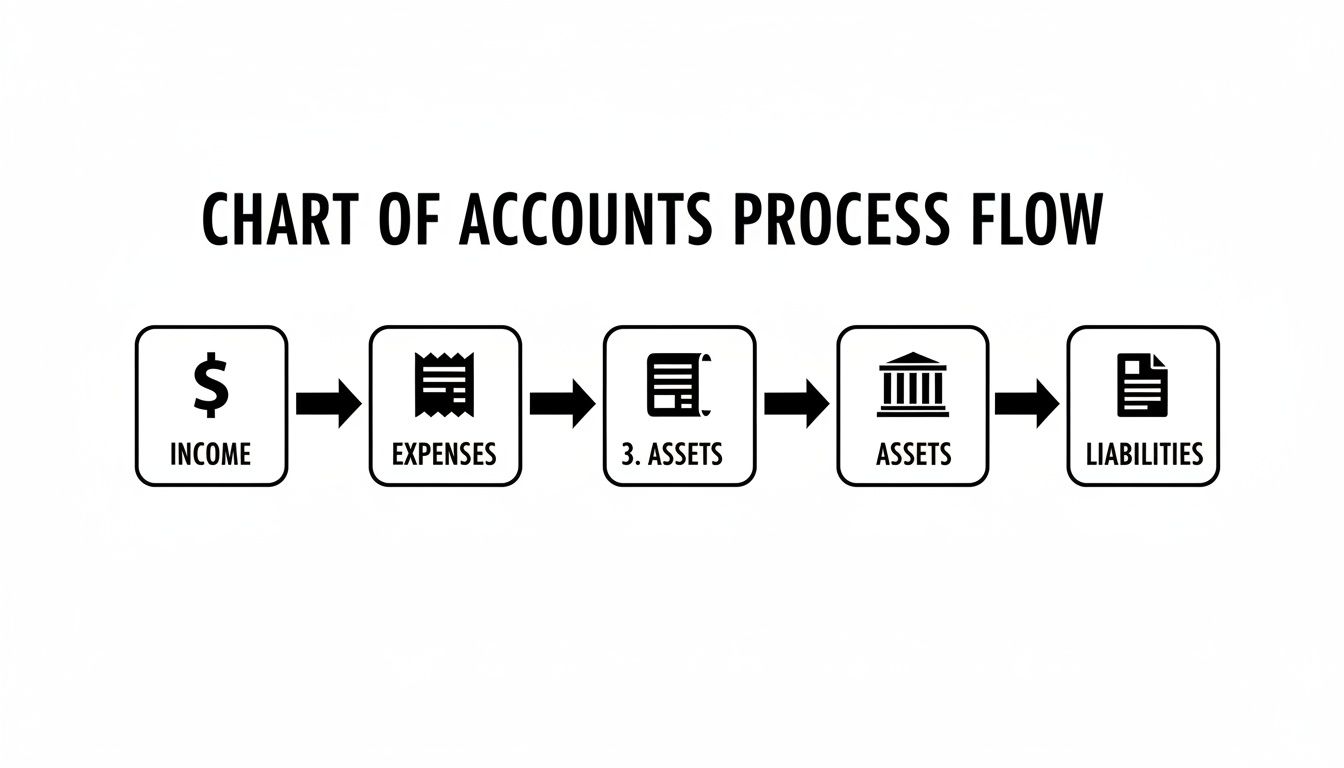
As you can see, every financial event has a specific home. This ensures your records paint a complete and accurate picture of your business's health.
Uncovering Commonly Missed Deductions
It happens all the time, especially with newer investors—money is left on the table simply because of overlooked deductions. Good bookkeeping habits help you catch everything. Make sure you're not forgetting to track these common, but often-missed, expenses:
Travel Costs: Did you drive to the property to show it to a new tenant, meet a plumber, or do an inspection? The mileage on your car is a deductible expense. Get a mileage log app for your phone and use it!
Home Office Deduction: If you have a dedicated space in your home that you use exclusively for managing your rental business, you can likely deduct a portion of your home's expenses, like utilities, insurance, and internet.
Professional Fees: Any money you spend on legal advice, accounting services, or property management fees is 100% deductible.
Insurance Premiums: Your landlord insurance policy is a necessary cost of doing business and is a major deduction.
Bank Fees: Don't forget about the small stuff. Any monthly service fees or transaction fees associated with your business bank account are also deductible.
Consistently tracking these smaller, recurring expenses can easily add up to thousands of dollars in tax savings by the end of the year. My best advice? Use a dedicated business credit card for every single property-related purchase. It creates a clean, itemized record that makes categorizing everything a breeze.
Choosing Your Bookkeeping Tools: Spreadsheets vs. Software

So, you have a solid plan for tracking your income and expenses. Now, where does all this information actually live? This brings us to the classic debate for landlords: spreadsheets versus dedicated software. The right answer really comes down to the size of your portfolio, your budget, and how comfortable you are with technology.
For a new landlord with just one or two doors, a well-organized spreadsheet can be a fantastic, cost-effective starting point. You get total control and flexibility to build a system that fits your exact needs, all without a monthly subscription fee. But this manual approach has its pitfalls.
The single biggest risk with spreadsheets is human error. One tiny misplaced decimal or a busted formula can throw off an entire year's worth of financial data, creating a massive headache when tax time rolls around. As you add more properties, the manual data entry gets more tedious and the chances for these slip-ups multiply.
When Spreadsheets Make Sense
A simple spreadsheet is often the perfect tool for landlords who are just dipping their toes in the water. It’s a great way to nail down the fundamentals of good bookkeeping without any upfront financial commitment.
You might want to stick with a spreadsheet if you:
Manage only one or two properties: The volume of transactions is still low enough that you can handle it manually without feeling buried.
Are on a tight budget: You can't beat free. This is a huge plus when you’re focused on keeping overhead as low as possible.
Have rock-solid organizational skills: You’re disciplined about entering data consistently and you’re comfortable managing your own formulas.
Even with these perks, I always advise landlords to think of spreadsheets as a stepping stone. Once your portfolio starts to grow, its limitations become glaringly obvious, and the time you'll save with software will more than justify the cost.
The Power of Dedicated Rental Property Software
Modern property management software has completely changed the game for landlords. These platforms are built from the ground up to handle the specific bookkeeping challenges we face, automating many of the tasks that are so mind-numbing in a spreadsheet.
The shift is undeniable—67% of property management companies have already adopted specialized software. This tech directly solves some of the biggest landlord headaches. For instance, while 41% of managers report issues with late rent, a whopping 80% of tenants prefer paying online. Implementing online payments can slash collection times by 50% on average. At Keshman Property Management, our tech-first approach to bookkeeping ensures every single deductible is captured, which can boost net yields by 10-15% each year. You can dive deeper into these industry trends on resimpli.com.
Platforms like Stessa, Baselane, and Landlord Studio connect right to your business bank accounts, automatically pulling in and categorizing transactions. This feature alone can give you back hours of your life every single month.
My Experience: I've seen landlords burn an entire weekend every quarter just trying to reconcile their books in a spreadsheet. After they finally switched to software, that same task took them less than an hour. Automation isn't just a nice-to-have; it’s a genuine competitive advantage that frees you up to find your next deal.
Key Features to Look For in Software
When you're ready to take the leap, remember that not all software is created equal. Your goal is to find a platform that actually simplifies your life and gives you crystal-clear financial insights. To get you started, check out our guide on the 12 best rental property accounting software picks for 2026.
Focus on finding a solution with a solid mix of these core features:
Automated Transaction Imports: Securely links to your bank to pull in income and expenses without manual entry.
Rent Collection Tools: Gives tenants an easy online portal to pay rent, ideally with auto-pay options.
Expense Tracking and Receipt Management: Lets you categorize expenses on the fly and upload digital copies of receipts for an audit-proof paper trail.
Financial Reporting: Generates key reports like your Income Statement and Cash Flow Statement with just a few clicks.
Picking the right tool is a critical step in building a bookkeeping system that’s not just efficient, but ready to grow with you.
Turning Data into Decisions with Financial Reports
All that tedious work of tracking income and categorizing expenses? This is where it finally pays off. Raw data is just a jumble of numbers until you organize it into financial reports. These reports are what give your business a voice, turning spreadsheets into a clear story about your portfolio's health.
Think of it this way: your daily bookkeeping is like chopping vegetables and measuring ingredients. Your financial reports are the finished meal. They show you what you've created, whether it's profitable, and if you have enough cash left to cook again tomorrow. For landlords, getting comfortable with three key reports is what separates a passive owner from a savvy investor who makes smart, data-driven moves.
Your Profitability Scorecard: The Income Statement
The Income Statement, which you'll often hear called a Profit and Loss (P&L) statement, is the single most important report for seeing how your property performed over a set period—be it a month, a quarter, or a full year. The formula couldn't be simpler: Total Income - Total Expenses = Net Profit (or Loss).
This is the report that tells you if your rental is actually making money. It cuts through all the noise and shows you the bottom-line profitability, which is crucial for knowing if your investment is living up to its potential. A P&L that’s consistently in the black is a great sign, but a negative one is a flashing red light telling you to dig in and find out what's wrong.
Key Takeaway: The P&L is your go-to tool for judging a property's operational success. It answers the big question, "Did I make a profit this year?" without getting muddied by things like loan payments or cash reserves.
For instance, your P&L might show $24,000 in rental income. After subtracting $15,000 in expenses (property taxes, insurance, repairs, mortgage interest), you’re left with a net profit of $9,000. That one number gives you a powerful snapshot of your property's efficiency.
A Financial Snapshot: The Balance Sheet
While the P&L tracks performance over a stretch of time, the Balance Sheet gives you a snapshot of your entire financial position on a single day. It’s all built on one simple, unbreakable rule: Assets = Liabilities + Equity.
This report gives you the 30,000-foot view of your net worth as a real estate investor. It lines up everything you own (Assets) against everything you owe (Liabilities). The difference is your Equity—the part of the property you can truly call your own.
Here’s a quick breakdown of what you'd see on a typical landlord’s Balance Sheet:
Assets: * Cash sitting in your business bank account. * The value of your rental property itself (usually recorded at its purchase price).
Liabilities: * The outstanding balance on your mortgage. * Security deposits you're holding for tenants (it's their money, not yours!).
Equity: * The magic number that shows the difference between assets and liabilities, representing your true ownership stake.
Glancing at your Balance Sheet regularly helps you watch your debt shrink and your equity grow as you pay down that mortgage. It's the ultimate report for tracking your long-term wealth building.
The Lifeblood of Your Business: The Cash Flow Statement
The Cash Flow Statement is easily the most misunderstood of the three, but it might be the most critical for your survival as a landlord. It answers one simple but vital question: "Where did my cash come from, and where did it go?"
Ever look at a profitable P&L and wonder why your bank account feels empty? This report explains why. The P&L includes non-cash items like depreciation and leaves out big cash expenses like the principal portion of your mortgage payment. The Cash Flow Statement connects those dots, showing you the real movement of cash through your business.
It's typically broken down into three parts:
Operating Activities: Cash from your core business—collecting rent and paying operating bills.
Investing Activities: Cash used to buy long-term assets, like the down payment on a new property.
Financing Activities: Cash from lenders or investors, like loan proceeds and your mortgage principal payments.
Getting a handle on this report is essential for staying liquid and avoiding those painful cash crunches. To really nail this down, check out our guide on how to master rental property cash flow analysis. Strong, positive cash flow is what pays for surprise repairs, funds your next down payment, and ultimately gets you to financial freedom. A profitable property can still go under without it.
Common Rental Bookkeeping Questions Answered
Even with a solid system, rental property bookkeeping can throw you a curveball now and then. As your portfolio grows, you'll inevitably run into situations that make you pause and wonder, "Am I handling this right?"
This section tackles the most common points of confusion I see landlords struggle with. Think of it as your quick-reference guide for those tricky, real-world questions.
Should I Use a Separate Bank Account for Each Rental Property?
You don't need a separate bank account for every single property, but having at least one dedicated business bank account for all your rentals is non-negotiable. This is the simplest way to avoid commingling funds—a massive headache that tangles up your taxes and puts your personal assets at risk.
Once you start managing a few properties, especially if they're held in different LLCs, the strategy changes. Setting up separate accounts for each LLC (or even for each individual property) gives you incredible financial clarity. It makes it dead simple to see how a specific asset is performing and creates an airtight audit trail for the IRS.
Expert Insight: Mixing personal and business money is one of the fastest ways to pierce the corporate veil and lose the liability protection of your LLC. A separate bank account is your most critical line of defense.
How Do I Handle Security Deposits in My Bookkeeping?
This is where a lot of landlords make a costly mistake. A tenant's security deposit is never your income when you first receive it. It's a liability. You're holding someone else's money, and you have a legal obligation to return it if they hold up their end of the lease.
When that deposit check comes in, you record it as an increase in cash and an equal increase in a liability account, usually called something like "Tenant Security Deposits." Remember, many states require you to hold these funds in a separate escrow account, so check your local laws.
Here's how a security deposit moves through your books:
Receipt: Cash goes up, and the "Security Deposit" liability account goes up by the same amount.
Move-Out: If the tenant leaves the place spotless, you refund the deposit. This brings your cash down and zeroes out the liability for that tenant.
Deductions: If you have to use part of the deposit for legitimate repairs, that portion moves from the liability account to cover the repair expense. The only time any part of a deposit becomes income is if the tenant forfeits it to cover unpaid rent.
Getting this right is crucial for staying compliant and keeping your financials accurate.
What Is the Difference Between a Repair and a Capital Improvement?
Nailing this distinction is absolutely vital for your tax strategy. The IRS treats these two categories very differently, and confusing them can lead to expensive problems down the road.
A repair is something you do to keep the property in good working order. Think of it as routine maintenance. Fixing a leaky pipe, patching drywall, or replacing a broken doorknob are all repairs. These costs are fully deductible in the year you pay for them.
A capital improvement, on the other hand, is a major upgrade that adds significant value, extends the property's life, or adapts it for a new use. Putting on a new roof, adding a deck, or overhauling the entire HVAC system are classic examples of improvements.
Instead of deducting the full cost at once, you have to capitalize these expenses and depreciate them over their IRS-defined useful life—which is 27.5 years for residential rentals. Your accountant will set up the depreciation schedule, but it's your job to classify the expense correctly from the get-go. Correctly categorizing these expenses is also a key component when dealing with tax forms. For more details, learn more about your guide to the rental income form 1099 for landlords.
At Keshman Property Management, we handle the complexities of rental property bookkeeping so you can focus on growing your portfolio. Our transparent, expert services ensure your finances are always accurate, optimized, and stress-free. Find out how we can help you maximize your returns.


Comments