
A Landlord's Guide to the Residential Landlord Tenant Act of Florida

Updated: Feb 14
If you're a landlord in Florida, there's one set of rules you absolutely need to know inside and out: the Residential Landlord and Tenant Act. This isn't just a bunch of legal jargon; it's the official playbook for renting out property in the Sunshine State.
You'll find it codified in Chapter 83, Part II of the Florida Statutes, and it lays out the fundamental rights and duties for both you and your tenants. Think of it as the legal foundation for your entire rental business, covering everything from how you handle a security deposit to the exact steps you must take if an eviction becomes necessary.
Your Guide to Florida's Landlord Tenant Framework
Navigating the Florida Residential Landlord and Tenant Act can feel daunting, but it doesn't have to be. This guide is designed to cut through the complexity and give you practical, actionable advice you can use immediately. We're translating the dense statutes into clear, real-world terms.
Here’s a look at the official source where these laws live, directly from the Florida Senate's website.
Having this link handy is always a good idea. It lets you go straight to the source and see the exact wording of any statute, ensuring you're always operating with the most accurate information.
Understanding these laws isn't just about avoiding trouble. It's about building a stable, profitable rental business. When you know the rules, you can protect your investment, foster better relationships with your tenants, and operate with confidence. Getting this right from the start is the best way to prevent headaches and costly legal battles down the road.
What This Act Covers
The Act is incredibly thorough, setting clear expectations for almost every interaction you'll have with a tenant. For landlords, following these rules isn't a suggestion—it’s a non-negotiable part of managing your risk.
Here are the key areas the law governs:
Financial Obligations: The proper way to handle security deposits, collect rent, and charge late fees.
Property Maintenance: Your legal duty to provide a safe, habitable home and the process for making repairs.
Landlord Access: Clear rules on when and how you can enter a tenant's unit.
Lease Termination: The specific notice periods required to end a tenancy, whether for cause or not.
Eviction Procedures: The strict, step-by-step legal process for removing a tenant who has breached their lease.
Mastering these core areas transforms you from a reactive property owner into a proactive manager. This knowledge empowers you to enforce your lease confidently while fully respecting your tenant's rights, which is the key to minimizing conflict and protecting your bottom line.
In the sections ahead, we’ll dive deep into the must-know provisions of the residential landlord tenant act florida. From handling funds correctly to navigating an eviction without a single misstep, let's turn legal compliance into your biggest strength.
Managing Security Deposits and Rent Collections
If there's one area where Florida landlords can get into hot water, it's handling tenant funds. The residential landlord tenant act florida is incredibly specific about security deposits and rent, and a simple misstep can lead to some serious financial penalties. Getting these financial procedures right isn't just good business—it's essential for protecting your investment.
Think of a tenant's security deposit as money you're holding in trust, not as part of your cash flow. Florida law sees it this way, too, which is why it lays out three very specific ways you can store these funds. You have to pick one; there's no fourth option.

Three Approved Ways to Hold a Security Deposit
Florida Statute § 83.49 doesn't leave any room for interpretation. You can't just drop the deposit into your personal savings or main business account. Instead, the law requires you to place it in one of these "secure vaults."
Separate Non-Interest-Bearing Account: This is the simplest and most popular route. You open a separate bank account in Florida that holds nothing but tenant security deposits. Crucially, this account cannot earn any interest.
Separate Interest-Bearing Account: You can also use a Florida bank account that earns interest. If you go this route, the law says you must pay the tenant either 75% of the interest the account earns annually or a flat 5% simple interest per year. The choice is yours.
Post a Surety Bond: This one is far less common. You can post a surety bond with the clerk of the circuit court in the county where your rental is. The bond needs to cover the total of all deposits you hold or $50,000, whichever is less. You're also on the hook for paying the tenant 5% simple interest each year.
No matter which method you choose, you have 30 days from receiving the deposit to inform the tenant in writing. Your notice must state which method you're using and include the name and address of the bank or institution holding their money.
The Critical Timelines for Returning Deposits
Once the lease is over and your tenant has moved out, the clock starts ticking. These deadlines are non-negotiable, and missing them could mean you forfeit your right to claim a single penny from the deposit, no matter the condition of the property.
For a full refund: You have 15 days from the move-out date to return the entire deposit.
To make a claim: You have 30 days to send the tenant an itemized notice of your claim. This must be sent by certified mail to their last known address.
If you fail to send the required notice within that 30-day window, you lose your right to claim any portion of the security deposit. This is a common and costly mistake for landlords who are unfamiliar with Florida's strict requirements. For a deeper look, check out our complete guide to deposit return timelines.
After receiving your notice, the tenant gets 15 days to object in writing. If you don't hear from them, you can go ahead and deduct the damages and return the rest. If they dispute your claim, you'll likely have to work it out through negotiation or, in some cases, small claims court.
Structuring Rent Collection and Late Fees
While the residential landlord tenant act florida doesn't put a hard cap on late fees, it does demand they be "reasonable." A good rule of thumb is that a reasonable fee should cover the actual costs you incur because of the late payment, like extra administrative work.
For a late fee to be enforceable, it has to be spelled out clearly in the lease. Don't be vague. The agreement should specify:
The exact dollar amount of the fee.
The grace period, if you offer one, before the fee kicks in.
When, exactly, the fee is officially due.
A common and generally accepted practice is to charge a flat fee or a small percentage of the rent, like around 5%. Anything that seems excessive could be challenged in court. Your best defense is a clear, fair policy that you apply consistently to every tenant.
Your Right of Entry vs. The Tenant's Right to Privacy
One of the trickiest parts of being a landlord is walking the tightrope between your need to access and maintain the property and your tenant's right to privacy. The residential landlord tenant act florida doesn't leave this up to chance; it lays out clear rules for when you can and can't enter a tenant's home.
Think of it this way: when you sign a lease, you're essentially handing over the right of "quiet enjoyment" to your tenant. This means you can't just pop in whenever you feel like it. Florida law requires you to give "reasonable notice" before you enter for things like inspections, repairs, or showing the unit to prospective renters.
What Counts as "Reasonable Notice"?
So, what does "reasonable" actually mean? While the law is a bit flexible, the gold standard in practice is at least 12 hours of notice. It's always best to put this in writing, clearly stating why you need to enter and giving a specific window of time. The law also sets acceptable hours for entry: between 7:30 a.m. and 8:00 p.m.
Of course, life happens, and the notice rule isn't set in stone. There are a few critical exceptions where you can enter without advance warning:
Emergencies: If a pipe bursts or there's a fire, you can and should enter immediately to protect life and property.
Tenant's Permission: If your tenant gives you the green light to come over at a specific time, you're good to go.
Long Absences: If a tenant is gone for an extended time (specifically, for a period equal to half the rental payment period when rent is not current), you can enter to make sure the property is secure.
Abandonment: If you have solid reason to believe the tenant has packed up and left for good, you are allowed to enter.
It's also important to know that a tenant can't just refuse entry for legitimate reasons like necessary repairs. If they unreasonably deny you access, it could be a breach of the lease, potentially giving you grounds to start the termination process.
Your Core Maintenance Responsibilities
Beyond just respecting a tenant's space, your most fundamental job is providing a safe and livable home. The residential landlord tenant act florida is very specific about the maintenance standards you have to meet. These aren't just friendly suggestions—they are legal requirements.
Think of your role as proactive, not just reactive. Your job isn't just to fix things after they break; it's to consistently maintain the property to meet all building, housing, and health codes. If you let things slide, you open the door to tenants legally withholding rent or even breaking their lease.
At a minimum, you are on the hook for the following:
Structural Integrity: The roof, windows, doors, floors, and walls must all be in good shape and keep the elements out.
Working Systems: You must provide functioning plumbing, hot water, and heat.
Safety Essentials: At the start of a lease, you must ensure there are working smoke detectors and that all doors and windows have secure, working locks.
Pest-Free Living: You are responsible for exterminating pests like rats, mice, roaches, ants, and bedbugs.
Clean Common Areas: Any shared spaces, like hallways or laundry rooms, must be kept clean and safe.
These responsibilities are non-negotiable. For a deeper dive, check out our essential guide on landlord repair responsibilities.
On a more practical note, being a great landlord means making smart decisions that protect your investment. This includes choosing durable, cost-effective items for your units and understanding what price range of appliances to buy for rental apartments. Balancing your legal duties with savvy business choices is the key to long-term success.
Navigating Lease Terminations and the Eviction Process
Let's be honest: for most landlords, the word "eviction" is enough to cause a headache. It’s one of the most stressful parts of the job, and for good reason. It's a formal legal process, not just a simple matter of asking a tenant to leave. The Florida Residential Landlord and Tenant Act lays out a very specific, step-by-step path for legally ending a lease and taking back your property. Getting it right is everything—a single slip-up on a notice can get your case thrown out, forcing you to start all over again.
Think of the eviction process like a precise legal dance. Every step has to be performed in the right order, at the right time. You can't just jump to the end. And the very first, most critical move is always serving the proper written notice.
The Power of the Proper Written Notice
The type of notice you send depends entirely on why you're terminating the lease. Sending the wrong one is a surefire way to lose in court. Florida law is crystal clear on this, specifying different notices for different situations, each with its own timeline.
We can draw a parallel to the rules for entering a tenant's unit, which also hinge on giving proper notice.
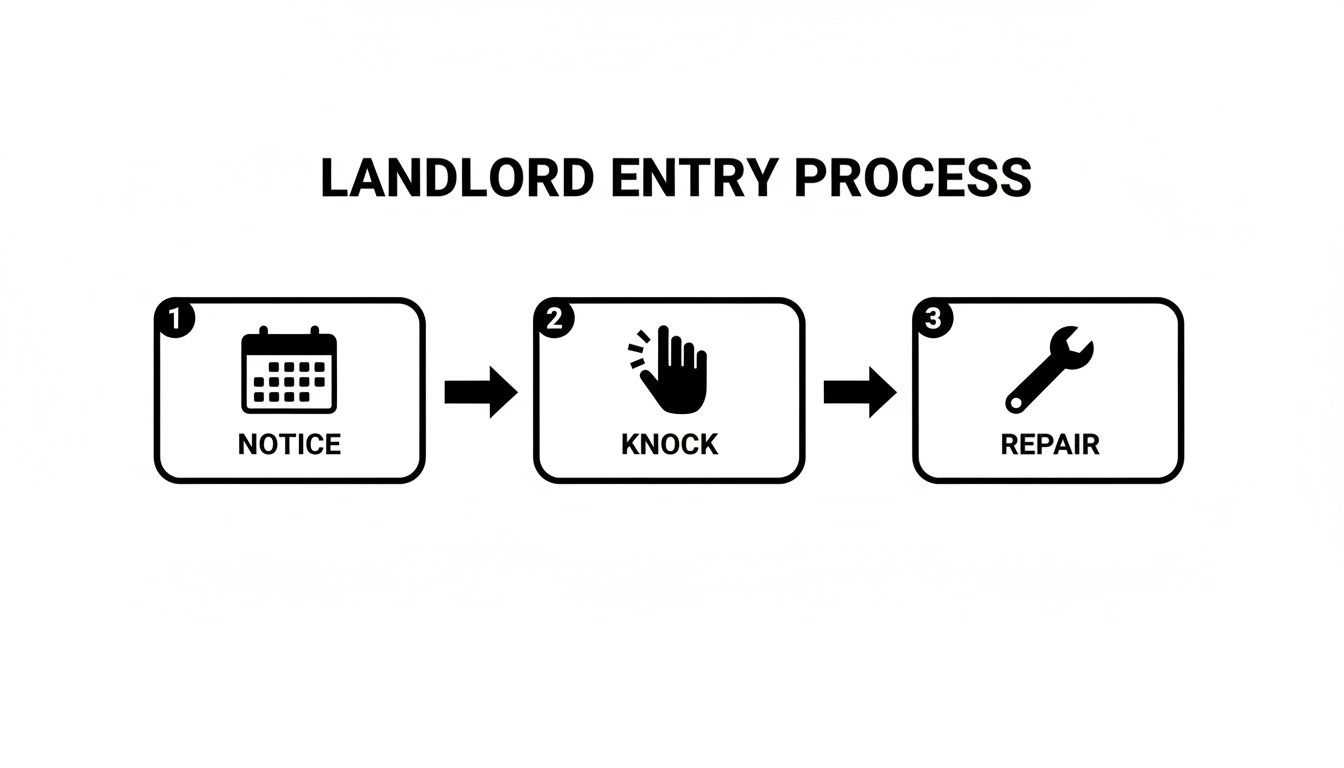
Just as you have to follow the rules for a simple entry, the legal notices for an eviction are even more strict. They must be perfect.
You'll generally encounter three main types of notices:
Notice for Non-Payment of Rent: This is the big one—the most common reason for an eviction. When rent is late, you must serve a formal written demand for the money or possession of the unit.
Notice to Cure a Lease Violation: If a tenant breaks a rule that can be fixed—maybe they got a pet without permission or the yard is a mess—you give them a notice with a chance to correct the problem.
Notice of Termination for Non-Curable Violations: For the really serious stuff, like intentionally damaging the property or engaging in illegal activities, you can issue a notice that ends the lease without offering a chance to fix it.
Understanding Key Notice Timelines
Each of these notices has a specific, legally required timeline. Getting the dates wrong is a fatal error for an eviction case.
Crucial Takeaway: Following procedure isn't just a good idea; it's the law. A judge won't overlook errors in your notice, no matter how obvious the tenant's violation might be. Double-check every single detail before you proceed.
Here are the standard timelines you need to know under the Florida Residential Landlord and Tenant Act:
3-Day Notice for Non-Payment of Rent: This gives the tenant three business days (don't count weekends or legal holidays) to either pay the full rent owed or move out. Heads up: a change is coming. A 2026 update will extend this to 5 days and will also prohibit landlords from tacking on extra fees during this period.
7-Day Notice with Opportunity to Cure: For those fixable lease violations, you must give the tenant a full 7 days to sort out the issue. If they do, the problem is solved. If not, you can move forward with filing the eviction.
7-Day Unconditional Quit Notice: When a tenant commits a serious violation that can't be fixed, you can serve a notice that terminates their tenancy and gives them 7 days to vacate the property.
From Notice to Lawsuit: Filing for Possession
So, what happens if the tenant ignores your notice? If they don't pay up, fix the problem, or move out, your next move is to file a formal eviction lawsuit in the county court where the property is. This is officially called an "action for possession."
At this point, it's critical to remember you cannot take matters into your own hands.
You are legally forbidden from:
Changing the locks.
Throwing out the tenant’s belongings.
Shutting off the water, power, or other utilities.
Harassing or trying to intimidate the tenant.
These "self-help" tactics are illegal and can land you in hot water, potentially leading to a lawsuit where you owe the tenant damages.
Once you file the lawsuit, the tenant is served with a summons and has 5 business days to file a response with the court. If they don't, you can usually get a default judgment. If they do respond, a hearing is scheduled. It's a process that requires patience and precision, so understanding how long an eviction can take in Florida will help you set realistic expectations from the start.
Avoiding Prohibited Practices and Retaliatory Actions
As a Florida landlord, some lines are simply not meant to be crossed. Knowing what you can't do under the residential landlord tenant act florida is just as important as knowing what you can. Think of these rules as the legal guardrails for your business—ignoring them can lead to serious legal and financial crashes, and pleading ignorance won't get you out of a ticket.
Two of the biggest missteps a landlord can make are retaliating against a tenant and attempting a "self-help" eviction. The law is crystal clear on these points: they are absolutely forbidden and carry steep penalties to protect tenants from being strong-armed.
Understanding Retaliatory Conduct
Let's say a tenant contacts the county health department about a leaky roof you haven't fixed. You might feel annoyed, but the law strictly prohibits you from punishing them for exercising a legal right. This is the essence of retaliatory conduct.
Retaliation isn't always obvious, but it often looks like this:
Sudden rent hikes that don't align with the market.
Cutting off services, like suddenly revoking access to the community pool.
Threatening to evict them without a valid, non-retaliatory reason.
Creating a hostile environment through harassment.
Be careful with timing. If you suddenly take one of these actions right after a tenant joins a tenants' union or files a formal complaint, the law will presume your motive was retaliation. If a judge agrees, your eviction case could be thrown out, and you could find yourself on the receiving end of a lawsuit.
The Dangers of "Self-Help" Evictions
When a tenant stops paying rent, it's natural to want to take swift action to regain control of your property. But you have to resist the urge to handle it yourself. Any attempt to force a tenant out without a court order is considered an illegal "self-help" eviction, and the consequences are designed to hurt.
This means you are legally barred from doing any of the following to reclaim your unit:
Changing the locks or padlocking the door.
Shutting off the water, electricity, or air conditioning.
Removing the tenant’s furniture or other belongings.
Taking off the front door or removing windows.
Florida law has a potent remedy for tenants who are victims of illegal evictions. If you're found guilty of a prohibited act like shutting off utilities, the tenant can sue for damages equal to three times their monthly rent or their actual damages, whichever is higher. This isn't about compensation; it's a punishment meant to stop landlords from taking the law into their own hands.
The only lawful path to remove a tenant in Florida is by filing a formal eviction lawsuit and getting a judge to issue an order. Period.
New Disclosure Requirements on the Horizon
Staying compliant also means keeping an eye on the future. As Florida's climate continues to change, new laws are emerging to make sure tenants are better informed about potential risks.
A major update is coming in 2026. A new law will require landlords to give all prospective tenants a separate written flood disclosure form before they sign a lease. This reflects the state's vulnerability to flooding and empowers renters with critical safety information. You can learn more about these 2026 Florida rental law updates on amgrents.com to prepare your business.
To help you keep these rules straight, we’ve put together a simple checklist summarizing the key do’s and don’ts for Florida landlords.
Florida Landlord Do's and Don'ts Checklist
This checklist provides a quick-glance summary of compliant actions versus prohibited practices under the Florida Residential Landlord Tenant Act. Use it as a guide to help avoid common legal pitfalls and operate your rental properties professionally.
Action (Do) | Prohibited Practice (Don't) |
|---|---|
Follow the formal court eviction process. | Engage in "self-help" evictions (e.g., changing locks, shutting off utilities). |
Maintain the property and make necessary repairs. | Retaliate against a tenant for requesting repairs or reporting a code violation. |
Provide proper written notice for entry, termination, or rent increases. | Enter the property without notice, except in true emergencies. |
Handle security deposits according to statutory timelines and notice requirements. | Punish a tenant for exercising their legal rights, like joining a tenants' union. |
Charge only reasonable, specified late fees as outlined in the lease. | Make up or inflate fees that are not disclosed in the rental agreement. |
Provide required disclosures (e.g., radon gas, flood risk starting in 2026). | Hide known defects or fail to provide legally mandated information to tenants. |
Sticking to the "Do" column and steering clear of the "Don't" list is the best way to protect yourself from costly legal battles. By always following the proper legal channels and treating tenants fairly, you'll save yourself an immense amount of time, money, and stress down the road.
Common Questions for Florida Landlords
As a landlord in Florida, you're bound to run into some recurring questions as you navigate the day-to-day realities of property management. Getting the answers right isn't just helpful—it's essential for protecting your investment and staying on the right side of the law. Let's tackle a few of the most common issues that come up.
Can I Charge Any Amount for a Late Fee?
This is a big one. While Florida law doesn't set a hard cap on late fees, it does require them to be "reasonable." That's the keyword. A fee is considered reasonable if it's meant to cover the actual costs and hassle you incur when rent isn't paid on time, not to punish the tenant.
For a late fee to be enforceable, you absolutely must spell it out in a written lease. A common approach that generally holds up is charging a small percentage of the monthly rent, like 5%, or a modest flat fee.
Your lease needs to be crystal clear about the exact fee and when it kicks in. If your policy is vague or the fee is outrageously high, a tenant could challenge it in court, and you could end up losing more than just the late fee itself.
What Happens If a Tenant Abandons the Property?
It's a frustrating scenario: the rent is overdue, and your tenant seems to have vanished. In Florida, a property might be considered legally abandoned if the tenant has been gone for at least 15 consecutive days without telling you, all while the rent is unpaid.
But hold on—you can't just barge in and change the locks. There's a strict legal process you must follow to take back possession and deal with any belongings left behind. This involves giving proper notice and, often, working through the courts. You also have a "duty to mitigate damages," which means you need to make a real effort to find a new tenant to limit your financial losses.
Is a Verbal Lease Agreement Enforceable?
Believe it or not, an oral lease for a term under one year can be binding in Florida, usually creating a default month-to-month tenancy. But just because it can be legally binding doesn't mean it's a good idea. In fact, it's a terrible one.
Relying on a handshake deal is asking for trouble. Without a written document, every important detail—the rent amount, due dates, security deposit rules, pet policies—becomes a "he said, she said" argument waiting to happen. It puts you in an incredibly vulnerable position.
To protect yourself and create a clear understanding for everyone, always use a detailed, written lease agreement signed by all parties. It’s the single most important step you can take to avoid future headaches and enforce your rights under the Florida Residential Landlord and Tenant Act.
Feeling overwhelmed by the legal complexities? At Keshman Property Management, we've spent over 20 years helping owners navigate these challenges, making rental property ownership more profitable and less stressful. We handle the details so you can focus on what matters. Find out more about our transparent, owner-focused services at https://mypropertymanaged.com.


Comments