
Deposit Rent Return: A Complete Guide to Deposit Rent Return Timelines

Navigating the deposit rent return is one of those make-or-break moments in landlording. Get it right, and you protect your investment and wrap up a tenancy on good terms. Get it wrong, and you're in for a world of headaches, potential legal trouble, and a hit to your reputation. A solid, repeatable process isn't just nice to have—it's essential for keeping your business running smoothly and profitably.
Handling Tenant Security Deposits The Right Way
Think of the deposit return as more than just a final chore; it’s a direct reflection of your professionalism. Botching this can lead to nasty disputes and even financial penalties that dwarf the original deposit amount. This guide will walk you through creating a process that’s fair, legal, and straightforward for everyone involved.
At its heart, a successful deposit return strategy boils down to three things: communicating clearly, documenting everything meticulously, and following the legal timelines to the letter. Every step, from the moment your tenant gives notice to the day you mail the check, requires careful attention.
The Essential Stages of Deposit Return
Let's break the whole thing down into a few manageable phases. Staying on top of each one is the best way to minimize risk and ensure you and your tenant are on the same page.
The Tenant Gives Notice: This is your starting pistol. As soon as you get that notice, spring into action. Send over a move-out checklist and get the final inspection scheduled on the calendar.
The Move-Out Inspection: This is where the rubber meets the road. You'll need to do a thorough walkthrough, comparing the property's current state to your original move-in report. For a deep dive, this checklist for landlords when a tenant moves out is a fantastic resource.
Calculating Deductions: The key here is separating normal wear and tear (which you can't charge for) from actual tenant-caused damage. Get real quotes for any necessary repairs to back up your figures.
The Final Refund and Statement: Mail the remaining deposit balance along with a detailed, itemized list of any deductions. You absolutely must do this within your state's legal deadline—no excuses.
This simple flowchart shows the process in a nutshell.
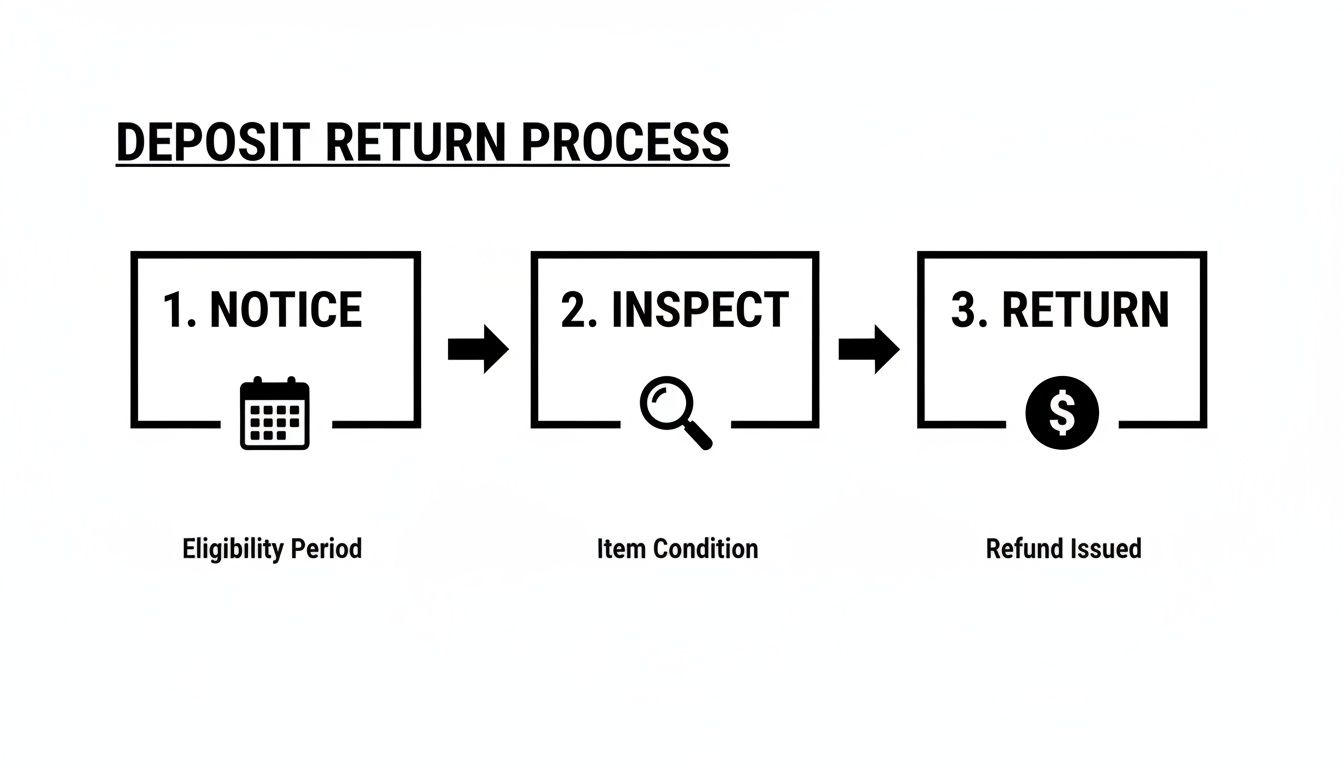
As you can see, the tenant's notice kicks everything off, leading to the inspection, which ultimately determines what gets returned. It’s a straightforward flow when you have a system.
To help visualize this, here’s a quick overview of the process.
Deposit Rent Return Process At a Glance
Stage | Key Action for Landlords | Primary Goal |
|---|---|---|
Notice to Vacate | Acknowledge notice, provide move-out instructions, and schedule the final inspection. | Set clear expectations and initiate the turnover process smoothly. |
Move-Out Inspection | Conduct a detailed walkthrough with the move-in checklist, documenting all changes. | Accurately assess the property's condition and identify any tenant-caused damage. |
Deduction & Refund | Calculate costs for repairs, create an itemized statement, and return the balance. | Ensure all deductions are legal, justified, and returned within the state-mandated deadline. |
This table serves as a quick-reference guide to keep you on track during one of the most critical parts of the rental cycle.
Laying the Groundwork for Success
Honestly, a smooth move-out process starts on day one. A well-written lease is your best tool for preventing disputes down the road. If you're looking for guidance, learning about crafting a robust rental agreement is a great place to start. A solid lease clearly spells out expectations, making the final walkthrough much less of a headache.
Your lease is your first and best line of defense. It needs to define what counts as damage versus normal wear and tear, detail cleaning standards, and outline the exact steps for the deposit return. The less ambiguity, the better.
Understanding Security Deposit Timelines and Penalties
Of all the potential missteps a landlord can make, messing up the security deposit return is one of the easiest ways to land in hot water. Every state has specific, non-negotiable laws that set a hard deadline for handling a tenant's deposit rent return. This isn't just a friendly suggestion—it’s a legal mandate you absolutely must follow.
The clock starts ticking the second your tenant hands over the keys and vacates the property. From that day, you have a set number of days to either return the full deposit or provide a detailed, itemized statement of deductions along with any remaining balance. This is where things get tricky, because the timelines vary dramatically from one state to the next.

State Timelines Can Make or Break You
For example, if your property is in Florida, you have 15 days to return the full amount if you're not making claims against it. But if you are making deductions, you have 30 days to send the required written notice. Hop over to New Jersey, and the deadline is a firm 30 days no matter what. Some states are even quicker, demanding action within just 14 days.
It’s completely on you to know your local laws inside and out. Pleading ignorance won't hold up in court and can lead to some pretty severe financial consequences.
Key Takeaway: Never assume you know the deadline. Laws can and do change, and what's true in one state is totally irrelevant in another. Always verify the current security deposit return timeline for your jurisdiction and mark it on your calendar the moment a tenant moves out.
Missing these deadlines can be incredibly expensive. The penalties aren't just a slap on the wrist; they often force you to pay the tenant double or even triple the amount of the original deposit, plus their court costs and attorney's fees. A simple administrative slip-up on a $2,000 deposit could easily spiral into a $6,000 judgment against you.
Calculating the Financial Stakes
The importance of nailing this process has only grown as rents have climbed. The average security deposit is typically one month's rent, but some states allow landlords to charge up to three months' rent, tying up thousands of dollars per tenancy. In high-cost states like California and Hawaii, average deposits hover around $1,856 and $1,868, respectively.
Some jurisdictions even build in incentives for proper handling; Arizona, for instance, requires landlords to add 5% annual interest to a tenant's deposit. At a firm like Keshman Property Management, this is central to how we manage risk. On a 20-unit building with average $2,000 deposits, mishandling returns could expose an owner to $40,000 in disputes or penalties. A compliant process, on the other hand, protects both cash flow and reputation. To see how these numbers stack up worldwide, you can find more insights on security deposit trends.
The Consequences of Non-Compliance
Let's walk through a real-world scenario. A landlord in New Jersey misses the 30-day deadline to return a $2,500 deposit. They’re only a week late, but the tenant knows their rights and takes the landlord to small claims court.
Under New Jersey law (N.J.S.A. 46:8-21.1), if a landlord fails to comply with the deposit return statute, the court can award the tenant double the amount wrongfully withheld. Here’s how that plays out:
Original Deposit: $2,500
Penalty Awarded: $5,000 (double the deposit)
Tenant's Court Fees: Potentially hundreds more
That one-week delay just cost the landlord over $5,000 and completely wiped out any legitimate claim they might have had for damages.
This highlights a critical point: the law often favors the tenant when deadlines are blown, regardless of the property's condition. Even if the tenant left significant damage, your failure to send that itemized statement on time can mean you forfeit your right to make any deductions. Your photos and receipts become worthless if they’re delivered late, making proactive planning essential for a successful deposit rent return.
Conducting the Move-Out Inspection and Calculating Deductions
The move-out inspection is where all your upfront documentation really starts to pay dividends. This isn't just a quick walk-around; it’s the moment you build a clear, factual case for any deductions you might need to make from the security deposit. Getting this right is your best defense against future disputes and keeps the entire deposit rent return process fair and legally compliant.
Your most important tool here is the move-in condition report—the one you and the tenant signed at the very beginning. The whole inspection is a direct, side-by-side comparison. You're not just looking at the property's condition in a vacuum; you're measuring it against the baseline you both agreed upon. This shows exactly what changed during the tenancy.
Fairly and promptly returning deposits is getting more attention these days, especially as rising rents make these funds more significant. With the national median rent for a two-bedroom apartment hovering around $1,906, a security deposit can easily tie up nearly $2,000 of a tenant's money. If you manage just 30 units, that’s about $60,000 in deposits you're holding at any given time. As rent growth starts to cool, tenants are far more likely to challenge deductions, which makes your meticulous documentation absolutely critical for protecting your bottom line.
Normal Wear and Tear vs. Tenant Damage
The single biggest point of friction in this process is almost always the line between normal wear and tear and actual damage. It's a critical distinction, as you can only legally deduct for damage.
Think of it like this: normal wear and tear is the gentle, expected decline of a property from someone simply living in it. Damage, on the other hand, comes from negligence, accidents, or outright abuse. The security deposit exists to cover the latter.
Here’s a practical table to help you tell the difference when you're walking the property.
Normal Wear and Tear vs Tenant Damage
Issue | Normal Wear and Tear (Landlord's Cost) | Tenant-Caused Damage (Deductible) |
|---|---|---|
Walls | Faded paint, minor scuffs from furniture, a few small nail holes from pictures. | Large holes, unapproved paint jobs, crayon art covering a wall. |
Flooring | Lightly worn carpet in high-traffic areas, minor scratches on hardwood floors. | Deep pet stains, cigarette burns, large gouges, or cracked tiles. |
Fixtures | A wobbly toilet seat, a loose cabinet handle from regular use. | A cracked mirror, a broken toilet tank, ripped or missing window screens. |
Cleanliness | A general need for a standard professional cleaning between tenants. | Excessive filth, heaps of abandoned trash, mildew buildup from neglect. |
Getting this right is key to making deductions that hold up under scrutiny. Every landlord should be confident in these distinctions before ever writing up an itemized list.
For a deeper dive, our guide on what landlords can deduct from a security deposit offers even more examples to help you make fair and defensible claims.
The Art of Accurate Deduction Calculation
Once you've identified legitimate damages, you can't just pull a number out of thin air. Your deductions have to reflect the actual cost to fix the problem. That means getting real quotes from your handyman or pricing out the materials at the local hardware store. Always, always keep copies of receipts and invoices to send along with your itemized statement.
A classic mistake is charging a tenant for the full replacement cost of an old item. You have to account for depreciation. For example, if a tenant ruins a ten-year-old carpet that only had a useful life of ten years to begin with, you can't charge them for a brand-new one.
Let’s say a new carpet costs $1,000 and has a five-year lifespan. If the tenant damaged it beyond repair at the end of year three, they've used up 60% of its value. You can only charge for the remaining 40% of its useful life—in this case, $400, not the full $1,000.
Pro Tip: Your smartphone camera is your best friend. During the move-out inspection, go overboard with photos and videos. Document every scuff, stain, and broken fixture from multiple angles, with good lighting. This visual evidence is priceless if a dispute ever lands you in court.
Finally, remember that while big problems require professional help, some minor issues don't. For common move-out cleaning tasks, knowing a few simple tricks, like the different cleaning uses of vinegar, can help you get the unit rent-ready without racking up unnecessary costs.
Creating a Legally Compliant Itemized Statement

Once you've done a thorough move-out inspection and figured out the legitimate deductions, it's time to draft the itemized statement. This isn't just a list of charges; it’s your official, written justification for every dollar you’re withholding from the security deposit. A vague or sloppy statement is an open invitation for a dispute, while a clear, professional one can stop disagreements in their tracks.
Think of this document as your final, formal conversation with the tenant. It needs to be transparent, fair, and backed up with solid proof. Your goal isn't just to check a legal box, but to show you've handled the deposit rent return with integrity. That protects both your business and your reputation.
Essential Components of the Statement
A solid, legally sound statement breaks down every single deduction with total clarity. Ambiguity is your worst enemy here. Every charge needs its own line item, leaving absolutely no room for a tenant to guess what you're talking about.
For your statement to hold up under scrutiny, it must include these core elements:
Total Security Deposit Received: Always start by clearly stating the full deposit amount you collected when the lease began.
A Detailed List of Deductions: Itemize each problem specifically. Don't just write "Wall Damage - $150." Instead, be precise: "Repair and repaint 3'x2' hole in living room wall - $150."
The Exact Cost of Each Repair: List the precise dollar amount for every single deduction. This demonstrates you're charging for actual costs, not just pulling numbers out of thin air.
Supporting Documentation: This part is non-negotiable. You have to attach copies of all receipts for materials and any invoices from contractors. This is the hard evidence that proves your costs are real.
An itemized statement without receipts is just an opinion. To make your deductions legally defensible, you must provide concrete proof of your expenses. This simple step can be the deciding factor in any dispute.
Using Professional Language to Minimize Conflict
The tone you use in the statement makes a huge difference. Keep it factual, business-like, and completely free of any emotion or personal commentary. Stick to the facts from your inspection report and avoid language that sounds accusatory.
For instance, a poorly written statement might say, "You wrecked the blinds in the bedroom, and it's going to cost $125 to replace them." That’s just asking for a fight.
A much better, more professional approach is: "Replacement of broken vertical blinds in the master bedroom - $125. See attached receipt from Home Depot." This phrasing is neutral and focuses on the issue and the documented cost, which is all that matters.
Proper Delivery and Creating a Paper Trail
How you send the statement is just as crucial as what’s in it. Simply dropping it in the mailbox with a standard stamp isn’t good enough to protect yourself. You need a verifiable record that proves you sent the document within your state’s legal time frame.
The gold standard for delivery is certified mail with a return receipt requested. This gives you a dated postmark and a signature confirming the tenant (or someone at their forwarding address) received it. That paper trail is your best defense if a tenant ever claims they never got the statement.
Here’s how to wrap up the deposit rent return process:
Finalize the Math: Double-check all your numbers. Subtract the total deductions from the original deposit amount to get the final refund.
Assemble the Packet: Put everything together in one envelope: the itemized statement, copies of all receipts and invoices, and the refund check itself.
Send Via Certified Mail: Mail the packet to the tenant’s forwarding address. If you don't have one, send it to their last known address—your rental unit.
File Your Records: Keep a complete copy of the packet you sent, along with the certified mail receipt, in your tenant's file.
This meticulous approach is vital. For example, in Florida, a landlord who fails to send this notice within 30 days can forfeit their right to claim any of the deposit. In New Jersey, the deadline is also 30 days, and failing to comply can result in a judge awarding the tenant double the deposit amount. These strict rules show why being precise in the final stages of the deposit rent return is absolutely paramount.
Handling Communication and Disputes Like a Pro

Even if you’ve followed every step perfectly, disagreements over the deposit rent return can and do happen. How you handle these conversations is a critical skill. It can mean the difference between a quick, professional resolution and a time-consuming, expensive trip to small claims court.
The trick is to be proactive, not reactive. A little communication can stop a small misunderstanding from spiraling into a major conflict. A friendly email a few weeks before the lease ends, complete with a move-out cleaning checklist and a reminder about the inspection, sets a collaborative tone. It shows you’re organized and want a smooth process for everyone, which often nips potential issues in the bud.
Keeping the Dialogue Professional
When a former tenant questions a deduction, your first response sets the stage for everything that follows. The goal is to stay calm, professional, and anchored to the facts you've carefully collected. This is a business transaction, so keep emotion out of it.
Don’t get defensive. Treat their questions as a simple request for more information. Your reply should be prompt and polite, always pointing back to the evidence.
Acknowledge their concern. Start by showing you've heard them. A simple, "Thanks for reaching out, I'm happy to clarify the deductions" goes a long way.
Point to your proof. Guide them back to the specific documentation. For instance, "Regarding the charge for the broken window blind, you can see the damage in photo #12 from the move-out report. I've also attached the invoice for its replacement."
Keep a paper trail. All conversations about deductions should be in writing, preferably email. This creates a clear, time-stamped record of the entire exchange, which is invaluable if things escalate.
This approach depersonalizes the disagreement and frames it as a business discussion based on documented facts. For more in-depth strategies, our landlord-tenant dispute resolution guide is a great resource.
Knowing When to Compromise
Sometimes, even with irrefutable proof, a tenant will still argue a valid deduction. This is where you have to weigh the costs—not just in dollars, but in your time and sanity. Is fighting over a $75 cleaning fee really worth hours of preparing for court?
Look at the big picture. In real estate investment, seamless turnovers are far more valuable than winning every minor argument. The real money is in maintaining consistent rental income, not nickel-and-diming former tenants.
A vacant unit is a liability. Every week a property sits empty while you're tangled in a deposit dispute costs you real money. Often, finding a reasonable compromise is the smartest financial move you can make.
If a tenant is being reasonable but remains firm on a particular charge, offering to split the cost can be a savvy business decision. A small concession can end the dispute immediately, letting you focus on what really matters: finding your next great tenant and keeping that cash flow positive.
Focus on Your Long-Term Income Strategy
It's essential to view the deposit rent return as just one part of a much larger income strategy. For long-term investors, the bulk of your profit comes from steady rental income, not from a property’s appreciation. In fact, one global real estate review found that roughly 78% of long-term returns are generated by income, not capital gains.
This means that minimizing vacancy days and avoiding legal headaches are far more important than squeezing every last dollar from a security deposit. Each week a $2,000-per-month unit sits empty costs you nearly $460 in lost rent—a loss that quickly dwarfs most repair charges.
This income-first reality rewards landlords who manage deposits professionally and efficiently. When you’re faced with a dispute, take a breath and ask yourself these three questions:
Is my documentation for this charge absolutely solid?
How much of my time and energy will fighting this consume?
What is the real financial cost of a prolonged vacancy?
Answering these honestly will help you make a decision that protects your most important asset: your rental income.
Common Questions About Deposit and Rent Returns
Even with the best systems, handling the deposit and rent return can get tricky. You'll inevitably run into situations that leave you scratching your head, wondering about the right, legal way to proceed. Let's walk through some of the most common questions I hear from property owners.
Having solid answers ready not only keeps you compliant but also helps you communicate clearly with former tenants. More often than not, this proactive approach can stop a small misunderstanding from spiraling into a full-blown dispute.
What If Damages Exceed the Security Deposit?
This is a tough one, and it's a situation every landlord dreads. You do the move-out inspection, start adding up the repair costs, and realize the security deposit won't even come close to covering it. So, what's the game plan?
First things first: you still have to send that itemized statement within your state’s deadline. No exceptions. This statement will detail how you applied the entire deposit to the costs and, crucially, show the remaining balance the tenant owes. Make sure you include copies of every receipt and contractor invoice to back up your numbers.
If the tenant doesn't pay the rest voluntarily, your next step is a formal demand letter. This isn't just a friendly reminder; it should clearly state the amount due, reference the statement you already sent, and give them a firm deadline for payment. If that still doesn't work, your final recourse is usually small claims court. This is where all your meticulous documentation—photos, the inspection checklist, receipts, and a log of your communication—becomes absolutely critical.
Can I Deduct for Unpaid Rent or Fees?
Absolutely. In most places, the security deposit isn't just for physical damages. Using it to cover unpaid rent is probably the most common deduction there is, and it's almost universally allowed.
You can often deduct for other financial hits as well, provided they are spelled out in your lease agreement. Think about things like:
Unpaid utility bills that the tenant was responsible for.
Late fees that were clearly defined in your rental agreement.
Costs tied to breaking the lease early, as long as the penalties are outlined in the contract.
The lease is your foundation here. If it's not in the lease, you probably can't deduct for it. When you put together the itemized statement for the deposit rent return, list these financial items just as clearly as you would a repair cost. For example, "Unpaid Rent for July: $1,950" or "Late Fee for June Rent: $50."
What if the Tenant Leaves No Forwarding Address?
This happens more than you'd think, but it doesn't get you off the hook. You still have to make a good-faith effort to send the deposit and the itemized statement.
The standard procedure is to mail the whole packet—the check, the statement, and all your supporting documents—to the tenant's last known address, which is usually your rental property. Send it via certified mail with a return receipt requested. If the post office sends the letter back as undeliverable, do not open it. Keep that sealed, returned envelope in your files. It’s your golden ticket, proving you did exactly what the law required.
Important Takeaway: Be aware of your state's escheatment laws. These rules dictate how long you must hold onto unclaimed funds. After a certain time, you might be required to turn the money over to the state. A quick check of your local regulations will keep you compliant.
Should I Let Tenants Attend the Inspection?
Whether you're legally required to let a tenant join the move-out inspection really depends on your state and city. Some areas, for instance, mandate a "pre-move-out inspection" to give the tenant a chance to fix things themselves.
But even if the law doesn't require it, I strongly recommend inviting the tenant to the final walkthrough. It's just good business. It builds transparency and can head off a lot of arguments before they even start. It's much easier to discuss a scuff on the wall or a dirty oven in person than it is to go back and forth over email a week later. If they do attend, have them sign the completed inspection checklist. That signature, acknowledging the property's condition, is another powerful piece of documentation for your records.
At Keshman Property Management, we navigate these complexities so you don’t have to. With over 20 years of experience, we ensure every detail, from tenant screening to deposit returns, is handled with professional precision. See how our transparent, owner-focused services can make your investment more profitable and far less stressful by visiting our website.


Comments