
Guide: getting out of a lease in florida - practical steps and tips
- Sarah Porter

- Feb 11
- 16 min read
Updated: Feb 14
The thought of getting out of a lease in Florida can be stressful, but you likely have more options than you realize. Life happens—an unexpected job transfer, a family crisis, or even unsafe living conditions can force your hand. The key is knowing the right way to approach it, whether that means using a legal justification or having a frank conversation with your landlord.
Your Guide to Early Lease Termination in Florida
Breaking a lease is a serious step, one with real financial and legal strings attached. But it's a path many tenants and landlords have walked before. For renters, a sudden life change can make fulfilling a lease term impossible. For property owners, an early departure creates an unexpected vacancy and a potential hit to their rental income.
The process for getting out of a lease in Florida isn't about exploiting loopholes. It’s about understanding your rights and responsibilities as defined by your lease and state law. In my experience, a cooperative mindset and clear, written communication almost always yield the best results for everyone. This guide will walk you through the practical steps to handle this situation correctly.
Why Your Lease Agreement Is the Starting Point
Before you do anything else, grab your lease. Sit down and read it carefully. This contract is the rulebook for your tenancy, and it should spell out the exact terms for ending it early.
Pay close attention to these specific clauses:
Early Termination Clause: Many modern leases have a section detailing a pre-agreed-upon exit strategy. It often involves paying a fee, usually equal to two months' rent, in exchange for a clean break.
Notice Requirements: Your lease will dictate how much advance notice is required before you move out. This is typically 30 to 60 days.
Subletting and Assignment Rules: See what the lease says about finding a replacement tenant. Does it allow subletting? What is the landlord's approval process?
A classic mistake I see tenants make is assuming a valid reason is enough to just pack up and leave. Even if you have a legally protected right to terminate, failing to follow the proper procedures can still expose you to financial penalties.
This decision tree gives you a bird's-eye view of the two main paths you can take when you need to break your lease early.
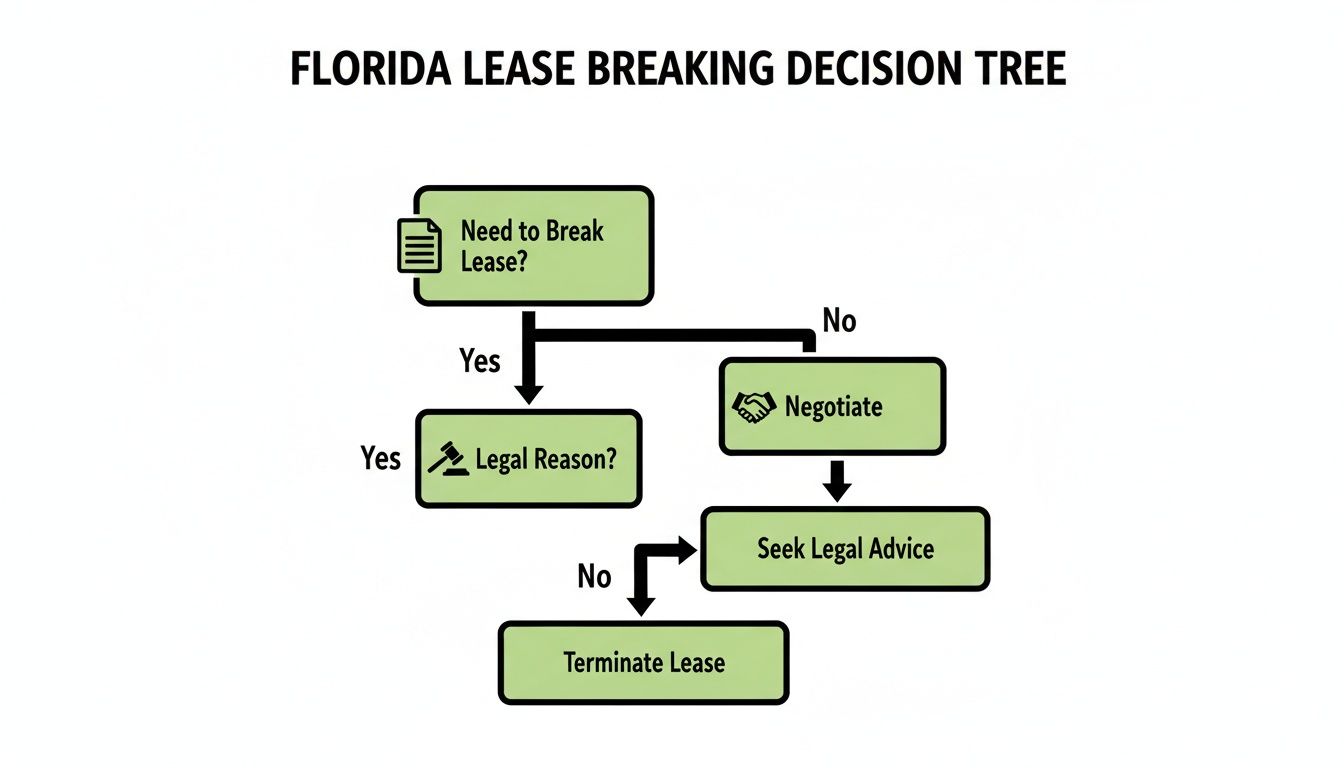
As the flowchart shows, your strategy really hinges on one key question: do you have a legally justified reason under Florida statutes, or will you need to negotiate a solution with your landlord? We'll dive deep into both of these routes.
Florida Lease Termination Options at a Glance
Navigating an early lease termination can feel complex, but most situations fall into one of a few categories. This table summarizes your primary options at a high level.
Method | Primary Requirement | Best For Tenants Who... |
|---|---|---|
Legal Justification | Your situation is covered by a specific Florida statute (e.g., military orders, uninhabitable conditions). | Have clear, documented proof that meets the legal standard for termination without penalty. |
Early Termination Clause | Your lease contains a specific clause outlining a buyout fee (often 1-2 months' rent). | Want a predictable, straightforward exit and can afford the pre-negotiated penalty fee. |
Lease Buyout Negotiation | Your lease has no early-out clause, so you must negotiate a mutual agreement with the landlord. | Are in a strong rental market where the unit can be quickly re-rented and have a good relationship with their landlord. |
Subletting or Assignment | Your lease permits you to find a qualified replacement tenant to take over your lease obligations. | Are willing to put in the work to find and screen a suitable new renter to minimize their financial loss. |
Each of these paths comes with its own set of procedures and potential outcomes. Understanding which one applies to you is the first step toward a successful resolution.
When You Can Legally Walk Away From Your Florida Lease

While talking things over with your landlord is often the best first move, there are specific situations where Florida law gives you a clear, penalty-free exit from your lease. These aren't loopholes; they're legal rights designed to protect tenants in circumstances beyond their control. Knowing these rights is crucial, but just as important is following the exact legal steps required.
Think of your lease as any other contract. The same fundamental contract interpretation principles that courts use apply here, all within the framework of Florida's landlord-tenant laws.
Active Military Duty Protections
If you're an active-duty military member, the federal Servicemembers Civil Relief Act (SCRA) is your strongest ally. This law protects servicemembers who receive official orders for a permanent change of station (PCS) or who are deployed for 90 days or more.
But you can't just pack up and go. To do this by the book, you must give your landlord written notice and include a copy of your official military orders. The lease doesn't end immediately—it terminates 30 days after your next rent payment is due.
For example, say your rent is due on the first of each month. If you provide notice on August 15th, your next rent payment is due September 1st. Your lease termination would then become effective on October 1st, meaning you are still responsible for September's rent.
Protections for Victims of Domestic Violence
Florida law provides a critical escape route for tenants who are victims of domestic violence, sexual violence, or stalking. You can terminate your lease early without penalty, but you have to follow a specific procedure.
To qualify for this protection, you need to:
Give your landlord a copy of a protective injunction or similar court document.
Notify your landlord in writing that you intend to vacate the property.
Move out. The lease is officially terminated once you have left the premises.
This law is in place so that a rental agreement never becomes a barrier to someone's safety.
Key Takeaway: Simply being a victim of a crime doesn't automatically void your lease. You must follow the statutory process and provide the landlord with the required legal proof. This ensures the process is handled correctly and protects both you and the property owner.
When Your Home Becomes Uninhabitable
This is a common reason tenants seek to break a lease, but it's also one of the most misunderstood. Legally, it's known as "constructive eviction," and it applies when a landlord's failure to maintain the property makes it unsafe or unlivable.
We're not talking about minor inconveniences like a leaky faucet or a squeaky door. This is for serious problems that violate the landlord's basic duty to provide a habitable home.
Real-World Examples of Uninhabitable Conditions: * No air conditioning during a blistering Florida summer. * Serious, unaddressed mold growth that poses a health hazard. * A major pest infestation (roaches, rodents) that the landlord has ignored. * Significant structural issues, like a roof leak causing major water damage.
You can't just declare the place unlivable and move out. The law requires you to give the landlord a formal written notice detailing the problem. You must give them a reasonable time to fix it—typically seven days for most issues. If they do nothing, only then might you have the right to terminate the lease. Document absolutely everything—photos, emails, and certified mail receipts will be your best evidence if things go south.
Keep in mind, today's rental market in Florida gives you a bit more leverage. Statewide vacancy rates are around 10%, with some cities like Jacksonville hitting 12.2%. This is a far cry from the pandemic-era boom, where rents in places like Tampa shot up nearly 38% and landlords held all the cards. Now, a landlord facing a legitimate complaint might be more willing to make repairs or agree to a mutual termination, especially when an empty unit could cost them an average of $1,900 per month in lost rent.
How to Negotiate an Early Termination With Your Landlord

So, what happens if your reason for leaving doesn't fall under Florida's legally protected categories? Your next best move is to open a direct and honest conversation with your landlord. It’s easy to assume they’ll just say no, but from my experience, that’s rarely the case. Landlords are running a business, and their biggest fears are prolonged vacancies and the hassle of finding a new tenant.
That shared interest is where you have some leverage. A good-faith negotiation can lead to a mutual agreement that saves everyone a ton of stress and money. How you approach it makes all the difference. For some background, reviewing general contract negotiation tips can give you a solid strategic foundation before you even pick up the phone.
Kicking Off the Conversation the Right Way
The way you start this dialogue really sets the stage. Don't just spring it on your landlord with a panicked phone call saying you have to leave. Frame it as a problem you want to solve together.
Your first real move should be to put it in writing. A professional, clear, and respectful letter or email is the way to go. Clearly state your intended move-out date, give a brief, honest reason for your departure (no need for a dramatic story), and—most importantly—propose a solution.
For instance, if you landed a sudden job offer across the country, you could write something like, "While I understand my obligation to the full lease term, I'd like to propose a mutually agreeable solution to ensure you don't experience any financial loss." This simple shift in language positions you as a responsible partner, not a tenant trying to bail.
The Power of a Lease Buyout Offer
One of the cleanest and most effective tools you have is offering a lease buyout fee. This is sometimes called a liquidated damages clause if it's already in your lease. Essentially, you pay a one-time fee to the landlord, and in return, they release you from the contract. It's a clean break for everyone.
A fair offer is typically one to two months' rent. This gives your landlord a cash cushion to cover the mortgage and advertising costs while they look for a new tenant.
When you make your offer, present it as a clear benefit to them. You might say, "I'm prepared to offer a buyout of $4,000, equal to two months' rent, to terminate my lease on [Date]. This should cover your costs and prevent any gap in rent while you find a great new tenant." It turns an emotional plea into a straightforward business proposition, which most property owners appreciate.
From a property owner's perspective, accepting a buyout is often a smart business move. It guarantees income, eliminates the uncertainty of how long a unit will sit empty, and avoids the potential costs and headaches of pursuing a former tenant for unpaid rent.
Find a Qualified Replacement Tenant Yourself
Another fantastic strategy is to do the legwork for your landlord by finding them a great replacement tenant. This directly solves their biggest problem: an empty unit that isn't making money.
But you need to be clear about how you're helping. There are two main ways this works, and landlords have a strong preference for one over the other.
Subletting: This is where you find someone to move in, but your name stays on the original lease. You collect rent from them and pay the landlord. The huge downside? You are still 100% responsible for rent payments and any damages. Most Florida landlords are not fans of this.
Lease Assignment: This is the gold standard. An assignment means you find a qualified applicant who then goes through the landlord’s full screening process (credit, background, income verification). Once they’re approved, they sign a new lease agreement directly with the landlord, and you are completely off the hook.
When you propose this, emphasize that you'll only bring them highly qualified candidates who meet their existing criteria. This shows you respect their business and dramatically improves your chances of getting a "yes." Always check your lease first for any clauses about subletting or assignments. If you need more guidance on the formal notification process, you can find it in this guide on what a notice to vacate entails.
Always, Always Get the Final Agreement in Writing
This is the most critical step. Once you've come to an agreement with your landlord—whether it's a buyout, a new tenant, or some other compromise—you must get it in writing. A handshake or a verbal promise is not enough.
This document is often called a "Mutual Termination of Lease Agreement." It needs to be signed by both you and your landlord and should clearly spell out a few key things:
The official, final date of your tenancy.
The exact amount of the buyout fee and when it's due.
The plan for returning your security deposit.
A statement releasing both you and the landlord from any further obligations under the original lease.
This signed agreement is your get-out-of-jail-free card. It's your legal proof that the lease was terminated properly and protects you from any future claims for rent or damages. It provides that clean, definitive end you're looking for.
What Breaking a Lease Really Costs in Florida
Thinking about leaving your lease early? It's more than just a matter of packing up and moving on. A lease is a binding financial contract, and breaking it without a legally sound reason comes with some very real financial consequences. Let's walk through what you can expect so there are no surprises.
When you sign a lease, you’re promising to pay rent for the entire term. If you leave early, the landlord is owed compensation for the money they lose. But—and this is a big but—Florida law doesn't let them just sit back and bill you for the whole thing.

The Landlord’s Responsibility to “Mitigate Damages”
Here's a term every Florida tenant should know: the duty to mitigate damages. This legal concept requires your landlord to make a reasonable effort to re-rent your unit after you leave. They can't just let the apartment sit empty for six months and then send you a massive bill for all the lost rent.
So, what does a "reasonable effort" look like? It means they need to get the property back on the market—advertising the vacancy, showing it to prospective renters, and screening new applicants, just like they would for any other empty unit.
You're generally on the hook for rent only for the time the property is vacant. The day a new tenant starts paying rent, your obligation for future rent stops. This is exactly why working with your landlord is so important. The quicker they find someone, the less you owe.
Calculating the True Cost of Your Early Exit
Your financial responsibility doesn't always stop at just the lost rent. Landlords can also charge you for the direct expenses they rack up specifically because you left early. These aren't meant to be penalties; they're reimbursements for actual costs.
Here are some legitimate expenses they might pass on to you:
Advertising Fees: The money spent listing the unit on Zillow, Apartments.com, or other rental platforms.
Re-Renting Commissions: If they use a real estate agent or property manager to find the next tenant, you could be responsible for the commission.
Screening Costs: The fees for running background and credit checks on potential applicants.
A good landlord will keep detailed records and receipts for every one of these charges. If they can't prove the expense, they can't charge you for it. As a tenant, you have every right to ask for an itemized breakdown of any costs they claim you owe.
An Expert’s Take: Florida's rental market is a huge factor here. With 350,000-400,000 new people moving to the state each year, demand is red-hot in most areas. In cities like Tampa or Orlando, a landlord making a "reasonable effort" can often find a new tenant in just a few weeks. This can seriously limit how much you'll end up owing. You can learn more about the state's rental trends and 2026 Florida rental demand on hamptonrea.com.
What Happens to Your Security Deposit?
When you break a lease, your security deposit is the first pot of money your landlord will look to. Under Florida law, once you've moved out, they have 30 days to either return your deposit in full or provide a written, itemized notice explaining why they're keeping some or all of it.
If you left early, expect deductions for:
Unpaid rent while the unit was empty.
Those legitimate re-renting costs we just talked about.
Any damage to the property that goes beyond normal wear and tear.
The rules around security deposits are strict. We dive much deeper into this in our complete guide to security deposit return timelines. Be sure to understand your rights, because if you don't respond properly to a landlord's claim, you could lose your entire deposit.
The Long-Term Consequences You Want to Avoid
So, what if the unpaid rent and re-renting fees are more than your security deposit? If you don't settle that remaining balance, the consequences can follow you for years.
A landlord can take you to small claims court or send your debt to a collections agency. Either of these actions will almost certainly end up on your credit report. A collection account or a civil judgment can tank your credit score, making it incredibly difficult to rent another apartment, get a car loan, or even qualify for a mortgage down the road.
Getting out of a lease in Florida the wrong way can cast a long financial shadow. It’s a move that requires careful thought, clear communication, and a solid understanding of your obligations.
A Landlord’s Guide to Managing Lease Breaks
When a tenant wants to break their lease, it’s easy to panic. But from an experienced landlord's point of view, it’s not a catastrophe—it’s just another part of the business. Handling it the right way is what protects your investment and keeps your property from sitting empty.
The single most powerful tool you have is your lease agreement. I can't stress this enough: a solid, legally sound early termination clause, included from day one, prevents almost all the drama and disputes that can come up later. It lays out a clear roadmap for both you and the tenant.
This simple step changes the entire dynamic. Instead of a messy, emotional conflict, you have a straightforward business transaction. It takes the guesswork out of the equation and replaces it with a clear-cut procedure that protects your bottom line while still being fair to your tenant.
Crafting a Proactive Early Termination Clause
Your lease is your first and best line of defense. Here in Florida, the law actually gives landlords a great option under Florida Statute 83.595. It allows you to offer a liquidated damages or early termination fee addendum right in the lease. Honestly, it's a game-changer.
So what does this look like in practice? Typically, the clause states that the tenant can walk away from all future rent obligations by paying a set fee—usually equal to two months' rent. It also requires them to give you proper notice, often up to 60 days.
When a tenant signs a lease with this provision, they know exactly what their exit strategy is. This is a huge win for you because it:
Guarantees Income: You get a lump sum payment that immediately covers the cost of finding a new tenant.
Ends the Uncertainty: You don't have to chase down a former tenant for unpaid rent or spend time calculating your exact financial damages.
Keeps Things Simple: It provides a clean, contractual off-ramp, avoiding drawn-out negotiations or potential legal battles.
For property owners, offering an early termination option isn't about being lenient; it's about being strategic. It provides financial certainty and turns a potential liability into a manageable, one-time transaction. This is a cornerstone of professional property management.
Responding to a Tenant's Request
The moment a tenant tells you they need to leave, your response sets the tone for everything that follows. Keep it professional and all-business. Your goal isn't to punish them; it's to enforce the terms of the agreement and make the transition as smooth as possible.
Your first move should be to direct them back to the lease itself. If you have that early termination clause we just talked about, walk them through the exact steps. If not, you’ll have to gently remind them of their legal obligation to continue paying rent until the unit is re-rented.
Documentation is your best friend here. Keep a record of every single conversation—every email, every phone call, every formal notice. If you end up negotiating a mutual termination that isn't already in the lease, get it all down in a signed written agreement. That document needs to be crystal clear about the move-out date, any money changing hands, and the final release from any future obligations for both of you.
The Duty to Mitigate and Re-Rent Quickly
Even when a tenant breaks the lease without a valid reason, you can’t just sit back and let the losses pile up. You have a responsibility to mitigate damages, which means you have to make a reasonable effort to find a new tenant as quickly as you can.
Get that property back on the market immediately. Use great photos, post the listing on all the major rental sites, and start scheduling showings right away. The faster you re-rent the unit, the less financial damage you can legally claim from the former tenant.
This is where knowing your local market really pays off. Pricing the unit correctly and advertising in the right places can slash your vacancy time. For more insight on this process, you can review this comprehensive landlord's guide to breaking a lease in Florida. We see it all the time—a professional manager can turn a month-long vacancy into a minor blip, protecting your income stream and cementing your reputation as a fair and proactive landlord.
Common Questions About Ending a Lease in Florida
Even with a solid plan, breaking a lease can stir up a lot of "what if" scenarios. Let's walk through some of the most common questions and concerns that pop up for both tenants and landlords in Florida. Getting clear, practical answers now can save you from major headaches and costly missteps down the road.
What Happens If I Just Move Out and Abandon the Property?
This is, hands down, the worst way to break a lease. It might feel like a quick escape, but abandoning your rental triggers a cascade of legal and financial problems that can haunt you for a long time.
First, your landlord can sue you for every dollar of rent remaining on your lease. While Florida law does require them to make a reasonable effort to find a new tenant (this is called "mitigating damages"), you're on the hook for the rent for every day the unit sits empty. On top of that, you'll likely be charged for their advertising and administrative costs.
Worse yet, this path almost always ends with a judgment against you. That judgment will torpedo your credit score and put a massive red flag on your rental history, making it incredibly difficult to get approved for another rental in the future.
Can My Landlord Charge an Early Termination Fee?
Yes, but there's a big catch: it has to be spelled out in the lease agreement from the very beginning.
Florida Statute 83.595 allows landlords to include a "liquidated damages" or "early termination fee" clause. This provision gives you the option to pay a set amount—usually equal to two months' rent—and walk away free and clear from any further obligations.
If that language isn't in your lease, the landlord can't just make up a fee. Their only option is to pursue you for their actual losses, which is the rent they lose while the property is vacant.
Expert Takeaway: A lease with an early termination clause is a good thing for everyone. It gives the tenant a clear, predictable exit ramp and provides the landlord with guaranteed compensation, eliminating the uncertainty and potential for a drawn-out conflict.
Do I Have to Allow Showings While I Still Live There?
Once you've given your official notice to vacate, yes, you do. Your landlord has a right to show the property to prospective tenants, and frankly, it's in your best interest that they do so quickly. This is a key part of their legal duty to mitigate damages.
Under Florida law, your landlord has to give you "reasonable notice" before entering, which is generally understood to be at least 12 hours. You can't unreasonably deny them access. If you do, a court could see it as you preventing them from re-renting the unit, which could make you responsible for even more lost rent.
What Is the Difference Between Subletting and a Lease Assignment?
People often use these terms interchangeably, but they are completely different arrangements with huge implications for your liability.
Subletting: You find someone new to live in your apartment and they pay rent to you. The crucial part? Your name is still on the original lease. You remain 100% responsible for paying the landlord, and you're on the hook for any damage the subtenant causes. Most Florida landlords aren't fans of this setup for obvious reasons.
Lease Assignment: This is what you want. You find a qualified replacement tenant who goes through the landlord's official screening process. If they're approved, they sign a new lease directly with the landlord, and your original lease is terminated. This gets you off the hook completely.
Always push for a lease assignment. It's the only way to make a clean break and ensure you're fully protected once you hand over the keys.
Navigating the complexities of lease terminations requires expertise and a deep understanding of Florida law. Keshman Property Management has over 20 years of experience helping property owners manage these situations efficiently, minimizing vacancies and protecting their investments. Learn how our transparent, professional services can make owning rental properties less daunting and more profitable at https://mypropertymanaged.com.
Comments