
What Is a Notice to Vacate a Landlord's Essential Guide

Updated: Feb 14
A Notice to Vacate is a formal, written document a landlord gives a tenant, telling them they need to move out of the rental property by a certain date. Think of it as the official, legally required first step to end a tenancy. It sets a clear timeline and expectations before you can take any further action, like filing for an eviction.
Deconstructing the Notice to Vacate

Think of a Notice to Vacate as the opening statement in a very serious conversation between you and your tenant. It’s not just a casual text or a quick phone call; it's a legally significant document that turns a simple request into an official, time-bound demand. This is a critical distinction, as it protects both your rights as a property owner and the tenant's right to due process.
This document is an absolutely essential tool for any landlord. It makes sure all communication about ending a tenancy is clear, documented, and, most importantly, legally compliant. Without a properly delivered notice, any attempt you make to remove a tenant is dead in the water from a legal standpoint.
The Purpose Behind the Paperwork
At its core, the main job of a Notice to Vacate is to create an official record. It formally communicates your intent and gives the tenant a specific, legally required amount of time to either fix the problem or move out. This isn't just a courtesy—it's a strict prerequisite for taking legal action.
This initial notice is the starting point for millions of tenancy terminations around the world every year. Across OECD countries, at least 2.4 million formal eviction procedures were started in the most recent reporting year. For professionals like us at Keshman Property Management, it's crucial to remember that this notice is the formal kick-off to the eviction process, and getting it right is fundamental to compliant operations. You can dig into more data about eviction procedures and policies on oecd.org.
Key Functions of the Notice
A well-drafted Notice to Vacate achieves several vital goals, solidifying your legal position and ensuring you're following the letter of the law in your jurisdiction.
Here’s what it really does for you:
Establishes a Legal Timeline: It officially starts the countdown on the required notice period before you're legally allowed to file for an eviction with the court.
Provides Clear Instructions: The notice leaves no room for confusion. It clearly states the exact date the tenant must be out of the property.
Creates a Paper Trail: This document is your proof. It serves as concrete evidence that you formally notified the tenant, which is absolutely essential if the situation ends up in court.
Encourages Resolution: Sometimes, just receiving a formal notice is enough to prompt a tenant to act. They might pay the rent they owe or decide to move out on their own, helping you avoid a long and costly court battle.
Common Scenarios for Issuing a Notice to Vacate
Knowing when to send a notice to vacate is every bit as important as knowing how to draft one. This isn't a tool for handling minor annoyances; it's a formal, legal document reserved for specific situations where you need to end a tenancy. Getting these scenarios right is key to protecting your property and ensuring you’re on solid legal footing.
By far, the most frequent reason landlords reach for this tool is when rent goes unpaid. While it's a major headache for property owners everywhere, an immediate notice usually isn't the first move. Most experienced landlords will first try to communicate, send reminders, and wait out any legally required grace periods before taking the formal step of issuing a notice.
Non-Payment of Rent
When a tenant misses a rent payment, they're breaking the single most important term of their lease. But before you act, pause and pull out two things: the lease agreement and your local landlord-tenant laws. These will tell you exactly what grace period is required and when you can legally serve a 3-day or 14-day notice to pay or vacate.
Non-payment is an unfortunately common reality in the rental market. While formal eviction filings affect about 5-6% of renter households in a given year, some data suggests that an incredible 50% of tenants are late on rent at least once during that same period. What does this tell us? That most landlords successfully work things out with their tenants before escalating to a formal notice. You can dig into the complexities of rent non-payment on bfi.uchicago.edu to see the data for yourself.
Key Takeaway: Documentation is your best friend here. Keep a meticulous log of every payment, late fee, text message, email, and phone call. This paper trail becomes invaluable if the situation sours and you need to move forward with an eviction.
Navigating late rent requires a clear, consistent process. For a deeper dive, take a look at our landlord’s guide to handling late payment for rent.
Significant Lease Violations
Of course, a tenancy can go off the rails for reasons other than money. A notice to vacate is also appropriate for serious lease violations—not small issues, but significant breaches that impact the property's safety, condition, or the peace and quiet of the neighborhood.
Here are a few common examples that might trigger a notice:
Unauthorized Occupants or Pets: A tenant moves in a new roommate or gets a dog without your permission, violating the terms you both agreed to.
Substantial Property Damage: This isn't about scuffed paint. We're talking about broken windows, holes in the wall, or destroyed fixtures caused by negligence or abuse.
Illegal Activities: Any criminal activity on the premises is a severe violation and often gives you grounds for a much faster termination process.
Nuisance Complaints: If one tenant is constantly causing documented disturbances—loud parties, aggressive behavior—that disrupt the lives of their neighbors, you have grounds to act.
For these types of issues, a 10-Day Notice to Comply or Vacate is a common starting point. It gives the tenant a short window to fix the problem (e.g., rehome the unauthorized pet). If the violation is something that can't be "cured," like a criminal act, the law may allow for a more immediate, non-negotiable notice.
End of a Lease Term
Not every notice to vacate is born from conflict. It's also a standard, professional tool used to formally end a tenancy when the lease term is expiring and you don't plan to renew.
Maybe you're planning to sell the property, move in a family member, or undertake a major renovation that requires the unit to be empty. In these "no-cause" situations, providing a formal notice is the legally required way to communicate your intent. The timeline here is much more generous, typically requiring 60 days or more of advance warning. This gives your tenant plenty of time to secure new housing and ensures a smooth, predictable transition for everyone involved.
Crafting a Legally Compliant Notice to Vacate

Think of a notice to vacate as the key that unlocks the legal process for regaining possession of your property. If that key is cut incorrectly—maybe it's missing a crucial piece of information or has the wrong shape—it simply won't turn the lock. A sloppy or incomplete notice can completely derail your efforts, forcing you to start all over again. That means more lost time and more lost rent.
Crafting a document that is both effective and legally sound isn't just about filling out a form; it's about precision. Every detail matters, from getting the tenant's full name right to specifying the exact date they must leave. Getting it right the first time isn’t just a best practice; it's a financial and legal necessity.
Essential Components of an Ironclad Notice
For your notice to hold up under legal scrutiny, it has to contain specific, accurate information. Missing even one of these elements can give a tenant an easy reason to challenge the notice in court, which only leads to frustrating and expensive delays.
Your notice absolutely must include these details:
Full Legal Names: List the complete legal names of every adult tenant on the lease agreement. No nicknames or partial names.
Complete Property Address: Be specific. Include the full street address, unit number, city, state, and ZIP code.
Date of Issuance: Clearly state the date you are writing and serving the notice. This is what starts the legal clock.
The Vacate Date: This is the most critical part of the document. State the exact date and time by which the tenant must be completely moved out.
Legal Tip: Specificity is your best friend. A notice saying "you must vacate in 30 days" is vague and weak. A notice stating "you must vacate the premises on or before 5:00 PM on July 31, 2024" is strong and unambiguous. Ambiguity creates legal loopholes.
For a better sense of how these documents are structured, it can be helpful to review various legal notice templates to see common formats and best practices.
Stating the Reason with Clarity and Professionalism
Beyond the basic who, what, and when, the "why" is absolutely crucial. You need to provide a clear, unemotional reason for ending the tenancy. This statement should be direct and based strictly on the facts and the terms laid out in the lease.
For example, if the notice is for a lease violation, you must point to the specific clause they broke. Instead of saying, "You have a dog you're not supposed to," you should write, "This notice is issued due to a violation of section 7B of your lease agreement, which prohibits pets on the premises without prior written consent."
This approach takes personal feelings out of the equation and grounds your actions firmly in the legal contract between you and your tenant.
The Importance of a Professional Tone
The language you choose can make or break your case if it ends up in front of a judge. It's essential to maintain a professional, neutral, and business-like tone from start to finish. Steer clear of any language that sounds aggressive, emotional, or accusatory.
Words that come across as personal attacks or accusations can be twisted and used against you, suggesting the notice is a form of retaliation or harassment rather than a standard legal action.
Compare the Phrasing:
Weak/Risky Phrasing (Avoid) | Strong/Professional Phrasing (Use) |
|---|---|
"You have repeatedly failed to pay rent on time." | "Rent in the amount of $1,500 for the period of June 2024 remains unpaid." |
"Your constant loud parties are a nuisance." | "A violation of lease section 9C (Quiet Enjoyment) occurred on June 15, 2024." |
"You need to get out immediately because of what you did." | "This notice requires you to vacate the premises due to actions constituting a non-curable breach." |
The stronger phrasing is factual, impersonal, and directly tied to the lease. This kind of language shows that you're acting as a professional enforcing a contract, not as a frustrated individual. By sticking to the facts, you build a much stronger legal foundation and protect yourself from potential counterclaims.
How to Properly Serve a Notice to Vacate

Writing a flawless notice to vacate is only half the battle. If that perfectly worded document isn't delivered according to the strict letter of the law, it’s legally worthless. This formal delivery process is called service, and getting it right is non-negotiable if you want the notice to hold up.
Think of proper service as the official handshake that makes the notice legally binding. Botch this step, and a judge could dismiss your case entirely. That means you’re back to square one, losing valuable time and money. Every state and city has specific rules, so digging into your local requirements is always the first and most critical step.
Legally Accepted Delivery Methods
As tempting as it is to just send a quick text or email, those methods almost never count for a formal notice to vacate. Courts need proof of delivery that can’t be disputed. The whole point is to eliminate any chance of a tenant later claiming, "I never got the notice."
Here are the most common and legally sound ways to serve a notice:
Personal Service: This is the gold standard. You, your property manager, or a professional process server physically hand a copy of the notice directly to the tenant. It's immediate, direct, and the hardest method for a tenant to argue against.
Substituted Service: What if the tenant isn't home? Some jurisdictions let you leave the notice with another responsible person at the property, like a teenage child or another adult living there. This often requires a follow-up step, like mailing a second copy to be safe.
Posting and Mailing: When you can't deliver the notice in person, this is usually your next best move. It involves securely taping a copy of the notice to a prominent spot, like the front door. Crucially, you must also mail another copy on the same day, typically via certified mail for tracking.
Proof is Paramount: No matter which method you choose, documenting the service is absolutely essential. You'll need to fill out a "Proof of Service" or "Affidavit of Service" form. This is your sworn statement detailing who was served, when, where, and how—and it becomes your most important piece of evidence if the case goes to court.
Comparing Methods for Delivering Your Notice
Choosing the right service method often depends on your local laws and the specific situation with your tenant. Some approaches offer much stronger legal protection than others, so it pays to understand the differences.
Delivery Method | Legal Acceptance | Proof of Service | Best For |
|---|---|---|---|
Personal Service | Universally Accepted | Strongest (with affidavit) | The first and most preferred attempt for ensuring direct delivery. |
Certified Mail | Widely Accepted | Strong (return receipt) | Providing documented proof that a notice was sent and received by the tenant. |
Posting & Mailing | Accepted (if others fail) | Good (with photos/affidavit) | Situations where the tenant is actively avoiding personal contact or is rarely home. |
Ultimately, the best method is the one that is legally accepted in your area and gives you rock-solid proof.
Common Mistakes That Invalidate Your Notice
Even the most well-meaning landlords can trip up on simple procedural mistakes that render their notice completely void. These errors are easy to avoid but can be incredibly costly if you make them.
Steer clear of these common pitfalls:
Using Text or Email: Fantastic for routine communication, but legally insufficient for a formal notice like this.
Slipping It Under the Door: This isn't considered secure delivery. It’s far too easy for a tenant to claim it blew away or they never saw it.
Leaving It in the Mailbox: Only the USPS can legally place items in a mailbox. Doing so yourself is actually a federal offense.
Incorrect Mailing: If your state law specifies certified mail with a return receipt, sending it via regular first-class mail simply won't cut it.
Serving a notice to vacate is a precise legal procedure, not an informal heads-up. By understanding and meticulously following the rules for delivery, you ensure your notice is legally sound, protecting your rights and paving the way for a smooth, compliant end to the tenancy.
Navigating State and Local Landlord-Tenant Laws
Think of landlord-tenant law like a complex road map where the route changes dramatically from one town to the next. The rules for a notice to vacate in one city might be completely different—or even illegal—just a few miles down the road. This extreme localization makes understanding your specific jurisdictional rules not just a good idea, but an absolute necessity for protecting your investment.
This is one area where you simply can't afford to make assumptions. Local and state laws dictate every single detail of the process. For example, the law will specify the minimum notice period you have to provide. A 3-day notice might be fine for non-payment of rent, while a 60-day notice could be required for a standard non-renewal of a lease.
The Growing Trend of Good Cause Eviction
A major shift is happening in landlord-tenant regulations across the country. More and more cities and states are adopting "good cause" eviction laws, which fundamentally change a landlord's ability to end a tenancy. Under these rules, you can no longer simply decide not to renew a lease; you must have a legally defined, valid reason to ask a tenant to leave.
This isn't just a local trend; it's part of a larger, global policy movement. The notice to vacate and eviction process has become a huge focus for lawmakers in many developed nations, showing a growing international preference for requiring landlords to show good cause. You can learn more by exploring the international trend toward requiring good cause for tenant evictions at digitalcommons.law.lsu.edu.
What this means for you as a landlord is that the ground is constantly shifting. The laws that applied last year might already be outdated, making ongoing education and strict compliance more critical than ever.
Key Insight: Grabbing a generic, one-size-fits-all notice to vacate template from the internet is one of the riskiest moves a landlord can make. A template that doesn’t account for your specific local ordinances is likely invalid and will be tossed out in court, forcing you to start the entire process all over again.
Why Professional Guidance Is Essential
The legal landscape is littered with pitfalls that can lead to costly lawsuits, significant financial losses, and months of wasted time. A tiny mistake, like using the wrong phrasing or miscalculating the notice period by a single day, can get your entire notice thrown out. To properly navigate these complex rules, especially for specific notice requirements, some firms even turn to outsourcing legal research to ensure efficiency and compliance.
This is why consulting with a legal professional or an experienced property management firm like Keshman Property Management isn't just an expense—it's an investment in protecting yourself. Experts stay on top of the intricate web of state, county, and city-level rules, ensuring every document you serve is fully compliant and legally sound.
This kind of professional oversight shields you from the simple procedural errors that could give a tenant grounds to fight the notice. For a complete overview of the entire process, check out our guide on how to evict a tenant legally. At the end of the day, handling these laws correctly is the only way to ensure you can regain possession of your property efficiently and lawfully.
What to Do After Sending the Notice
Once you've officially served the notice to vacate, the clock starts ticking. This isn't a passive waiting game; it's a critical period where you need to be ready for what comes next.
Essentially, the road ahead will fork into one of two paths. Your tenant will either comply with the notice, or they won't. Being prepared for both scenarios is the key to protecting your investment and ensuring you stay on the right side of the law.
Scenario 1: The Tenant Complies and Moves Out
This is the outcome every landlord hopes for. The tenant respects the notice, packs their things, and leaves by the deadline. When this happens, your job shifts from ending the tenancy to managing a smooth transition.
A clean hand-off is all about process. You'll need to:
Schedule a Move-Out Inspection: Arrange a time to walk through the property with the tenant, comparing its current state to your move-in condition report.
Handle the Security Deposit: Following your state and local regulations to the letter, calculate any valid deductions for damages—things beyond normal wear and tear—and return the rest of the deposit within the legally mandated timeframe.
Finalize the Details: Collect all the keys and make sure you have a forwarding address for any final correspondence or the security deposit return.
Managing this final stage correctly prevents future disputes. For a step-by-step guide, check out our checklist for landlords when a tenant moves out.
Scenario 2: The Tenant Ignores the Notice
What if the move-out date comes and goes, and your tenant is still there? This is where many landlords make critical mistakes. Your next move is not another conversation or a stronger-worded letter; it's a court filing.
The notice to vacate was the necessary first step, but it doesn't grant you the authority to physically remove anyone. Only the legal system can do that.
You'll need to file a formal eviction lawsuit with the local court. This is often called an unlawful detainer action. This legal step is what officially asks a judge to order the tenant to leave and return possession of the property to you.
Before you head to the courthouse, it’s vital to confirm your initial notice was legally airtight. This decision tree can help you double-check your work.
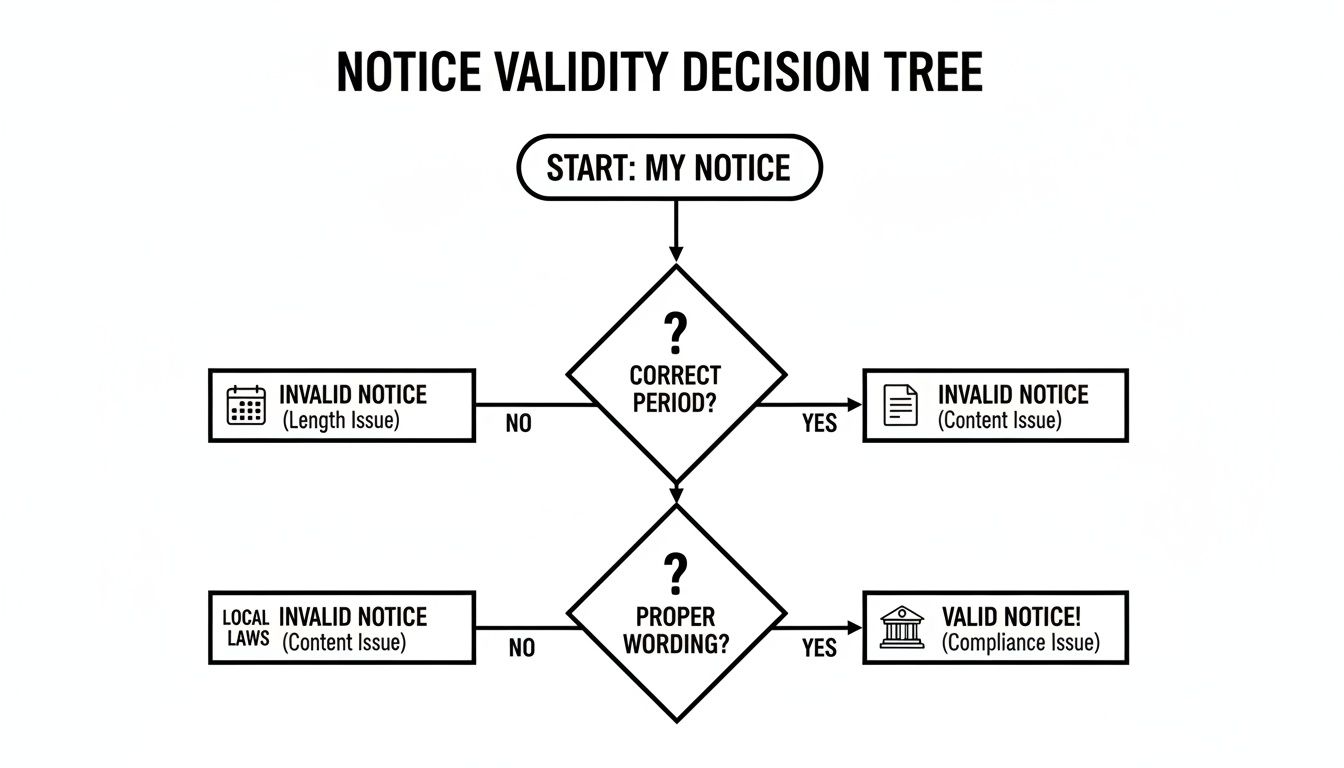
As the graphic shows, a valid notice depends on getting the notice period, wording, and delivery method exactly right according to your local laws. Any mistake can get your case thrown out.
Crucial Warning: Never, under any circumstances, attempt a "self-help" eviction. This includes changing the locks, shutting off the power or water, or moving the tenant's belongings out yourself. These actions are illegal and will land you in serious legal and financial trouble.
When a tenant refuses to leave, the court is your only legitimate path forward. Following the correct legal procedure is the only way to enforce your rights as a property owner and regain control of your unit.
Landlord Questions About Notices to Vacate
Even when you know the rules, issuing a notice to vacate can still feel tricky. Every tenancy is different, and unique situations pop up that aren't always covered in a standard guide. Let's tackle some of the most common questions we get from landlords, focusing on practical answers you can use right away.
Think of this as your go-to resource for those "what if" moments. Getting these details right from the start will give you the confidence to handle any tenant response while staying on the right side of the law.
Can a Tenant Refuse to Accept a Notice?
Absolutely. A tenant can refuse to take the paper from your hand or slam the door in your face. But here's the crucial part: that act of refusal does not make your notice invalid.
The law isn't concerned with whether they accepted it, but whether you served it correctly. This is exactly why legal service methods exist. Things like certified mail (which gives you a receipt) or "post and mail" (taping the notice to the door and sending a copy by mail) create a legal assumption that it was delivered. In the end, your careful record-keeping of how and when you served the notice is what holds up in court.
Key Takeaway: A tenant's refusal to acknowledge the notice is legally irrelevant as long as you can prove you followed the proper delivery procedure. This is why a detailed "Affidavit of Service" is one of your most powerful tools.
What Is the Difference Between a Notice to Vacate and an Eviction Notice?
People often use these terms interchangeably, but in the legal world, they mean two very different things. Getting the distinction right is key.
Notice to Vacate: This is the first step. It's the official document you give the tenant, warning them that the tenancy is ending and giving them a deadline to either leave or fix a problem.
Eviction: This is the legal lawsuit you file with the court after the tenant has ignored the notice to vacate. You can't just evict someone; you must first give them a proper notice.
Think of it like this: the notice to vacate is the formal warning shot. The eviction is the legal battle that follows if they don't heed that warning.
Should I Write My Own Notice or Hire a Professional?
You can certainly find endless templates online and try to write one yourself, but you're walking into a minefield. Landlord-tenant law is incredibly complex and changes not just from state to state, but sometimes even from one city to the next.
One tiny mistake—miscalculating the notice period by a single day or using the wrong legal phrasing—can be enough for a judge to throw out your entire case. If that happens, you're back to square one, losing weeks or months of rent and paying more in legal fees. Considering what's at stake, having an attorney or a seasoned property manager draft the notice is a smart investment that ensures it’s done right the first time.
What If a Tenant Wants to Negotiate After Receiving the Notice?
It’s always an option, and often a better one than a drawn-out court battle. If a tenant gets a notice for unpaid rent and reaches out to set up a payment plan, it’s usually worth hearing them out.
Just be sure to get any new agreement in writing. Draft a formal document that clearly states the original notice to vacate is on hold and will only be canceled once they meet the new terms (like paying in full by a new, specific date). This protects your position and allows you to move forward with the eviction immediately if they don't hold up their end of the new deal.
Navigating tenant notices and legal compliance is a lot to handle on your own. Keshman Property Management has over 20 years of experience protecting landlords and their investments. Let our experts manage the headaches so you can focus on the rewards of ownership. Learn more about our comprehensive property management services.


Comments