
How to Screen Tenants for Rental Property to Protect Your Investment

Updated: Feb 14
Learning how to screen tenants for your rental property is probably the single most important thing you can do to protect your investment. It’s not just about filling a vacancy; it's a systematic process of vetting applicants to find someone who will pay on time and take care of your property. A meticulous approach here is the foundation of a profitable, low-stress rental business.
Why Smart Tenant Screening Is Non-Negotiable

Tenant screening is far more than just paperwork—it’s your first line of defense against major financial risk. Just one bad tenant can turn a great asset into a cash-draining nightmare, costing you months of lost rent, thousands in property damage, and endless legal headaches. Placing the wrong person in your property doesn't just cause frustration; it hits your bank account directly.
Think about it this way: when you hand over the keys, you're trusting someone with an asset that's likely worth hundreds of thousands of dollars. Without a rigorous, consistent process, you're essentially gambling with that investment. A solid screening system helps you stop hoping you'll get a good tenant and start making an informed business decision based on real data.
The Staggering Financial Risks of Poor Screening
The consequences of cutting corners on screening aren't just a possibility; they come with very real, and often shocking, price tags. One of the biggest threats we're seeing today is rental application fraud. It's on the rise, and it’s getting sophisticated. In fact, over 93% of property managers reported dealing with fraudulent applications last year alone.
This kind of fraud is a direct pipeline to evictions, which can cost a property owner an average of $20,000 to $25,000 per case when you add up legal fees, lost rent, and turnover expenses. For landlords with larger portfolios, bad debt from unpaid rent can easily run into the millions each year. You can dig into the specifics in this report on modern tenant screening.
Beyond outright fraud, the costs of a bad tenancy stack up fast:
Lost Rent: A non-paying tenant means your property generates zero income while you're stuck navigating the lengthy eviction process.
Property Damage: A security deposit often doesn't even begin to cover the cost of damage from a negligent tenant—think ruined floors, broken appliances, and more.
Legal Fees: Eviction isn't free. Court filings, attorney fees, and other legal costs can be substantial.
Turnover Costs: Once they're finally out, you’re left paying for deep cleaning, extensive repairs, and the marketing costs to find a new renter all over again.
"Your tenant screening process is the gatekeeper of your rental business. A weak gate lets in costly problems, while a strong one protects your cash flow and peace of mind."
Building a Foundation for Success
Having a proactive, well-documented screening process does more than just weed out potentially problematic applicants. It immediately sets a professional tone. When prospective renters see that you're a serious and diligent landlord, it tends to attract a higher quality of applicant—the kind of people who appreciate a well-managed property.
Ultimately, mastering how to screen tenants isn't about finding the "perfect" person. It's about establishing a consistent, objective, and legally compliant system that dramatically minimizes your risk and sets you up for a successful, long-term tenancy. This guide will walk you through exactly how to build that system.
A Rental Application That Does the Heavy Lifting for You

Your rental application is so much more than a piece of paper. It's your single most powerful screening tool. A thoughtfully designed application gathers the specific, verifiable details you need to make a smart decision, weeding out unqualified or unserious inquiries right from the start.
Think of it as a structured interview that asks all the right questions before you ever shake hands. The goal is a form that’s thorough, legally sound, and dead simple for applicants to fill out. A confusing application just means you’ll be chasing down missing information, which is a headache for everyone. But a great one? It does most of the hard work for you. If you're building yours from scratch, learning How To Create Application Forms Online can make the process much smoother.
What Every Solid Application Needs
Every single field on your application must have a clear purpose. Don't ask for information you don't need or, more importantly, can't legally consider. Your focus should be on gathering the hard data that directly ties back to your rental criteria.
Your application is a good starting point to gather the essential details that paint a clear picture of an applicant's stability and rental history. The table below outlines the non-negotiable sections you'll want to include.
Essential Components of a Bulletproof Rental Application
Section | Key Information to Collect | Why It Matters |
|---|---|---|
Personal Information | Full legal name, DOB, phone, and email for every adult (18+) | This is basic identity verification and ensures you can communicate with all responsible parties. |
Residential History | Current & past addresses (last 3-5 years), with landlord contact info | This is your roadmap for verifying rental history. Gaps or missing info can be a red flag. |
Employment & Income | Current/past employers, supervisor contacts, gross monthly income | Verifies financial stability and your all-important income-to-rent ratio. |
Additional Occupants | Names and relationships of all residents (including minors) | Gives you a clear count of who will be living in the unit, which is crucial for occupancy limits. |
Pet Information | If you allow pets: type, breed, weight, and age | Helps you enforce your pet policy and collect any applicable pet fees or rent. |
Vehicle Information | Make, model, year, and license plate number for all vehicles | Critical for managing parking assignments and identifying unauthorized vehicles on the property. |
Putting these pieces together gives you a solid foundation for the next steps in your screening process. For a more detailed breakdown, you can check out our guide on what a rental application is and how it works.
Pro Tip: Make it a non-negotiable rule: every single adult who will live in the property fills out their own application. This isn't just for couples; it applies to roommates, adult children, everyone. Each person must individually consent to a background check and be held to your screening standards.
Questions That Tell the Real Story
Beyond the basics, you need a few carefully worded questions that give you a clearer picture of an applicant's history as a tenant. The key is to keep them direct, objective, and strictly related to the tenancy itself. This is how you get crucial information while staying on the right side of Fair Housing laws.
Try adding these to your form:
Have you ever been evicted or received an eviction notice?
Have you ever intentionally refused to pay rent when it was due?
What is your target move-in date?
Do you or any other occupants smoke? (Remember, smoking status is not a legally protected class.)
Notice how these questions are focused on past behavior and logistical needs. You must avoid any questions about race, religion, disability, family status, or other protected classes. Consistency is your best friend here—ask every single applicant the exact same questions, every single time.
The Most Important Part: The Authorization Clause
If you remember one thing, make it this: without explicit, signed consent, you cannot legally run background or credit checks. This section is absolutely non-negotiable.
Your application must include a clear paragraph that authorizes you to perform your due diligence. It should state that by signing, the applicant gives you permission to:
Contact their past landlords and employers.
Run a full consumer credit report.
Check for criminal and eviction records.
Verify any and all information provided on the application.
Right below this clause, you need a signature line and a date line for each adult applicant. That signed consent is the legal key that unlocks your entire screening process. Without it, your application is just a collection of unverified claims.
Looking Beyond the Credit Score
Once you’ve got a short list of promising applicants, it’s time to roll up your sleeves and dig into the credit and background checks. This is where many landlords make a critical mistake: they see a three-digit credit score and think the work is done. But that number is just the headline.
The real story of an applicant's financial reliability is woven into the details of their full credit report.
A low score isn't an automatic "no," just as a high score isn't a guaranteed "yes." Think about it: a recent college grad might have a thin credit file and a lower score simply due to a lack of history, but they could be an incredibly responsible renter. On the flip side, someone with a high score might be juggling massive amounts of debt, making them a far bigger risk than the number suggests. Your job is to understand the context behind that score.
Decoding the Full Credit Report
When you pull a credit report from a reputable, Fair Credit Reporting Act (FCRA) compliant service, you're getting a full financial snapshot. Instead of just fixating on the score, train your eye to spot the patterns that really matter.
Here's what I always zero in on:
Payment History: This is the big one. I want to see a consistent record of on-time payments for things like credit cards, car loans, and other bills. A couple of late payments from five years ago? Not a huge deal. A string of missed payments in the last six months? That’s a massive red flag.
Credit Utilization: This tells you how much of their available credit someone is actively using. If all their cards are maxed out, it can be a sign of financial distress, even if they're squeaking by with minimum payments.
Public Records: This section is for major financial events—think bankruptcies, foreclosures, or civil judgments. A recent bankruptcy, for example, tells me there's a higher risk of non-payment.
Collections Accounts: I pay close attention to this. Any accounts in collections are a concern, but if I see one from a previous landlord or a utility company, alarm bells start ringing. Unpaid rent is one of the most direct predictors of future problems.
"The credit score is a summary, but the credit report is the story. Learning to read that story is one of the most valuable skills a landlord can develop to protect their investment from costly vacancies and evictions."
This kind of detailed analysis helps you make an informed decision based on the whole picture, not just one number. There's a reason landlords are getting stricter, with many now requiring credit scores above 650 and income of at least 2.5-3 times the rent. According to industry data, property owners face an average of $4.2 million in bad debt write-offs annually, much of it from tenants who stop paying. You can see why the financial stakes are so high by looking into the tenant screening services market.
Navigating Criminal Background Checks
The criminal background check is another essential piece of the puzzle, but you have to handle it carefully to stay on the right side of the law. You can't just have a blanket policy that rejects anyone with a criminal record. The U.S. Department of Housing and Urban Development (HUD) has been very clear that this can be discriminatory because it can unfairly impact certain protected groups.
What you must do is conduct an individualized assessment for any applicant with a criminal history. This means looking at the specifics of the offense and asking yourself: does this pose a direct threat to my property or the safety of my other tenants?
When I'm reviewing a criminal record, I weigh these three key factors:
Nature of the Offense: Was it a violent crime? Financial fraud? Property damage? An old DUI is very different from a conviction for manufacturing drugs in a rental unit.
Severity of the Offense: A felony conviction is obviously more serious than a misdemeanor. The gravity of the crime is a major consideration.
Recency of the Conviction: How long ago did this happen? A mistake made a decade ago by someone with a clean record since is less concerning than a conviction from last year.
This nuanced approach ensures you’re making a fair, consistent, and legally defensible decision. For a deeper dive, our guide on a criminal background check for renters is a great resource.
Always document your assessment process for every single applicant. It’s the best way to maintain consistency and protect yourself if your decision is ever challenged. This kind of systematic process is the cornerstone of screening tenants effectively and ethically.
How to Verify Income and Landlord References

An application is just a piece of paper with claims until you pick up the phone. This is where the real work begins—turning an applicant's written statements into verified facts. It's how you get a clear, objective picture of who might be living in your property.
The two most critical things you'll verify are income and rental history. Skipping these is like buying a car without checking under the hood; you're just hoping for the best. A few deliberate phone calls now can save you from a world of headaches later.
Confirming Employment and Income
Your goal here is simple: make sure the applicant actually earns what they claim and that the income is stable. The most reliable way to do this is to speak directly with their employer’s Human Resources department. They're the official source.
When you call, get straight to the point. Introduce yourself and explain that you're calling to verify employment for a rental application. Most HR departments handle these requests all the time and have a standard process.
Here’s a simple script that I’ve found works well:
"Hello, my name is [Your Name], and I'm a landlord. [Applicant's Name] has applied to rent one of my properties and has listed you as their current employer. With their signed consent, I'm just calling to verify a few details from their application. Could you please confirm their job title, start date, and current salary?"
Keep it professional and stick to the facts. Don't ask about their job performance or personal opinions—most company policies forbid sharing that kind of information anyway. You're just there for the numbers.
Questions for Employer Verification
Can you confirm that [Applicant Name] is currently employed with your company? This is your baseline, the most crucial starting point.
What is their official job title? This helps you spot any embellishments on the application.
What was their start date? This tells you about their employment longevity and stability.
Can you verify their gross monthly or annual salary? This is the number you need to calculate their income-to-rent ratio.
Sometimes, a company won’t give you information over the phone and will direct you to a third-party verification service or ask for an email request. Just roll with it and follow their procedure. If you hit a dead end, you can always fall back on the pay stubs the applicant provided, but direct verification is always the gold standard.
Uncovering the Truth with Landlord References
Talking to a previous landlord is, in my experience, the most revealing part of the whole screening process. This is your chance to get a real-world report card on an applicant's behavior from someone who's been in your shoes. But you have to ask the right questions to get past the generic, polite answers.
Here's a crucial tip: always try to call the previous landlord, not the current one. Why? A current landlord might give a glowing review just to get a problem tenant off their hands. The previous landlord has no skin in the game and is far more likely to be honest. Our guide on how to verify rental history dives deeper into this strategy.
Insightful Questions for Past Landlords
Can you confirm the dates [Applicant Name] rented from you? This verifies their timeline.
How much was the monthly rent, and did they consistently pay on time? This is the money question, literally.
Were there ever any complaints from neighbors about noise or other issues? This gives you a peek into their conduct.
Did they provide proper notice before moving out? This shows responsibility and good communication.
How did they leave the property, aside from normal wear and tear? This helps you predict how they'll treat your unit.
And the most powerful question of all: Would you rent to them again? The answer—and any hesitation before it—tells you everything you need to know.
Keep your radar up for red flags. If a landlord is evasive or only gives one-word answers, something might be off. Another common scam is an applicant listing a friend as a fake landlord. You can often sniff this out by asking a specific question like, "Can you just confirm the address of the unit they rented from you?" A real landlord will know it instantly; a friend will likely hesitate. Trust your gut. If something feels wrong, it probably is.
Staying on the Right Side of Fair Housing Laws
When you're screening tenants, legal compliance isn't just a good idea—it's everything. A misstep, even an unintentional one, can lead to serious trouble, from massive fines to draining lawsuits. The absolute foundation you need to build your process on is the federal Fair Housing Act (FHA).
This is a major civil rights law that makes it illegal to discriminate in any housing-related activity. You cannot make a decision based on an applicant's:
Race
Color
National Origin
Religion
Sex (this includes gender identity and sexual orientation)
Familial Status (like having kids under 18)
Disability
What does this mean for you? It means every single part of your process—from the words you use in your rental ad to the final "yes" or "no"—has to be completely neutral when it comes to these protected traits.
Your Best Defense? Standardized Screening Criteria
If there's one piece of advice I can give you, it's this: create a written, objective set of screening criteria before you even list your property. Then, apply those exact same criteria to every single person who applies. No exceptions. This is how you take subjective gut feelings and unconscious bias out of the equation.
Your written criteria act as your playbook. Get specific and define your minimum requirements for things like:
Income: A common industry standard is a gross monthly income of 3x the rent.
Credit Score: Decide on a minimum number you're comfortable with, like a 650 FICO score.
Rental History: You might require positive references from previous landlords and a clean record with no prior evictions.
Criminal Background: This one is tricky. You need to outline a clear policy that aligns with current HUD guidelines.
Having this documented from the start is an incredibly powerful legal shield. It proves you're making decisions based on legitimate business reasons, not discriminatory ones.
"Consistency is your best legal shield. When you apply the same objective criteria to every application, you're not just finding a good tenant—you're building a defensible, professional screening process."
Understanding the finer points is crucial, especially regarding how the Fair Housing Act applies to individuals with criminal records. You can't just have a blanket "no felons" policy, as that can be considered discriminatory. Instead, you need to assess offenses individually, looking at the nature of the crime, how long ago it happened, and whether it's relevant to their tenancy.
Don't Forget About State and Local Laws
The federal Fair Housing Act is the baseline, but the rules don't stop there. Many states, counties, and cities have their own fair housing laws that often add even more protected classes.
For instance, depending on where your property is, you might be prohibited from discriminating based on:
Source of income (meaning you must accept Section 8 vouchers)
Marital status
Age
Veteran status
As the landlord, it’s 100% your responsibility to know the specific laws for your area. Claiming you didn't know about a local ordinance won't hold up in court. Make a habit of checking your state and municipal government websites to stay current.
When You Have to Say No: The Adverse Action Notice
So, what happens when you have to deny an applicant? If that decision was based—even partly—on something you found in their credit report or background check, the Fair Credit Reporting Act (FCRA) has a very specific rule you must follow.
You are required to send the applicant an adverse action notice. This is a formal letter that tells them they've been denied and must include a few key things:
The name, address, and phone number of the screening company that gave you the report.
A clear statement that the screening company did not make the rental decision and can't tell them why they were denied.
Information on their right to dispute anything in the report and to get a free copy for themselves within 60 days.
Forgetting to send this notice is a simple mistake that can get you into a lot of legal hot water. The best practice is to have a template ready to go. Make sending this letter a standard, non-negotiable step in your process whenever a screening report influences a denial.
Making the Final Call with Confidence
You’ve done the hard work. Income has been verified, references checked, and you have the credit and background reports in hand. Now comes the moment of truth: weighing all the information to choose the best applicant for your property.
The key here is to stick to the script. Go back to the written screening criteria you established from the very beginning. This isn't about a gut feeling or picking who you liked best; it’s a business decision, pure and simple. Line up each application against your standards for income, credit, and rental history. The person who best meets—or exceeds—those benchmarks is your choice.
Using a Decision-Making Framework
A structured approach is your best friend. It keeps bias out of the picture and ensures you're treating every applicant fairly, which is absolutely critical for staying compliant with Fair Housing laws. When you rely on your documented criteria, you can easily and confidently justify your decision if it’s ever challenged.
This flowchart breaks down the core logic for making a legally sound decision.
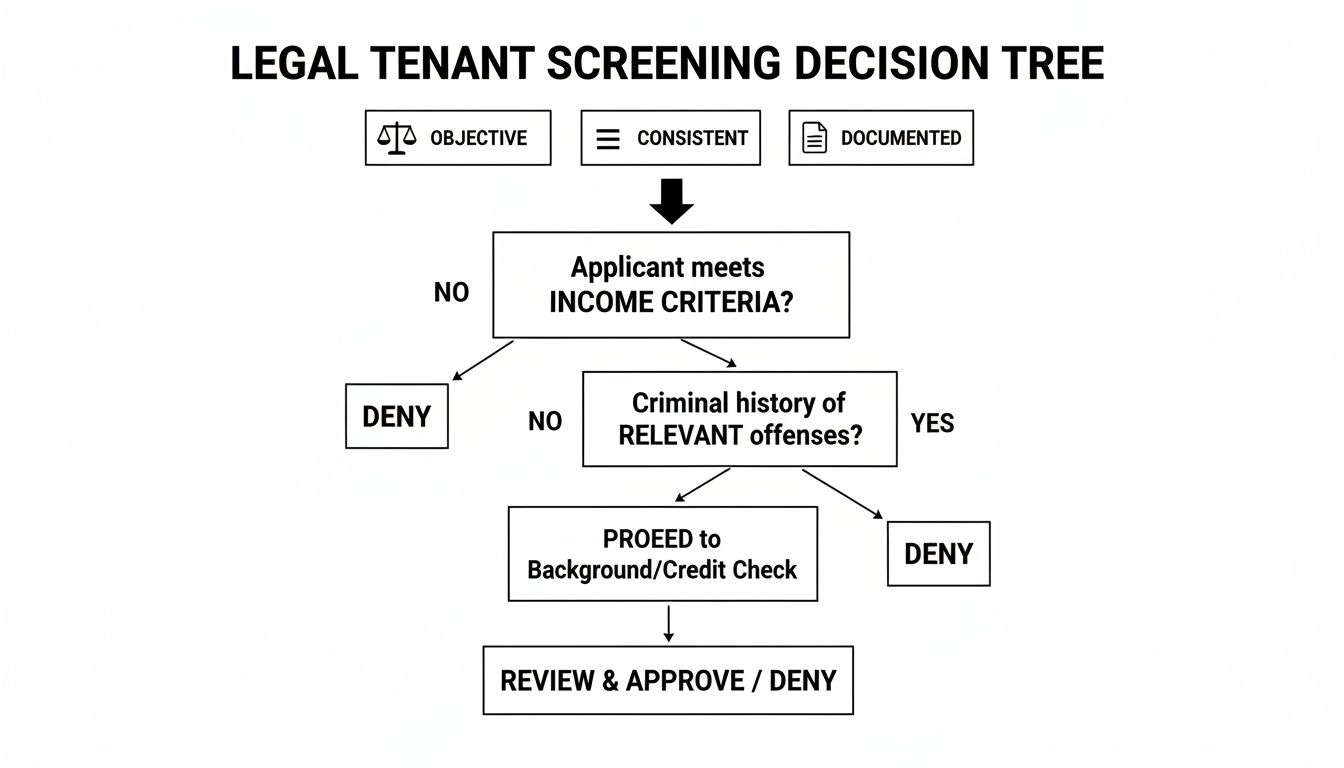
Ultimately, every decision needs to be objective, consistent across all applicants, and well-documented.
Notifying Your Applicants
Once you've made your pick, how you communicate that decision is just as important as the decision itself. Professionalism is non-negotiable.
The Approved Tenant: Give them a call first to share the good news. People appreciate a personal touch. Immediately follow up that call with an official acceptance email. This message should clearly lay out the next steps: lease signing details, deadlines for the security deposit and first month's rent, and logistics for the move-in day.
The Other Applicants: It's crucial to notify everyone else promptly and respectfully. If you deny an applicant based on information from their credit or background report, the law requires you to send them an adverse action notice. This formal letter must explain the reason for the denial and include the name and contact information of the screening company that provided the report.
A clear, compliant process for accepting and declining applicants doesn't just protect you legally; it builds your reputation as a fair and professional landlord. It’s the final, critical piece of the puzzle.
Tenant Screening Questions Answered
If you're new to being a landlord, the tenant screening process can feel a little overwhelming. Let's walk through a few of the questions I hear most often from property owners just starting out.
How Long Does Tenant Screening Usually Take?
You should plan for the entire screening process to take anywhere from 24 to 72 hours. While you can get credit and background reports back almost instantly through most online services, the real work is what takes time.
The most common hold-up is getting in touch with previous landlords and current employers. People are busy, and you might have to leave a few messages. Don't rush this part. A couple of extra days of due diligence now can save you from a year-long tenant nightmare. I always make it a point to tell applicants my timeline upfront so they know what to expect.
Can I Charge an Application Fee?
Absolutely, and you definitely should. Just be aware that many states and cities have specific laws about how much you can charge and what it can cover. You'll need to look up your local regulations before setting a fee.
The idea is to cover your out-of-pocket costs for running the background and credit checks, not to make money off of applicants. A good rule of thumb is to keep the fee reasonable and directly tied to your actual expenses. Some states even require the fee to be refundable if the applicant is denied before you run any checks.
My Advice: Think of the application fee as cost recovery, not profit. It’s a good habit to keep receipts for your screening service expenses to justify the amount if you ever need to.
What Are the Biggest Red Flags on an Application?
After screening hundreds of applications, you start to see patterns. Some red flags are glaringly obvious, but others are more subtle.
Here’s what I always look out for:
Gaps and Gibberish: If there are missing chunks of time in their rental history or the information just doesn't add up, I start asking more questions.
"No Thanks" to a Background Check: An applicant who balks at signing the consent form is a hard pass. No exceptions.
Fishy References: A previous landlord who sounds a little too enthusiastic or vague might just be the applicant's buddy on the other end of the line. I try to ask specific questions that only a real landlord would know.
The Big Rush: Anyone pressuring you to skip steps or make a decision immediately is usually trying to hide something. A good tenant will understand and respect a thorough process.
At the end of the day, you have to trust your gut. If a conversation or an application just feels off, it’s worth digging a little deeper before handing over the keys to your property.
A solid screening process is your single best defense for protecting your investment. At Keshman Property Management, we've refined our process over 20 years to ensure our clients get reliable tenants without the stress. See how we can make your life easier at https://mypropertymanaged.com.


Comments