
A Landlord's Guide to Handling Late Payment for Rent
- Sarah Porter

- Jan 5
- 13 min read
Updated: Jan 8
Dealing with late rent is just part of the game when you're a landlord. It's bound to happen, but it doesn't have to throw your entire operation into chaos. The key is to stop reacting to late payments and start getting ahead of them. A solid, proactive plan built on a clear lease, consistent communication, and a defined legal process is your best defense.
This approach takes a stressful, often personal, situation and turns it into a manageable business task. It’s all about protecting your investment and keeping your cash flow steady.
Your Proactive Plan for Late Rent Payments

It's easy to get frustrated when a tenant misses their rent due date. I've been there. But from years of experience, I can tell you that viewing late rent through a systematic lens is far more effective. The single most important thing you can do is have a predefined process that you follow every single time, no exceptions. This consistency takes the emotion out of it and ensures you treat every tenant fairly and, just as importantly, legally.
Late payments have become a bigger issue for landlords across the country. According to the Consumer Financial Protection Bureau, the percentage of renters getting hit with a late fee jumped from 15.4% at the end of 2021 to a high of 23% in early 2023. You can read more about these rental housing delinquency trends to see why having a strategy is so critical.
Laying the Groundwork for Success
A winning strategy doesn't start when a payment is already late. It starts the moment you sign the lease. The foundation is built right into your lease agreement and reinforced during the tenant onboarding process. Your goal is to create a clear framework that encourages on-time payments while giving you an enforceable path to follow when they're missed.
This guide is that framework. We’re going to move past just sending simple reminders and get into the real-world strategies that minimize conflict and, most importantly, secure your income.
Here’s what you’ll learn:
Establish a Bulletproof Policy: How to write lease clauses that clearly outline due dates, grace periods, and late fees that comply with state and local laws.
Communicate Effectively: Using professional scripts and templates to open a dialogue with your tenant without immediately escalating the tension.
Execute Legal Steps Correctly: Knowing exactly when and how to serve formal notices, like a Pay or Quit notice, to protect your rights.
Document Everything: Why creating a detailed log of every email, call, and notice is crucial evidence if you end up in court.
Having a robust system doesn't just protect your investment; it makes your life as a landlord a whole lot easier. For more ideas on how to improve your process, you can explore our guide on rental collection services designed to streamline payments for landlords.
To give you a high-level view, here's a look at the key stages you'll follow.
Key Stages of Managing Late Rent
Stage | Action | Key Objective |
|---|---|---|
Grace Period | Monitor payment status after the due date. | Allow a few days for payment processing before taking action. |
Initial Contact | Send a friendly, informal reminder (email or text). | Open communication and prompt the tenant to pay or explain their situation. |
Apply Late Fee | Add the legally-stipulated late fee to the tenant's balance. | Enforce the lease terms and compensate for the administrative hassle. |
Serve Formal Notice | Deliver a formal "Pay or Quit" or similar legal notice. | Officially start the legal clock and inform the tenant of potential eviction. |
Follow-Up | Make a final attempt to communicate and secure payment. | Offer a last chance to resolve the issue before escalating to eviction. |
Legal Action | File for eviction with the court if rent remains unpaid. | Regain possession of your property through the legal eviction process. |
Following these stages systematically provides a clear and defensible trail of action, ensuring you handle every late rent situation professionally and effectively.
Crafting an Ironclad Late Rent Policy in Your Lease
When it comes to late rent, your lease agreement is your best friend—or your worst enemy. A vague policy creates confusion and opens the door to disputes, while a strong, clear policy sets expectations from the very beginning and gives you a legal framework to stand on.
Think of it as the foundation for your entire rent collection strategy. If that foundation is shaky, everything else, from sending a simple reminder to filing a formal notice, becomes a struggle. Your lease is where you lay down the rules of the game so there are no surprises for anyone.
The key is to remove all guesswork. Don't just say rent is due "at the beginning of the month." Be specific: state that rent is due "on the 1st day of each month." This single, clear date is the starting point for everything that follows.
Defining Your Grace Period and Late Fees
Most experienced landlords offer a grace period—a few days after the due date when a tenant can pay up without any penalty. While it’s not always legally required, it’s a standard practice that builds goodwill. Just be sure to spell it out in the lease. For example: "Rent is due on the 1st, but a late fee will only be charged if payment is not received by 5:00 PM on the 4th of the month."
Now, let's talk about late fees. You have to be careful here. A late fee is meant to cover the actual hassle and costs you face because of the delay; it's not a way to punish the tenant.
A good rule of thumb is to set the late fee around 5% of the total monthly rent. If you charge an outrageous amount, a judge could throw it out and invalidate that part of your lease. Always double-check your local and state laws on this.
Your lease needs to clearly outline:
The exact late fee: Specify if it's a flat amount (e.g., "$75") or a percentage ("5% of the monthly rent").
When it kicks in: For instance, "on the 5th day of the month."
How it's applied: A one-time charge is usually simpler and legally safer than a fee that compounds daily.
Put It All in Writing
Every single detail about payments belongs in the lease. This includes what payment methods you accept and any penalties for things like bounced checks. In California, for example, the law allows you to charge a service fee of up to $25 for the first bounced check and $35 for any after that.
When these terms are documented, a potential argument becomes a straightforward contractual issue. And as you manage your properties over time, remember that leases evolve. A helpful landlord's guide to lease renewals can be a great resource for keeping your policies up-to-date.
Ultimately, a well-written lease protects everyone involved by making sure there are no gray areas. To get a head start, you can download our rental lease agreement template and use it as a solid base for your own agreement.
The First 72 Hours: Your Game Plan for Late Rent
The moment your grace period ends and rent is officially late, the clock starts ticking. What you do in the next three days is absolutely critical. It sets the tone for how the situation will be resolved, protects your legal standing, and can often mean the difference between getting paid and starting a lengthy eviction process.
Let's be clear: a late payment isn't always a five-alarm fire. Life happens. A tenant might have honestly forgotten, a bank transfer could be stuck in processing, or the check is literally in the mail. That's why your first move should be calm and methodical, not aggressive. The goal is to enforce the lease while keeping a positive landlord-tenant relationship intact.
Day 1: The Gentle Nudge
On the very first day rent is officially late, it's time to reach out. This isn't about making demands or threats; it's a simple, professional inquiry.
I've found that a friendly email or a quick text message is the best way to start. It feels less confrontational than a phone call and, just as importantly, it immediately creates a paper trail. You want this first touchpoint to be a simple, non-accusatory reminder.
Here’s a template I've used that works well:
Subject: Quick Reminder: Rent for 123 Main Street Hi [Tenant's Name], Hope you're doing well. Just a friendly heads-up that we haven't received your rent payment for 123 Main Street, which was due on the 1st. As a reminder, the lease mentions a late fee will be applied after [End of Grace Period Date]. If you've already sent it, please let me know. If you're running into any issues, please reach out so we can talk. Thanks, [Your Name]
This script is effective because it’s polite but firm. It clearly references the lease and opens the door for the tenant to communicate if there's a problem, all without escalating the situation right out of the gate.
Document Everything. No, Really—Everything.
From that very first email, you need to switch into documentation mode. It might feel like overkill for a simple reminder, but this habit will be your best friend if things go south.
I recommend keeping a simple communication log for each property. For every interaction, jot down:
Date and Time: When did you send the text or make the call?
Method: Was it an email, text, phone call, or in-person chat?
Summary: A quick note like, "Sent initial late rent reminder via email."
Response: Did they reply? When? What did they say?
This detailed log is more than just good record-keeping; it’s your evidence. If you ever have to serve a legal notice or, worst-case scenario, go to court, this file demonstrates you acted fairly, consistently, and in good faith to resolve the problem.
If you don't hear back from your initial message within 24 hours, it's time to pick up the phone. A direct call can often cut through the noise when a text or email gets ignored. Keep the same calm, professional tone. If it goes to voicemail, leave a brief message and—you guessed it—document the attempt in your log. This blend of a human touch with disciplined business practice is the secret to navigating late rent effectively.
Using a Pay or Quit Notice Correctly
When the friendly reminders and follow-up calls have gone nowhere, it’s time to shift gears. You're moving from a customer service issue to a formal legal process, and that begins with a Pay or Quit Notice.
This document is more than just a sternly worded letter; it's the official, legally required first step you must take before you can file for eviction over non-payment of rent. Getting this step right is non-negotiable.
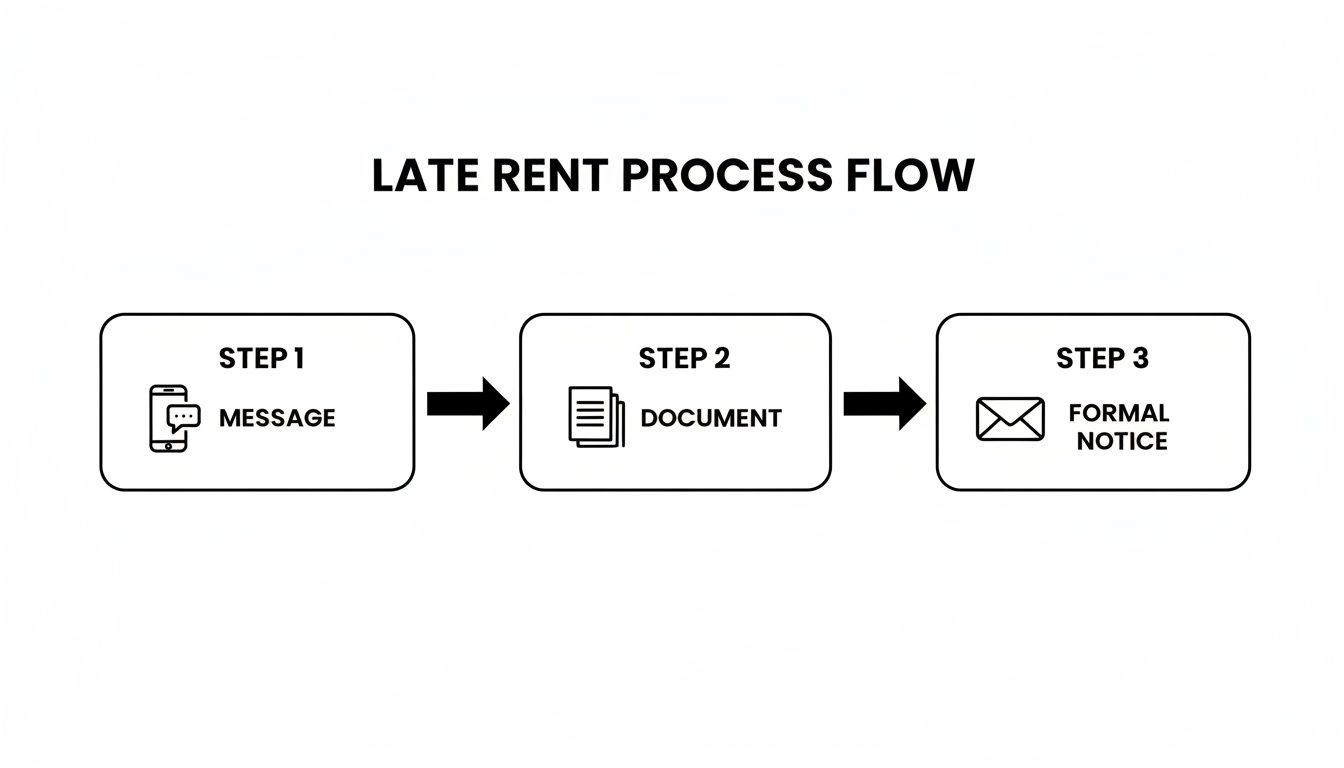
This process shows the natural escalation from a simple message to a formal notice. Documentation is the critical bridge that ensures you have a solid record every step of the way.
Even simple mistakes—like miscalculating the amount owed or delivering the notice improperly—can get your entire eviction case thrown out of court. If that happens, you’re back to square one, losing more time and money. Think of this as a critical legal move that requires precision to protect your rights as a landlord.
What Must Be Included in the Notice
For a Pay or Quit Notice to be legally sound, it has to be crystal clear and contain very specific information. Ambiguity is your worst enemy here, as even a small omission can render the whole thing invalid.
Here’s what your notice absolutely must include:
The Tenant's Full Name: Make sure you list every adult tenant who is on the lease agreement.
The Property Address: Be specific. Include the full street address and the unit number.
The Exact Rent Owed: This is a big one. Only include past-due rent. Do not add late fees, utility bills, or any other charges. Lumping everything together is a common mistake that can invalidate your notice in many states.
A Firm Payment Deadline: Clearly state the exact date the tenant must pay by. This timeline (whether it’s 3 days, 5 days, or 10 days) is dictated by your state and local laws. Be sure you calculate it correctly, excluding weekends and holidays if your jurisdiction requires it.
A Clear Statement: The notice needs to explicitly state that the tenant must either pay the full amount of rent owed or vacate (quit) the property by the deadline.
Your Contact Information: Include your name, address, and phone number, plus clear instructions on how and where they can deliver the payment.
Pro Tip from the Trenches: Before you ever need to send one, find a state-specific template from a reputable source like your local apartment association or a legal forms website. The laws on this vary so dramatically from one place to another that a generic online form is a recipe for disaster.
Delivering the Notice the Right Way
How you deliver the notice is just as important as what's written on it. You can't just text a picture of it or slide it into the mailbox and call it a day. State laws are very particular about proper service.
While you should always check your local regulations, acceptable delivery methods usually include:
Personal Service: Handing the notice directly to the tenant.
Substituted Service: Leaving the notice with another adult at the property and mailing a copy.
Posting and Mailing: Taping the notice securely to the tenant's front door in a visible spot and mailing a copy. This is often the go-to method when you can't find the tenant at home.
Once the notice is served, your job isn't done. You must immediately fill out a Proof of Service document. This is a simple form you sign that details the date, time, and method of delivery. It becomes your evidence in court that you followed the law. Without it, a tenant could simply claim they never received the notice, which could derail your entire case.
Staying on top of this formal process is more critical than ever. In the 'mom-and-pop' rental sector, the moving average for late payments recently climbed from 8.4% to 12.5% in mid-2025. You can dig into more data on independent landlord rental performance to see why mastering these legal steps is so vital for protecting your investment.
Knowing When to Escalate to Eviction
Deciding to evict a tenant is probably the hardest call you'll have to make as a landlord. It's an emotionally draining, time-consuming, and often expensive process. That’s why it should always be your absolute last resort.
But after you’ve sent the friendly reminders and served a formal Pay or Quit Notice, you need to be ready to switch gears. It's time to make a logical business decision based on the facts, not your feelings. This isn't about being heartless; it's about protecting your investment from spiraling losses.
Recognizing the Red Flags
So, how do you know when you’ve reached the point of no return? From my experience, certain patterns of behavior are dead giveaways that the situation isn't going to fix itself. If you've been documenting everything, these signs will make your decision much clearer.
Keep an eye out for these tell-tale signs:
A Pattern of Broken Promises: The tenant constantly agrees to a payment plan—often with a compelling story—but never actually follows through.
Complete Communication Breakdown: They’ve gone dark. Your calls, texts, and emails are met with total silence.
Chronic Late Payments: This isn't their first rodeo. A history of late rent often points to persistent financial instability that isn't likely to improve overnight.
These red flags are usually symptoms of a much bigger problem. Rent delinquencies often signal ongoing financial strain, and you can’t carry that burden for them. The longer you wait, the harder it becomes to recover what you're owed.
The decision to evict should be a data-driven one. Pull up your communication logs, payment records, and the tenant's history. If the evidence shows a clear pattern of non-compliance, it’s time to act decisively.
Exploring Alternatives to Formal Eviction
Before you start dialing your lawyer and heading to the courthouse, there's one last option that can save everyone a ton of grief: a "cash for keys" agreement.
Here’s how it works: you offer the tenant a lump sum of cash to voluntarily move out by a specific date, leaving the property in good shape. It might sound completely backward—paying someone who already owes you money—but it’s often the most pragmatic financial move.
Think about it. A formal eviction can drag on for months and cost thousands in legal fees, court costs, and lost rent. A cash for keys deal, on the other hand, can get you possession of your property back in a matter of days for a fraction of that cost. It's a clean break.
Of course, navigating the legal maze of eviction is no small feat; sometimes it helps to see how professionals approach it by reviewing a case study of a law firm's website. If you do decide to move forward with a formal eviction, you absolutely must follow the law to the letter. For a step-by-step breakdown, check out our landlord's guide on how to evict a tenant legally.
Answering Your Questions About Late Rent
Navigating late rent can feel like walking a tightrope. Even with a rock-solid lease agreement, tricky situations always come up that leave you second-guessing the right move. Let's tackle some of the most common questions landlords ask, drawing from real-world experience.
These aren't just hypotheticals. They're the day-to-day challenges that can make or break your relationship with a tenant and, ultimately, your bottom line. Getting them right is essential.
Can I Charge a Daily Late Fee for Rent?
I get this question all the time, and the answer is almost always a hard no. It really depends on your state and local laws, but many jurisdictions see daily or compounding late fees as excessive penalties, not as fair compensation for the hassle. They just don't hold up in court.
Most areas cap late fees at a reasonable percentage of the rent—often around 5%—or a simple flat dollar amount. If you charge an improper fee, especially a daily one, you could not only lose the right to collect it but also find yourself in legal trouble. It's just not worth the risk.
The safest, most legally sound approach is to stick with a one-time, reasonable flat fee that’s spelled out clearly in your lease. Before you do anything, double-check your local landlord-tenant laws.
What Should I Do If a Tenant Offers Partial Payment?
Accepting partial rent is a major judgment call, and it's loaded with legal traps. Here's the critical thing to understand: in many states, if you accept any money after serving a "Pay or Quit" notice, you've legally nullified that notice. This can reset the entire eviction clock, forcing you to start from square one.
So, what do you do? Before you even think about taking a partial payment, have the tenant sign an "Agreement for Partial Payment." It’s a simple document, but it's your shield. It must state:
The total rent currently owed.
The partial amount they are paying now.
The exact date the rest of the balance is due.
A crystal-clear acknowledgment that by accepting this payment, you are not waiving your right to evict if they miss the new deadline.
This protects your legal position while still letting you get some of the money you're owed. It’s a win-win.
How Should a Tenant's Payment History Affect My Actions?
Context is everything. You absolutely should let a tenant’s payment history guide your response. Treating a five-year tenant who’s late for the first time ever the same as someone who is late every other month is just bad business.
For that great, long-term tenant who calls you to say they'll be a day late? A gentle reminder and a little grace can go a long way toward keeping a fantastic relationship intact. But for the tenant with a track record of late payments and broken promises? You have to be firm and follow your lease to the letter. Send the formal notices immediately and be ready to escalate. Your policy provides the foundation, but applying it with wisdom is the key.
Managing late rent effectively is one of the pillars of successful property ownership. At Keshman Property Management, we've seen it all and handle these challenges with the professionalism and expertise that protects your investment. If you’re done with the stress of chasing down rent, let our 20 years of experience go to work for you. Find out more about our comprehensive property management services.


Comments