
How Landlords Can Legally Break a Lease in Florida
- Sarah Porter

- Feb 2
- 16 min read
Updated: Feb 14
When a tenant wants to break a lease in Florida, it can throw a serious wrench in your plans, affecting both your cash flow and your workload. While a lease is a solid legal contract, Florida law does carve out specific situations where a tenant can legally walk away early. As a property owner, your job is to understand this complex landscape so you can tell the difference between a tenant who is just up and leaving and one who has a legally protected right to do so.
The Landlord's Perspective on Early Lease Termination

From a landlord's point of view, a tenant breaking their lease triggers a cascade of financial and operational hurdles. This isn't just about an empty unit; it's about real, tangible costs that hit your bottom line. Knowing exactly what these immediate effects are helps clarify why having a firm grasp of the Florida Statutes is your best tool for avoiding unnecessary losses.
The second a tenant leaves, you’re losing rental income. Every single day that property sits vacant is money you’ll never get back. On top of that, you're hit with a list of turnover expenses that can add up faster than you think.
Immediate Financial Impacts
A premature vacancy means you're immediately on the hook for several direct costs. These aren't just hypotheticals—they are real expenses that can quickly eat into your profits.
Marketing and Advertising: You've got to get the property listed again, maybe run some ads, and invest your time showing the unit to new prospects.
Turnover and Maintenance: Think about professional cleaning, a fresh coat of paint, and any minor repairs needed to get the property rent-ready for the next person.
Screening Costs: Don't forget the cost of running background and credit checks on every new applicant.
These costs are exactly why you can't just let a tenant break a lease without following the proper procedures. It’s simply not a sustainable way to run a rental business.
The real problem isn't just that the tenant is gone. It's the unexpected hit to your cash flow and the sudden pile of work needed to find and screen a new, qualified renter. Having a clear, established process is absolutely essential.
Legal Distinctions You Must Know
It’s incredibly important to know the difference between a tenant legally breaking their lease and one who is simply abandoning the property. Abandonment is a breach of contract, which means the tenant is on the hook for rent until you can find a new one. A legally justified termination, on the other hand, releases them from that responsibility.
This distinction has huge legal and financial implications. For context, it can be helpful to see how tenants in other states handle this; for example, this guide covers how to get out of a lease from a tenant's viewpoint.
Understanding the difference dictates every move you make. If a tenant breaks the lease improperly, your response and legal remedies are completely different than if they are acting within their rights. For a deeper look at the proper way to remove a tenant, you might find our guide on https://www.mypropertymanaged.com/post/a-landlord-s-guide-on-how-to-evict-a-tenant-legally helpful. This knowledge is the foundation for handling the situation correctly from the very start.
When a Tenant Can Legally Break a Lease in Florida

While a lease is a solid contract, it’s not unbreakable. Florida law carves out specific situations where a tenant has the legal right to walk away without penalty. As a landlord, knowing these rules inside and out is crucial. Mistaking a legitimate lease termination for an illegal abandonment can land you in hot water and lead to costly legal mistakes.
Getting a handle on these valid reasons isn't just about compliance; it's about managing your property effectively when a tenant needs to move on for a legally protected reason. Let’s break down what those reasons are.
Active Military Duty
This is probably the most straightforward exception, protected at the federal level by the Servicemembers Civil Relief Act (SCRA). This law is specifically designed to prevent military members from being unfairly burdened by contracts, like leases, when their service demands they relocate.
A tenant can end their lease under the SCRA if they are a member of the armed forces (or National Guard, Public Health Service, or NOAA) and either:
Receive orders for a permanent change of station (PCS).
Are deployed to a new location for 90 days or more.
To do this properly, the tenant has to give you a written notice along with a copy of their official military orders. The lease doesn't end immediately, though. The termination takes effect 30 days after the next rent payment is due. So, if their rent is due on the 1st and they give you notice on September 15th, the lease officially ends on October 31st. They’re still on the hook for October's rent.
The Unit Becomes Uninhabitable
Here in Florida, landlords have a duty to provide a safe and habitable home. If a property deteriorates to the point where it's no longer livable, a tenant may have grounds for what's called "constructive eviction."
This isn't for minor issues like a leaky faucet or a squeaky door. We're talking about serious problems that fundamentally make the unit unsafe or unhealthy.
What counts as uninhabitable? Think big: * No running hot water. * A completely busted HVAC system (a massive issue in our Florida heat). * Major structural defects, like a collapsing roof or unstable floors. * A severe pest infestation (like rats or roaches) that you, the landlord, have failed to handle.
It’s not as simple as the tenant just packing up and leaving. First, they must give you a formal written notice describing the problem. Florida law then gives you a reasonable opportunity to fix it. Only after you’ve failed to make the necessary repairs can they legally terminate the lease. While it’s a valid defense, keep in mind that tenants only successfully argue constructive eviction in about 10-15% of cases. You can find more details in our deep dive into Florida's landlord-tenant laws.
Landlord Harassment or Violating Privacy
Every tenant has a legal right to "quiet enjoyment" of their home. This basically means you can't show up whenever you want or otherwise interfere with their ability to live in peace. If you repeatedly violate their privacy or harass them, they can use it as grounds to break the lease.
Under Florida Statute § 83.53, you’re required to give at least 24 hours' notice before entering a tenant’s unit for things like inspections or repairs, and you have to come at a reasonable time.
If a landlord just keeps showing up unannounced, or worse, does things like changing the locks or shutting off the power, it crosses the line into harassment. For a tenant to break the lease on these grounds, they need to have documented every incident and sent you a written notice demanding the behavior stop. If it continues, they may have a case.
It’s easy for misunderstandings to pop up, so it's helpful to see a clear breakdown of what flies in court and what doesn't.
Valid vs Invalid Reasons for Lease Termination in Florida
Here's a quick comparison to help you distinguish between a legitimate reason for a tenant to break their lease and a common excuse that won't hold up legally.
Reason Given by Tenant | Legally Justified in Florida? | Landlord Considerations |
|---|---|---|
Military PCS or deployment orders | Yes (under SCRA) | Must receive written notice and copy of orders. |
The unit has no heat or A/C | Yes (Constructive Eviction) | Only if you fail to repair after proper written notice. |
Job relocation for a civilian job | No | Tenant remains liable for rent unless a lease-break clause exists. |
Buying a house | No | This is a personal financial decision, not a legal justification. |
Landlord enters without notice | Yes (if repeated) | Tenant must document violations and provide a notice to cure. |
Noise from neighbors | No | This is typically a matter to be resolved through property management or a nuisance complaint. |
Understanding these distinctions is key. Personal life changes for the tenant—like getting a new job, buying a home, or breaking up with a partner—are generally not legal grounds to break a contract. The exceptions are very specific and tied directly to military service, the habitability of the unit, or your actions as a landlord.
Calculating a Tenant's Financial Responsibility
When a tenant breaks a lease in Florida without a legally justified reason, they haven’t just walked away from a property—they’ve breached a contract. This means they’re still on the hook financially, but figuring out the exact amount you can recover isn't as simple as demanding the rest of the rent. You have to follow Florida law to the letter to make sure your claim holds up.
The whole process is governed by Florida Statute § 83.595, which gives landlords two main paths to take after an early termination. It’s absolutely critical that your lease agreement clearly spells out which path applies. A vague or poorly written clause here could be thrown out, leaving you with far fewer options to recover what you've lost.
Understanding Your Recovery Options
You have two main avenues for financial recovery: collecting a pre-set fee or going the traditional route of collecting rent until you find a new tenant. The choice between them dramatically changes what the tenant owes.
Liquidated Damages or Early Termination Fee: This is often the cleanest and most straightforward option. Your lease can include a clause letting the tenant pay a fixed amount—usually no more than two months' rent—to be completely released from the lease. The tenant has to agree to this in writing, but it creates a predictable and final outcome for everyone involved.
Default Remedy (Rent Owed Until Re-Rented): If your lease doesn't have an early termination fee, or if the tenant rejects that option, you fall back to the standard remedy. Here, the tenant is technically liable for all rent due for the rest of the lease. But this comes with a huge catch.
That catch is your duty to mitigate damages. You can't just let the property sit empty for six months and then send the former tenant a massive bill. Florida law requires you to make a reasonable, good-faith effort to re-rent the unit as quickly as you can. This means actively marketing the property, showing it, and accepting a qualified applicant.
The Landlord's Duty to Mitigate Damages
The moment your tenant vacates, the clock starts on your responsibility to find a replacement. Your efforts should look exactly like they would for any other vacancy.
This means you need to be:
Listing the property on the MLS, Zillow, and other relevant rental sites.
Placing a "For Rent" sign in the yard.
Responding promptly to every inquiry from potential renters.
Screening new applicants in a timely manner.
You absolutely must keep detailed records of everything you do. Save copies of your rental ads, screenshots of listings, emails with prospects, and notes from phone calls. This paper trail is your proof that you fulfilled your legal duty and is essential if you need to justify the amount of lost rent you’re trying to collect.
Breaking a lease can expose tenants to significant financial risk, including potential double rent liability in certain circuits as outlined in Florida Statutes §83.595. Even so, landlords typically recover only 70-80% of their potential losses because of their duty to re-rent the property. For more insights into market trends, check out the latest Florida rental market report.
Putting It All Together: A Real-World Scenario
Let's walk through a practical example. A tenant signs a 12-month lease for $2,000 per month. After just six months, they need to leave for a reason not covered by Florida law, leaving six months on their agreement.
Here’s how the math works under the "duty to mitigate" model:
Initial Vacancy: The tenant moves out, and the unit is now empty.
Landlord's Action: You immediately get to work. You have the unit professionally cleaned, you list it online, and you start showing it to prospective tenants. You spend $200 on advertising fees.
Finding a New Tenant: After two full months of diligent searching, you find a qualified new tenant who signs a lease at the same $2,000/month rate.
Calculating What the Original Tenant Owes: * Lost Rent: 2 months x $2,000/month = $4,000 * Advertising Costs: $200 * Total Owed by Original Tenant: $4,200
In this situation, the original tenant is not liable for the full $12,000 left on their lease. Their financial responsibility is limited to the actual damages you suffered while the unit was vacant. This can also include any partial months of rent, a topic we cover in our guide to calculating prorated rent. When you calculate these figures correctly and keep meticulous records, you can confidently and legally recover your losses.
Your Protocol for Handling a Lease Break Request
When a tenant tells you they need to break their lease, it's easy to feel a jolt of panic. But it doesn't have to be a crisis. Having a clear, established protocol turns a potentially chaotic situation into a manageable business process. This isn't just about damage control; it's about protecting yourself legally, setting clear expectations, and getting a new, qualified tenant in the door as quickly as possible.
The very first thing you should do—before you even reply to their email—is pull out the signed lease agreement. That document is your roadmap. Look for any clauses that mention early termination, liquidated damages, or specific notice requirements. This isn't just a friendly suggestion; it's the critical first step that anchors your entire response in the legal contract you both agreed to.
After you've reviewed the lease, your next move is to communicate with the tenant in writing. Acknowledge their request and clearly lay out their options based on the lease terms and Florida law. This simple act of putting everything in writing prevents so many misunderstandings and creates a paper trail that can be a lifesaver later on.
Providing Legal Options in Writing
Your written response should be professional and informative, never confrontational. The goal is to present their legal paths forward, not to start a fight.
Most of the time, their options will boil down to one of these:
The Early Termination/Liquidated Damages Clause: If your lease includes this, spell it out. Explain the fixed fee they must pay (usually one to two months' rent) to be completely released from the lease. It's a clean break for both of you.
The Default Remedy: If your lease doesn't have a termination clause, or if they reject it, explain their other obligation. They are responsible for paying rent until you find a new tenant, plus any reasonable costs you incur, like advertising. You absolutely must also inform them of your legal duty to mitigate damages by actively trying to re-rent the property.
Mutual Termination Agreement: Sometimes, a custom solution makes sense. You might negotiate a deal where they forfeit their security deposit in exchange for being let out of the lease. This is completely at your discretion and should be handled with a formal agreement.
Presenting these choices clearly and calmly empowers the tenant to make an informed decision, which usually results in a much smoother, more cooperative exit.
Document Every Single Interaction
I can't stress this enough: from the moment a tenant mentions breaking their lease, documentation is your best friend. Start a log. Record the date, time, and a quick summary of every phone call, text, and email. This meticulous record-keeping is invaluable if a dispute ever pops up over unpaid rent or the security deposit.
A well-documented lease break is a defensible one. When every conversation, expense, and decision is recorded, you remove ambiguity and protect your business from "he said, she said" arguments down the line. It transforms a messy situation into a clear, factual timeline.
Once the tenant decides which option they're taking—let's say they agree to pay the early termination fee—you need to get it in writing. This is where a Lease Break Agreement comes into play.
Formalizing the Departure with a Lease Break Agreement
A Lease Break Agreement is a straightforward but powerful addendum to the original lease. It confirms the terms of the early departure, making sure everyone is on the same page and heading off future arguments.
Your agreement should clearly state:
The Move-Out Date: The specific date the tenant will officially hand over the keys.
Final Payments: The exact amount due (the termination fee or other agreed-upon sum) and the deadline for payment.
Property Condition: A quick reminder that the unit must be returned in the condition spelled out in the original lease, accounting for normal wear and tear.
Security Deposit Handling: A statement clarifying how and when their security deposit will be handled according to Florida statutes.
Release of Liability: A clause confirming that once they've met these terms, they are released from all future rent obligations.
This flowchart shows how to calculate what a tenant might owe if they go the default route instead of paying a fixed fee.
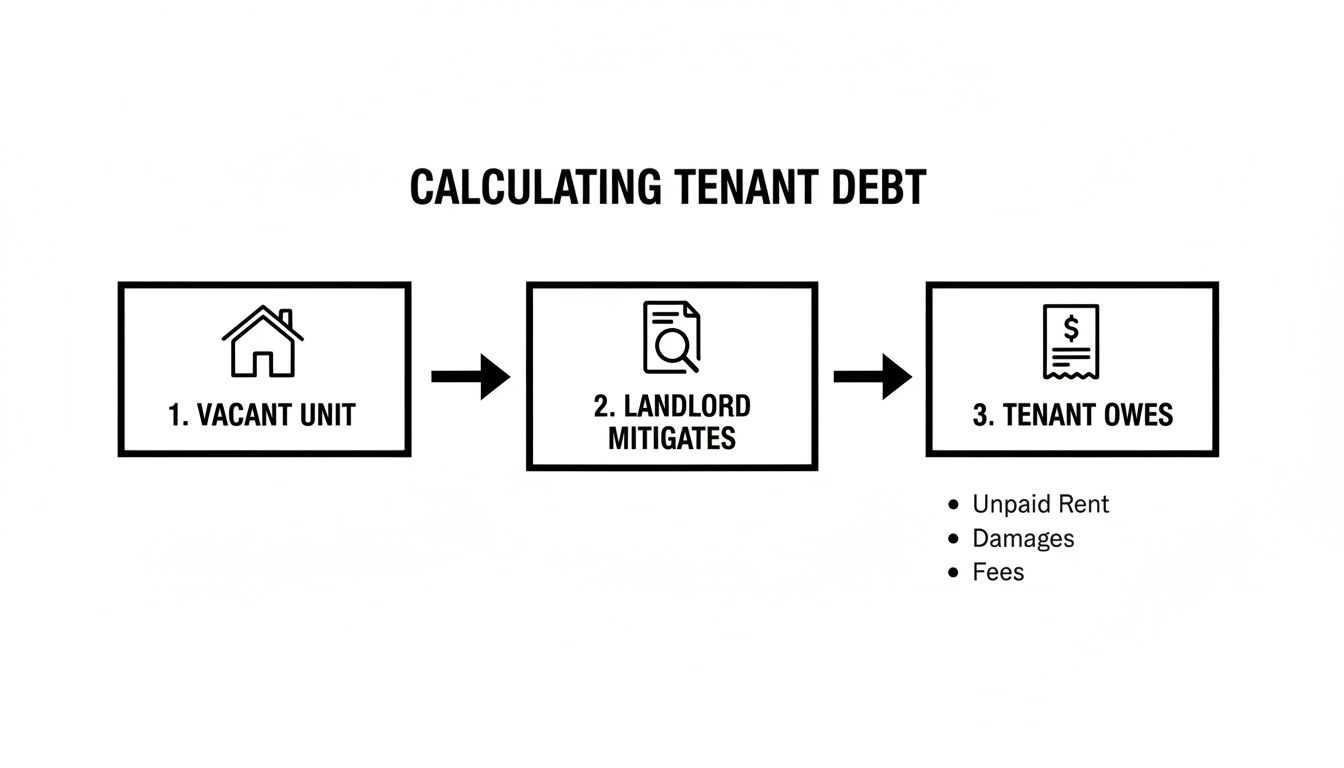
As you can see, their financial responsibility is directly tied to how long the property stays vacant while you're actively trying to fill it.
Following a structured process like this not only protects you financially but also keeps the interaction professional, even when a tenancy ends unexpectedly. To help your tenant with a smooth exit, you might consider sharing a helpful resource like a moving out of rental checklist. And if you ever find yourself on the other side of this situation, you can learn more about the formal process from our article on https://www.mypropertymanaged.com/post/what-is-a-notice-to-vacate-a-landlord-s-essential-guide.
Proactive Strategies to Reduce Tenant Turnover
The best way to handle a tenant breaking their lease in Florida is to stop it from happening in the first place. Of course, you can't control life events like a job relocation or a family emergency, but you absolutely can build a rental business that encourages tenants to stay put.
Taking a proactive approach isn't just about avoiding headaches; it saves you thousands in turnover costs and countless hours of work. It all starts with who you let in the door.
Building a Foundation with Rigorous Tenant Screening
A flimsy screening process is an open invitation for future problems. You have to go deeper than a basic credit check to get a true picture of an applicant's reliability and financial health.
I can't stress this enough: a thorough screening is non-negotiable.
Verify Income Stability: Don't just glance at one pay stub. Ask for several months' worth to see a consistent employment history. A good rule of thumb is an income that's at least three times the monthly rent.
Check Rental History: Always call their last two landlords. Ask pointed questions: Did they pay on time, every time? How did they maintain the property? Did they give proper notice before moving out?
Conduct a Full Background Check: This means running a national criminal background check and looking for any prior evictions. An applicant with a history of evictions is a massive red flag.
This deep dive helps you weed out applicants who are statistically more likely to run into financial trouble or have a pattern of jumping from one lease to another. It sets the stage for a stable, long-term tenancy from day one.
Fostering Loyalty Through Proactive Communication
Once you've found a great tenant, your job is to keep them. The secret is building a solid, professional relationship based on good communication and being responsive. Tenants who feel like you actually care are far less likely to start looking for an exit.
One of the biggest complaints from renters is slow maintenance. When a tenant calls about a broken AC in the middle of a brutal Florida summer, that's not something that can wait. A quick response and a professional repair show them you're serious about their comfort and the property's upkeep.
A stable rental income is built on more than just collecting checks; it's built on relationships. When tenants feel respected and know their concerns will be addressed quickly, they are more likely to renew their lease and treat your property with care.
From my experience, something as simple as a check-in email every few months makes a real difference. Just asking, "How is everything going with the property?" shows you're engaged and gives them an opening to mention small issues before they become huge frustrations.
Using Strategic Lease Renewal Incentives
In a hot rental market, a small incentive can be the deciding factor for a tenant on the fence about renewing. The cost of a simple renewal bonus is almost always a fraction of what you'd spend on a turnover.
Think about it: lost rent during vacancy, marketing the unit, cleaning, and repairs can easily add up to $1,000-$2,000 or more.
Why not offer a tangible thank-you to good tenants who renew?
A modest rent discount on the first month of the new term.
A gift card to a local restaurant.
An upgrade to a small appliance, like a new microwave or a modern ceiling fan.
These aren't expenses; they're investments in stability. For investors with condos, townhomes, and multifamily properties, high renewal rates are the ultimate sign of smart management. In markets like Orlando, for example, renewal rates can hit as high as 66%. Retaining good tenants is just good business. To learn more, you can read the full analysis on the Florida rental market.
By putting these strategies to work, you can dramatically lower the odds of ever having to navigate the messy process of a tenant breaking a lease.
Common Landlord Questions About Breaking Leases
When a tenant wants to break their lease early, it can throw a wrench in your plans. It's a situation filled with legal nuances, and frankly, it can be a real headache. I've been navigating these waters with Florida property owners for decades, so let's walk through some of the most common questions that pop up.
What Is The First Thing I Should Do?
Before you even think about firing off a reply to your tenant, stop. Go find your signed lease agreement. That document is your playbook, and you need to read it—specifically the part about breaking the lease.
You're hunting for a clause titled "Early Termination" or "Liquidated Damages." What it says, or doesn't say, will shape your entire strategy. This isn't just a suggestion; it’s the legal foundation for every conversation and decision that comes next. Knowing your contract inside and out puts you in control.
Do I Have To Let My Tenant Sublet?
In a word, no. Florida law doesn't force you to allow subletting. The right for a tenant to bring in a sublessee has to be spelled out in the lease itself. If your lease is silent on the issue or flat-out forbids it, you hold all the cards and can deny the request.
That said, sometimes it makes good business sense. Allowing a qualified subtenant can be a win-win. Your original tenant gets out from under their obligation, and you avoid a costly vacancy. If you decide to go this route, treat the prospective subtenant like any brand-new applicant. That means running a full background and credit check—no shortcuts.
My Two Cents: You have the final say on subletting unless your lease states otherwise. It's a judgment call. Think about whether a steady rent check from a new person outweighs the hassle and risk.
What If The Tenant Just Disappears?
This is a tricky one. When a tenant vanishes without a word and the rent stops coming, it's legally considered abandonment. This is very different from a mutual agreement to terminate the lease. Your first instinct might be to change the locks and clear the place out, but that could land you in serious legal trouble.
You have to follow a specific process to legally reclaim your property. This usually involves sending formal written notices and trying to confirm that the tenant has, in fact, left for good. Telltale signs like disconnected utilities or removed belongings can support your case, but you still need to follow the letter of the law, which might mean getting a court order.
Having a clear, pre-planned procedure for handling abandoned units is crucial. It’s one of those things you hope you never need, but you’ll be glad you have it if you do.
Can I Keep The Security Deposit?
Here’s where a lot of landlords get tripped up. You can absolutely use the security deposit to cover your losses, but you can't just pocket it because the tenant broke the lease. Florida has very strict laws governing security deposits that you must follow to the letter.
Within 30 days of the tenant moving out, you are legally required to send them a written, itemized list of any deductions you're making from their deposit. This notice must be sent by certified mail. If you miss this deadline, you could lose your right to claim a single penny of it.
You can typically apply the deposit to:
Any unpaid rent that accrued before you found a new tenant.
The early termination fee, if one is outlined in your lease.
The cost to repair any damages that go beyond normal wear and tear.
Always, always document everything. Take photos, keep receipts, and be prepared to justify every deduction. Handling the security deposit correctly is your best defense against future disputes.
Managing a rental property is full of these kinds of challenges, but you don't have to navigate them on your own. At Keshman Property Management, we bring over 20 years of hands-on experience to the table, helping Florida landlords protect their investments through tricky situations like lease breaks. Learn how our expertise can make your life easier.


Comments