
Criminal Background Check for Renters A Landlord Guide
- Sarah Porter

- Nov 17, 2025
- 17 min read
Sifting through a stack of rental applications can feel like a gamble, but a solid screening process is the single best way to protect yourself from the nightmare of evictions and property damage. A consistent, fair criminal background check for renters isn't just about ticking a box for safety; it's a smart business move to reduce financial risk and build the kind of stable, respectful community every landlord wants. Let’s walk through how to screen applicants with the confidence of a seasoned pro.
Why Screening Is Your First and Best Line of Defense

As a landlord, you know your property is more than just a building—it's a massive financial investment. Protecting that investment begins long before anyone signs a lease. A thorough screening process, with a criminal background check at its core, is your most crucial line of defense. It allows you to look beyond what an applicant tells you and get a much clearer picture.
This isn't about being distrustful; it's about being a diligent business owner. The right tenant can mean years of on-time rent and a property that’s cared for. The wrong one? That can quickly spiral into thousands of dollars in legal fees, lost income, and costly repairs.
Getting Ahead of Financial and Safety Risks
The financial stakes are incredibly high right now. The economic instability of recent years has caused a shocking spike in rental application fraud. In just a six-month period during the COVID-19 pandemic, the rate of fraudulent applications property managers received doubled, jumping from 15% to 29%.
The fallout from this trend is staggering. A recent survey showed 85% of landlords reported being victims of rental fraud, a massive leap from 66% the year before. The numbers don't lie.
By taking the time to verify an applicant's history, you’re not just looking for red flags. You’re actively preventing problems like unpaid rent, property damage, and disruptive behavior that can poison your community and tank your investment.
Mastering effective prospect vetting and lead qualification is fundamental to protecting your assets. It’s what turns screening from a tedious chore into a strategic part of your business.
Building a Community, Not Just Filling a Vacancy
Your screening process echoes far beyond a single tenancy. It directly shapes the health and safety of your entire rental community. When you consistently vet every applicant using the same fair criteria, you cultivate an environment where good tenants want to stay.
This creates a ripple effect of positive outcomes:
Higher Tenant Retention: People who feel safe and secure are far more likely to renew their leases. That means less turnover, fewer vacancy days, and more money in your pocket.
A Stronger Reputation: A well-managed property filled with reliable tenants earns a great reputation, making it that much easier to attract top-tier applicants next time you have an opening.
Reduced Legal Headaches: Having a documented, fair, and consistent screening policy is your shield against potential discrimination claims and other legal challenges.
At the end of the day, a proactive screening approach isn't about finding reasons to say "no." It's about gathering the information you need to make an informed "yes." You’re selecting tenants who are most likely to be great partners in upholding their lease, which is the cornerstone of a profitable, stable rental business. This diligence is what separates landlords who thrive from those constantly putting out fires.
Staying on the Right Side of Screening Laws
Running a criminal background check on a potential tenant isn't the Wild West. It’s a process that's tightly regulated by a mix of federal, state, and even city laws. Getting this right is crucial for protecting your business from some seriously expensive lawsuits and discrimination claims. Think of these laws less as obstacles and more as the rulebook for making fair, consistent, and legally sound decisions.
The whole tenant screening industry is getting more sophisticated, and the legal scrutiny is growing right along with it. In fact, background check services are on track to become a $5.1 billion industry by 2025, largely because technology and legal requirements are pushing landlords to be more thorough. As a property owner, staying current is no longer optional—it's a fundamental part of the job. You can dig into the full industry trends and growth projections to see just how much this space is evolving.
The Fair Credit Reporting Act (FCRA)
The moment you hire a third-party service to run a background check—which is really the only smart way to do it—you're officially playing in the Fair Credit Reporting Act (FCRA) sandbox. This is the big federal law that governs how consumer reports (including background checks) are handled, ensuring everything is accurate, fair, and private.
For landlords, this boils down to a few critical, non-negotiable steps.
First, you absolutely must get written permission from the applicant before you run the report. This can't be some sentence buried in the fine print of your application. It needs to be a clear, standalone disclosure that plainly states you'll be getting a consumer report for housing purposes.
Second, you have to follow the adverse action process to the letter if you deny an applicant based on something in their report. This also applies if you ask for a larger deposit or take any other negative step. You're required to send them a formal adverse action notice.
This notice must include:
The name, address, and phone number of the screening company you used.
A clear statement that the screening company did not make the decision and can't explain why you did.
Information on the applicant's right to dispute anything they believe is inaccurate in the report.
Notice that they can request a free copy of their report from that company within 60 days.
Failing to follow the adverse action process is one of the most common and easily avoidable legal blunders landlords make. It’s a simple procedure that proves you're being transparent and giving applicants the due process they're entitled to.
When you use a third-party screening service, the FCRA puts specific legal responsibilities on your shoulders. The table below breaks down exactly what you need to do and why it matters.
Key Legal Obligations for Landlords Under FCRA
Requirement | What It Means for You | Why It's Important |
|---|---|---|
Get Written Consent | You must get explicit, written permission from the applicant on a separate form before ordering a background check. | Protects the applicant's privacy and proves you had the legal right to access their personal information. |
Use a Reputable CRA | Partner with a Consumer Reporting Agency (CRA) that is known for providing accurate and up-to-date information. | Using unreliable data can lead to unfair decisions and expose you to lawsuits for negligence. |
Provide Pre-Adverse Action | If you might deny based on the report, you must give the applicant a copy of the report and a summary of their rights before making a final decision. | This gives the applicant a chance to spot and correct any errors in the report that could unfairly disqualify them. |
Send Adverse Action Notice | If you make a final decision to deny, you must send a formal notice containing specific information about the CRA and the applicant's rights. | This is a mandatory step that ensures transparency and gives the applicant legal recourse if they feel the decision was based on inaccurate information. |
Following these FCRA guidelines isn't just about checking boxes; it’s about creating a fair and defensible screening process that protects both you and your applicants.
Navigating the Fair Housing Act and HUD Guidance
While the FCRA tells you how to get a report, the Fair Housing Act (FHA) dictates how you use the information you find, especially when it comes to criminal history. The FHA is the federal law that bans housing discrimination based on race, color, national origin, religion, sex, familial status, or disability.
So, how does a criminal check connect to these protected classes? The Department of Housing and Urban Development (HUD) has pointed out that due to long-standing disparities in the justice system, broad policies that automatically disqualify anyone with a criminal record can end up illegally discriminating against certain groups, even if that's not your intention.
This means that a blanket "no felonies, no exceptions" policy is a massive legal risk.
Instead of a hard-and-fast ban, HUD pushes for an individualized assessment. This approach forces you to look beyond the charge and consider the actual person and circumstances.
A proper assessment means weighing factors like:
The Nature and Severity: Was the crime a minor offense, or was it something that poses a real threat to the safety of your property and other residents? A conviction for writing bad checks a decade ago is worlds away from a recent conviction for arson.
The Time Passed: How long ago did this happen? An offense from 15 years ago is far less relevant than one that occurred last year. Time can and does demonstrate change.
Rehabilitative Efforts: Look for evidence the applicant has turned things around. Have they completed a treatment program, held down a steady job, or gathered positive references from a current landlord or employer?
State and Local Laws: The Final Layer of Compliance
Finally, never assume federal law is the end of the story. Many states and cities have passed their own "ban the box" or fair chance housing laws that add another layer of rules you have to follow.
These local ordinances are often much stricter than federal guidelines. They can limit when you're allowed to ask about criminal history (often not until after you've made a conditional offer) and what types of records you can even consider.
For example, places like Seattle and San Francisco have some of the toughest laws in the nation, severely restricting the use of most criminal records in housing decisions. Other jurisdictions might prevent you from considering arrests that never led to a conviction or records that have been legally sealed or expunged. Because these rules are all over the map, you simply have to do your homework and know the specific laws for the city and state where your property is located. Trust me, ignoring a local ordinance is the fastest way to find yourself in legal hot water.
Crafting Your Written Tenant Screening Policy

If you're still screening tenants based on a "gut feeling," you're taking a massive gamble. Without a formal, written policy, every decision you make is inconsistent at best and discriminatory at worst. Think of a written screening policy as your operational playbook—it guarantees every single applicant is measured by the same objective standards.
This document is your best defense in a legal dispute. It proves your decisions are based on solid business criteria, not personal feelings or biases. By setting your standards down on paper before you even meet an applicant, you build a fair, transparent process that protects your property and keeps you on the right side of the law.
Defining Your Core Rental Criteria
Before you even think about criminal histories, your policy needs to nail down the fundamentals. What are your absolute minimum requirements for income and rental history? These are the foundational pillars of your entire screening process.
Get specific and write down your standards for these key areas:
Income Requirements: The industry rule of thumb is an income-to-rent ratio of 3:1. If you use this, state it clearly: "Applicant's gross monthly income must be at least three times the monthly rent."
Credit Score Minimums: Settle on a minimum credit score you’ll accept and stick to it. You should also decide how you'll handle applicants with thin credit files or no credit history at all.
Rental History: Your policy should require positive references from past landlords. Go a step further and define what a "negative" history looks like. For instance, you might automatically disqualify anyone with an eviction filed within the last 5-7 years or a documented history of lease violations.
Putting these non-negotiables in writing is essential. To explore this part of the process in more detail, our comprehensive tenant screening guide is a great resource.
Structuring Your Criminal History Assessment
This is the part of your policy that demands the most careful attention to stay compliant with Fair Housing laws. A blanket ban on anyone with a criminal record is a recipe for a lawsuit. The modern, legally-sound approach is to build a policy around an individualized assessment that objectively evaluates potential risk.
Your written policy must outline how you will analyze a criminal record. Be prepared to consider these factors for any conviction that pops up:
The Nature and Severity of the Offense: Your policy can and should draw distinctions between different types of crimes. Offenses that pose a direct threat to the property or the safety of other residents—like arson, assault, or manufacturing drugs—should naturally carry more weight than, say, a non-violent financial crime from years ago.
The Time That Has Passed: Establish a clear look-back period. Many property managers align with FCRA reporting limits and choose not to consider convictions older than seven years.
Evidence of Rehabilitation: Smart policies include a clause that allows you to consider mitigating information from the applicant. This could be anything from a letter from a parole officer, proof of steady employment, or certificates from rehabilitation programs.
Your goal isn't to punish people for past mistakes. It's to make a sound business decision based on demonstrable risk to your property and community. A policy that focuses on relevance—how a past offense might reasonably impact a tenancy today—is both fair and legally defensible.
For example, your policy might state that felony convictions related to the manufacture or distribution of controlled substances are grounds for automatic denial. In the same document, you could specify that a single misdemeanor for shoplifting from eight years ago will not, on its own, be a disqualifying factor.
Documenting these specifics creates a clear, consistent framework that guides your decisions every time. This is what turns tenant screening from a subjective guessing game into a professional business practice—one that protects you from liability and helps you find great tenants.
How to Choose a Reliable Screening Service
Don't fall for it.
Many of these are just data scrapers, not compliant with the Fair Credit Reporting Act (FCRA), and their reports are often riddled with errors. Relying on them is a recipe for a lawsuit and a bad tenant.
For any serious landlord, partnering with a professional, reputable screening service isn't optional—it's essential. These companies are built to handle the legal maze of consumer reporting laws, making sure the information you get is both legally sound and accurate. This isn't just about covering your bases; it’s about making fair, smart decisions.
Database Dumps vs. Verified Reports
When you start comparing services, you'll run into two main types of reports: "instant" and "verified." Knowing the difference is crucial.
Instant Database Reports: These are the quick-and-dirty option. They automatically pull data from a bunch of databases. They're fast and cheap, but you get what you pay for. They're notorious for errors like mistaken identity—flagging your applicant for a crime committed by someone with a similar name—and often include old or dismissed records that shouldn't be there.
Manually Verified Reports: This is the gold standard. The process starts with a database search, but then a real person steps in. A trained professional actually cross-references the findings with county courthouse records to confirm the details, weed out irrelevant junk, and make sure the record actually belongs to your applicant.
An instant report might be a decent starting point, but a manually verified report gives you the confidence you need, especially when something questionable pops up.
The Consumer Financial Protection Bureau recently called out a massive problem in the tenant screening industry: reports are often packed with inaccurate or unverified information. Landlords acting on that bad data risk making unfair decisions and getting dragged into court. This is exactly why paying for accuracy is worth every penny.
Key Factors for Comparing Screening Services
Even among FCRA-compliant companies, not all are created equal. As you vet potential partners, here's what you should be looking for.
1. Ironclad FCRA Compliance
This is your non-negotiable starting point. The service absolutely must operate as a legitimate Consumer Reporting Agency (CRA) and follow every FCRA rule to the letter. This includes everything from how they get the applicant's consent to how they guide you through the adverse action process. If a company's website isn’t screaming about its FCRA compliance, close the tab and move on.
2. The Quality of Their Data Sources
You need to ask where they're getting their information. A top-tier service casts a wide net, pulling from multiple, reliable sources:
Nationwide Criminal Databases: Gives you the big-picture view.
County-Level Court Records: This is where the most accurate, up-to-date details live.
Sex Offender Registries: A must-have for community safety.
Terrorist Watchlists: Includes federal lists like the OFAC.
The best services don't just rely on one; they combine these sources to build a much clearer picture of an applicant's background.
3. Their Accuracy and Verification Process
How does the service make sure the data is right? This is what separates the pros from the amateurs. Ask them point-blank if they manually verify records to confirm a match. That extra step of human oversight prevents huge mistakes based on something as simple as a common name. A company willing to invest in that is a company that cares about accuracy.
4. Turnaround Time and Real Support
Accuracy is king, but you can't wait forever. A good applicant won't. Most professional services can deliver a comprehensive report within 24-48 hours. Just as important is their customer support. If you have a question about a report, can you get a real person on the phone to help you make sense of it? Good support is priceless when you're on the fence.
5. Clear, Usable Reports
The final report needs to be easy to read and understand. It should clearly break down the types of offenses, list the dates, and show the final disposition (like convicted, dismissed, or pending). A report that’s a jumbled mess of legal jargon is almost as useless as an inaccurate one.
Choosing the right screening partner is a major business decision. For a deep dive into the top providers, our guide to the 12 best tenant screening services for landlords in 2025 has detailed reviews to help you choose with confidence. By prioritizing compliance, accuracy, and quality, you give yourself the tools to make fair, defensible, and intelligent rental decisions every time.
Reading the Report and Making a Fair Decision
The background check has landed in your inbox. Now, the real work begins. This document isn't a simple "yes" or "no" button—it's a collection of raw data. Your job is to move past gut reactions and interpret that data fairly and consistently, making a solid business decision based on a clear-eyed assessment of actual risk.
It's a common mistake to paint all negative information with the same broad brush, but the details are what truly matter. Let's break down what you're actually looking at.
Decoding the Report: Arrests vs. Convictions
The first and most critical distinction you need to make is between an arrest and a conviction. They are fundamentally different, and treating them as the same thing can land you in a world of legal trouble.
An Arrest Record: This just means someone was taken into custody because they were suspected of a crime. That's it. It is not proof of guilt. The charges could have been dropped, the person found not guilty, or the whole case dismissed. Basing a rental decision on an arrest alone is incredibly risky because it doesn't prove any wrongdoing.
A Conviction Record: This is what matters. It means a court of law found the individual guilty of a crime. Your screening policy should be laser-focused on convictions, as these represent a legal finding of guilt.
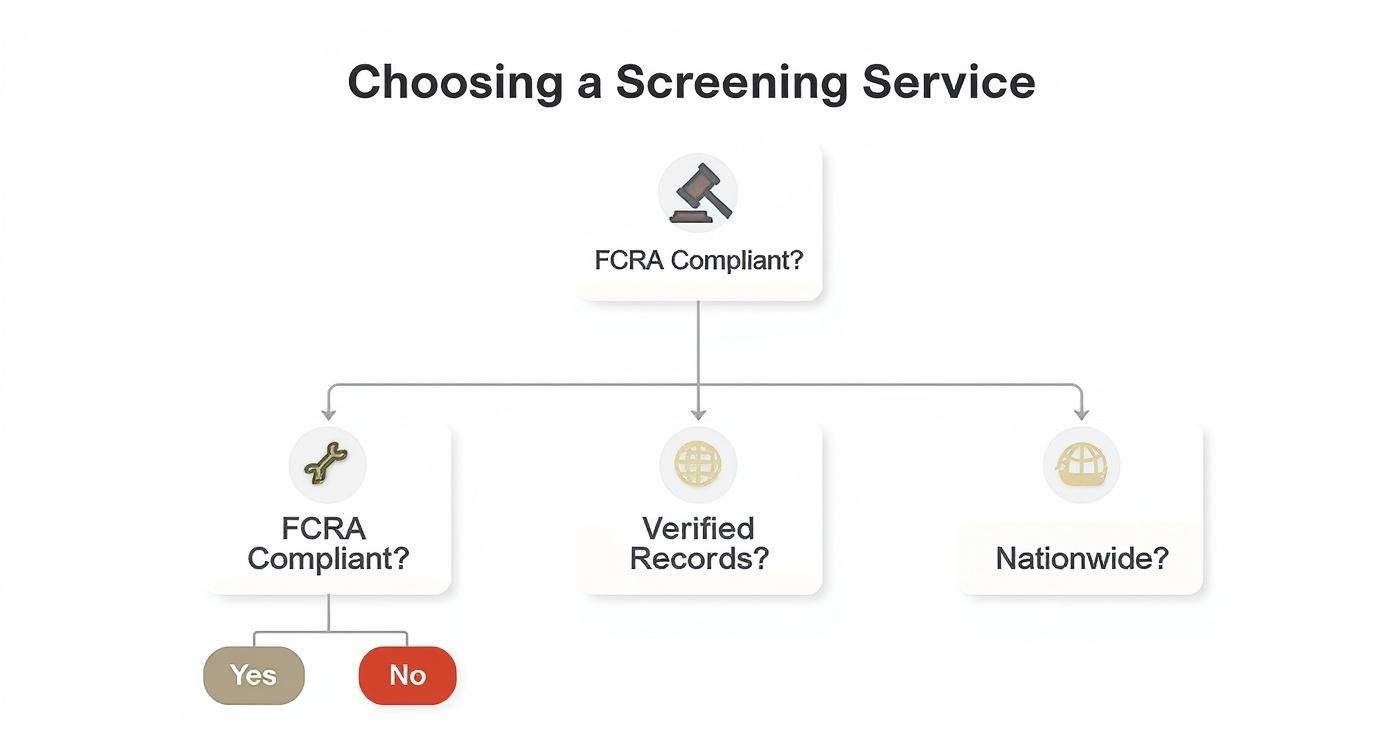
As this shows, your entire process rests on getting reliable, legally compliant information from the start.
Misdemeanors and Felonies
Next, you need to understand the severity of different offenses. While the exact legal lines can vary by state, the general idea is straightforward. Misdemeanors are less serious crimes, often leading to fines or less than a year in jail. Felonies are the big ones—serious offenses that can carry prison sentences of a year or more.
Your written policy has to account for this. A misdemeanor for a minor traffic violation five years ago is in a completely different universe from a recent felony conviction for arson.
Conducting an Individualized Assessment
With a solid grasp of the terminology, you can move on to the individualized assessment, a framework strongly recommended by HUD. This is how you look at the whole person, not just a single line item on a report.
Let’s walk through a real-world scenario. Say an applicant’s report shows a felony conviction for drug possession from six years ago. An old-school, blanket "no felonies" policy is out. Instead, you apply your individualized criteria:
Analyze the Nature of the Offense: The crime was drug possession—not manufacturing or distribution. While it’s serious, it doesn't automatically signal a risk of property damage or danger to other tenants in the same way a violent crime would.
Consider the Time Passed: The conviction is six years old. If your policy has a seven-year look-back period (which is common), this offense is getting close to aging out anyway. The time that has passed without further incident is a powerful indicator.
Look for Mitigating Evidence: You absolutely should give the applicant a chance to provide context. Maybe they can show you they completed a court-ordered rehab program, have held a steady job for the last five years, and have a glowing reference from their current landlord. This kind of information is gold.
This approach fundamentally shifts your thinking from, "What did this person do?" to "Does this past action present a legitimate, demonstrable risk to my property or my community today?" By documenting these three steps for every applicant with a record, you build a consistent, fair, and legally defensible process.
This kind of thoughtful evaluation is more critical now than ever. Even as some crime rates fall, a recent global trends report found a worrying increase in the severity of offenses on renter background checks. Reportable records of violence and threats are up, and sex offender searches have jumped by 20% since 2022. You can dig into the full analysis on changing criminal risk profiles to see these trends for yourself.
This data really drives home the need for a nuanced assessment rather than a simple pass/fail. Making a fair decision isn't just about checking a legal box; it's about accurately gauging risk in a world that's constantly changing.
Common Questions About Renter Background Checks
Even with a solid screening policy, you're going to run into unique situations and tricky questions. It just happens. Navigating a criminal background check for renters demands a clear understanding of the little details that separate fair practice from a major legal headache. This is where a lot of landlords get nervous, so let's tackle some of the most common questions I hear.
Answering these questions consistently is just as critical as having the written policy in the first place. One wrong move can undermine your entire process.
Can I Deny an Applicant for Any Criminal Conviction?
Absolutely not. Trying to enforce a blanket ban on anyone with a criminal record is a massive legal risk and a really bad idea.
Fair Housing guidelines strongly advise against these "zero tolerance" policies because they often lead to discrimination, even if unintended. Your focus has to be on relevance. A conviction for a minor, non-violent offense from a decade ago is a completely different story than a recent conviction for arson or assault. You have to look at each case individually and document why you believe a specific conviction poses a direct threat to your property or the safety of other residents.
What Is the Difference Between an Arrest and a Conviction?
This is probably one of the most important distinctions you need to make during the screening process. They are not the same thing.
An arrest simply means someone was taken into custody on suspicion of a crime. It is not proof of guilt. Charges get dropped and cases get dismissed all the time.
A conviction means a court of law has formally found the person guilty of a crime.
Basing your decision on an arrest record alone is walking on thin ice, legally speaking. Your screening criteria should be focused almost exclusively on convictions, as that's what represents a legal finding of guilt.
For a clear understanding of the information landlords seek, it's important to know what constitutes a criminal record and how it may impact rental decisions. This context helps ensure you're evaluating the right information fairly.
Do I Need an Applicant's Permission to Run a Background Check?
Yes, 100%. This is non-negotiable. The Fair Credit Reporting Act (FCRA) is crystal clear: you must get explicit, written consent from every single applicant before you run a criminal background check through a third-party service.
This authorization should be a distinct, clearly labeled part of your rental application that the applicant has to sign. If you move forward without that signed consent, you're violating federal law, and the penalties can be severe.
What if an Applicant Disputes Their Report?
If a potential tenant tells you the information on their background check is wrong, the FCRA lays out your next steps. You are legally required to tell them they have the right to dispute the error directly with the screening company that generated the report.
Your job is to hit the pause button on their application. Give them a reasonable amount of time to get it sorted out. Making a final decision based on information you've been told is inaccurate is not only unfair, it’s risky. You need to wait until the screening agency finishes its investigation and sends over an updated, accurate report before you make a final call. The time this takes can vary, and for more insight, you can learn about how long tenant screening can take and what factors influence the timeline.
At Keshman Property Management, we handle the complexities of tenant screening to ensure every placement is compliant, fair, and protects your investment. Let our 20 years of experience make your rental property ownership less daunting and more profitable. Learn more about our comprehensive services at https://mypropertymanaged.com.


Comments