
What Is a Rental Application and How Does It Work

Updated: Sep 13
So, what exactly is a rental application? Think of it as a renter's resume. It’s the formal document you fill out that gives a landlord or property manager a complete picture of who you are as a potential tenant. This is their primary tool for screening applicants and finding the best fit for their property.
Your Blueprint for Securing a New Home

Handing in a rental application is that first, critical step toward landing your next place. It’s much more than just a form; it's a detailed snapshot that proves you’re a reliable tenant. Landlords lean on this document to gather all the necessary facts and figure out if you can hold up your end of the lease.
The details you share kick off a thorough verification process. The property manager will confirm your identity, take a look at your financial health, and check into your rental history. They're essentially putting together a puzzle to see if you're the right person for the property and the community.
The Role of a Rental Application
At its heart, the application creates a level playing field. It standardizes the evaluation so that every single applicant is measured by the same yardstick. This structured method helps landlords make fair, data-driven decisions instead of just going with a gut feeling. It’s all about reducing risks like late rent or property damage.
For you, the applicant, getting a handle on the rental application process helps you put your best foot forward. The key parts almost always include:
Personal and Contact Information: The basics, so they know who you are and how to reach you.
Rental and Residence History: A look back at where you've lived and how things went.
Employment and Income Verification: Proof that you have a steady income to cover the rent.
Authorization for Checks: Your green light for the landlord to run background and credit screenings. You can get the full scoop by exploring our ultimate guide to tenant background checks.
The shift to digital applications has made this whole ordeal much easier for everyone. North America is a great example, leading the global market with a 36.1% share in rental application platforms. This shows a huge move toward using technology for quicker, more open rental transactions. You can read more about the growth of the rental applications market and see just how common this has become.
A Look Inside a Standard Rental Application
Think of a rental application less like a form and more like a structured interview on paper. It’s a landlord's primary tool for getting to know a potential tenant and understanding if they’re a good fit for the property. Each section is designed to paint a clear picture of your reliability, financial stability, and history as a renter.
The questions aren't random; they're all pieces of a puzzle. Landlords use this information to build a risk profile and ensure they’re placing a responsible person in their property. Let's break down what they're looking for, section by section.
Personal and Contact Information
This is ground zero. You'll provide your full legal name, current address, phone number, and email. The purpose is simple but critical: identity verification. Before anything else, a landlord has to confirm you are who you say you are.
This section also opens a direct line of communication. The screening process usually takes 24 to 72 hours, and property managers often need to reach out for a quick clarification or a missing document. Getting your contact details right from the start keeps things moving.
Key Takeaway: Double-check every single letter and number here. A simple typo in your email or phone number is one of the most common reasons for delays. If a landlord can't reach you, they might just move on to the next applicant.
Rental and Residence History
Next, you’ll be asked about where you’ve lived previously, for how long, and for your former landlords' contact info. This is essentially your rental resume. It offers a real-world look at your track record as a tenant, which is often the best indicator of how you'll be in a new place.
When a landlord calls a past reference, they're not just checking a box. They want to know:
Payment History: Did you pay your rent on time, every time?
Property Care: How did you treat the unit? Did you leave it in good shape?
Lease Compliance: Were you a good neighbor who followed the community rules?
Reason for Leaving: Was it a smooth, professional departure?
A string of glowing references is incredibly powerful. It tells a potential landlord you’re a low-risk choice who respects the property and the lease agreement.
Employment and Income Verification
This section is all about the numbers. You’ll detail your current employer, job title, length of employment, and your gross monthly income. The landlord's goal here is straightforward: they need to feel confident you can consistently afford the rent.
To back this up, you'll need to provide proof. The most common financial yardstick in the rental world is the 3x income rule—meaning your gross monthly income should be at least three times the monthly rent. Falling short of this benchmark is a frequent reason for an application denial, so it's important to know where you stand.
Authorization for Screening Checks
The final piece of the puzzle is your signature. This section gives the landlord your explicit, written permission to run background and credit checks. It’s a non-negotiable step in virtually every application process today. Your signature authorizes them (or a third-party screening company) to pull your credit report, check for a criminal record, and search for any past evictions.
Without this signed consent, a landlord legally cannot access your private data. Refusing to sign is an immediate red flag and will almost certainly get your application tossed out. It's the key that unlocks the final verification stage, allowing the landlord to make a fair, informed decision.
Anatomy of a Standard Rental Application
To pull it all together, here’s a quick overview of what each part of the application is for and the documents you should have ready to go.
Section of Application | Purpose for the Landlord | Common Documents Required from Tenant |
|---|---|---|
Personal Information | To verify your identity and establish communication channels. | Government-issued photo ID (e.g., driver's license, passport). |
Rental History | To assess your track record and reliability as a tenant. | Contact information for previous landlords (names, phone numbers). |
Employment & Income | To confirm your financial stability and ability to pay rent. | Recent pay stubs, bank statements, or an offer letter of employment. |
Authorization | To obtain legal consent for running background and credit checks. | A signed consent form, which is typically part of the application. |
Having these documents organized and on hand before you even start filling out applications will make the entire process faster and smoother for everyone involved.
The Application Journey from Start to Finish
Ever feel like submitting a rental application is like sending a message in a bottle? You hit "submit," and then... you wait. In reality, that click kicks off a very specific, almost assembly-line-like process for the landlord or property manager. Knowing how this works from both sides of the table demystifies the whole thing and sets the right expectations.
For you, the applicant, the heavy lifting is done once you’ve paid the fee and uploaded your documents. For the landlord, that’s precisely when their work begins. They take the information you’ve provided and start the crucial verification process.
The goal is to build a complete, trustworthy picture of you as a potential tenant. They're essentially checking three main things: your identity, your history, and your income.
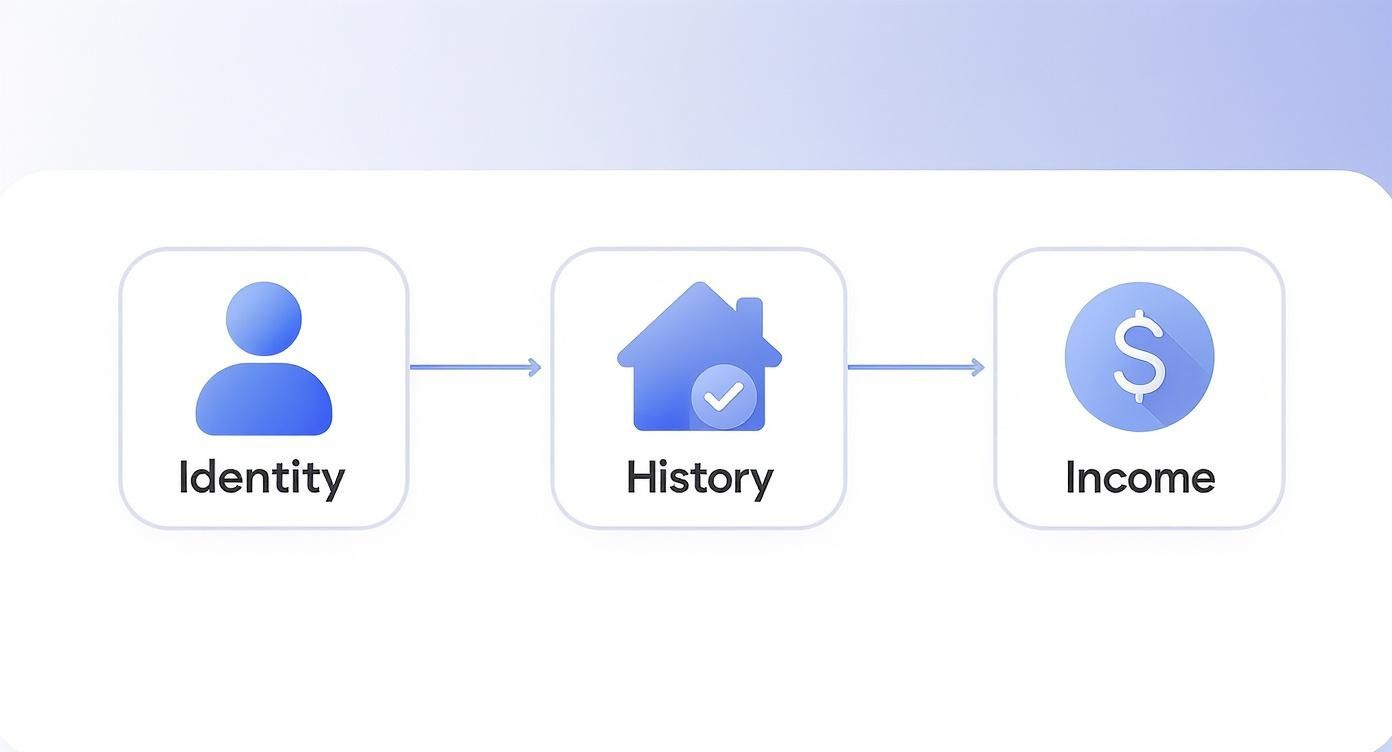
This diagram neatly lays out the core pieces of that screening "assembly line." Each step confirms a different part of your story, giving the landlord a comprehensive view of who you are as a renter.
The Landlord's Verification Workflow
Once your application lands on their desk (or in their inbox), a property manager doesn't just glance at it. They follow a clear sequence of checks to make sure everything lines up.
Initial Review: First, a quick once-over for completeness. Are all the fields filled out? Are the necessary documents attached? Is the authorization to run a background check signed? An incomplete application is the fastest ticket to the bottom of the pile, so don't skip anything.
Credit and Background Screening: With your signed consent, the landlord will use a professional tenant screening service. This pulls your credit report, scans for any criminal history, and checks national eviction databases. It’s an automated, data-driven step that gives them a hard look at your financial responsibility and background.
Income and Employment Verification: Next up, they confirm you can actually afford the place. They’ll look over the pay stubs or bank statements you sent in and will likely call your employer. They're just confirming your job title, employment status, and that the income you listed is accurate. The common benchmark they're looking for is an income of at least three times the monthly rent.
Landlord Reference Checks: This is often the final piece of the puzzle and can be the most telling. The property manager will call your previous landlords to ask about your track record. Did you pay on time? Did you take care of the property? Were you a good tenant? A glowing reference can make all the difference, especially when multiple people are vying for the same unit.
The Tenant's Waiting Period
While the landlord is busy with all this digging, you're stuck in the waiting game. The whole thing usually takes between 24 to 72 hours, but it can drag on if your references are hard to reach or if the landlord needs more information from you.
During this time, stay responsive. If a landlord asks for an extra document, get it to them quickly. It shows you're on top of things and serious about the property. For a more detailed look at what can speed up or slow down this process, check out our guide on how long tenant screening takes and key timeline tips.
A Pro Tip for Applicants: Give your boss and former landlords a quick heads-up before you apply. Just let them know to expect a call. This simple courtesy can dramatically speed up the process and prevent your application from getting stuck in limbo.
Finally, you get the decision. If you're approved, you'll receive a lease agreement to review and sign. If you're denied, the landlord is often legally required to tell you why, especially if it was based on something in your credit report. This whole structured journey is designed to keep the process fair, consistent, and based on real, verifiable facts.
Understanding the Legal Rules of Renting
Diving into the rental application process is more than just filling out forms—it's about knowing the legal playbook. Both landlords and tenants have a set of rights and responsibilities that are there to keep things fair, transparent, and above board. Think of these laws as the official rules of the game.
Trying to play without knowing the rules can get you into hot water, leading to legal fights and hefty fines. For landlords, following these laws is just smart risk management. For tenants, knowing your rights is your best defense against being treated unfairly.
Fair Housing Laws and Protected Classes
The absolute cornerstone of rental law is the Fair Housing Act. This is a major federal law that flat-out prohibits discrimination in anything related to housing. In simple terms, it makes it illegal for a landlord to turn down an applicant because they belong to what's called a "protected class." These rules aren't optional; they apply to everything from how an apartment is advertised to how applications are screened.
Federally protected classes include:
Race
Color
National Origin
Religion
Sex (this includes gender identity and sexual orientation)
Familial Status (meaning, if you have kids under 18)
Disability
Keep in mind, many states and even individual cities have added their own protections to this list, like age, marital status, or source of income. This means a landlord typically can't reject your application just because you're using a housing voucher or because you're a single parent.
Important Insight: Discrimination isn't always a blatant "we don't rent to you" situation. It can be subtle, like an ad that says "ideal for a young professional" or asking nosy questions about a potential tenant's disability. Both of those could be considered violations of the Fair Housing Act.
Regulations on Application Fees
Application fees are pretty standard. They're meant to cover the landlord's real costs for screening a potential tenant, which usually means paying for credit and background checks. But this isn't a blank check for landlords; these fees are actually regulated pretty heavily.
The laws around application fees can change a lot depending on your state or city. Some places put a hard cap on how much a landlord can charge. For instance, a state might limit the fee to $20 or the actual cost of the screening report, whichever is less. Other areas might require landlords to give you an itemized receipt or even refund the fee if someone else rents the place before they get to your application.
It's super important for both landlords and tenants to know the local rules. Landlords need to make sure their fees are compliant to stay out of legal trouble, and tenants should know what the limits are and when they might be owed a refund.
Data Privacy and the FCRA
When you hand over a rental application, you're sharing a lot of sensitive information—your Social Security number, your financial history, you name it. This data is protected by laws designed to keep it safe and ensure it’s used correctly.
The main law in play here is the Fair Credit Reporting Act (FCRA). This federal law dictates how consumer credit information can be accessed and handled. When a landlord runs a credit check on you, they're using a "consumer report" and have to follow all the FCRA rules.
Here are a few key things the FCRA requires from landlords:
Permissible Purpose: They need a legitimate reason to pull your credit report. Your signed application gives them that permission.
Adverse Action Notice: If a landlord rejects your application because of something in your credit report, they are legally required to send you an "adverse action notice." This letter has to tell you which credit reporting agency they used and explain that you have the right to get a free copy of your own report.
This whole process creates transparency and gives you a chance to spot and fix any errors on your credit file. Landlords have a legal duty to protect your data and get rid of it securely. As a renter, it's also wise to be aware of other legal details, like whether a lease needs to be notarized, to make sure every part of the rental agreement is sound.
How Landlords Can Create a Smoother Screening Process
As a landlord or property manager, you quickly learn that the rental application is more than just paperwork. It's your first line of defense and the single most important tool for finding a great tenant. A smart, repeatable screening process protects your investment, keeps vacancies low, and makes sure you're following the law. It’s time to move past a simple "first-come, first-served" mentality.
The secret is building a system. This means you need a clear, consistent set of rental criteria that you apply to every single person who applies—no exceptions. Not only does this help you make fair, fact-based decisions, but it’s also your best protection against accusations of housing discrimination.
Establish Your Rental Criteria Before You List
Before you even think about posting that "For Rent" sign, you need to decide what a qualified tenant looks like on paper. This isn't about your gut feeling; it’s about setting professional business standards. Get these criteria down in writing and stick to them for every application.
A solid set of criteria usually covers these four bases:
Income Requirements: The industry rule of thumb is asking for a gross monthly income of at least three times the monthly rent.
Credit Score Minimums: Decide on a minimum credit score you’ll accept. Keep it reasonable for your specific rental market.
Rental History: Be clear about what you expect. For example, no past evictions and good references from their last two landlords.
Criminal Background: Set a clear policy regarding criminal convictions, making sure it aligns with all local and federal Fair Housing guidelines.
Putting these standards in place from the get-go transforms tenant screening from a guessing game into a straightforward business process.
Dig In and Verify Everything
When you call their previous landlords, don't just ask, "Were they a good tenant?" That's too easy to answer with a simple "yes." You need to ask better questions to get the real story:
Did they always pay their rent on time?
Did they give you proper notice before they left?
Were there ever any noise complaints or issues with neighbors?
Knowing what you know now, would you rent to them again?
This kind of detail gives you a much richer picture of the applicant, allowing you to make a decision with confidence.
Put Technology to Work for You
The days of chasing down paper applications, running checks one by one, and spending hours on the phone are over. Modern tenant screening software has completely changed the game for landlords, automating almost the entire workflow.
Pro Tip: Using a dedicated screening service is a game-changer. These platforms bring everything into one place—the application, the credit and background checks, and all the supporting documents. It’s faster, more accurate, and far more secure.
These services are built to be efficient and keep you compliant. For a deep dive into the best options available, check out our guide to the 12 best tenant screening services for landlords. Using one of these tools will help you find and place a qualified tenant in a fraction of the time, with much less headache.
How to Handle Denials Professionally and Legally
Let's face it, you can't say yes to everyone. When you have to turn an applicant down, it’s incredibly important to do it the right way—respectfully and legally. You should always send a formal notice, often called an "adverse action notice," especially if your decision was based on anything in their credit report.
This notice needs to state why they were denied, and it should point directly back to your pre-established rental criteria. For instance, you could say, "The application did not meet the minimum income requirement of three times the monthly rent." This transparent, criteria-driven approach keeps you on the right side of the law and helps you maintain a professional reputation.
Standing Out in a Competitive Rental Market

In a hot rental market, your application is more than just a form—it's your one shot at a great first impression. When a landlord is staring at a mountain of applications for one great apartment, a complete, honest, and well-organized submission instantly puts you on the short list. It tells them you’re responsible, organized, and serious about renting their property.
For landlords and property managers, that same competition makes a solid screening process absolutely essential. Think of your rental application as your most important risk management tool. It's the data that lets you sort through a deep pool of candidates fairly and efficiently, helping you spot the people most likely to become reliable, long-term tenants.
The Reality of Rental Competition
The days of leisurely browsing for a rental and being the only applicant are a distant memory in most cities. Today, it’s completely normal for a good property to get buried in applications just hours after it’s listed. This kind of demand can be pretty stressful for renters trying to find their next home.
The numbers don't lie. In the Northeast, for example, the rental competitiveness index hit a score of 80.5, with an average of 11 applicants fighting for every single rental. You can dig into more data on the hottest rental markets in the country to see just how fierce it gets. That’s why turning in a flawless application isn’t just a good idea; it’s a necessity.
The Bottom Line: A standout application is your best competitive edge. It shows you're ready to go and trustworthy, making it easy for a landlord to choose you with confidence. This isn’t about just checking the boxes—it’s about proving you're the best candidate for the home.
Making Your Application Rise to the Top
So, how do you make sure your application doesn't get lost in the shuffle? It all comes down to being prepared and paying close attention to the details. The real work starts before you even find the perfect place.
Have Your Docs Ready to Go: Keep digital copies of your photo ID, a few recent pay stubs, and the names and contact info for your references saved and ready. When you find a place you love, you can pounce.
Be Honest and Complete: Fill out every single field on the application. Don't skip anything. Gaps or information that doesn't quite add up are the fastest way to raise a red flag.
Add a Personal Touch: A short, simple cover letter can work wonders. Just a few sentences introducing yourself and explaining why you're interested in the property can make a huge difference.
In the end, knowing what a rental application is and why every section matters helps everyone involved. For tenants, it's the key to winning over a landlord. And for landlords, it’s the bedrock of a stable, successful rental business.
Got Questions About Your Rental Application? We've Got Answers.
The rental application process can feel like a bit of a mystery, whether you're a first-time renter or a seasoned landlord. You've got questions about timelines, fees, and what happens if things don't go as planned. Let's clear up some of the most common uncertainties.
How Long Does It Take to Hear Back About an Application?
Waiting for a decision can be nerve-wracking, but the good news is you usually won't be left hanging for long. Most of the time, you can expect an answer within 24 to 72 hours.
What causes the variation? It really comes down to how quickly your references—like past landlords or your current employer—get back to the property manager. The completeness of your application also matters a lot; any missing information can slow things down. Thankfully, many landlords now use online platforms that automate credit and background checks, which definitely helps speed up the process.
What Are the Most Common Reasons an Application Is Denied?
A few red flags can unfortunately lead to a rejection. A low credit score, a history of evictions, or a less-than-glowing review from a previous landlord are some of the most frequent culprits.
Income is another big one. Landlords typically want to see that your gross monthly income is at least three times the monthly rent. Of course, being dishonest on your application is an automatic deal-breaker. If you are denied due to something on your credit report, the landlord is required by law to send you an "adverse action" letter explaining the decision.
Good to Know: That application fee you paid? It's almost always non-refundable. It's meant to cover the landlord's direct costs for running background and credit checks. Keep in mind that laws around fee amounts and refunds can differ quite a bit by state, so it’s always smart to know the local rules.
Can I Get a Co-Signer if My Application Isn't Strong Enough?
Absolutely. Many landlords are perfectly willing to work with a co-signer (sometimes called a guarantor). This is a fantastic solution for students, young professionals building their credit, or anyone who doesn't quite meet the income threshold on their own.
A co-signer is someone who signs the lease with you and legally agrees to cover the rent if you can't. They'll need to fill out their own application and prove they have the solid credit and income required to back you up.
Finding the right tenants and keeping your properties running smoothly is the key to a successful investment. At Keshman Property Management, we take the hassle out of tenant screening and day-to-day management so you can relax. With our 20 years of experience, we make owning rental property stress-free. See how we can help you at https://mypropertymanaged.com.


Comments