
What Is a Rent Roll Report: what is a rent roll report, explained
- Sarah Porter

- Jan 28
- 12 min read
At its heart, a rent roll is a snapshot of all the income a rental property is generating at one specific moment. Think of it as your investment's financial dashboard, showing you exactly who is paying what, for which unit, and for how long.
Your Property's Financial Heartbeat Explained
If you were trying to gauge someone's health, you'd check their pulse. For a rental property, the rent roll report is that essential diagnostic tool. It’s far more detailed than a simple profit and loss statement, giving you a real-time, unit-by-unit breakdown of your revenue. This single document tells the complete story of your investment’s current stability and performance.
This report isn’t just a static list of names and numbers; it’s a living document that guides your strategy. It contains the hard data you need to make smart decisions, whether you're trying to tighten up daily operations, plan for future capital improvements, or justify your property's value to a potential buyer or lender.
Why This Report Is So Important
The true power of a meticulously kept rent roll goes way beyond simple bookkeeping. It’s a multi-purpose tool that directly impacts your bottom line and your ability to manage your property effectively.
Verifies Your Income: It’s the official proof of the gross rental income your property pulls in—absolutely critical when you're trying to secure a loan or attract serious investors.
Measures Performance: By tracking rent payments, vacancies, and upcoming lease expirations, you can instantly pinpoint underperforming units and head off potential cash flow problems before they start.
Drives Valuation: A strong, consistent rent roll is one of the very first things a potential buyer will ask to see. It’s the primary document that backs up your asking price and justifies a higher property valuation.
Streamlines Management: It puts all the essential tenant and lease information in one place, making everything from daily management to long-term strategic planning much more straightforward.
At its core, a rent roll transforms raw data into actionable intelligence. It answers the most fundamental questions about your rental property: Who is paying, how much are they paying, and for how long?
To give you a clearer picture, this table breaks down the report's main purpose and who relies on it most.
Rent Roll Report at a Glance
Report Aspect | Primary Function | Key Users |
|---|---|---|
Data Snapshot | Provides a real-time summary of gross rental income and occupancy status. | Property Owners, Investors |
Financial Health | Used to assess cash flow, identify payment issues, and evaluate overall stability. | Lenders, Appraisers |
Operational Tool | Centralizes tenant and lease information for efficient day-to-day management. | Property Managers, Landlords |
Ultimately, getting comfortable with your rent roll is the first step toward making smarter, more profitable decisions. It gives you the clarity to manage risks, spot opportunities, and confidently steer your investment toward its financial goals. For a deeper dive into organizing these figures, check out our guide on rental property bookkeeping to ensure your records are always accurate.
Deconstructing the Rent Roll, Line by Line
A rent roll might look like just another spreadsheet at first glance, but it’s so much more. Each column tells a piece of a larger story about your investment’s health, stability, and future potential. Once you know what you’re looking at, you can turn that raw data into powerful strategic insights.
Think of it as the financial narrative of your property. Every line item is a character, and every number is a plot point, all contributing to the bottom line. Let's break down the essential components you'll find in any standard report.
This map here shows how the rent roll ties together the financial pillars of your property—the income streams, the lease agreements, and your overall cash flow.
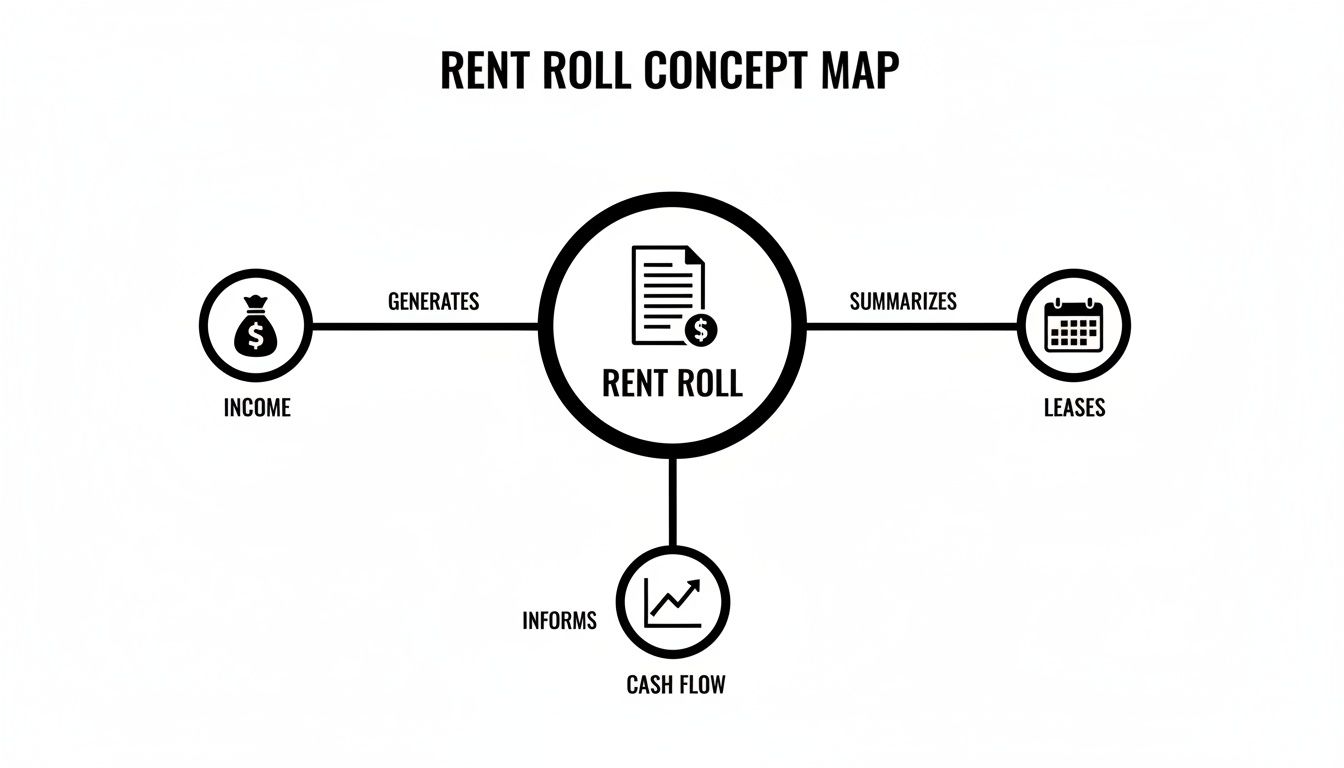
As you can see, the document acts as a central hub. It translates individual lease terms and tenant payments into a clear, big-picture view of how your investment is actually performing.
Essential Tenant and Unit Information
The first few columns usually set the stage, identifying the specific units and the people in them. These foundational details are the bedrock of good organization and communication.
Unit Number: This simply identifies the apartment, office, or rental home. It’s the anchor that links all the other data back to a physical asset.
Tenant Name: This lists who is currently on the lease. For an investor, seeing the same names on the report year after year is a great sign of a stable, low-turnover property.
Occupancy Status: This tells you if a unit is Occupied or Vacant. A high vacancy rate is an immediate red flag, pointing to potential issues with pricing, the property’s condition, or weak market demand.
These basic fields are the building blocks of the entire report. Without them, the financial data that follows would have no context, making it nearly impossible to manage your property effectively. If you want to dive even deeper into individual payment histories, you should also get familiar with the rent ledger.
Lease and Financial Details
This is where you find the financial heartbeat of your property. These columns get into the nitty-gritty of the contractual agreements and cash flow for each unit, revealing the true income-generating power of your investment.
A typical report will include:
Lease Start & End Dates: These dates are absolutely critical for forecasting. If you see a big cluster of leases expiring around the same time, that signals a potential income risk you need to get ahead of with a renewal strategy.
Monthly Rent: This is the base rent amount due each month according to the lease. Add up this entire column, and you get the property’s Gross Scheduled Rent—its maximum income potential before you factor in vacancies or non-payments.
Security Deposit: This shows the amount held to cover potential damages or unpaid rent. If you notice these amounts are all over the place, it could point to inconsistent management practices.
The real story is often found in the details beyond just the base rent. Columns for arrears or concessions expose the gap between what you should be collecting and what you actually are.
Beyond these basics, you'll often find columns for Concessions (discounts like "one month free" to entice new tenants) and Arrears (past-due rent). A high number of concessions might mean you're struggling to attract tenants at market rates, while significant arrears point directly to collection problems. A modern rent roll can even show real-time payment status, revealing who is current, who is delinquent, and who has paid in advance.
In fact, detailed rent rolls are proven to help lower delinquency rates by 10-15% because that kind of consistent monitoring allows property managers to intervene early.
How to Use Your Rent Roll for Strategic Decisions
A rent roll is far more than just a list of names and numbers. Once you understand what each column means, you can start using it as a powerful tool to make smarter, more profitable decisions for your properties. It's the difference between being a passive landlord and a proactive investor.
Think of it as your property's financial roadmap. It helps you anticipate challenges, spot hidden opportunities, and manage your investment with a clear, data-driven perspective. Honestly, it's one of the most critical documents for maximizing your returns and ensuring the long-term health of your portfolio.
Forecast Cash Flow and Plan Renewals
Right off the bat, one of the most practical uses for your rent roll is forecasting income. Just by looking at the Lease End Date column, you can see exactly when your rental agreements are due to expire. This isn't just about bracing for a potential vacancy; it’s about getting ahead of the curve.
For example, what if you see that 30% of your leases are all ending in the same quarter? That’s a huge potential cash flow risk all at once. This single piece of information lets you take action months in advance:
Launch a Renewal Campaign: You can start reaching out to those tenants early with attractive renewal offers, locking them in and avoiding the high costs of tenant turnover.
Schedule Maintenance Wisely: If you know certain tenants are leaving, you can budget for and schedule any needed repairs or upgrades to minimize how long the unit sits empty.
Ramp Up Marketing: You can start advertising the upcoming vacancies ahead of time, aiming to have a new, qualified tenant ready to move in the day after the old one leaves.
This kind of forward-thinking turns a potential income cliff into a smooth, managed transition, which is key to keeping your cash flow steady and predictable.
Identify Opportunities and Underperforming Units
Your rent roll also doubles as a diagnostic tool for your property's performance. A quick scan can tell you which units are your star players and which ones are lagging behind. Are some units consistently rented for less than the market rate? Do you have a tenant who is always behind on rent?
A rent roll report serves as the financial cornerstone for property valuation and investment decisions in the residential and commercial real estate markets.
This document makes those trends jump right off the page. Maybe one unit has a lower rent because it hasn't been updated in a decade—that's a clear signal for a value-add renovation that could justify a significant rent increase. Or perhaps you notice a pattern of late fees from another tenant, prompting a crucial conversation to get ahead of a bigger problem.
Secure Financing and Justify Your Valuation
When it comes time to refinance your mortgage or sell the property, a clean and accurate rent roll is absolutely essential. Lenders and potential buyers will pour over this document to verify your income claims and assess the property's financial stability.
A well-maintained report instantly signals professional management and proves your investment is on solid ground. In fact, properties managed with detailed rent rolls show roughly 15-20% higher accuracy in cash flow projections than those using basic spreadsheets. That precision gives lenders the confidence to say yes. For a deeper dive, you can explore the data on rent roll reporting.
Ultimately, a strong report directly supports a higher valuation for your property, giving you more negotiating power and securing better terms on any loans.
Using a Rent Roll to Value and Vet Properties
When you're serious about buying an investment property, the rent roll isn't just another document—it's your most important due diligence tool. Think of it as a truth serum for the seller's income claims. It lets you peel back the curtain and see the real financial story of the property, far beyond the fresh paint and staged photos.
By digging into the details of the rent roll, you can build a realistic financial forecast. You're no longer just taking the seller's pro forma numbers at face value. Instead, you're looking at tenant stability, actual lease terms, and the real money coming in each month. This is how you accurately value a potential acquisition.

Uncovering Red Flags Before You Invest
A rent roll is your first line of defense against a bad deal. It’s where you’ll spot the subtle but critical red flags that could sink your investment down the road. These warning signs often point to deeper issues with management or market stability.
Keep a sharp eye out for these potential problems:
Excessive Month-to-Month Leases: A property stacked with month-to-month tenants is a sign of instability. Is the seller having trouble keeping long-term residents, or are they just trying to make the occupancy numbers look good for the sale?
Widespread Rent Concessions: If you see "one month free" or other discounts scattered across the report, it's a huge clue that the advertised rental rates might not be sustainable in the real market.
Persistent Vacancies or Arrears: High vacancy rates are an obvious problem, but a long list of tenants behind on rent is just as bad. This signals either poor management, weak market demand, or both.
Finding these issues isn’t necessarily a deal-breaker. In fact, they can give you powerful leverage to negotiate a better price based on the property’s actual performance and inherent risks.
Calculating Key Investment Metrics
Beyond just spotting trouble, the rent roll gives you the hard data you need to calculate the most important valuation metrics. The total monthly rent is the foundation for figuring out the property’s Net Operating Income (NOI), which is the bedrock of any commercial real estate valuation.
The strategic importance of rent roll reports extends beyond day-to-day property management, serving as foundational documentation during property sales and refinancing events. Properties with transparent, accurate rent roll histories command higher valuations because potential buyers can confidently project future income streams.
Once you have a solid NOI, you can calculate the Capitalization Rate (Cap Rate) to see how the property's potential return stacks up against other investments. For an even deeper analysis of long-term value, many savvy investors use a Discounted Cash Flow (DCF) model, which relies heavily on the income projections you pull from the rent roll.
To really get a handle on this critical calculation, check out our https://www.mypropertymanaged.com/post/what-is-net-operating-income-guide-to-boost-your-property-profits. Ultimately, the rent roll is a non-negotiable tool in any serious property transaction, directly influencing both the final price and your strength at the negotiating table.
A Simple Rent Roll Template You Can Use
Alright, enough with the theory. The best way to really get a feel for a rent roll is to see one in action. Let's look at a straightforward example for a small, four-unit apartment building.
This isn't just a table of numbers. I'll break down what each line item actually means for an owner and, more importantly, what you should do with that information. This is where the data comes to life.

Sample Rent Roll for a 4-Unit Property
Here’s a snapshot of a simple rent roll. Imagine this is what your property manager sends you at the beginning of the month. It’s a clean, at-a-glance view of your property’s financial health.
Unit | Tenant Name | Lease End | Monthly Rent | Deposit Held | Balance Due |
|---|---|---|---|---|---|
1A | Jane Smith | Dec 31, 2024 | $1,250 | $1,250 | $0 |
1B | Tom Davis | Feb 28, 2025 | $1,300 | $1,300 | $650 |
2A | Emily Chen | Jul 31, 2025 | $1,275 | $1,000 | $0 |
2B | Mark Jones | Apr 30, 2025 | $1,325 | $1,325 | $0 |
Even with just four units, you can immediately spot opportunities and potential problems that need your attention.
Turning Data Into Actionable Insights
Just by scanning this simple table, a couple of things should jump right out at you. This is the real power of a rent roll—it tells you where to focus your energy.
Financial Red Flag (Unit 1B): Tom Davis owes $650. That’s an immediate hit to your cash flow for the month. The next step is clear: initiate your collections process. That might mean a formal late notice or a quick phone call to see what’s going on. The goal is to get it resolved before it becomes a bigger headache.
Upcoming Lease Expiration (Unit 2B): Mark Jones's lease is up on April 30, 2025. That's just around the corner. It's time to be proactive. Reach out now to see if he's interested in renewing. If he's not, you can get a head start on marketing the unit to line up a new tenant and avoid a costly vacancy.
A rent roll isn't just a record of past events; it's a forward-looking tool that helps you anticipate future challenges and opportunities.
As you can see, the report is more than just a spreadsheet; it's a strategic dashboard. It flags urgent financial issues and upcoming lease events, letting you stay ahead of the game and keep your investment running smoothly.
Get Clear Financial Reporting with Keshman Property Management
Keeping a detailed and accurate rent roll takes serious time and attention to detail—time you could be spending on finding your next deal or just enjoying your life. This is exactly where a professional property manager proves their worth, turning a tedious administrative headache into a simple, clear process for you.
At Keshman Property Management, we believe financial tracking should be straightforward. That’s why we provide consistent, easy-to-read rent roll reports as a fundamental part of our service. We want you to have total transparency into how your investment is doing, giving you a crystal-clear picture of your property's financial health at all times.
We’re landlords ourselves, so we get it. We know how critical this information is for making smart decisions and maximizing what you earn. We handle all the day-to-day grind of tracking payments, managing lease expirations, and keeping tenant records up-to-date so you don’t have to.
Your Partner in Profitability
We do more than just send you a spreadsheet full of raw data. We give you the expert analysis to go with it. Our team will help you read between the lines, spot important trends, and find opportunities to boost your cash flow. It’s a proactive approach that keeps you one step ahead.
Peace of mind comes from knowing your investment is being managed with precision and expertise. We provide the clarity you need to own your property confidently.
Of course, using the right tools makes all the difference in getting comprehensive financial reports and managing your rent roll efficiently. It’s worth exploring the best accounting software for rental property to see how technology can support your financial goals.
Working with Keshman means you can finally step away from the spreadsheets and focus on what truly matters to you. Let us take care of the meticulous record-keeping so you can enjoy the benefits of clear, professional, and profitable property ownership. Our commitment is to make your experience as an owner less stressful and a lot more rewarding.
Got Questions About Rent Rolls? We Have Answers
Even after you get the hang of reading a rent roll, a few practical questions almost always pop up. Let's tackle some of the most common ones so you can use this report like a seasoned pro.
How Often Should I Be Looking at an Updated Rent Roll?
Think of your rent roll as a live snapshot of your property's health, not a dusty old file. For it to be truly useful, it needs to be fresh.
As a rule of thumb, you should review an updated report at least once per month, usually right after all the rent checks have been collected and posted. That said, the best practice is to update it in real-time whenever a major event happens. This could be anything from a tenant moving out, a lease renewal with new terms, or a resident falling behind on payments.
Staying on top of these changes ensures you're always making decisions based on what's actually happening at your property, not what was happening last quarter.
Is a Rent Roll Just Another Name for a Profit and Loss Statement?
That's a great question, and the answer is no—they're two very different, but related, documents. A what is a rent roll report is laser-focused on one thing: your property's rental income. It gives you that granular, unit-by-unit breakdown of who is paying what, and when.
A Profit and Loss (P&L) statement, on the other hand, paints the bigger picture. It takes all your income (including the gross rent from your rent roll) and subtracts all your expenses—maintenance, property taxes, insurance, mortgage payments, you name it—to show your true net profit or loss.
The easiest way to think about it is that your rent roll is a critical piece of the puzzle that feeds into your P&L statement. You can't have an accurate P&L without a solid rent roll.
Ready for professional, clear financial reporting without the hassle? The experts at Keshman Property Management provide detailed rent roll reports and comprehensive management to maximize your earnings. Learn more about our services.


Comments