
Calculate Prorated Rent Move Out The Landlord's Guide
- Sarah Porter

- Jan 22
- 12 min read
Updated: Jan 28
When a tenant moves out mid-month, you'll need to calculate their final rent payment. The most common way to do this is to figure out the daily rental rate first. Just take the total monthly rent and divide it by the number of days in that specific month. Once you have that daily rate, multiply it by the number of days the tenant actually lived in the property during their last month to get the final amount they owe.
Why Getting Prorated Rent Right Is a Big Deal

When a tenant leaves, your job isn't over once you've done the final walkthrough and collected the keys. That final financial exchange is a critical moment that really defines the end of your professional relationship.
Knowing how to accurately calculate prorated rent for a move-out is more than just good math—it's a cornerstone of being seen as a fair and professional landlord. It shows you're only charging tenants for the exact time they used the property, which goes a long way in building trust and, frankly, avoiding headaches.
If you get the numbers wrong, it can quickly turn a good tenancy sour. Overcharge someone, and they'll feel ripped off. That can lead to bad online reviews or even legal fights over their security deposit. But if you undercharge, you're literally giving away money. Having a clear, consistent process protects your bottom line and your reputation.
Setting the Stage for a Smooth Exit
The move-out is the last impression you leave on a tenant. Nailing the final rent calculation makes the whole process, including the security deposit return, feel straightforward and transparent. This isn't just a "nice to have"—it's a fundamental part of good property management.
As the property management industry's revenue is expected to reach $136.9 billion in 2025, the bar for professionalism keeps getting higher. Landlords who have systems in place for tasks like rent proration are just better prepared to manage their properties well and keep tenant relationships positive. If you want to brush up on the fundamentals, our guide on what is prorated rent is a great place to start.
The Bottom Line: Financial accuracy at move-out is about more than money. It’s about integrity. Getting it right proves you're a fair landlord, which helps prevent costly disputes and ensures every lease ends on a professional note.
This kind of systematic approach is non-negotiable, especially as your portfolio grows. With about 35% of property management businesses handling between 101 and 500 units, you can see why having a consistent, accurate method for financial settlements is a must. By creating a clear-cut way to calculate final payments, you build a repeatable system that saves you time, cuts down on mistakes, and cements your professional standing in the industry.
Picking the Right Way to Calculate Prorated Rent
When a tenant moves out mid-month, you need to figure out their final rent payment. The thing is, there’s more than one way to do the math. While the difference might only be a few dollars, the most important thing is to be consistent.
Pick one method, spell it out clearly in your lease agreement, and stick to it for every single tenant. This simple step can save you from a world of headaches and disputes later on.
Let's walk through the three most common ways landlords calculate a daily rent rate. Each has its pros and cons, and the best one for you really boils down to whether you prefer simplicity or pinpoint accuracy.
Method 1: The "Banker's Month" (Using 30 Days)
This is the old-school, straightforward approach. It simplifies the math by pretending every month has exactly 30 days. It doesn't matter if it's a short February or a long August; the number is always 30.
The Math: You just divide the total monthly rent by 30 to get the daily rate.
Quick Example: If rent is $1,500 a month, your daily rate is always $1,500 / 30 = $50 per day.
Who it’s for: Landlords who love simplicity. If you want one daily rate that never changes, no matter the month, this is your go-to.
The beauty of this method is its predictability. You never have to pull up a calendar. The trade-off, however, is that it's slightly less precise for months that don't have 30 days.
Method 2: Using the Exact Days in the Month
This is probably the most popular and widely accepted method out there. Why? Because it’s seen as the fairest. It uses the actual number of days in the month the tenant is moving out, tying the daily rate directly to the calendar.
To do this, you divide the monthly rent by the total number of days in that specific month—28 for February, 31 for July, and so on.
Example in a 31-day month: For a $1,500 rent in May, the daily rate would be $1,500 / 31 = $48.39.
Example in a 30-day month: That same $1,500 rent in June comes out to a daily rate of $1,500 / 30 = $50.00.
Because the calculation reflects the actual calendar, tenants often see this as more transparent. The only real "downside" is that you have a slightly different daily rate depending on the month.
A Quick Word of Advice: While laws differ everywhere, many courts and local regulations favor this method because it's the most accurate reflection of the cost per day for that specific month. It's always a smart move to double-check your local landlord-tenant laws to make sure your method is compliant.
Method 3: The Annual Calculation
This one is less common for residential leases but offers the highest degree of precision. It's often used in commercial real estate or by larger property management firms that want to smooth out the monthly differences across their entire portfolio.
Here’s how you break it down:
Get the total annual rent: Monthly Rent x 12.
Find the annual daily rate: Total Annual Rent / 365.
Calculate the final amount: Daily Rate x Number of Days Occupied.
So, for a $1,500 monthly rent, the total annual rent is $18,000. The daily rate works out to be $18,000 / 365 = $49.32. And don't forget to adjust for leap years! In those years, you'll need to use 366 days in your calculation.
To make it even clearer, here's a quick comparison of these three approaches.
Comparing Prorated Rent Calculation Methods
Method | How to Calculate Daily Rate | Best For |
|---|---|---|
Banker's Month | (Monthly Rent) / 30 | Landlords who prioritize simplicity and consistency. |
Exact Days in Month | (Monthly Rent) / (Actual Days in that Month) | The most common and widely accepted fair-market approach. |
Annual Calculation | (Monthly Rent x 12) / 365 | Maximum precision; often used in commercial or large portfolios. |
Ultimately, there isn't one "perfect" method—just the one that works best for your business.
No matter which path you take, the most critical step is to get it in writing. A clear, unambiguous clause in your lease agreement explaining how you will calculate prorated rent at move-out is your best defense against confusion and potential disputes.
A Practical Guide to Calculating Final Rent
Alright, let's get down to the brass tacks of actually calculating that final rent payment. Knowing the methods is one thing, but putting them into practice is where it counts. Getting this right comes down to a simple, repeatable process that protects both you and your tenant.
First things first: you need the official move-out date. This isn't just the day they drop off the keys. The date you need is the final day of their legal responsibility, which is dictated by the lease or their formal move-out notice. A tenant might be physically gone by the 15th, but if their 30-day notice takes them to the 20th, your calculation runs through the 20th.
Next, grab the lease and confirm the exact monthly rent. This might sound obvious, but it's a common trip-up. You need the base rent figure—before any temporary credits, utility charges, or other fees are tacked on. Starting with the wrong number throws the whole calculation off.
Putting the Numbers to Work
Let's walk through a typical scenario to see how this plays out. We'll use the "Exact Days in the Month" method, since it’s generally seen as the fairest and is widely used.
Monthly Rent: $1,800
Move-Out Month: April (which has 30 days)
Official Move-Out Date: April 12th
Your first move is to figure out the daily rent for April. To do this, just divide the total monthly rent by the number of days in that specific month.
The Math: $1,800 (Monthly Rent) ÷ 30 (Days in April) = $60.00 per day
Easy enough. Now that you have that daily rate, you can find the final prorated amount. Multiply the daily rate by the number of days the tenant is responsible for the property—in this case, 12 days.
The Final Tally: $60.00 (Daily Rate) x 12 (Days Responsible) = $720.00
And there you have it. The final prorated rent for that partial month is $720.00. This gives you a clear, defensible figure to share with your tenant, which goes a long way in preventing confusion or disputes.
The flowchart below gives you a quick visual on the main ways you can approach proration.
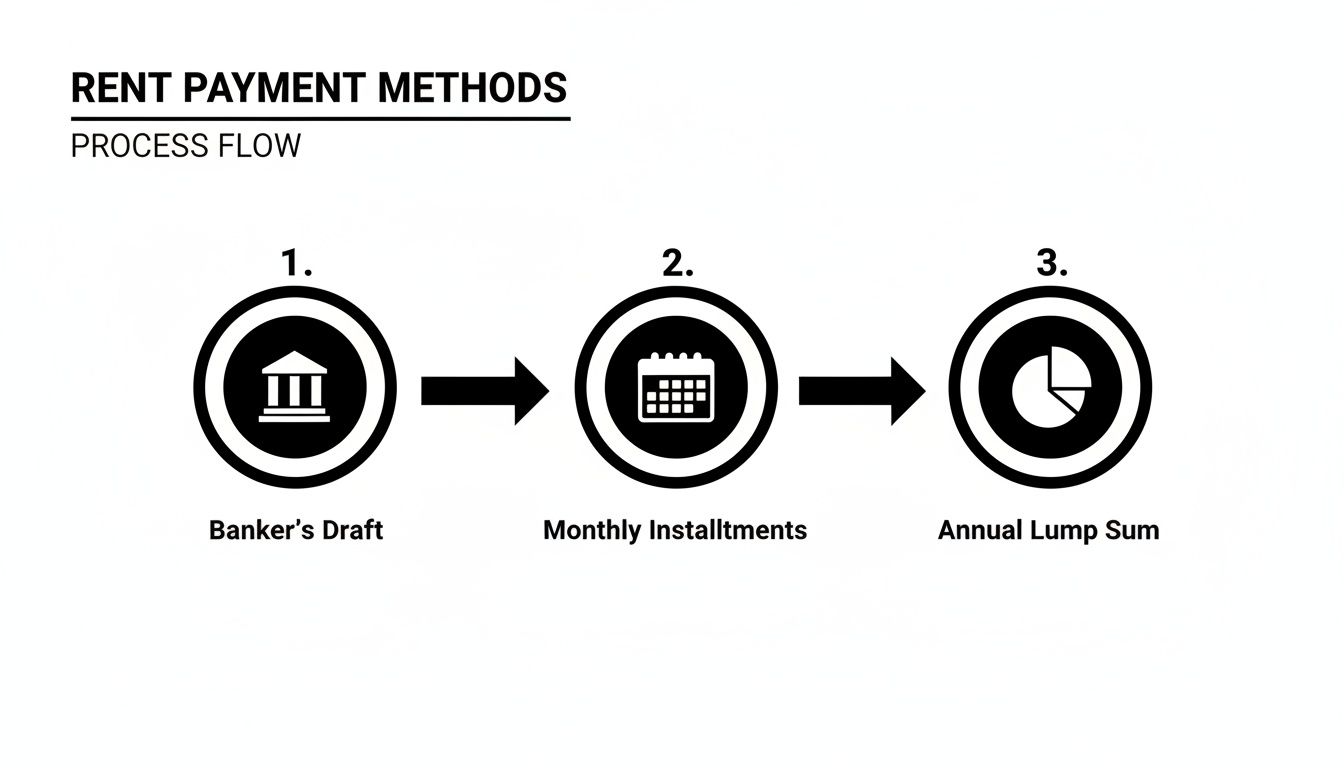
As you can see, whether you use a banker's draft, monthly, or annual method, the daily rate can vary slightly, which will change the final amount owed.
Handling Calculation Complexities
Of course, the real world is rarely that neat and tidy. You're bound to run into a few curveballs, but they're manageable if you know what to look for.
A leap year is a classic example. If you happen to use the annual proration method, don't forget to divide the total yearly rent by 366 days instead of 365. It's a tiny detail, but getting it right keeps your numbers accurate.
Disagreements over the move-out date can also pop up. If a tenant insists they were gone by the 10th but their notice officially ended on the 15th, your anchor is always the lease and their written notice. Your calculation must be based on their legal obligation, not just their physical presence.
Once you have the final number calculated, the next step is actually collecting it. If you're looking to make that process smoother, it's worth exploring payment solutions tailored for the housing rentals industry. A solid payment system is just as crucial as getting the math right.
Your Lease Is Your Best Defense Against Rent Disputes
When it comes to avoiding a headache over the final rent payment, your lease agreement is everything. A lease that’s vague or, even worse, silent on how to handle a mid-month move-out is just an invitation for conflict. By getting ahead of it and clearly defining your prorating method from the start, you set crystal-clear expectations and protect both your investment and your tenant relationship.
Think of it this way: your lease is the official rulebook for the tenancy. A solid clause on prorating rent isn't just about being fair; it's about creating a professional, transparent process. It stops potential arguments before they even have a chance to start.
What to Include in Your Proration Clause
To really work, your lease clause has to be specific. Don't leave any room for guessing. It needs to state exactly which method you'll use—whether you calculate based on the actual days in that specific month, a flat 30-day "banker's month," or an annual daily rate.
Your clause should spell out a few key things:
The Method: Be explicit. For example, state, "Prorated rent will be calculated using a daily rate based on the actual number of days in the month of departure."
Notice Periods: It's smart to reiterate that rent is owed through the end of the tenant's official notice period, even if they decide to move their belongings out sooner.
Payment Deadline: Clarify when the final prorated payment is due. A common and effective practice is to require it upon the return of the keys.
By laying all this out in black and white, your lease becomes a go-to guide for the tenant. It turns what could be a tense negotiation into a simple process of following the contract, which makes for a much smoother move-out for everyone.
The global property management market is projected to hit $27.812 billion in 2025, and with that growth comes a higher expectation for standardized, professional practices. Clear proration rules are a huge part of that. As the industry evolves, landlords who use clear, compliant financial procedures will stand out.
Don't Forget Legal Compliance
As powerful as your lease is, it can't override the law. Landlord-tenant laws can change dramatically from one state or city to the next. Some areas actually have specific rules about how you must prorate rent, so what works in one state might not be enforceable in another. Staying on top of your local regulations is non-negotiable.
To head off the most common disputes, it's also a great idea to clearly list potential deductions from the security deposit. This includes things like unpaid prorated rent. You can reference a security deposit deductions list and local regulations to make sure you're covering your bases.
If you're looking for a solid starting point, you can download our rental lease agreement template to see how these clauses fit into a complete document. Ultimately, an airtight lease is your best defense against misunderstandings that can cost you time and money.
Letting Your Tenant Know the Final Amount

You've crunched the numbers, but your work isn't done yet. The way you present the final, prorated rent to your tenant is just as critical as getting the math right. A clear and professional approach here is your best defense against confusion or disputes, helping end the tenancy on a good note.
The goal is simple: give your tenant a final rent statement that is so straightforward it answers their questions before they even have to ask. This isn't just good customer service; it's smart property management that maintains your reputation, even as someone is moving out.
Building a Clear and Itemized Final Statement
Don't just send an invoice with a single number on it. That’s a recipe for a follow-up email full of questions. Instead, provide a simple, itemized breakdown showing exactly how you got to that final figure.
Make sure the statement clearly shows:
Full Monthly Rent: The standard, full rent amount for the month.
Calculated Daily Rate: The exact per-day cost you determined.
Number of Days Billed: The specific number of days they are being charged for.
Total Prorated Rent Due: The final, bottom-line amount.
Laying it all out like this demonstrates that your calculation is fair and based on the lease they signed. It keeps the conversation focused on the facts, not feelings.
My Two Cents: Always, and I mean always, put this in writing. An email or a formal letter creates a paper trail that protects both you and the tenant if any disagreements pop up down the line.
When and How to Deliver the News
Timing is everything. Don't spring this on them a day before the rent is due. The best time to provide the final prorated rent amount is right after they've given you their official notice to vacate. This gives them plenty of time to process the information, ask questions, and plan their finances accordingly.
Handling this final payment properly also sets a positive tone for the security deposit return. When tenants feel you've been transparent about their last rent payment, they’re more likely to trust your process for the deposit reconciliation. For a deeper dive into that, check out our complete guide to deposit rent return timelines.
Ultimately, proactive and clear communication reinforces your role as a fair, organized landlord and ensures the tenancy wraps up smoothly for everyone involved.
Frequently Asked Questions About Prorated Rent
Even with a solid process, prorated rent can still throw some curveballs. Let's walk through some of the most common questions and gray areas that pop up during a move-out. Getting these right will help you handle every situation with confidence and consistency.
Am I Legally Required to Prorate the Last Month's Rent?
This is the big one, and the short answer is: it depends.
There's no single federal law that forces landlords to prorate rent. It all comes down to your specific state and even local city ordinances. Landlord-tenant laws vary wildly from place to place.
Some jurisdictions require it as a standard practice for fairness, while others leave it completely up to what's written in the lease agreement. This is precisely why your lease is your most important tool. A clear, well-defined clause about how you calculate prorated rent move out removes any doubt and sets the rules of the game, especially if local laws are quiet on the subject.
Key Takeaway: Think of your lease as your first line of defense. A solid policy on proration protects you from potential disputes, no matter what local statutes say. Always double-check your local regulations to make sure your lease is fully compliant.
What Is the Best Method to Calculate Prorated Rent?
You’ve got a few options, but from my experience, the most accurate and legally sound method is using the actual number of days in the move-out month.
For instance, you'd divide the monthly rent by 31 for a move-out in March or by 28 for February (or 29 in a leap year!). This method is seen as the fairest because it accurately reflects the real daily cost for that specific month.
The "Banker's Month" method, which uses a flat 30 days for every calculation, is simpler but less precise. The "best" method is whichever one you clearly spell out in your lease and apply consistently to every single tenant, without exception. Consistency is key.
What if a Tenant Leaves Before Their Notice Period Ends?
This happens more often than you'd think. A tenant might drop off the keys on the 15th, but their 30-day notice period doesn't technically end until the 20th of the month. So, which date do you use for your calculation?
In nearly all cases, the tenant is responsible for paying rent through the end of their official notice period, not just until the day they move their stuff out. Your calculation should cover every single day of their legal obligation. Make sure your lease agreement states this explicitly to head off any arguments about when their financial responsibility truly ends.
At Keshman Property Management, we've navigated these exact scenarios for over 20 years, ensuring every tenant transition is smooth, professional, and financially sound. We handle the nitty-gritty details so you don't have to. Learn how we can make your life as a landlord easier.


Comments