
What Is Prorated Rent: A Quick Guide to Fair, Accurate Charges
- Sarah Porter

- Dec 31, 2025
- 13 min read
Let's get straight to it: what exactly is prorated rent? Think of it as a custom-fit rent payment for a partial month. Instead of paying for a full 30 or 31 days, a tenant only pays for the exact number of days they actually live in the property.
This comes into play most often with mid-month move-ins or move-outs, and it’s a cornerstone of fair and transparent property management. It just makes sense—you shouldn't have to pay for time you aren't there.
Why Prorated Rent Matters
Imagine you sign a lease and your move-in date is set for May 15th. It wouldn't feel right to be handed a bill for the entire month of May, would it? You'd only be living in the unit for about half the month. This is precisely the situation where prorated rent saves the day.
It’s a simple, logical practice that aligns the rent due with the tenant’s actual occupancy. You can think of it like your utility bill—you only pay for the electricity you actually use. Applying that same principle to rent helps head off potential disputes and starts the landlord-tenant relationship on the right foot. It's a fundamental piece of ethical property management that works out better for everyone.
Before we dive into the math, here's a quick overview of what makes prorated rent so important.
Prorated Rent at a Glance
Component | What Landlords Need to Know |
|---|---|
Definition | An adjusted rent payment calculated for a partial month of occupancy. |
Purpose | To ensure tenants only pay for the specific days they live in the property. |
Common Use Cases | Mid-month move-ins, approved early move-outs, and delayed move-ins. |
Landlord Benefit | Fills vacancies faster by offering flexible start dates and builds a reputation for fairness. |
Tenant Benefit | Provides fair billing, reduces the financial burden of moving, and increases trust. |
Ultimately, prorating rent is a win-win. It offers flexibility that helps landlords keep their properties occupied and gives tenants a fair deal, setting the stage for a positive tenancy from day one.
Key Scenarios for Prorating Rent
While moving in during the middle of the month is the classic example, it’s not the only time you’ll need to prorate. Knowing when to apply it is crucial for keeping things clear and professional.
Here are the most common situations:
Mid-Month Move-Ins: This is the big one. The tenant’s lease officially starts after the first of the month.
Approved Mid-Month Move-Outs: The landlord and tenant agree on a move-out date that isn't the last day of the month.
Leap Years: That extra day in February can throw off daily rent calculations, so an adjustment is needed to keep things accurate.
Delayed Occupancy: Sometimes things happen. If unexpected repairs or cleaning prevent a tenant from moving in on the 1st as planned, the rent should be prorated to reflect their actual move-in date.
Prorating rent is more than a mathematical calculation; it’s a gesture of fairness. It demonstrates a landlord's commitment to transparent billing and helps build a foundation of trust that can last for the entire lease term.
This simple act of fairness allows for much greater scheduling flexibility. For landlords, it means you can fill a vacancy the moment it's ready without waiting for the first of the next month. For tenants, it provides more convenient and realistic moving options. Mastering what is prorated rent isn't just about the numbers; it’s an essential skill for successful, conflict-free property management.
The Foundation of Fair Rent Proration
So, what is prorated rent, really? It's more than just a math problem. Think of it as the bedrock of a fair and professional landlord-tenant relationship. At its core, prorating is about one simple, powerful idea: a tenant should only pay for the time they actually live in your property.
This simple act of fairness builds immediate trust. When you prorate rent for a partial first or last month, you're sending a clear message that you’re transparent and reasonable. It stops that initial friction before it can even start—that feeling a new tenant gets when they’re handed a bill for a full month but only got keys on the 15th. Starting off on the right foot like this is invaluable.
This isn't just about being nice, either. It’s smart business. A willingness to prorate makes your listings more appealing and gives you the flexibility to fill vacancies any day of the month, not just on the first. You aren't stuck waiting. This flexibility protects your income and builds a reputation as a professional landlord, which ultimately attracts better, more reliable tenants.
Common Scenarios Requiring Proration
While the idea is simple, knowing when to put it into practice is what matters. Prorating isn't a one-trick pony; it’s a flexible solution for a few common situations.
Mid-Month Move-Ins: This is the big one. Your new tenant signs a lease starting on the 10th, the 20th, or any day other than the first of the month.
Approved Early Move-Outs: Sometimes things change. If you and your tenant mutually agree they can leave before the end of the final month, prorating their last payment is the clean, fair way to wrap things up.
Delayed Move-Ins: Things happen. If a last-minute repair or cleaning issue on your end pushes back the move-in date, prorating the rent is the right thing to do. It acknowledges the inconvenience and shows good faith.
Prorated rent calculations address a fundamental fairness principle in residential property management, ensuring that rental charges align precisely with actual occupancy periods rather than forcing tenants into arbitrary full-month payments.
The rental market is more fluid than ever, with people moving in and out all the time, not just at the end of the month. That’s why getting proration right is so important. As property management pros at LandlordStudio.com often point out, accurate prorating is key to preventing disputes and running a transparent operation.
Ultimately, mastering proration is a fundamental skill. It’s a small calculation that has a huge, positive impact on your relationships with tenants and the overall health of your business.
How to Calculate Prorated Rent Step by Step
Figuring out prorated rent sounds more intimidating than it is. At its core, the process is simple: you just need to calculate a fair daily rental rate and then multiply it by the number of days your tenant is actually in the property for that first or last partial month. The real key is picking a method and sticking with it.
There are a few different ways to tackle the math, but they all circle back to the same goal of fairness. The most common approach involves using the exact number of days in the specific month of the move-in. However, some landlords prefer to simplify things by using a standard 30-day period for every month, often called the 'banker's month' method.
Ultimately, getting this calculation right shows you're committed to a fair and transparent process, which is the bedrock of any good landlord-tenant relationship.
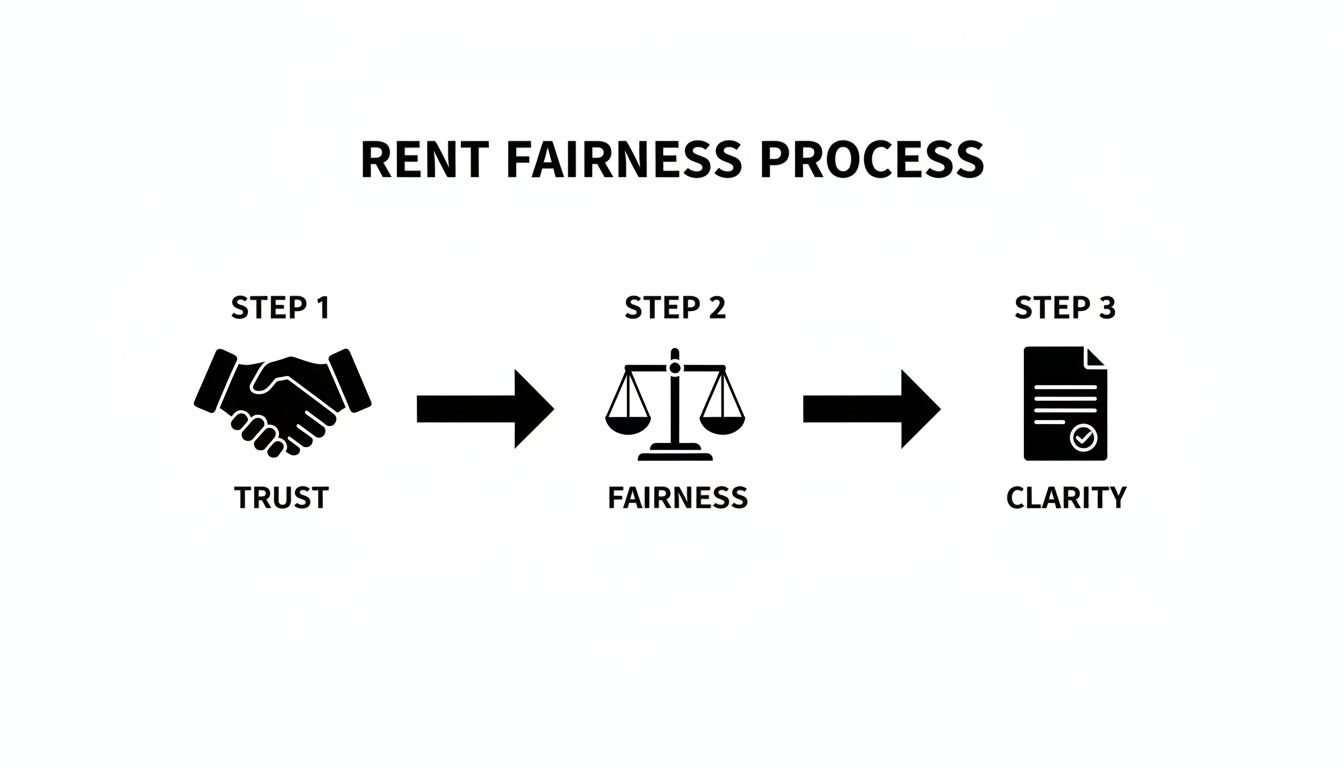
When you start things off with an honest calculation, you immediately build trust. That trust leads to clearer communication and helps you sidestep potential arguments down the line.
Method 1: Using the Actual Number of Days in the Month
This is by far the most popular—and arguably the fairest—way to do it. This method perfectly accounts for the quirky lengths of our months, whether it’s a short 28-day February or a long 31-day July. This ensures the daily rate is spot-on for that specific time frame.
Here's the straightforward formula:
Step 1: Find the Daily Rate: (Total Monthly Rent) / (Number of Days in the Month) = Daily Rent
Step 2: Calculate Prorated Rent: (Daily Rent) x (Number of Days Occupied) = Prorated Rent Due
Because it's so precise, this method is easy to explain to tenants and stands up to any questions they might have. It's especially useful in common rental move-in and move-out scenarios, where dates rarely line up perfectly with the first of the month.
Method 2: Using the Banker’s Month (30 Days)
If you're a landlord who values consistency and simple bookkeeping over absolute precision, the "banker's month" method is a great option. With this approach, you just assume every month has 30 days. It doesn't matter if it's August or February; the number is always 30.
The calculation looks like this:
Step 1: Find the Daily Rate: (Total Monthly Rent) / 30 = Daily Rent
Step 2: Calculate Prorated Rent: (Daily Rent) x (Number of Days Occupied) = Prorated Rent Due
This approach keeps your math standardized all year long, which can make life a little easier. Just be aware that the daily rate will be slightly higher in 31-day months and a bit lower in February. As long as you explain this clearly in the lease, it rarely causes an issue.
Method 3: Using the Number of Days in the Year
This is the most exact method of all, though it’s also the least common. Here, you calculate a daily rental rate based on the entire year, which completely smooths out any monthly variations. You end up with a single daily rate that applies for the whole lease term.
The formula is a little different:
Step 1: Find the Annual Rent: (Total Monthly Rent) x 12 = Total Annual Rent
Step 2: Find the Daily Rate: (Total Annual Rent) / 365 = Daily Rent (or 366 in a leap year)
Step 3: Calculate Prorated Rent: (Daily Rent) x (Number of Days Occupied) = Prorated Rent Due
Key Takeaway: There's no single "best" way to calculate prorated rent. What truly matters is that you choose one method, spell it out clearly in your lease agreement, and use it consistently for every tenant. That kind of transparency is what prevents misunderstandings and makes sure everyone is on the same page.
For a deeper look at these formulas with more real-world examples, check out our guide to help you calculate prorated rent with confidence.
Putting Prorated Rent Calculations into Practice
Theory is one thing, but running the numbers is where it all clicks. Let's walk through a few real-world scenarios to see how prorated rent calculations work when a tenant moves in or out. Seeing the math in action will help you apply these formulas confidently to your own properties.
For consistency, we’ll use a monthly rent of $1,500 across our examples. This will make it easy to see how different move-in dates and calculation methods affect the final amount owed.
Example 1: The Standard Mid-Month Move-In
This is by far the most common situation you'll encounter. Imagine a new tenant is moving in on June 20th. Since June has 30 days, the tenant will be living in the unit for a total of 11 days that month (from the 20th through the 30th).
Let's do the math using the most popular method—basing the calculation on the actual number of days in the month.
Step 1: Find the Daily Rate. You take the full month's rent and divide it by the number of days in that specific month. $1,500 / 30 days = $50.00 per day
Step 2: Calculate the Prorated Amount. Now, just multiply that daily rate by the number of days the tenant will be there. $50.00 x 11 days = $550.00
Simple enough, right? The tenant owes $550 for their partial month in June. It’s a fair and direct calculation that perfectly matches the time they're actually in the property.
Example 2: The Short Month Challenge
Things get a little more interesting with a short month like February. Let’s say your tenant moves in on February 15th during a non-leap year, which has 28 days. This means they'll be in the unit for 14 days.
Daily Rate: $1,500 / 28 days = $53.57 per day (rounded)
Porated Rent: $53.57 x 14 days = $749.98
You'll notice the daily rate is a bit higher in February than it was in June. That's because the same monthly rent is spread over fewer days. This is precisely why using the actual number of days in the month is often seen as the fairest method—it accurately reflects the cost per day for that specific period.
Example 3: When a Long Month Changes the Math
Now, let's see how a 31-day month impacts the numbers. This time, we'll use a monthly rent of $1,000 to show the effect. If a tenant moves in on the 16th of a 30-day month, they're occupying the property for 15 days. The daily rent comes out to $33.33 ($1,000 / 30 days), making the prorated total about $500. You can find more details about how the month's length affects the final amount on TenantCloud.com.
But what happens if that same move-in happens in May, which has 31 days? The tenant is now there for 16 days (the 16th through the 31st).
Daily Rate: $1,000 / 31 days = $32.26 per day (rounded)
Prorated Rent (16 days): $32.26 x 16 days = $516.16
Even a small difference in the daily rate adds up. This is a perfect example of why it's so critical to be consistent with whichever calculation method you choose.
Landlord Tip: The single most important thing you can do is clearly state your prorated rent calculation method in the lease agreement. Whether you use the actual days in the month, a standard 30-day "banker's month," or an annual calculation, putting it in writing avoids any confusion or disputes down the road.
When you document your process, you set clear expectations from the very beginning. This simple act of transparency turns what could be a headache into a smooth, professional part of managing your property.
Integrating Proration into Your Lease Agreement
A handshake or a verbal agreement on prorated rent just won't cut it. To truly protect yourself and make sure everyone is on the same page, you need a specific proration clause written directly into your lease agreement. This one simple step can turn a potential point of conflict into a clear, straightforward procedure, getting the tenancy started on the right foot.
Think of this clause as your opportunity to set the rules of the game upfront. Ambiguity is the enemy of a healthy landlord-tenant relationship, and a well-crafted lease is your best tool for eliminating it. A solid proration clause leaves no room for guessing, establishing a professional and trusting dynamic from day one.

What Your Proration Clause Must Include
A strong proration clause is all about clarity and detail. Vague language is a recipe for headaches down the road.
To make your clause ironclad, be sure it clearly specifies:
The Calculation Method: State exactly how you'll do the math. Are you using the number of days in that specific month? A "banker's month" of 30 days? The annual method? Spell it out in writing.
The Conditions for Proration: Define precisely when proration kicks in, such as for mid-month move-ins or pre-approved early move-outs.
Non-Applicability: It’s just as important to state when rent will not be prorated. A common example is when a tenant breaks the lease and moves out early without permission.
Getting this level of detail into your lease prevents disputes by making the entire process transparent. For property managers handling multiple units, efficiently adding these terms to a digital lease is key. You can simplify the entire rental agreement process by mastering a flawless online lease signing workflow.
Sample Language for Your Lease
You don't need to be a lawyer to draft this, and there's no need to reinvent the wheel. Using standard, accepted language is usually the safest bet.
Here’s a sample clause you can adapt for your own lease agreement:
Prorated Rent: In the event the Lease Term commences on a day other than the first day of a calendar month, Tenant shall pay to Landlord as prorated rent an amount equal to the monthly rent of [Monthly Rent Amount], divided by the actual number of days in that specific month, multiplied by the number of days Tenant occupies the Property during that month. This prorated rent payment is due on or before the lease commencement date.
Always Check Local Landlord-Tenant Laws
While prorating rent is a common and fair practice, landlord-tenant laws can differ dramatically from one state—or even one city—to the next. Some jurisdictions might have specific regulations dictating how you must calculate or apply prorated rent.
Before you finalize your lease, always take the time to review your local landlord-tenant statutes or have a legal professional look it over. This crucial step ensures your proration clause is not just clear, but fully compliant with the law, saving you from potential legal trouble. You can learn more about these best practices in our complete guide to fair billing.
Find it here: https://www.mypropertymanaged.com/post/how-is-rent-prorated-a-landlord-s-guide-to-fair-billing
Common Questions About Prorated Rent
Even after you've crunched the numbers, you're bound to have some questions about prorated rent. It's a topic where specific scenarios pop up all the time for both landlords and tenants. Getting ahead of these common questions is the key to keeping things clear, professional, and dispute-free.
Let's walk through some of the most frequent questions we hear from landlords. Having these answers ready will help you manage your property with confidence and fairness.
Are Landlords Legally Required to Prorate Rent?
This is the big one, and the answer is... it depends. There’s no simple yes or no that applies everywhere. The legal requirement to prorate rent can change dramatically depending on your state or even city laws. Some jurisdictions require it for move-ins, while others leave it entirely up to what’s in the lease.
But here’s the thing: legal requirement or not, prorating rent is just good business. Think of it as a best practice that sets a professional tone from day one. When you only charge tenants for the days they actually live in the property, you immediately build trust. It’s a simple act of fairness that prevents that initial friction of a tenant feeling like they were overcharged before they even unpacked.
Which Calculation Method for Prorated Rent Is Best?
There’s no single “best” way to do it—the right choice really comes down to your priorities. Are you looking for maximum fairness, easy bookkeeping, or pure precision?
Here's a quick breakdown of the main options:
Actual Days in the Month: This is the most common method for a reason. It's widely seen as the fairest approach, it's easy to explain to tenants, and the daily rate perfectly reflects that specific month.
Banker's Month (30 Days): If simplicity is your goal, this is your method. The daily rate is the same whether it's February or August, which can make your accounting a little smoother.
Annual Calculation (365 Days): This is the most technically precise method. By averaging the cost over the entire year, you get one consistent daily rate that smooths out any monthly variations.
The most important takeaway here is to pick one method and stick with it. State it clearly in your lease agreement and apply it consistently for every single tenant. Consistency is your best friend.
How Should You Handle Prorated Rent for Move-Ins and Move-Outs?
For move-ins, the process is pretty straightforward. You'll typically collect the prorated rent payment right at the beginning, along with the security deposit and the first full month's rent. This gets all the initial payments handled before you hand over the keys.
Move-outs are a bit different. Proration usually only comes into play if you and the tenant have agreed in writing that they can leave mid-month. In that case, you’d adjust their final rent payment. It's crucial to remember that this doesn't apply if a tenant breaks their lease and leaves early without your consent. Tenants often have their own questions, so it can be helpful to point them to resources that explain how prorated rent works from their perspective.
A Critical Distinction: Never, ever prorate the security deposit. The deposit is a fixed amount meant to cover potential damages or unpaid bills after a tenant moves out. It has nothing to do with monthly rent. Always collect the full deposit amount as stated in your lease and permitted by law.
By tackling these questions proactively, you set clear expectations, minimize confusion, and help maintain a positive, professional relationship with your tenants from start to finish.
At Keshman Property Management, we handle every detail of the rental process with professionalism and clarity. We treat your property with personalized attention, drawing on our 20 years of experience to make ownership rewarding and stress-free. If you're looking to maximize your earnings with a transparent and dedicated partner, explore our services at https://mypropertymanaged.com.


Comments