
Rent Collection Services: A Guide for Rental Owners

Updated: Sep 13
For landlords and property investors, the first of the month often brings a familiar mix of anticipation and anxiety. Chasing down checks, sending "gentle" reminders, and making trips to the bank—it's a time-consuming cycle that can feel more like a part-time job than a passive investment.
What if you could set that entire process on autopilot?
What Are Rent Collection Services Really?

Think of a rent collection service as a dedicated financial middleman for your rental business. Instead of you personally handling every payment, a specialized platform steps in to automate the entire workflow. It sends reminders, processes digital payments, tracks who has paid, and deposits the funds directly into your account.
Essentially, it transforms the unpredictable, hands-on task of collecting rent into a reliable and streamlined system. This isn't just about convenience; it's about professionalizing your operation and reclaiming your time.
Moving Beyond Manual Methods
Relying on paper checks, cash, or money orders in today's world is not just old-fashioned—it's a massive operational drag. Checks can bounce or get lost. Cash creates security risks and leaves a poor paper trail. These manual methods are riddled with inefficiencies that only get worse as you scale your portfolio.
This shift toward professional management is happening on a global scale. The housing rental service market was valued at an incredible $1.56 trillion in 2023 and is projected to hit $2.56 trillion by 2032. A huge driver of that growth is the adoption of tools that bring efficiency to property management. You can find more details on these trends in a report on the global housing rental service market.
A dedicated rent collection service acts as a professional buffer between you and your tenants. It handles the financial logistics, automates reminders, and manages late fees according to your lease, preserving a positive relationship while enforcing financial discipline.
To see the difference clearly, let's compare the two approaches side-by-side.
Traditional vs. Professional Rent Collection at a Glance
This table breaks down the core differences between the old way of doing things and using a modern service.
Aspect | DIY Rent Collection | Professional Rent Collection Services |
|---|---|---|
Payment Method | Manual (checks, cash, money order) | Automated (ACH, credit/debit card) |
Cash Flow | Unpredictable; depends on tenant action | Consistent; scheduled, on-time payments |
Time Investment | High (reminders, deposits, follow-ups) | Minimal (set it and forget it) |
Record-Keeping | Manual spreadsheets; prone to errors | Automatic digital ledger for all transactions |
Late Fees | Awkward conversations; inconsistent enforcement | Automated calculation and notification |
Tenant Experience | Inconvenient; requires manual effort | Simple and modern; offers payment flexibility |
As you can see, the move to a professional service isn't just an upgrade—it's a fundamental shift in how you run your business.
Why It's a Strategic Business Decision
Adopting a formal rent collection system goes far beyond simply getting paid on time. It's a strategic move that solves some of the biggest headaches landlords face.
Consider what these services eliminate:
Inconsistent Cash Flow: Automated debits and reminders make your rental income predictable, which is crucial for budgeting and growth.
Time-Consuming Administration: Forget spending hours chasing payments and logging them in a spreadsheet. The system does it for you.
Difficult Tenant Conversations: Let the platform be the "bad guy." It handles late fee notifications impartially, based on the terms of your lease.
Poor Record-Keeping: Every payment is automatically tracked, creating a clean, accurate financial history for tax time and analysis.
Ultimately, outsourcing the nuts and bolts of rent collection frees you up to think like a true investor. You can spend your time finding your next property, overseeing improvements, and focusing on the big picture—not chasing down last month's rent.
How Modern Rent Collection Actually Works

To really get what modern rent collection services are all about, stop thinking of them as just a tool. It’s more like a connected digital ecosystem built to get money from your tenant's account into yours—smoothly, securely, and with as little manual effort as possible. It takes all the old-school steps like writing checks, driving to the bank, and logging payments by hand and replaces them with a smart, tech-driven workflow.
This whole process runs on a few key technologies, each designed for different situations but all driving toward the same goal: getting you paid on time, every time. It’s no surprise that landlords who make the switch often say they get back nearly 20 hours weekly that used to be spent on admin. That’s a game-changer for growing your portfolio.
The secret sauce is automation. A big part of how modern rent collection actually works involves using tools like email automation for recurring emails to send out reminders. A simple automated nudge before rent is due can slash the number of late payments you have to chase down.
The Power of Online Tenant Portals
Imagine giving every tenant their own personal, 24/7 digital hub for anything related to their lease. That's essentially what an online tenant portal is. It’s a secure website or app where they can log in anytime to handle payments and check their rental details.
This self-service approach is a huge win. It empowers your tenants and takes a ton of work off your plate. Through the portal, they can:
Schedule Payments: Set up a one-time payment or, even better, a recurring "autopay" from their preferred account.
View Payment History: Pull up a complete record of every payment they’ve ever made and download receipts.
Check Balances: Instantly see what they owe, including any late fees or credits you've applied.
Update Information: Securely change their payment method or contact details without needing to call you.
Portals turn rent collection from a monthly headache into a simple, transparent transaction. They deliver the kind of convenience and clarity that modern renters just expect.
By offering a dedicated portal, you provide a professional experience that rivals large apartment complexes. This enhances tenant satisfaction and retention while giving you a clear, automated system for tracking every dollar.
Understanding the Payment Mechanisms
Behind that slick portal interface, a few different technologies are working in the background to move the money. Each one has its place.
1. ACH (Automated Clearing House) TransfersThink of ACH as a direct, secure pipeline between your tenant's bank and yours. It's the exact same system businesses use for direct deposit payroll and other automatic bill payments. For landlords, ACH is usually the cheapest way to go, as many services offer it for free or for a small flat fee. Tenants link their bank account one time, and the rent gets pulled automatically on schedule.
2. Credit and Debit Card PaymentsGiving tenants the option to pay by card is all about flexibility. While you'll almost always see a processing fee (typically 2.9% to 3.5%), many landlords simply pass this on to the tenant as a convenience fee. The ability to pay with a credit card can be a lifesaver for a tenant in a temporary cash crunch, which means you’re more likely to get paid on time.
3. Digital Wallets and Mobile AppsMore and more people live on their smartphones, so accepting payments from digital wallets like Apple Pay or Google Pay is quickly becoming standard. These methods are incredibly fast and secure, letting a tenant pay their rent in just a few taps.
The best part? Every single one of these transactions is automatically recorded and tracked. If you want to dive deeper into how this financial data is organized, check out our guide on what a rent ledger is. Having that solid digital paper trail is non-negotiable for keeping your books straight and staying protected legally.
What Are the Real Benefits for Landlords and Investors?
Let's move past the simple idea of convenience. What does using a professional rent collection service really do for your business? For most landlords and investors, it’s the difference between having a stressful second job and owning a profitable, hands-off asset.
Think about two landlords. Landlord A spends the first week of every month chasing rent. He’s sending text reminders, making awkward phone calls, and then driving to the bank to deposit a random assortment of checks. Meanwhile, Landlord B gets a simple notification that rent has been deposited directly into her account on the first of the month. She's already focused on finding her next investment property.
Which one do you want to be?
Finally Achieve Consistent, Predictable Cash Flow
The single biggest win here is stabilizing your income. When tenants can schedule recurring payments, rent just shows up on time, every single time. This consistency gets rid of those stressful cash flow gaps that make it hard to pay the mortgage, property taxes, or cover an unexpected repair.
Predictable income is the bedrock of any healthy rental business. It means you can actually budget for future projects, plan your next acquisition, and just operate with a sense of financial calm instead of constant uncertainty.
There's a reason the entire industry is shifting this way. The rent collection slice of the property management market in North America is set to grow at a massive 7.0% CAGR from 2025 to 2033. This boom is almost entirely driven by digital payment platforms and automated systems that cut down late payments and smooth out cash flow. You can dig into more property management market growth on grandviewresearch.com.
Get Your Most Valuable Asset Back: Your Time
Let's be honest: chasing down late rent is a soul-crushing time-suck. The hours you spend sending reminders, answering calls, and manually logging every payment add up faster than you think.
Imagine what you could do with that time back. Instead of chasing checks, you could be:
Analyzing new deals to grow your portfolio.
Managing property upgrades that boost your rental income.
Networking with agents, lenders, and contractors who can help you scale.
This is how you stop working in your business and start working on your business. It’s the critical mindset shift that separates a casual landlord from a serious investor.
A dedicated service acts as a professional buffer, impartially handling late fees and enforcement according to the lease. This preserves the landlord-tenant relationship while maintaining the financial discipline necessary for a successful operation.
Reduce Tenant Drama and Improve Relationships
Nobody enjoys asking for money, especially when it’s late. It’s awkward, it’s confrontational, and it can quickly sour a good landlord-tenant relationship. A professional rent collection service takes you out of that uncomfortable position.
The system becomes the "bad guy." Automated reminders and late fee notifications are sent based on the clear terms of the lease, not your personal feelings. This impartial approach ensures every tenant is treated fairly and professionally, which minimizes disputes and keeps the relationship positive. The service enforces the rules so you can focus on being a great property owner.
Good financial records are key to this process. If you need to get your books in order, take a look at our complete guide to bookkeeping for rental property.
Bulletproof Your Legal and Financial Compliance
Using a dedicated service creates a perfect, indisputable digital paper trail. Every single payment, communication, and late fee is automatically time-stamped and logged. This clean record-keeping is a lifesaver when it comes to:
Tax Time: No more digging through bank statements to sort out your income.
Disputes: Got a tenant claiming they paid? You have clear, undeniable evidence.
Evictions: A clear payment history is critical if you ever have to go to court.
By automating your documentation, you’re building a fortress of compliance around your investment, protecting it from headaches and potential legal challenges down the road.
Getting to the Bottom of Pricing Models and Hidden Fees
When your money is on the line, you need absolute clarity. Trying to figure out the cost of rent collection services can feel like wading through mud, but it all starts with understanding the common pricing structures. The goal is to look past the shiny advertised price and nail down the real, total cost.
You'll generally run into two main models: a flat fee per unit or a percentage of the rent. Each has its pros and cons, and the best fit for you really depends on your monthly rent roll and how many doors you manage.
Flat-Fee vs. Percentage-Based Pricing
A flat-fee model is as simple as it sounds. You pay a set dollar amount for each unit, every month, no matter what the rent is. For instance, a service might charge $25 per door. This predictability is fantastic for budgeting, especially if you own higher-end properties where a percentage fee would quickly add up.
The other common approach is the percentage-based model. Here, the service takes a cut of the monthly rent collected, which typically falls between 3% and 10%. So, on a $2,000 rental, a 5% fee works out to $100 a month. You’ll often see this model bundled into more comprehensive property management packages.
To see how these charges fit into the broader landscape of property management costs, our guide on the topic offers a great deep dive: https://www.mypropertymanaged.com/post/your-guide-to-property-management-fee-structures.
These fees pay for services that deliver tangible benefits, helping you justify the cost.
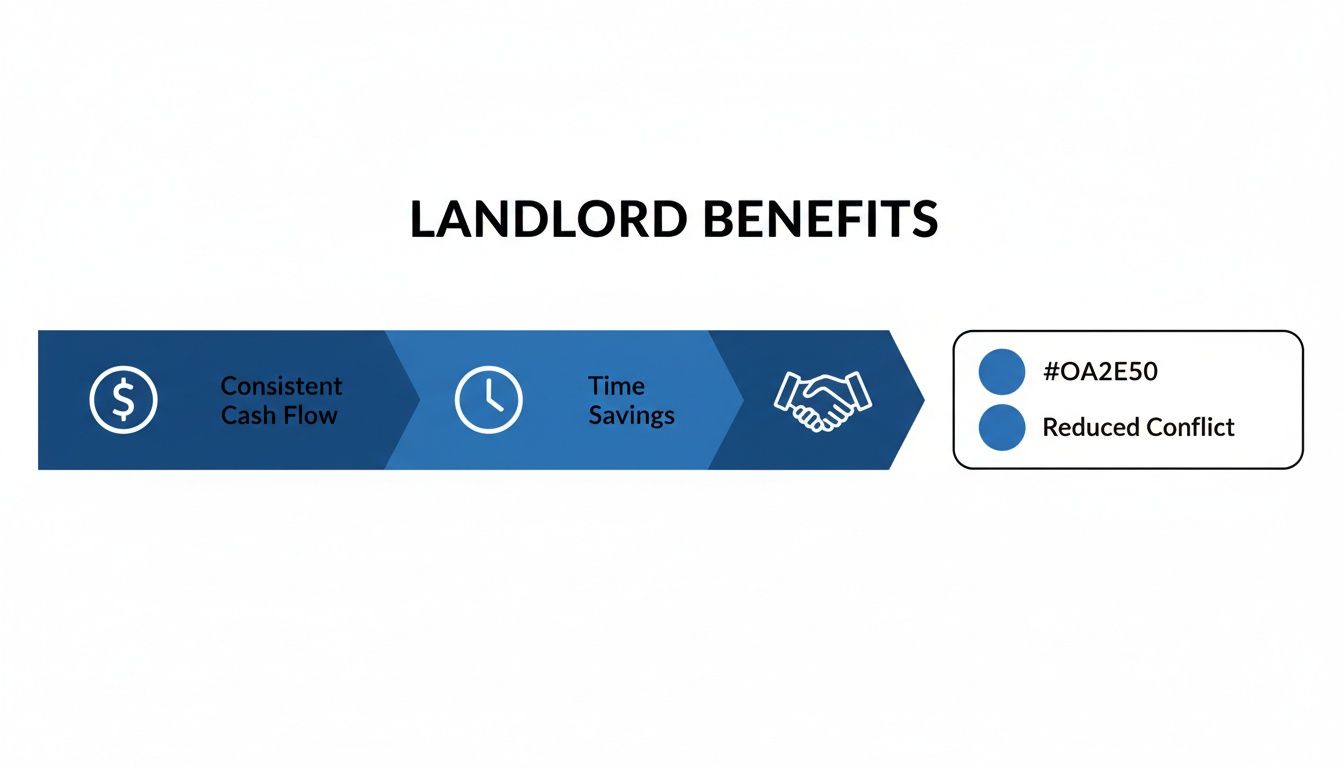
As you can see, the right service doesn't just collect money—it saves you time, smooths out cash flow, and cuts down on stressful tenant interactions.
Watch Out For These Common Hidden Fees
The price on the homepage is almost never the full story. Many services have a list of extra charges that can sneak up on you if you're not carefully reading the fine print.
Here are a few of the most common "gotchas" to look for:
Setup or Onboarding Fees: A one-time charge just to get your account and properties loaded into their system.
Tenant Onboarding Charges: Some platforms will ding you a small fee every time you add a new tenant.
ACH/Bank Transfer Fees: While often free, some providers still charge a small fee, like $1-$2, for each bank transfer.
Credit Card Processing Fees: This is a big one. Expect to see fees around 2.9% to 3.5% of the transaction value. The good news is most platforms let you pass this cost on to the tenant.
Late Fee Surcharges: The service might take a percentage of any late fees they successfully collect for you.
Insufficient Funds (NSF) Fees: A penalty fee if a tenant's payment bounces.
To give you a clearer picture, here’s a quick breakdown of what you might encounter.
Common Fee Structures for Rent Collection Services
This table breaks down the typical pricing models and potential additional costs property owners might encounter.
Fee Type | Common Structure | Example Cost | What to Watch For |
|---|---|---|---|
Primary Service Fee | Flat-rate per unit/month or percentage of rent collected | $10-$30/unit or 3%-10% of rent | Is the fee based on rent collected or rent due? |
Onboarding Fee | One-time charge at setup | $50-$200 | Ask if this can be waived with an annual contract. |
Payment Processing | Fee per transaction for ACH or credit cards | $1-$2 for ACH, 2.9%+ for cards | Can you pass credit card fees to the tenant? |
Ancillary Fees | Charges for bounced payments (NSF) or a cut of late fees | $25-$50 for NSF, 10%-50% of late fee | Understand how these are split between you and the provider. |
Looking at a complete fee schedule is the only way to get a true side-by-side comparison of different providers.
Before you sign anything, always demand a complete, itemized fee schedule. Real transparency means no surprises on your statement, period.
Questions Every Landlord Should Ask a Potential Provider
When you're vetting a rent collection service, make sure you ask these questions directly:
Is your pricing a flat fee per unit or a percentage of the rent?
Do you charge any one-time setup or onboarding fees?
Are there fees for standard ACH (bank-to-bank) transfers?
What are your credit and debit card processing fees, and can I make the tenant responsible for them?
Do you take a cut of late fees or charge me for bounced payments?
Are there any extra costs for things like customer support, lease tools, or maintenance coordination?
Asking these direct questions helps you find a true partner, not just a vendor with a knack for hiding fees. A provider that values your business will have simple, clear answers.
Staying Compliant with Rent Collection Laws
When you're a landlord, collecting rent isn't just about cashing a check. You're stepping into a world governed by a tangled web of local, state, and federal laws. So many landlords, even with the best intentions, trip over legal wires they didn't even know were there, especially with things like late fees and payment notices.
This is exactly where professional rent collection services become an indispensable part of your toolkit. These platforms aren't just about convenience; they’re built with legal guardrails baked right in. They help you sidestep costly lawsuits and fines by making sure your processes follow the letter of the law for your specific area. It's like having a compliance expert built directly into your payment workflow.
Navigating the Legal Minefield
Landlord-tenant law can be a real headache. The rules change dramatically not just from state to state, but often from one city to the next. A simple slip-up—like charging a late fee that’s just $10 over the legal limit—can spark a messy dispute with a tenant or even get parts of your lease thrown out in court.
A good rent collection service keeps you on the straight and narrow with these critical regulations:
Late Fee Caps: The system automatically calculates and applies the correct late fee based on local laws, so you never have to worry about overcharging.
Mandatory Grace Periods: It honors any legally required grace periods before a late fee ever kicks in, preventing you from penalizing a tenant too soon.
Proper Payment Notices: It sends out legally compliant notifications for late or missed payments, building the paper trail you need if things escalate.
Receipt Requirements: Tenants get an instant, detailed digital receipt for every single payment, which satisfies legal record-keeping rules.
This shift toward digital tools is completely changing the game. The entire property management service market, which includes rent collection, is expected to explode from $27.2 billion in 2024 to $67.8 billion by 2035. This massive growth is being fueled by smart, AI-driven tools that deliver the accuracy and security modern landlords and tenants demand. You can read more about this trend in this report on the evolving property management service market.
Using a compliant rent collection service isn't just about making your life easier; it's a powerful risk management strategy. It ensures your financial practices are fair, consistent, and legally defensible, protecting your investment from preventable legal challenges.
Fair Housing Act Considerations
Your payment policies have to be a one-size-fits-all deal. To steer clear of discrimination claims, you must apply your rules consistently to every single tenant. The Fair Housing Act (FHA) is crystal clear: you can't treat people differently based on protected characteristics like race, religion, or family status.
An automated rent collection system is your best defense here.
By using a rent collection service, you create a uniform policy for everyone. The software handles late fees, reminders, and payment processing based on the rules you set, with no room for human bias. This systematic approach removes any hint—or accusation—of favoritism in how you manage tenant finances.
This consistency is non-negotiable. If you decide to waive a late fee for one tenant but enforce it for another, you’re practically inviting a discrimination complaint. A platform ensures the terms of your lease are the only rules that apply, and they're enforced the same way for every resident, every time. This isn't just a good idea; it's a crucial shield against very serious legal trouble.
Choosing the Right Rent Collection Partner
Picking a partner to manage your rental income is a big deal. It's not just a software decision; it's a core business decision. Get it right, and it feels like you’ve hired the most reliable employee you’ve ever had—someone who’s efficient, dependable, and always has an eye on your cash flow. Get it wrong, and you're stuck with a system that creates more problems than it solves.
This isn't just about finding a service with a slick-looking app. You need a partner that genuinely fits how you run your business and helps you meet your financial goals. The best services do way more than just transfer money. They create a smooth, professional experience for your tenants, give you a crystal-clear view of your finances, and keep you protected with solid security and compliance. To find that fit, you have to dig deeper than the marketing promises and really look at what makes a service stand out.
Kick the Tires on the Technology and User Experience
Let's be honest: if a platform is clunky or confusing, nobody's going to use it. A frustrating system for your tenants means you’ll be the one fielding tech support calls instead of collecting rent. The technology has to be rock-solid and intuitive, period.
As you look at different providers, put yourself in both your shoes and your tenant's shoes. Think about:
The Tenant Portal: Is it dead simple for a tenant to log in, check what they owe, and pay? A clean, mobile-friendly interface is absolutely essential. Most tenants will be paying from their phones.
The Landlord Dashboard: Can you see who has paid, track income across all your units, and run reports without pulling your hair out? Your dashboard should give you a quick, comprehensive snapshot of your portfolio's financial health.
Automation: Does it handle the busywork for you? Look for features like automatic recurring payments, late fee calculations, and payment reminders. Good automation is what frees up your time.
A great user experience isn't just a "nice-to-have." Data shows that landlords who move to a good online platform can save nearly 20 hours per week on admin work, but that only happens when the technology actually works for you, not against you.
Scrutinize the Fee Structure and Support
Nothing sours a partnership faster than surprise fees. We've already talked about how hidden costs can eat into your profits, so transparency here is non-negotiable. A good partner will lay out all their fees upfront, with no smoke and mirrors. But cost is only half the equation. You also need to know there’s a real human ready to help when things go sideways.
A great rent collection partner is more than a software provider; they are an extension of your business. Their customer support should be responsive, knowledgeable, and genuinely invested in helping you resolve issues quickly.
Before you sign on the dotted line, make sure you get straight answers to these questions:
Can I see a complete fee schedule? Ask for a document that lists every single potential charge, from setup fees to what happens when a payment bounces.
How long does it take to get my money? You need to know the standard processing time from when a tenant pays to when the money hits your account. For ACH transfers, this is typically 2-5 business days.
What does your customer support actually look like? Find out their hours, average response times, and if you’ll get to talk to a person who can solve your problem.
How do you handle disputes or failed payments? Understand their exact process. What steps do they take when a payment fails or is challenged?
Choosing your rent collection partner is a strategic move that pays you back in time, predictable income, and peace of mind. By focusing on smart technology, transparent pricing, and real support, you can find a service that helps you run a more professional and profitable business.
Frequently Asked Questions
Jumping into the world of rent collection services can definitely stir up a few questions. Getting straight answers is the best way to feel good about the decision to professionalize how you run your rental business. Let's tackle some of the most common things landlords ask when they're thinking about making a change.
How Much Do Rent Collection Services Typically Cost?
Pricing isn't one-size-fits-all, but you'll usually see one of two approaches. Some companies charge a percentage of the monthly rent, typically falling somewhere between 3% and 10%, which is common if you bundle it with full-service property management. Others go with a simple flat fee per door, which can be anywhere from $10 to $30 a month if you just want the payment processing.
But the sticker price isn't the whole story. It's smart to ask for a complete fee schedule to see what else might pop up. Look out for one-time setup costs, charges for handling late payments, or small transaction fees on things like ACH bank transfers.
What Happens If a Tenant Pays Late Through the Service?
This is honestly one of the biggest perks of using a professional service. It takes the awkward, confrontational part of chasing down late rent completely off your plate. The system handles it automatically, all based on the rules in your lease and local landlord-tenant laws.
Here’s how it usually plays out:
Automatic Fee Calculation: The moment the grace period ends, the platform crunches the numbers and applies the correct late fee.
Automated Notifications: It then sends official late payment reminders to the tenant, usually by email or text.
Detailed Record-Keeping: Everything is time-stamped and logged, which gives you a rock-solid paper trail if you ever need it.
This approach keeps things impartial and consistent for every single tenant. It removes the emotion and frees you up from being the "bad guy."
Can I Use a Service for Just One Property?
You bet. Most of the rent collection platforms out there today are built to grow with you. They work just as well for a landlord with a single-family rental as they do for an investor with a huge portfolio.
For owners with just one property, these tools can be a game-changer. You get access to the same powerful systems and legal safeguards that the big management firms use, letting you run your small operation with total professionalism.
Is My Financial Information Secure with These Services?
Any reputable rent collection service puts security at the very top of its list. They know they're dealing with sensitive bank details and build their systems to protect that information at all costs.
A good rule of thumb is to look for services that mention bank-level, 256-bit encryption and use well-known, secure payment gateways to handle the money. This is the technology that shields both your account information and your tenants' data from anyone who shouldn't see it. Always ask about a provider's security protocols before you sign up.
Choosing a service that takes security and compliance seriously helps you build trust with your tenants while protecting your own bottom line. It’s a non-negotiable feature of any platform worth its salt.
Ready to transform your rental property management and maximize your returns? Keshman Property Management offers transparent, expert services with no hidden fees, backed by 20 years of hands-on experience. Discover a more profitable and less stressful way to own rental properties by visiting us at https://mypropertymanaged.com.


Comments