
How Is Rent Prorated? A Landlord’s Guide to Fair Billing
- Sarah Porter

- Dec 27, 2025
- 13 min read
For landlords juggling a million things, prorated rent is a simple, fair way to handle tenants who don't move in or out on the first of the month. Instead of charging for a full month they won't be there, you just calculate what they owe for the specific days they actually occupy the property. Getting this right is a small detail that makes a big difference in professional property management.
A Quick Guide for Landlords on Prorated Rent

Knowing how to calculate prorated rent isn't just a nice gesture; it's a core business practice. It helps you build trust from the very start and heads off potential arguments down the road. It shows you're a fair, professional landlord, which is exactly the reputation you want.
Let's be honest, move-in dates rarely line up perfectly with the first of the month. Offering a flexible start date can be your secret weapon to fill vacancies faster, and prorating the rent makes that possible. It turns what could be a point of confusion into a smooth, welcoming experience for your new tenant.
Why Prorating Matters
Having a clear, consistent prorating policy is a win-win. It signals transparency and fairness, which are the bedrock of any solid landlord-tenant relationship.
Here's why it's a non-negotiable part of my own management playbook:
It Builds Tenant Trust: When a tenant sees you're charging them fairly from day one, it sets a positive, respectful tone for the entire lease.
It Prevents Disputes: A prorating clause in your lease agreement eliminates any guesswork or arguments about that first or last month's rent. Everything is in writing.
It Reduces Vacancy Time: Being flexible with move-in dates makes your property far more appealing. More applications mean you can fill units faster.
It Keeps Your Books Accurate: Proper calculations mean you're collecting the exact income you're owed for every single day of occupancy. No more, no less.
Prorating is just about making sure a tenant pays only for the time they're actually in the unit. For example, say the monthly rent is $1,560 for a 699-square-foot apartment (a recent national average). If a new tenant moves in on the 15th of a 31-day month, they’re responsible for 17 days of rent, not the full 31. This simple fairness is essential, especially in markets where rents have been climbing.
Of course, getting the rent right is just one piece of the puzzle. Once you've got your prorating method down, it's smart to get a handle on the bigger financial picture. This landlord's guide to taxes on rental income is a great resource to make sure all your property's finances are buttoned up.
For a quick reference, here's a simple breakdown of the core concepts of prorated rent.
Prorated Rent At a Glance Key Concepts
Concept | Description for Landlords |
|---|---|
What It Is | A partial rent payment is calculated for a tenant occupying a property for only a portion of a standard rental period (usually a month). |
When to Use It | Most commonly for mid-month move-ins or move-outs. |
Why It's Important | It demonstrates fairness, prevents payment disputes, and can help you fill vacancies faster by offering flexible start dates. |
Calculation Basis | Typically based on the number of days in the specific month or a consistent 30-day "banker's month." Consistency is key. |
In short, making prorated rent a standard part of your process is a small effort that pays off by creating smoother turnovers and better tenant relationships from the start.
Picking Your Prorated Rent Calculation Method
When it's time to prorate rent, you’ll quickly discover there’s no single, universally mandated formula. Landlords generally lean on one of two common methods. Your choice will likely come down to what's outlined in your lease, any local landlord-tenant laws, or simply your own preference for consistency.
Getting a handle on both approaches is crucial. The right method for your business ensures your numbers are fair, transparent, and easy to explain to a new tenant, heading off any potential confusion before it starts.
The Per Diem Method: Based on the Month's Actual Days
For landlords who prioritize precision, calculating a daily rate based on the exact number of days in that specific month is the way to go. This method is often seen as the fairest because it accurately reflects the shorter and longer months. After all, February is not the same as August.
Here’s how the math breaks down:
(Total Monthly Rent / Number of Days in the Month) x Number of Days Tenant Lives There = Prorated Rent
Let's run through a quick example. A tenant is moving into a $2,100/month apartment on July 20th. Since July has 31 days, the daily rate is $67.74 ($2,100 / 31). They’ll be in the unit for 12 days (from the 20th to the 31st), so their prorated rent comes out to $812.88.
But see what happens in a short month. If that same tenant moved in on February 10th (in a non-leap year), you'd divide by 28 days. This gives you a higher daily rate of $75.00 ($2,100 / 28). That small difference is the defining feature of this approach.
The "Banker's Month" Method: Using a Flat 30 Days
If you value simplicity and consistency over granular accuracy, the "Banker's Month" method is a fantastic choice. This popular approach standardizes the math by assuming every single month has 30 days. No need to check the calendar.
The formula is just as simple:
(Total Monthly Rent / 30) x Number of Days Tenant Lives There = Prorated Rent
Let's go back to that $2,100/month apartment. Using the 30-day method, the daily rent is always a clean $70.00 ($2,100 / 30), every single time.
July Move-In (12 Days): $70.00 x 12 = $840.00
February Move-In (19 Days): $70.00 x 19 = $1,330.00
This method makes the math quick and uniform, which is always a bonus for busy landlords. Anything that simplifies rent collection is a win. On that note, if you’re looking to make the whole process smoother, it's worth learning how to choose a rent collection company to handle payments automatically.
The Bottom Line: The only real difference is the number you divide by. The per diem method uses the actual days in the month (28, 29, 30, or 31), while the Banker's Month method always uses 30. This can cause minor differences in the final rent amount.
So, which one should you use? The actual days method is technically more precise, but the 30-day method is foolproof and predictable. Honestly, the most important thing isn’t which method you pick, but that you pick one and use it consistently. Just be sure to spell out your chosen method clearly in the lease agreement to keep everyone on the same page.
Calculating Prorated Rent with Real-World Examples
It's one thing to understand the concept of prorated rent, but it’s another to actually sit down and crunch the numbers. This is where the rubber meets the road. So, let’s walk through the exact calculations you’ll face as a landlord.
We'll start with the most common scenario out there: a great new tenant is ready to go, but they can't move in on the first of the month. How do you figure out what they owe for that first, partial month? Getting this right from the start prevents confusion and sets a professional tone for the entire tenancy.
The process boils down to two main approaches, which you can see laid out here.
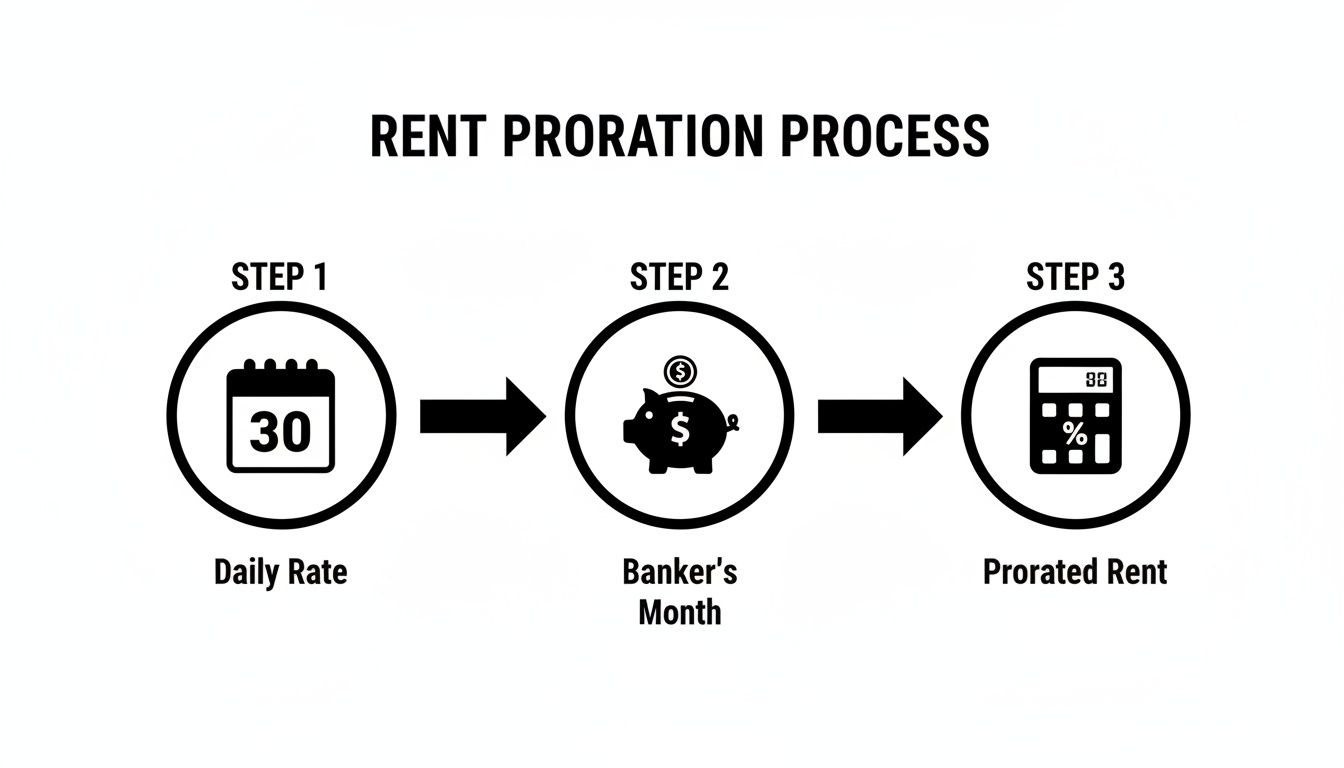
As the visual shows, you’re either going to calculate the daily rent based on the actual number of days in the month or use a standardized 30-day period. Both get you to a fair number, but the path—and sometimes the final total—can differ.
Mid-Month Move-In Scenario
Let's put some real numbers to this. Imagine you're leasing a property for $2,200 a month, and the tenant is moving in on June 20th. Let's calculate what they owe using both methods to see how they stack up.
Calculation Using the Per Diem (Actual Days) Method
First, we need the number of days in June, which is 30.
Find the daily rate: $2,200 / 30 days = $73.33 per day
Count the days they'll be there: From June 20th through June 30th is 11 days. (Don't forget to include the move-in day!)
Calculate the final amount: $73.33 x 11 days = $806.63
So, for their first partial month, the tenant would pay $806.63. This method is popular because it’s precise—it reflects the true daily cost for that specific month.
Calculation Using the Banker's Month (30-Day) Method
Now, let's do the same math but with the simplified 30-day approach. This method is often favored for its consistency, treating every month as if it has 30 days.
Find the daily rate: $2,200 / 30 days = $73.33 per day
Count the days they'll be there: Still 11 days.
Calculate the final amount: $73.33 x 11 days = $806.63
In this case, the result is identical. Why? Because June happens to have exactly 30 days. You'll only see a difference when dealing with months that have 31 or 28/29 days.
Comparing Methods in a Longer Month
Let's tweak the scenario to highlight that difference. The move-in is now May 20th, rent is still $2,200, but May has 31 days.
Per Diem Method (31 Days):
Daily Rate: $2,200 / 31 = $70.97
Payable Days (May 20-31): 12 days
Prorated Rent: $70.97 x 12 = $851.64
Banker's Month Method (30 Days):
Daily Rate: $2,200 / 30 = $73.33
Payable Days: 12 days
Prorated Rent: $73.33 x 12 = $879.96
See the difference? In a longer month, the Banker's Month method leads to a slightly higher prorated rent because the daily rate is calculated from a smaller number of days.
Key Takeaway: The method you choose can create small but real differences in what your tenant owes. That’s why it is absolutely critical to state your prorating method clearly in the lease agreement. It removes all ambiguity.
Getting these calculations right is more than just good bookkeeping; it directly impacts your bottom line. In competitive markets, aligning move-ins with peak rental seasons is a smart strategy, especially when 30-40% of leases start mid-month after holidays. For an average $1,902 two-bedroom unit, a tenant moving in on day 10 of a 30-day month would pay around $1,332.40, preventing that income from being lost. You can learn more about how market trends influence rental income by reading the full research about rent growth on Stessa.com.
These calculations are a core part of managing your rental income, and solid organization is key. To get a better handle on your finances, take a look at our guide on bookkeeping for rental property.
Including Prorated Rent in Your Lease Agreement

Every successful tenancy is built on clear expectations, and the lease agreement is your blueprint for that success. When it comes to something like prorated rent, ambiguity is your worst enemy. A vague clause—or worse, no clause at all—is one of the fastest and most avoidable routes to a landlord-tenant dispute.
Think of your lease as the single source of truth for the tenancy. It needs to spell out your prorated rent policy in plain English, leaving absolutely no room for misinterpretation. This isn't just a suggestion; it's a critical step in protecting your investment and keeping your business relationship professional from day one.
Crafting a Clear Prorated Rent Clause
Your lease clause doesn't need to be dense with legalese to be legally sound. In my experience, clarity and directness are far more powerful. The goal is simple: anyone should be able to read it and know exactly how a partial month's rent will be calculated.
To get this right, you'll want to start with a solid rental lease agreement template that you can adapt. Your final clause should hit these essential points:
Specify Your Calculation Method: State clearly whether you use the daily "per diem" method (based on the actual days in the month) or the "pro rata" method (using a standard 30-day month). This is the most important detail to include.
Define When It Applies: Make it clear that the policy covers both mid-month move-ins and, if applicable, mid-month move-outs.
Show the Formula: Briefly outline the math involved, like "(Monthly Rent / Number of Days in Month) x Days of Occupancy."
Sample Lease Clause Snippet:"In the event the Lease Term commences or terminates on a day other than the first or last day of a calendar month, the rent for such partial month shall be prorated. The prorated amount will be calculated by dividing the total monthly rent by the actual number of days in that specific month to determine a daily rate, then multiplying the daily rate by the number of days the Tenant occupies the Property during that month."
To ensure your clause is ironclad, it's helpful to break down its components. A well-written clause leaves no stone unturned, preventing confusion down the line.
Essential Elements of a Prorated Rent Lease Clause
Clause Component | Why It's Important | Example Wording Snippet |
|---|---|---|
Clear Triggering Conditions | Defines exactly when proration applies (e.g., move-in or move-out). | "Should the Lease Term begin on any day other than the first..." |
Calculation Method | Explicitly states the formula to be used, removing all guesswork. | "...prorated rent will be calculated using the daily 'per diem' method based on the actual number of days in the specific month." |
Definition of "Occupancy Days" | Clarifies which days are counted in the calculation. | "...multiplied by the number of days Tenant has legal possession of the Property during that partial month." |
Timing of Payment | Specifies when the prorated amount is due (usually with the first full month's rent). | "The prorated rent is due and payable on or before the Commencement Date of this Lease Agreement." |
No Proration for Mid-Lease Breaks | Protects you from tenants trying to prorate if they break the lease early. | "This prorated rent clause does not apply if the Tenant vacates in breach of this Lease Agreement." |
Having a detailed table like this as a checklist can be invaluable when you're drafting or reviewing your lease. It ensures you've covered all your bases.
Proactive Communication Sets the Tone
While the lease is your legal foundation, good communication is what makes everything run smoothly. I’ve found that a simple welcome email sent to a new tenant before move-in day can work wonders. In it, you can transparently break down their first payment, showing the math for their prorated rent so they see exactly how you arrived at the number.
This small gesture reinforces your professionalism and ensures the tenant understands their initial costs, preventing any "sticker shock" or confusion. It shows you're organized and fair, which is the perfect way to start a new tenancy.
To see how these clauses fit into a comprehensive document, you can download our rental lease agreement template. And remember, always double-check your local and state landlord-tenant laws to ensure your prorating policies are fully compliant.
Common Prorated Rent Mistakes and How to Avoid Them
Even landlords who’ve been in the game for years can stumble when it comes to prorated rent. The math seems simple enough, but a small oversight can easily snowball into a frustrating tenant dispute, tarnish your reputation, and cause financial headaches you just don't need.
The good news? Most of these mistakes are completely avoidable once you know what to look for.
Inconsistent Calculation Methods
One of the most common blunders I see is a lack of consistency. A landlord might use a daily rate for one tenant who moves in mid-August but then switch to a "banker's month" calculation for someone else in September. This inconsistency breeds confusion and can make you look unprofessional or, worse, unfair.
The fix is simple: pick one method, write it into your standard lease agreement, and stick with it. Every single time. Consistency is key to running a smooth, professional operation.
Another easy-to-make error is miscounting the number of days. It’s surprisingly common to forget to include the actual move-in day in the calculation, which shorts you a day’s rent. Always count from the move-in day through the last day of that month to get the number right.
The Biggest Mistake? Not Putting It in the Lease
If you take away just one thing, let it be this: outline your prorated rent policy directly in the lease agreement. If it’s not in writing, it’s just your word against theirs. This ambiguity is a recipe for conflict right at the start of a tenancy. Imagine the friction when your new tenant expects one calculation, and you've used a completely different one.
My Advice: Your lease is your single source of truth. A clearly worded prorated rent clause that specifies your exact calculation method is the best tool you have to prevent misunderstandings. It makes the entire process transparent and legally sound.
This documentation protects both you and the tenant by setting clear, agreed-upon expectations from day one.
Forgetting About Local Landlord-Tenant Laws
Finally, never assume your chosen method is legal everywhere. This is a risky oversight. Some states and even local municipalities have specific rules dictating how landlords must handle partial rent payments. For instance, your preferred 30-day "banker's month" calculation might be illegal in a jurisdiction that mandates a true daily rate based on the actual days in that specific month.
The Risk: Failing to comply can open you up to legal challenges and potential fines.
The Fix: A quick search of your local landlord-tenant laws is all it takes to confirm your policy is compliant. When in doubt, consult a legal professional.
Professional property managers are usually on top of these local nuances, which is critical in today's market. With renter costs on the rise, getting this right matters. In a market where a one-bedroom apartment averages $1,534, a tenant moving out on day 20 of a 31-day month leaves 11 days of vacancy. Prorating this correctly—which comes out to $544.79—and getting the unit turned over quickly is crucial for optimizing your income.
You can dig deeper into nationwide rental trends with this Multilytics Rent Forecast Report.
Answering Your Prorated Rent Questions
Even when you've got the basics down, tricky situations can pop up. Let's walk through some of the most common questions landlords ask about prorating rent so you can handle them like a pro.
Is Prorating Rent Required by Law?
This is the big one, and the short answer is usually no. In most places, the law doesn't force you to prorate rent unless you've already committed to it in your lease agreement.
That said, it’s a standard industry practice for a reason. Insisting on a full month's rent for a partial month's stay can be a major turn-off for great applicants. Think of it as a gesture of fairness that starts your landlord-tenant relationship on the right foot.
What’s the Best Way to Calculate It?
There isn't one "correct" formula, but the golden rule is consistency. Pick a method and stick with it for every tenant, every time.
Your two main options are:
The Per Diem Method: This one is the most precise, as it uses the actual number of days in that specific month for the calculation.
The "Banker's Month" Method: This is often simpler because it assumes every month has 30 days, regardless of whether it's February or August.
Whichever you choose, spell it out clearly in your lease. Ambiguity here can lead to disputes down the road.
How Do I Handle a Mid-Month Move-Out?
Prorating for a move-out is just the reverse of a move-in. You figure out the daily rent rate and multiply it by the number of days the tenant actually lived in the unit that month. So, if their lease ends and they move out on the 15th, they're responsible for those 15 days.
A critical distinction: This only applies to a planned, end-of-lease move-out. If a tenant breaks their lease and leaves early, they are generally on the hook for the entire month's rent (and potentially more), not just the days they were there.
Should I Prorate Other Fees, Like Parking or Utilities?
Good question. If you charge a flat monthly fee for things like parking, pet rent, or a utility bundle, it's only fair to prorate those costs right along with the rent. Just apply the same daily rate calculation to those charges.
The exception is usage-based utilities. If the tenant is responsible for their own electricity or water bill, that's not something you'd prorate. They'll just pay the final bill generated by the utility company based on their last meter reading.
At Keshman Property Management, we sweat the small stuff so you don’t have to. With over 20 years of experience, we take the headaches out of property ownership. We believe in maximizing your earnings with a transparent, no-hidden-fee approach. Find out how we can help at mypropertymanaged.com.


Comments