
8 Questions to Ask a Property Manager in 2025
- Sarah Porter

- Oct 14, 2025
- 15 min read
Choosing a property manager is one of the most impactful decisions a rental property owner can make. The right partner can transform your investment into a source of passive income and peace of mind, while the wrong one can lead to costly vacancies, legal troubles, and endless headaches. The key to distinguishing the experts from the amateurs lies in asking the right questions, moving beyond generic inquiries to truly understand their operations.
This comprehensive guide provides a curated list of crucial questions to ask a property manager before signing a contract. Each question is designed to uncover their true capabilities, operational processes, and overall suitability for your specific property and investment goals. By digging deeper with these targeted inquiries, you can confidently evaluate potential partners and select a manager who will protect your asset, attract quality tenants, and maximize your returns.
We'll cover everything from fee structures and tenant screening protocols to maintenance procedures and contract terms. This isn't just a checklist; it's a strategic framework for conducting a thorough interview. Using these questions will empower you to make an informed decision, securing a management partner who aligns with your expectations and helps your investment thrive for years to come.
1. What are your management fees and what services are included?
This is arguably the most critical of all questions to ask a property manager, as it directly impacts your return on investment. The fee structure dictates your ongoing costs and clarifies the value you receive. Simply comparing percentage points is not enough; you must understand the complete financial picture to avoid hidden costs that can erode your profits.
Understanding the Common Fee Structures
Property management compensation isn't one-size-fits-all. The most common model is a percentage of the monthly collected rent, typically ranging from 8% to 12%. However, some companies offer a flat-fee model, which provides predictable monthly costs regardless of the rent amount. Beyond the base management fee, look for additional charges that can add up.
Common additional fees to clarify:
Leasing or Tenant Placement Fee: Often 50% to 100% of the first month's rent for finding and screening a new tenant.
Maintenance Markup: A percentage (e.g., 10%) added to vendor invoices for coordinating repairs.
Lease Renewal Fee: A charge for negotiating and processing a lease extension with an existing tenant.
Eviction Fee: A flat or hourly rate for managing the legal eviction process.
Vacancy Fee: Some managers charge a fee even when the property is vacant, while others only charge on rent collected.
The following bar chart breaks down the typical ranges for the most common fees you'll encounter.
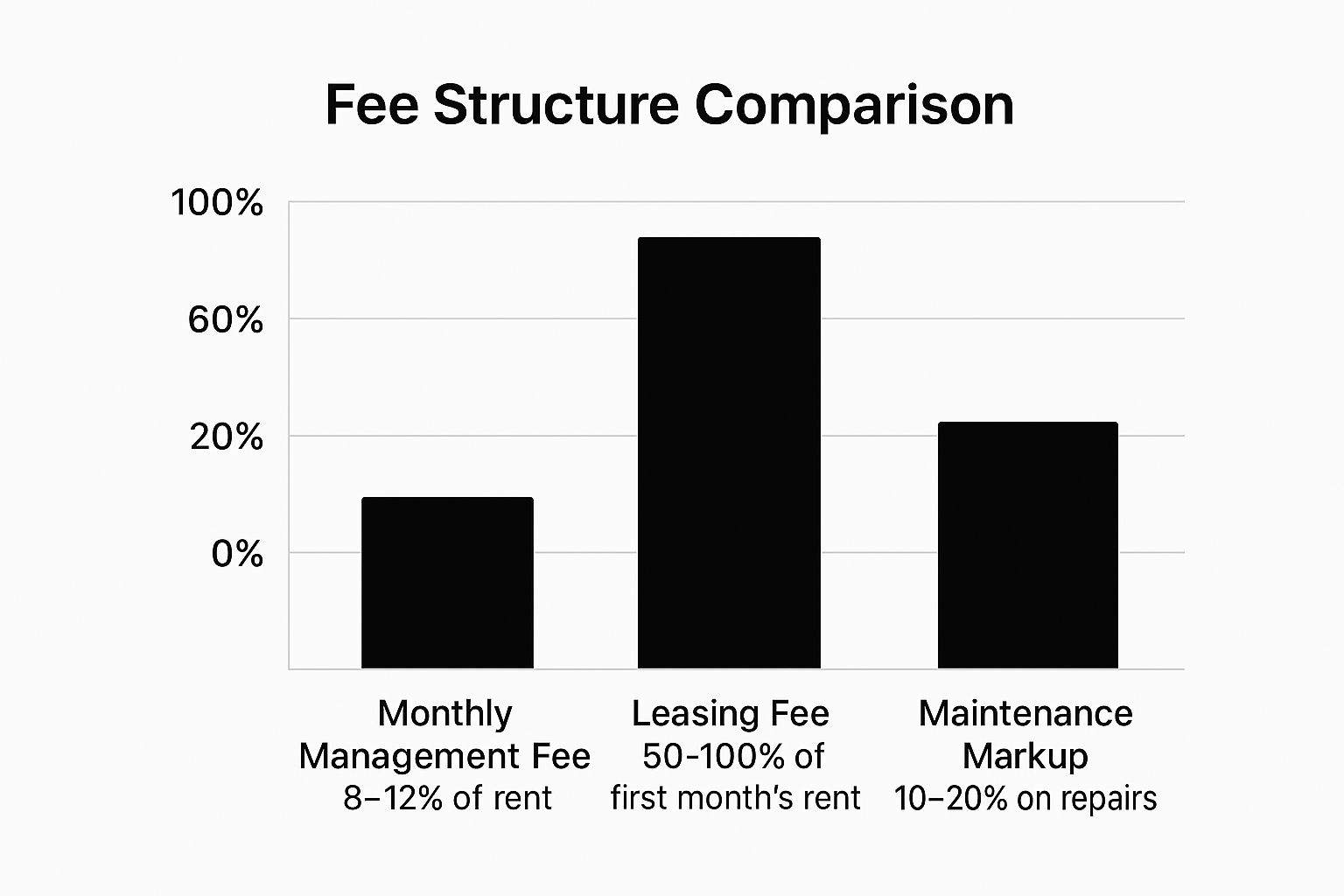
As the chart illustrates, a one-time leasing fee can often be a more significant initial cost than several months of management fees combined.
Actionable Tips for Evaluating Fees
To make an informed decision, insist on transparency. Request a detailed, itemized fee schedule in writing before signing any agreement. This document is your best tool for comparing companies apples-to-apples. For instance, a company with a lower 8% management fee might charge a 15% maintenance markup, making them more expensive over time than a 10% manager with no markup. Always ask if fees are negotiable, especially if you plan to bring multiple properties to their portfolio. This simple question can lead to significant long-term savings.
2. How do you screen and select tenants?
This is one of the most vital questions to ask a property manager, as their tenant screening process is the frontline defense for your investment. Placing a high-quality tenant minimizes risks like late payments, property damage, and costly evictions, directly influencing your cash flow and peace of mind. A superficial process can lead to long-term headaches, while a rigorous, well-documented one is a hallmark of a professional firm.

Understanding the Screening Process
A comprehensive screening process goes far beyond a basic credit check. It involves a multi-layered verification system designed to build a complete profile of an applicant. This ensures that every potential tenant meets a consistent set of predefined, legally compliant criteria. A professional manager will not just collect an application; they will verify every piece of information provided.
Key components of a robust screening process:
Credit & Financial Check: Evaluating credit score, payment history, and debt-to-income ratio to assess financial responsibility.
Income Verification: Requiring pay stubs or bank statements to confirm the applicant meets income requirements, typically 3x the monthly rent.
Rental History: Contacting previous landlords to inquire about on-time payments, property care, and rule compliance.
Criminal Background Check: Screening national databases for relevant criminal history that could pose a risk to the property or community.
Eviction History: Searching for any prior eviction filings, a major red flag for future tenancy issues.
A thorough process significantly reduces risk. For example, property managers who require a 650+ credit score and 3x income verification often report on-time payment rates exceeding 85%. For an in-depth look at this crucial topic, you can learn more about a robust tenant screening process on mypropertymanaged.com.
Actionable Tips for Evaluating Screening
To truly gauge a manager's competence, you need to dig into the specifics of their system. Ask for their written screening criteria to ensure they have a standardized, non-discriminatory process that complies with Fair Housing laws. A quality manager should be able to clearly articulate their standards and rejection rate; a rate between 10-30% often indicates they are diligently filtering applicants. Verify they use professional screening services like TransUnion SmartMove or RentPrep, not just basic online searches. Asking how they handle unique situations, such as applicants with a limited credit history, will reveal their flexibility and problem-solving skills.
3. What is your process for handling maintenance requests and emergencies?
A property manager's approach to maintenance is a direct reflection of their operational efficiency and commitment to preserving your asset's value. A slow or disorganized response not only frustrates tenants, leading to higher turnover, but can also allow minor issues to escalate into costly, major repairs. This is one of the most important questions to ask a property manager because it reveals their ability to protect both your tenants and your investment.

Understanding the Common Fee Structures
A robust maintenance system should cover everything from routine service calls to middle-of-the-night emergencies. Top-tier managers utilize a combination of technology, established vendor relationships, and clear communication protocols. This system ensures tenants can easily submit requests, emergencies are handled 24/7, and you, the owner, are kept in the loop according to pre-defined spending limits.
Common additional fees to clarify:
Response Time Guarantees: Do they commit to specific timelines for different issue severities (e.g., 2 hours for emergencies, 24 hours for urgent requests)?
Spending Authorization Limit: What is the maximum amount they can spend on a repair without your direct approval? This is typically set between $250 and $500.
Vendor Network: Do they have a list of vetted, insured, and licensed contractors? Do they have an in-house team, which can reduce costs by 15-25%?
Preventive Maintenance: Do they offer a proactive schedule for tasks like HVAC servicing or gutter cleaning? Companies like Balfour Beatty Communities have reduced emergency calls by 35% with such programs.
Technology Use: Do they use management software like Buildium or AppFolio for tracking requests, which can improve response times by up to 40%?
The following video provides a landlord's perspective on establishing a solid maintenance plan with a property manager.
Actionable Tips for Evaluating Fees
To get a clear picture, ask for a step-by-step walkthrough of their process, from the moment a tenant reports a leaky faucet to the final invoice. Inquire about their after-hours emergency protocol and who fields those calls. A crucial detail is to clarify their spending authorization limit; setting this threshold protects you from unexpected large expenses. Finally, ask for a sample of their preferred vendor list and inquire if they add a markup to vendor invoices, as this can be a hidden cost affecting your bottom line.
4. How do you handle rent collection and what happens when tenants don't pay?
Consistent cash flow is the lifeblood of a rental investment, making this one of the most vital questions to ask a property manager. A manager's approach to rent collection directly influences your property's profitability and financial stability. A haphazard process leads to late payments and costly vacancies, while a systematic approach ensures reliable income and protects your asset.
Understanding the Common Fee Structures
An effective manager utilizes modern tools and has a clearly defined, legally compliant process for delinquencies. Many top-tier managers use online payment portals that allow for automated payments, a method proven to increase on-time collection rates. For example, property managers using automatic payment systems often report 92-96% on-time payment rates versus 75-80% for manual collection. When payments are late, a strict, documented protocol is essential.
Common protocols for late or non-payment:
Automated Reminders: Sending polite reminders a few days before and on the day rent is due.
Late Fee Enforcement: A clear, written policy on late fees that is strictly and consistently enforced.
Pay or Quit Notice: Promptly serving the legally required notice as soon as the grace period expires.
Eviction Filing: Initiating the formal eviction process without delay if the tenant fails to comply with the notice.
Collections Process: A plan for pursuing unpaid rent and damages after a tenant vacates or is evicted.
Managers who file for eviction within 10 days of non-payment can recover significantly more lost rent than those who wait a month or longer.
Actionable Tips for Evaluating Fees
To accurately gauge a manager’s effectiveness, you need to dig into their specific procedures and performance metrics. Vague answers are a red flag; look for a manager who can provide clear, data-backed responses. Ask for their collection policy in writing to see how they handle every step, from initial reminder to final judgment collection. A manager with a high collection rate (above 95% is excellent) and a swift, documented eviction process is better equipped to protect your income stream. Also, clarify who bears the financial burden of an eviction; some management agreements pass all legal fees directly to the owner, while others may offer protection plans or in-house legal services for a flat fee.
5. How often will you inspect the property and provide reports?
This question gauges a manager's commitment to proactive asset protection. Regular inspections are your first line of defense against costly repairs and lease violations, directly preserving your property's value. A manager who treats inspections as a mere formality is a significant risk; you need a partner who meticulously documents the property’s condition and keeps you informed.
Understanding the Common Fee Structures
A robust inspection schedule includes move-in, move-out, and periodic (e.g., quarterly or bi-annual) checks. These are not just quick walkthroughs; they are detailed assessments backed by comprehensive documentation. The best managers use software like AppFolio or PropertyWare to provide owners with real-time online portals where they can view photos, videos, and detailed notes from each visit. This level of transparency is non-negotiable for safeguarding your investment.
Common inspection and reporting practices to clarify:
Move-In/Move-Out Inspections: Detailed condition reports with extensive photographic evidence to accurately assess tenant damages.
Periodic Inspections: Typically conducted every six to twelve months to check for preventative maintenance needs, safety issues (like smoke detectors), and lease compliance.
Drive-By Inspections: Quick exterior checks to ensure curb appeal is maintained and there are no obvious external issues.
Reporting: How quickly after an inspection will you receive a report, and what format will it be in (e.g., PDF, online portal)?
Inspection Fees: Clarify if periodic inspections are included in the management fee or if they are an additional charge.
Some firms, like Mynd Property Management, conduct quarterly inspections with 50+ point checklists, while others find that bi-annual inspections are sufficient to identify problems averaging $400 before they escalate into $2,000+ repairs.
Actionable Tips for Evaluating Fees
To truly understand a manager's process, go beyond their verbal promises. Request to see a sample inspection report and a monthly owner financial statement. This will show you the level of detail they provide and the clarity of their financial reporting. Ask specifically about their documentation process: do they use photos, videos, or both? A thorough visual record is your best evidence in the event of a security deposit dispute. Ensure the manager's proposed inspection frequency is permitted within your lease agreement to avoid tenant conflicts. For an in-depth look at what should be covered, you can use a rental property inspection checklist as a guide. You can get more information about this with our post about a checklist for a rental property inspection on mypropertymanaged.com.
6. What is your vacancy rate and average time to lease a property?
Every day a property sits empty is a day you lose money, making this one of the most vital questions to ask a property manager. A manager's vacancy rate and the average time it takes them to lease a property are direct indicators of their marketing effectiveness, pricing strategy, and operational efficiency. A low vacancy rate is a strong sign of a proactive manager who can keep your rental income flowing consistently.
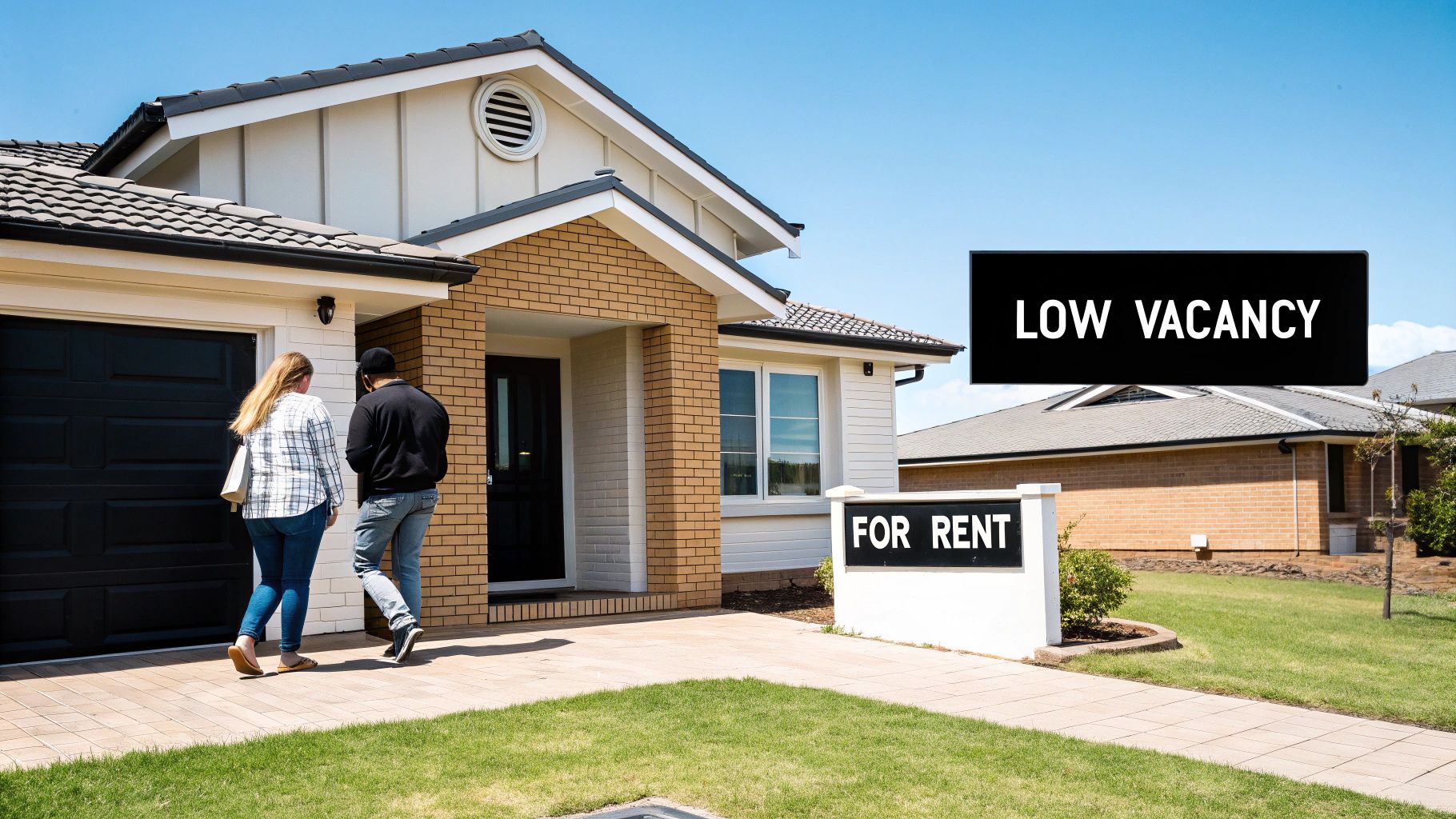
As the infographic highlights, top-tier managers often maintain vacancy rates well below the industry average, which can significantly boost your annual returns.
Understanding the Key Metrics
A manager's historical performance data is the best predictor of how they will manage your property. Don't settle for vague answers; ask for specific figures that paint a clear picture of their success in filling units and retaining tenants. For example, leading property management firms often report occupancy rates above 95% and average turn times of around 30 days.
Key performance indicators to request:
Annual Vacancy Rate: Ask for their rate over the past 12-24 months, specifically for properties similar to yours in the same area.
Average Days on Market (DOM): This tells you how long it takes, on average, from when a property is listed to when a lease is signed.
Lease Renewal Rate: A high renewal rate (ideally over 70%) indicates they are skilled at tenant retention, which saves you the cost and hassle of a full turnover.
Marketing Reach: Inquire about their marketing channels, such as Zillow, Trulia, and social media, and whether they use modern tools like virtual tours.
Actionable Tips for Evaluating Performance
To properly vet a manager, dig deeper than their headline numbers. Ask them to break down their vacancy rates by property type and neighborhood to ensure their expertise aligns with your asset. It's also crucial to understand their process for turning a unit over between tenants, as an efficient system minimizes lost rent. For a deeper understanding of the entire process, explore this guide on professional tenant placement services. Finally, clarify their fee structure during vacancies; a manager who only gets paid when you do is highly motivated to fill your property quickly.
7. What is included in your management contract and what are the termination terms?
The management agreement is the legally binding document that governs your entire relationship with the property manager. Overlooking its details is a common but costly mistake. This contract outlines every party's responsibilities, liabilities, and, crucially, the rules for ending the partnership. A thorough review of these terms is one of the most vital questions to ask a property manager to protect your assets and prevent future disputes.
Understanding the Common Contract and Termination Terms
Management contracts vary significantly in duration and flexibility. A standard agreement often lasts for one year, automatically renewing unless one party provides notice, typically 30 to 60 days in advance. However, the termination clause is where you need to pay the closest attention, as it dictates your ability to exit the relationship if it's not working.
Common contract and termination clauses to clarify:
Contract Duration: Is it a month-to-month agreement or a fixed-term contract (e.g., one year)?
Termination Notice: How much advance notice is required to end the contract (e.g., 30, 60, or 90 days)?
Early Termination Penalty: Is there a fee for ending the contract before its term expires? Some companies charge a flat fee or the equivalent of several months' management fees.
Cause for Termination: Does the contract specify conditions under which you can terminate immediately without penalty, such as gross negligence or breach of contract?
Post-Termination Responsibilities: The agreement should detail the process for transferring security deposits, keys, and tenant records to you or a new manager.
Some progressive managers offer more owner-friendly terms, such as a satisfaction guarantee that allows for penalty-free termination within a certain period if you are unhappy with their service.
Actionable Tips for Evaluating Contracts
Never sign a management agreement without a comprehensive review. The best practice is to have an attorney specializing in real estate law examine the document, but at a minimum, you must read every line yourself. Identify any clauses that seem ambiguous or heavily favor the manager and ask for clarification or negotiation before signing. For example, a clause that makes you liable for the manager's legal fees, regardless of fault, should be a major red flag. Always ensure the contract clearly specifies the manager's service standards, such as guaranteed response times for owner and tenant inquiries, as this creates a measurable performance benchmark.
8. What is your experience with properties like mine and in this area?
This is one of the most important questions to ask a property manager because their answer reveals their suitability for your specific investment. A manager's local market expertise and specialization in your property type directly affect everything from setting competitive rent to finding quality tenants and navigating local regulations. A generalist manager may struggle to achieve the same results as a specialist who deeply understands the nuances of your neighborhood and asset class.
Understanding the Importance of Specialization
Not all property management is the same. A manager who excels with single-family homes in the suburbs may not have the expertise to handle a downtown condo with a complex HOA or a multi-unit building in a historic district. Their familiarity with local market conditions, tenant demographics, and area-specific challenges is crucial for maximizing your financial returns and minimizing headaches.
Key areas where specialization matters:
Rental Rate Accuracy: A local expert knows the block-by-block differences in rent prices and can set the optimal rate to attract tenants quickly without leaving money on the table.
Targeted Marketing: They understand the ideal tenant profile for your area and know how to reach them effectively, reducing vacancy periods.
Regulatory Compliance: Knowledge of specific city or county ordinances, HOA rules, or historic preservation requirements prevents costly fines and legal issues.
Vendor Relationships: A manager with a strong local network has access to reliable and cost-effective contractors who can respond quickly to maintenance needs.
For example, a manager specializing in vacation rentals near popular tourist destinations will understand dynamic pricing and marketing in a way a long-term rental manager won't. Similarly, a manager experienced with luxury properties knows the higher standard of service and amenities that high-end tenants expect.
Actionable Tips for Evaluating Experience
To gauge a manager's true expertise, you need to ask specific, targeted questions. Their answers will help you determine if their experience aligns with your property's unique needs. Insist on concrete examples rather than general assurances of their capabilities. For instance, a manager who can cite current market rents for comparable units on your street is far more credible than one who gives a vague city-wide average. Asking for references from owners with similar properties in your immediate area is an excellent way to verify their claims and performance.
Key Questions Comparison for Property Managers
Topic | Implementation Complexity 🔄 | Resource Requirements ⚡ | Expected Outcomes 📊 | Ideal Use Cases 💡 | Key Advantages ⭐ |
|---|---|---|---|---|---|
Management Fees and Included Services | Medium – understanding various fee models 🔄 | Moderate – fee negotiation and cost tracking ⚡ | Clear budgeting, ROI accuracy, avoidance of surprises 📊 | Landlords comparing service costs and budgeting 💡 | Transparent costs, service comparison, ROI clarity ⭐ |
Tenant Screening and Selection | High – comprehensive checks and compliance 🔄 | High – requires access to credit, criminal data ⚡ | Reduced risk of non-payment, property damage 📊 | Owners prioritizing tenant quality and compliance 💡 | Quality tenants, eviction risk reduction, legality ⭐ |
Maintenance Requests & Emergency Handling | Medium-High – 24/7 system and vendor network 🔄 | High – contractor relations, software, staffing ⚡ | Faster repairs, reduced property damage, tenant satisfaction 📊 | Properties needing prompt and reliable maintenance 💡 | Quick response, vendor quality, liability protection ⭐ |
Rent Collection & Non-Payment Procedures | Medium – system setup & legal enforcement 🔄 | Moderate – payment platforms, legal expertise ⚡ | Consistent cash flow, reduced income loss on arrears 📊 | Properties with high rent payment risk 💡 | Higher collection rates, legal compliance, eviction efficiency ⭐ |
Property Inspections & Reporting | Medium – scheduling, documentation, reporting 🔄 | Moderate – software/tools, photo documentation ⚡ | Early issue detection, tenant compliance, transparency 📊 | Properties needing detailed oversight and reporting 💡 | Prevents costly repairs, keeps owners informed ⭐ |
Vacancy Rate & Leasing Time | Medium – data tracking & marketing strategies 🔄 | Moderate – marketing tools, showing coordination ⚡ | Lower vacancy, faster tenant placement, optimized income 📊 | Owners focused on occupancy maximization 💡 | Reduced income loss, efficient turnover, data-driven pricing ⭐ |
Management Contract & Termination Terms | Low-Medium – contract drafting and review 🔄 | Low – legal consultation, negotiation ⚡ | Clear legal framework, flexible exit, defined roles 📊 | All landlords signing agreements 💡 | Legal protection, dispute prevention, accountability ⭐ |
Experience with Similar Properties & Area | Variable – depends on market knowledge 🔄 | Moderate – local expertise, vendor network ⚡ | Better local pricing and tenant fit, regulatory compliance 📊 | Owners seeking specialized or local management 💡 | Market expertise, faster issue resolution, compliance ⭐ |
Making Your Final Decision with Confidence
Navigating the landscape of property management can feel overwhelming, but you are now equipped with the essential framework to make an informed and confident decision. The comprehensive list of questions to ask a property manager provided in this guide moves beyond surface-level inquiries. It empowers you to dissect a company's core operations, from their financial transparency and tenant screening rigor to their proactive maintenance strategies and contractual obligations.
The goal is not simply to fill a vacant role; it is to forge a strategic partnership. The right property manager acts as a fiduciary, a steward of your valuable asset, and a key partner in achieving your long-term investment goals. This decision directly impacts your profitability, the condition of your property, and your peace of mind.
Synthesizing the Answers for a Clear Choice
As you gather responses from different management candidates, avoid the pitfall of focusing on just one area, like the lowest management fee. Instead, adopt a holistic perspective. Consider how the answers to these critical questions interconnect to paint a complete picture of their service quality and operational philosophy.
Financial Alignment: Does their fee structure (Question 1) align with their stated vacancy rates and leasing times (Question 6)? A low fee is meaningless if the property sits vacant for months.
Asset Protection: How do their tenant screening processes (Question 2) and routine inspections (Question 5) work together to protect your investment from a bad tenancy? A robust screening process is your first line of defense.
Operational Efficiency: Does their process for handling maintenance (Question 3) and rent collection (Question 4) demonstrate a streamlined, technology-driven approach? Efficient systems minimize costly delays and improve tenant satisfaction.
Risk Mitigation: Are the terms of their management contract and termination policies (Question 7) fair and transparent? This, combined with their specific experience with properties like yours (Question 8), helps you gauge and mitigate potential risks.
Key Takeaway: The quality of a property manager is not defined by a single answer, but by the coherence and strength of their entire operational system. Look for a manager whose processes are not just described, but are supported by data, clear examples, and proven results.
Choosing your property manager is one of the most significant decisions you will make as a real estate investor. The due diligence you perform now, using these targeted questions to ask a property manager, is a direct investment in your property's future success. Listen for detailed, transparent answers that demonstrate expertise and a genuine commitment to client success. By doing so, you're not just hiring a service provider; you are securing a valuable ally dedicated to maximizing the return and minimizing the stress of your real estate journey.
Ready to partner with a management company that has the right answers? Keshman Property Management was built by landlords for landlords, so we understand precisely what it takes to protect and grow your investment. Visit us at Keshman Property Management to see how our transparent, data-driven approach can benefit your portfolio.


Comments