
What Is a Master Lease Agreement? A Practical Guide to Passive Income
- Sarah Porter

- Dec 15, 2025
- 18 min read
Updated: Dec 20, 2025
Ever feel like you're drowning in the day-to-day chaos of managing a multi-unit property? Juggling dozens of tenants, chasing down late rent, and fielding endless maintenance calls can turn a great investment into a full-time headache. This is where a master lease agreement comes in, offering a way to step back and turn your hands-on property into a truly passive income stream.
Understanding the Master Lease Agreement
At its core, a master lease is a real estate strategy where you, the property owner, lease an entire building—like an apartment complex or a commercial center—to a single entity. This entity, known as the master tenant, essentially becomes your sole tenant.
They then take on the massive job of managing the property. They find and screen individual tenants (sub-tenants), collect all the separate rent payments, handle repairs, and send you one, reliable rent check every month. In effect, you're outsourcing the entire operational side of your investment to a professional who aims to profit from the "spread"—the difference between the rent they collect from sub-tenants and the fixed master rent they pay you.
This creates a simple, three-tiered structure: you, your master tenant, and their sub-tenants.
The diagram below breaks down this hierarchy, showing how the master tenant acts as a buffer between the property owner and the individual occupants.
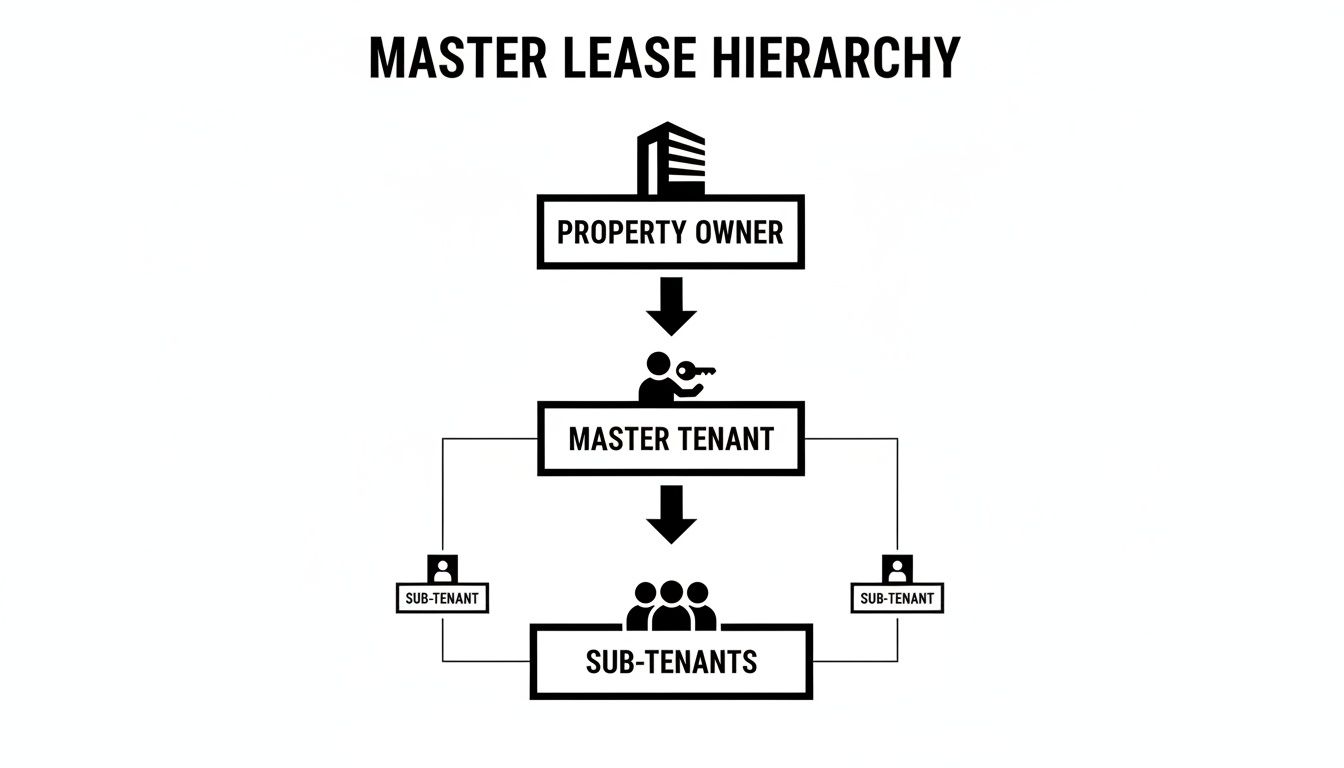
As you can see, your only direct contractual relationship is with the master tenant. They are responsible for everything downstream.
Key Roles And Responsibilities
The real beauty of a master lease is the crystal-clear division of labor it creates. The property owner gets to take a significant step back from the daily grind, while the master tenant steps up to run the show.
Property Owner: Your job simplifies dramatically. You collect the master rent check and remain responsible for major capital expenditures—think big-ticket items like a new roof or foundation work, as outlined in the lease.
Master Tenant: This is the operational expert. They handle everything from marketing vacant units and screening applicants to collecting rent, managing routine maintenance, and dealing with all tenant communications.
This model isn't just convenient; it's proven to be incredibly stable, even in tough economic times. For instance, between 2020 and 2022, properties under a master lease saw a rent delinquency rate of only 5%. In contrast, traditionally managed properties saw a 25% delinquency rate. That’s because the master tenant, not the owner, absorbs the financial hit from vacancies and non-paying tenants.
A master lease agreement is a powerful tool for creating predictable cash flow. It allows a property owner to secure a guaranteed income stream while insulating themselves from the volatility of vacancy rates and tenant turnover.
Before signing on the dotted line, it’s a good idea to brush up on general contract interpretation principles. Understanding the basics of how a contract is read and enforced by courts will give you a huge advantage in negotiations and help you fully grasp your rights and responsibilities.
Property Owner Vs Master Tenant Roles At A Glance
To make the division of responsibilities even clearer, let's break down who typically handles what in a master lease arrangement.
Responsibility | Property Owner Role | Master Tenant Role |
|---|---|---|
Rent Collection | Collects one fixed rent payment from the Master Tenant. | Collects individual rent payments from all sub-tenants. |
Tenant Management | No direct interaction with sub-tenants. | Handles all screening, leasing, communication, and eviction processes for sub-tenants. |
Maintenance & Repairs | Responsible for major capital expenditures (e.g., roof, HVAC replacement). | Manages all routine maintenance, repairs, and property upkeep (e.g., plumbing, paint). |
Vacancy Risk | Receives fixed rent regardless of occupancy. | Assumes all financial risk associated with vacant units. |
Property Taxes & Insurance | Typically pays property taxes and building insurance. | Often pays for their own liability insurance and manages utility payments. |
Marketing & Leasing | Not involved in marketing individual units. | Markets the property, shows units, and executes leases with sub-tenants. |
This table highlights how the master tenant effectively takes on the role of a hands-on landlord, allowing the property owner to enjoy a more passive investment experience.
The Anatomy of a Bulletproof Master Lease

A master lease agreement is far more than a simple handshake; it’s the detailed blueprint that governs the entire relationship between you and your master tenant. Get it wrong, and you could be facing costly disputes and unexpected losses. But a well-crafted, crystal-clear agreement protects your asset and sets the stage for a smooth, profitable partnership for years.
Think of it like inspecting a car before a long road trip—you have to check every single component to make sure you won’t break down on the highway. Each clause in a master lease is designed to answer a specific "what if" question, from rent payments to major repairs, creating a solid framework that leaves no room for misunderstanding.
These agreements have been around for a while, evolving from early 20th-century retail 'net lease' models, but they really took off during the 1980s real estate boom. Today, they're a cornerstone of the global lease management industry, a sector valued at $5.65 billion that’s expected to climb to $8.13 billion by 2030. This growth is all about the need for clear, enforceable contracts that can manage complex landlord-tenant dynamics.
Defining The Core Financial Terms
Let's get straight to the heart of it: the money. This part of the agreement dictates how and when you get paid, making it arguably the most critical section to nail down. It’s not just about a dollar amount; it establishes the economic foundation for the entire deal.
You'll generally see one of two rent structures:
Fixed Master Lease: This is the straightforward option. The master tenant pays you a set amount—say, $10,000 a month—no matter what. Their occupancy rates or collection issues don't affect your check. This gives you maximum predictability and shields you from market swings.
Performance Master Lease: Here, your income is tied to the property's success. The master tenant pays you a percentage of the gross rent they collect from their sub-tenants. You have more upside potential, but you also share more of the risk if they struggle to keep units filled.
Beyond the rent model, this section must clearly spell out the payment due date, how you’ll be paid, and exactly what happens if a payment is late. When it comes to financial terms, specificity is your best friend.
Outlining Maintenance and Repair Obligations
Who fixes a leaky faucet? Who replaces the entire HVAC system? Ambiguity here is a recipe for conflict. A bulletproof master lease defines these responsibilities with surgical precision.
Typically, the duties are split like this:
Master Tenant's Duties: They handle the day-to-day stuff. This means all routine maintenance, minor repairs, and general upkeep of the property—from landscaping and painting to fixing appliances and responding to sub-tenant calls.
Property Owner's Duties: You’re usually on the hook for major capital expenditures. These are the big-ticket items that preserve the property's value, like a new roof, structural repairs, or repaving the parking lot.
A great way to avoid any gray area is to include a specific dollar threshold in the agreement. For example, any repair under $500 is automatically the master tenant's responsibility. This simple clause can prevent a world of headaches.
Subleasing Rights And Default Protocols
The master tenant's entire business model is built on their ability to sublease your units, so the agreement has to explicitly grant them the right to sublease. At the same time, you'll want to outline any restrictions, like requiring your approval on certain sub-tenants or prohibiting uses that could hurt the property's reputation.
A well-drafted default clause is your ultimate safety net. It clearly defines what constitutes a breach of contract and outlines the specific, step-by-step process for resolution, protecting your investment if the partnership sours.
Just as important is the default and termination clause. This section explains what happens if someone doesn't hold up their end of the bargain. It needs to define what counts as a default (like not paying rent or failing to maintain the property) and specify the "cure period"—the time the party has to fix the problem before you can take legal action or terminate the lease.
To truly get comfortable with these documents, it helps to understand the fundamentals of contract formation business law. A little knowledge here goes a long way, empowering you to review and negotiate your master lease with confidence.
Is a Master Lease Right for You? Weighing the Pros and Cons
A master lease can feel like hitting the easy button for property management, transforming a hands-on, multi-tenant asset into a single, predictable income stream. But it's not a magic wand. Before you hand over the keys, you need to get real about what you're gaining and what you're giving up.
At its core, this strategy changes your job description from active property manager to passive investor. Let's dig into what that really means for your bottom line and your peace of mind.
The Upside: Hands-Off Income and Zero Hassle
For many property owners, the biggest draw of a master lease is getting out of the landlord business without selling the property. You're no longer the one getting a call at 10 PM about a leaky faucet or trying to collect rent from a dozen different tenants. You have one point of contact: your master tenant.
This single shift creates some powerful advantages:
Predictable Cash Flow: You get one check, for one fixed amount, on the same day every month. It doesn't matter if there are two vacancies or ten—your income is locked in. This turns your volatile rental property into something more like a stable, bond-like investment.
Zero Vacancy Risk: The headache of empty units is no longer yours. That financial risk is completely transferred to the master tenant. If they can't fill the units, it's their problem to solve and their profit that takes the hit. Your check still clears.
Reduced Management Burden: Think about all the work that goes into running a property: marketing units, screening applicants, handling maintenance, and dealing with evictions. All of that is now off your plate. This is a game-changer for owners who live far away, are nearing retirement, or simply want their time back.
Picture this: you own a 20-unit building. A major local employer announces layoffs, and suddenly, your occupancy drops to 80%. In a traditional setup, your revenue just took a 20% nosedive. With a master lease, you don't even feel it—you receive your full payment while the master tenant absorbs the loss.
The Potential Downsides: Giving Up Control and Upside
Of course, there's no such thing as a free lunch. The convenience and stability of a master lease come at a price, namely a loss of direct control and a cap on your potential profits. You have to be comfortable with these trade-offs.
Here’s what you need to watch out for:
Lower Profit Ceiling: Your master tenant is a business, and they need to make money. They do this by leasing the units for more than they pay you. This means the rent you receive will always be less than the property's maximum potential income. You're trading peak profit for total predictability.
Loss of Direct Control: You no longer hand-pick the people living in your property. A great master tenant will find high-quality residents, but a careless one could fill your building with tenants who damage the property and hurt its reputation.
Risk of Master Tenant Default: This is the big one. Your entire income stream is now tied to a single entity. If your master tenant goes out of business or stops paying, you're in a tough spot. You could be left with a building full of tenants you didn't choose and the sudden, overwhelming task of taking back management.
The success of a master lease agreement hinges almost entirely on the quality and integrity of the master tenant. Thorough vetting isn't just a suggestion; it's the most critical step in protecting your investment.
Imagine the worst-case scenario: your master tenant defaults, stops maintaining the property, and disappears. You're left with a legal mess, no income, and a building that might need significant repairs. This is why doing deep due diligence on a potential master tenant’s financial health and operational history is absolutely non-negotiable.
Master Lease vs Traditional Management
To put it all in perspective, let's compare a master lease directly with hiring a traditional property management company like Keshman Property Management. While both reduce your workload, they operate on fundamentally different financial and operational models.
The table below breaks down the key differences to help you see which path aligns better with your goals as an owner.
Aspect | Master Lease Agreement | Traditional Management Agreement |
|---|---|---|
Income | Fixed, guaranteed monthly rent. | Variable; based on actual rent collected, minus fees. |
Vacancy Risk | Borne entirely by the master tenant. | Borne entirely by you, the property owner. |
Management Fees | None. Your "cost" is the spread between your rent and the market rent. | Typically 8-12% of monthly collected rent. |
Control | Low. You have no say in tenant selection or day-to-day operations. | High. You approve tenants, set rental rates, and authorize major repairs. |
Involvement | Passive. You simply collect a check. | Active. You oversee the manager and make key decisions. |
Best For | Owners seeking maximum stability, zero hassle, and predictable income. | Owners wanting to maximize potential income and retain ultimate control. |
Ultimately, choosing a master lease means you are prioritizing guaranteed income and a completely hands-off experience. With traditional management, you retain more control and keep more of the upside, but you also hold all the risk. Neither is universally "better"—the right choice depends entirely on your personal risk tolerance and financial objectives.
How Master Leases Work in the Real World
Theory is one thing, but seeing a master lease agreement in action is where its power really clicks. This isn't some niche strategy for a single type of property; its real strength is its flexibility. It's a tool that can solve a surprisingly wide range of problems across the real estate landscape.
By walking through a few practical, real-world scenarios, you can start to see how this structure might fit into your own investment portfolio. Let's get past the legal jargon and see how smart property owners are using master leases to lock in a stable retirement income or even turn around a struggling commercial property.
The Retiring Multifamily Owner
Picture this: an owner of a 30-unit apartment building is finally ready to retire. After decades of hands-on management, they're tired of the late-night maintenance calls, chasing down rent checks, and the constant stress of finding new tenants. Selling the building is an option, but it comes with a hefty capital gains tax bill. Continuing to manage it themselves just isn't sustainable anymore.
This is a textbook case for a master lease. The owner finds an experienced operator or property management firm to step in as the master tenant. They negotiate a fixed monthly rent—say, $35,000—which might be a little less than the building's absolute maximum potential, but it's completely predictable.
The result is a game-changer for the owner:
Guaranteed Income: They now get a single, reliable check every month. It’s the perfect foundation for a worry-free retirement.
Zero Management Hassle: All the day-to-day operations, from screening tenants to fixing leaky faucets, are now the master tenant's problem.
Asset Retention: The owner gets to hold onto their valuable property, benefiting from its long-term appreciation without any of the landlord headaches.
This approach has become incredibly popular because it delivers on the promise of truly passive income. If you're aiming to make your property a hands-off investment, it's worth exploring all the different ways to generate rental property passive income.
The Corporate Housing Entrepreneur
Here's another angle. An investor spots a golden opportunity in the corporate housing market near a bustling business district. Instead of buying a whole building, they target a 15-unit condo complex where individual owners are struggling to keep their units filled with traditional long-term tenants.
The investor pitches a master lease to these owners, offering to rent their units for a 3-year term with guaranteed monthly payments. Once the investor has control of the units, they furnish them beautifully and market them as premium, short-term corporate rentals, charging a much higher nightly or weekly rate.
By bundling multiple units under one master agreement, the investor builds a scalable business from the ground up. The master lease gives them the operational control they need to run a specialized rental business that the individual condo owners could never manage on their own.
The Commercial Center Turnaround
Finally, think about a small, tired-looking retail strip center. The owner is bleeding cash. Several storefronts are empty, and the remaining tenants are frequently late with rent. The property just isn't attracting the kind of quality businesses it needs.
A savvy commercial real estate operator sees the hidden potential. They approach the owner with a master lease proposal to take over the entire center. Their plan? Invest their own money into cosmetic upgrades, rebrand the center, and aggressively recruit a vibrant new tenant mix—like a popular local coffee shop or a boutique fitness studio. The owner agrees to a lower fixed rent for the first year, which then increases as the operator successfully revitalizes the property.
The impact of these strategies is felt across the industry. Master leases are a major force in the global lease management market, especially in fast-growing areas. In the U.S. alone, top master lease companies have managed over 50,000 units. They've delivered 10-15% ROI for investors through subleasing while helping property owners cut their operational costs by an average of 20%.
Negotiating Your Lease and Spotting Red Flags

Signing a master lease agreement is a major financial commitment, not something to be taken lightly. When you get to the negotiation table, you’re not just accepting an offer—you're actively shaping a partnership that will define your income and protect your asset for years. Every single clause is a lever you can pull to build in safeguards and ensure this deal works for you.
The success of the entire arrangement really comes down to one thing: the quality, experience, and financial health of your master tenant. Think of them as the captain of your ship. If they're not up to the task, the whole thing could sink. That's why vetting your potential partner is just as critical as negotiating the contract itself. A weak agreement or an unreliable tenant can quickly turn your passive income dream into a real-life nightmare, leaving you with a damaged property and a huge financial mess.
Key Negotiation Points for Property Owners
When you're hammering out the details, some terms matter more than others. Focusing your energy on these key areas will have the biggest impact on your bottom line and your peace of mind.
Here’s what should be at the top of your list:
The Master Rent Amount: This is the big one. Is the rent they're offering truly fair, especially since you’re handing off all management duties and vacancy risks? Do your homework on what similar properties are getting and come prepared to back up your number.
Rent Escalation Clauses: A long-term lease has to account for rising costs. You need to insist on an annual rent increase, whether it’s tied to the Consumer Price Index (CPI) or a fixed percentage, like 2-3%. This ensures your income doesn't get eroded by inflation over time.
Maintenance Spending Caps: You need to draw a very clear line between the master tenant's responsibility for day-to-day repairs and your own for major capital projects. A great way to do this is by setting a dollar threshold. For example, the master tenant could be responsible for any single repair under $500, leaving the big-ticket items to you.
Getting these points nailed down from the start eliminates the gray areas that always seem to cause fights later. Remember, a clear contract makes for a good partnership.
Red Flags to Watch for in a Potential Master Tenant
When you're vetting a potential master tenant, you need to have a healthy dose of skepticism. You're trusting them with an incredibly valuable asset, and if they fail, it becomes your problem. As you screen candidates, keep an eye out for these warning signs that should make you pause and dig deeper.
A master tenant's proposal is only as strong as their ability to execute it. A flashy business plan without the financial backing or operational experience to support it is a major red flag that should not be ignored.
Be on the lookout for these critical red flags:
A Vague or Unrealistic Business Plan: The candidate needs to show you exactly how they plan to make a profit. If their projections feel more like wishful thinking than a solid strategy, it's time to walk away.
Insufficient Capital Reserves: Don't be afraid to ask for proof of funds. The master tenant absolutely must have enough cash on hand to cover your rent during the initial lease-up period and handle any unexpected repairs that pop up. A lack of reserves is a sure sign they’re flying too close to the sun.
Resistance to Background Checks: Any legitimate, professional operator will have zero issue with you running thorough credit, criminal, and financial background checks. If they hesitate or refuse, that’s an immediate deal-breaker.
Weak or Irrelevant References: Ask for references from other property owners they’ve worked with. If all they can give you are personal friends or contacts from unrelated businesses, it probably means they don't have the experience they claim.
Pressure to Sign Quickly: If a candidate is rushing you or trying to get you to skip a proper legal review, it’s usually because they're hoping you won't notice a clause that's bad for you. Always insist on taking the time you need for due diligence.
Ultimately, navigating these complex agreements often calls for professional guidance. While a master lease is different from a typical rental contract, understanding the basics of a property management agreement can give you some valuable context. Protecting your investment is the top priority, and getting expert legal and financial advice isn't optional—it's essential.
Your Action Plan for Getting Started
Considering a master lease agreement is a major move. You're essentially shifting from being a hands-on landlord to a more passive, hands-off investor. If the idea of guaranteed income without the day-to-day headaches sounds appealing, then a solid action plan is what you need to make it happen.
The journey doesn't start with a "For Rent" sign. It starts with an honest look in the mirror.
First, get crystal clear on your own goals. What are you really after? Is it the security of a stable, predictable check hitting your bank account every month, or are you trying to squeeze every last dollar of potential profit out of the property? This is a crucial distinction, because a master lease often means trading a little bit of upside potential for a whole lot of peace of mind.
Once you’re sure this is the right path, turn your attention to the property itself. Think of it like preparing a car for a premium sale. You need to get it in top shape to attract a high-caliber master tenant. That means tackling that list of deferred maintenance you've been putting off and making sure the property shines.
Finding the Right Partner
With your property ready, the real work begins: finding and vetting the right person or company to take over. I can't stress this enough—the success or failure of your entire master lease agreement rests on the quality and integrity of this partner.
Your screening process has to be disciplined and thorough. Don't cut corners here.
Dig into the Financials: Ask for their business plan, proof of funds, and run credit reports. You need to be absolutely certain they have the financial horsepower to meet their obligations, month after month.
Verify Their Background: Run comprehensive background checks on the company's key players. Who are you really getting into business with?
Check Their References: This is non-negotiable. Talk to other property owners they've partnered with. Ask the tough questions about their performance, communication, and reliability.
Finally, get your own professional team in place. You’ll want a real estate attorney who has specific experience with these types of complex agreements, not just a generalist. It’s also wise to consult a financial advisor to help structure the deal in a way that’s most beneficial for you.
Following these steps turns a potentially overwhelming process into a manageable one. When you're ready to explore this further, it's smart to get expert guidance. Understanding how to outsource property management effectively offers a great framework for choosing a partner you can trust. A quick consultation can help you figure out if your property is a good fit and ensure your agreement is built to last.
Common Questions About Master Lease Agreements
Even after weighing the pros and cons, it's natural to have a few lingering questions about how a master lease really works in the real world. This isn't your everyday rental contract, and the details matter. Let's tackle some of the most common questions we hear from property owners.
Our aim here is to cut through the jargon and give you straight answers, so you can feel confident deciding if this strategy is the right move for you.
Is a Master Lease a Legally Binding Contract?
Yes, absolutely. A master lease agreement is a formal, legally binding contract that spells out every detail of the relationship between you (the owner) and the master tenant. It’s an enforceable document covering everything from rent payments and management duties to what happens if someone doesn't hold up their end of the bargain.
Think of it as the comprehensive rulebook that governs the entire partnership for years to come.
Who Is Responsible for Paying Property Taxes?
Typically, the property owner remains responsible for paying the property taxes. Since you still hold the title and legal ownership of the asset, this fundamental expense usually stays on your side of the ledger.
That said, this is often a point of negotiation. In certain commercial setups, especially a triple net (NNN) lease, the master tenant might agree to take on the property taxes, insurance, and maintenance costs. The critical thing is to make sure this is explicitly defined in writing.
What’s the Difference Between a Standard Lease and a Master Lease?
The biggest difference comes down to control and responsibility. A standard lease simply gives a tenant the right to live in or use a single unit. A master lease, however, hands over full operational control of the entire property—or a large block of units—to the master tenant.
A standard lease is about renting a space; a master lease is about renting an entire business operation. The master tenant isn't just a renter; they're an operator who has to find subtenants, manage the property, and make it profitable.
Can You Include an Option to Buy in a Master Lease?
You certainly can, and it's a popular way to sweeten the deal for a top-tier master tenant. This structure is often called a master lease with an option to purchase. It gives the master tenant the exclusive right to buy the property for a pre-agreed price at a specified time in the future.
This can create a true win-win:
For the Master Tenant: It gives them a path to ownership, allowing them to build equity in a property they are already invested in improving.
For the Property Owner: It sets up a potential, clean exit strategy with a buyer who knows the property better than anyone else.
Structuring a master lease agreement correctly takes experience and a sharp eye for detail. At Keshman Property Management, we work with property owners to figure out if this hands-off strategy fits their long-term vision and help them find qualified, professional operators. If you're tired of the day-to-day grind and ready to explore a truly passive income stream, let's have a conversation. Learn more about our owner-focused services and see how we can help you get the most out of your investment with none of the hassle.


Comments