
What Is a Good Credit Score for Renters Your Ultimate Guide

Updated: Dec 20, 2025
Let’s cut to the chase: most landlords are looking for a credit score of 620 or higher. Think of it as your financial first impression—a quick snapshot for landlords to gauge your reliability before they even meet you. It’s their first clue about whether you’re a dependable bet to pay rent on time.
What Credit Score Do Landlords Actually Want?

When you submit that rental application, your credit score is one of the first data points a property manager glances at. It’s a simple, standardized way for them to assess your financial track record without knowing you personally. A strong score signals a history of on-time payments, which is exactly what they want to see.
But here’s the thing: the concept of a "good" score isn't set in stone. It’s a moving target that shifts based on the rental market you’re in.
In a hyper-competitive city like New York or San Francisco, where a dozen people are vying for the same apartment, landlords can afford to be picky. They might raise their minimum to 700 or even higher. On the flip side, in a market with plenty of open units, landlords are often more flexible and might be perfectly happy with a score closer to 600. It really comes down to supply and demand.
Renter Credit Score Ranges at a Glance
This table breaks down common credit score tiers to help you understand your standing and what to expect during your rental application process.
Credit Score Range | Tier | What It Means for Your Application | Typical Property Level |
|---|---|---|---|
750+ | Excellent | You're a top-tier applicant. Landlords see you as very low-risk and you’ll likely sail through approvals. | Premium, high-demand properties. |
700 - 749 | Good | Your application is strong in almost any market. You have a proven track record of financial responsibility. | Most mid-to-high-end apartments. |
620 - 699 | Fair/Average | This is the sweet spot where most renters land. You should qualify for many places but may face tougher competition in hot markets. | Standard apartments and rentals. |
Below 620 | Needs Improvement | Getting approved will be a challenge, but it’s not a deal-breaker. Landlords will need to see other strengths to offset the perceived risk. | More flexible, privately-owned, or entry-level rentals. |
These ranges are a great starting point, but remember, landlords don't make decisions based on this three-digit number alone. It's just the beginning of their review process.
A credit score is more than just a number; it's a story of your financial habits. For a landlord, it’s a quick way to read the introduction to that story and decide if they want to learn more.
Ultimately, knowing what landlords are looking for helps you manage your expectations. If your score is on the lower side, you can go into the process prepared with a co-signer or a larger security deposit. If your score is high, you can apply with the confidence that you’re putting your best foot forward.
How Landlords Really Read Your Credit Report
Think of your credit score as the cover of a book. It gives a landlord a quick first impression, a snapshot. But to really understand your financial story, they have to open that book and read the chapters. That "book" is your full credit report, and it tells a far more detailed story than any single three-digit number can.
At the end of the day, a landlord has one primary goal: find a tenant who will consistently pay their rent on time. It's not a personal judgment on you; it's a business decision based on managing risk. Your credit report gives them a detailed history of how you've handled your financial responsibilities, which they see as the best predictor of your future behavior as a tenant.
This is why just knowing your score isn't enough. A great score can still have specific red flags that give a landlord pause, just as a lower score can be explained away by an otherwise solid history. It's much more nuanced than just hitting a magic number.
The Key Chapters of Your Financial Story
When a landlord gets your credit report, they're looking for patterns. They're basically playing detective, searching for clues that tell them whether you’ll be a dependable renter.
Here are the main sections they’ll zero in on:
Payment History: This is the big one. It’s a detailed log of your payments on everything from credit cards and car loans to student debt. A consistent track record of on-time payments is exactly what they want to see, as it's the closest thing to a guarantee you'll pay your rent on time.
Credit Utilization: This little metric shows how much of your available credit you're currently using. If your cards are maxed out, it suggests you might be under financial stress, which could make affording rent a struggle. The general rule of thumb is to keep this below 30%.
Derogatory Marks: These are the serious red flags. This section includes things like accounts in collections, bankruptcies, repossessions, and—most critically for a landlord—any past evictions or debts owed to a previous property. Even one of these can be a major hurdle to overcome.
Reading Between the Lines: What Landlords Actually Care About
Beyond those main categories, landlords dig into the specifics. For example, a couple of late credit card payments from two years ago are a lot less worrying than a recent account that just went to collections. They're weighing both the recency and the severity of any negative marks.
An old medical bill in collections might get a pass. But an unpaid utility bill from your last apartment? That’s a huge warning sign to a potential landlord.
Landlords often look for a credit score between 620 and 700 as a baseline for approval. Anything above 670 is generally considered good. This standard comes from the FICO model, which is heavily weighted towards payment history (35%) and credit utilization (30%)—coincidentally, the two things landlords care about the most.
They also look at the type of debt you have. A healthy mix, like a car loan or even a mortgage, can actually be a good thing. It shows you know how to manage different kinds of financial commitments over the long term.
To see how this all fits into the bigger picture, you can learn more about what a rental application is and how it works. A good landlord isn't just looking for a score to pass or fail you; they're doing a holistic review to find a reliable partner for their property.
How Location and Property Type Change the Rules
If you think there's a single, magic number that defines a "good" credit score for every renter, think again. The reality is much more dynamic, shaped by the simple economics of supply and demand. A score that gets you the keys in a quiet suburb might not even get you a callback in a bustling downtown.
It’s a bit like trying out for a sports team. In a small town with only a few people showing up, the coach is just happy to have enough players. But in a major city, the competition is fierce, and only the absolute best make the roster. Your credit score is your stat sheet, and landlords in different markets have very different ideas of what a star player looks like.
This is precisely why the answer to what is a good credit score for renters always comes with a follow-up question: where are you looking? In a competitive rental market, landlords hold all the cards and can afford to be incredibly selective.
Big City Competition Drives Scores Higher
In major cities like New York, San Francisco, or Boston, high demand and low inventory create a classic landlord's market. When a single apartment gets dozens of applications, property managers need a quick way to sort through the pile. A strong credit score becomes the first—and most important—filter.
Just look at the numbers. A 2020 analysis of over 5 million lease applications laid out the differences in stark detail. While the national average credit score for renters hovered around 638, the scores in hot markets were in another league entirely.
Renters in San Francisco had an average score of 719, Bostonians averaged 716, and applicants in New York City came in at 715. You can dig into all the details in RENTCafé's in-depth market analysis of renter credit trends.
In a hot rental market, a credit score isn't just about qualifying—it's about competing. A high score becomes a key differentiator that puts your application at the top of the pile.
The takeaway is clear: in these top-tier cities, a score in the mid-600s will likely leave you on the sidelines. Landlords have plenty of applicants with scores well over 700, so they have little reason to take a chance on anyone who looks like a higher risk.
The Property Class Hierarchy
It’s not just the city that matters; the type of building you’re applying to is just as important. The expectations for a brand-new luxury high-rise are completely different from those for an older duplex managed by a private owner. Landlords naturally adjust their standards to match the quality and demand for their properties.
Here’s a quick breakdown of how these property classes usually stack up.
Credit Score Expectations by Property Type and MarketThis table shows how credit score requirements can vary significantly based on the quality of the apartment building and the competitiveness of the city it's in.
Category | Average Credit Score | Example/Note |
|---|---|---|
Class A (Luxury) | 700+ | New construction, prime locations, high-end amenities. Competition is intense. |
Class B (Mid-Range) | 620-699 | Well-maintained buildings in good neighborhoods. This is the most common rental stock. |
Class C (Value) | Below 620 | Older properties with fewer amenities. Landlords are often more flexible on credit. |
Competitive City (e.g., Boston) | ~716 | High demand means landlords can require near-excellent credit from most applicants. |
Average U.S. City | ~638 | Represents the national benchmark, aligning with Class B property expectations. |
As you can see, the higher the rent and the more desirable the property, the less tolerance landlords have for financial risk.
The infographic below shows what landlords are looking for, no matter the property type.
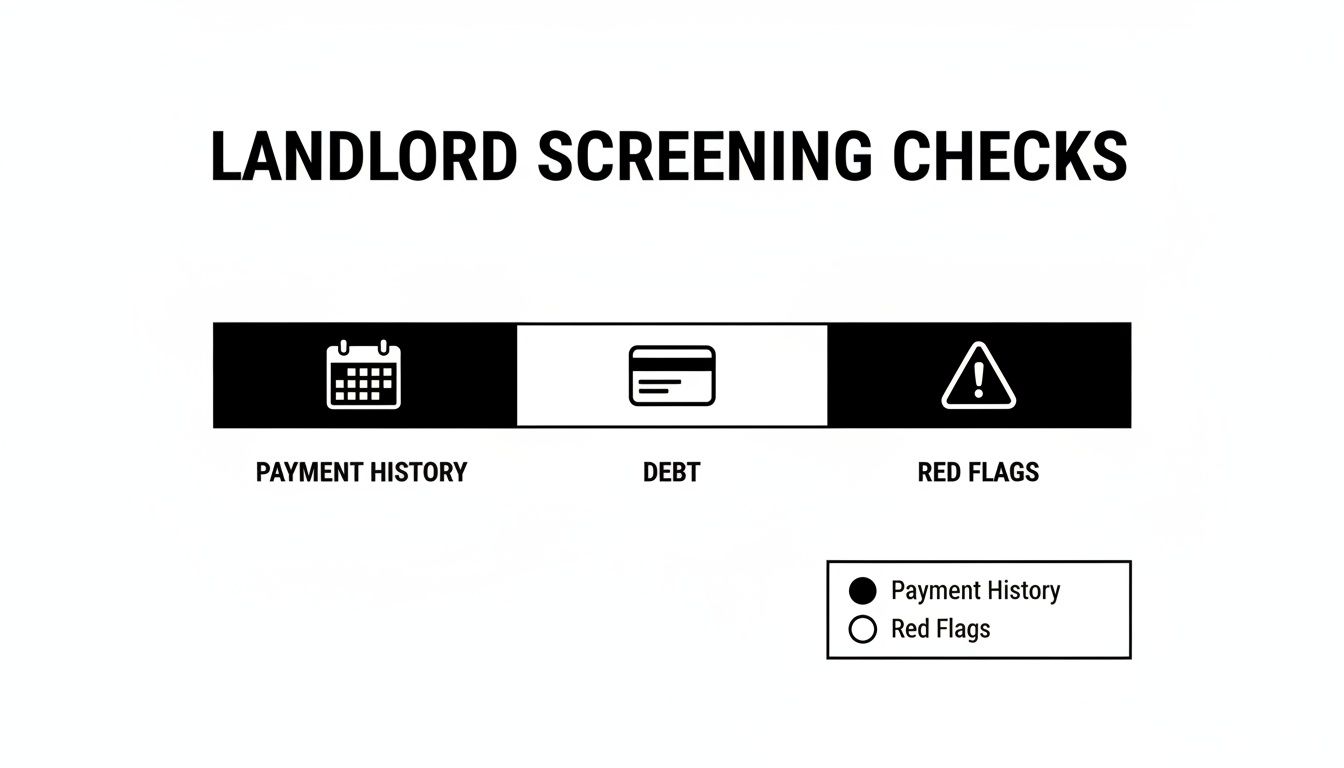
At the end of the day, every landlord is checking for the same fundamentals: a history of paying on time, manageable debt, and no major financial red flags. How much wiggle room they have on those factors is what really changes from one building to the next.
How to Rent with a Less-Than-Perfect Credit Score

Finding out your credit score is below the typical 620 benchmark can feel like a major setback in your apartment hunt. But it’s not a rejection slip. Think of it as a flag for the landlord—a signal that they just need a bit more assurance you’re a safe bet. Your job is to get ahead of their concerns and build a compelling case for yourself.
Your rental application is much more than a three-digit number. It’s a complete package that tells the story of your financial reliability. If one part of that package is a little weak, you just need to beef up the other areas to compensate. The goal is to show the landlord the full picture, not just the credit score snapshot.
Strengthen Your Application with Financial Proof
The fastest way to ease a landlord's worries about a low credit score is to show them you have solid, stable finances. At the end of the day, their biggest concern is whether the rent will be paid on time. You can put that fear to rest by proving your income more than covers the cost.
This is where your income-to-rent ratio becomes your best friend. The standard expectation is that your income is 3x the monthly rent, but if you can show you make 4x or 5x the rent, that low credit score suddenly becomes much less important. Come prepared with the paperwork to prove it:
Recent Pay Stubs: Bring two or three months of your most recent pay stubs to show a steady stream of income.
Bank Statements: A few months of bank statements can demonstrate a healthy savings balance and responsible spending habits.
Employment Offer Letter: If you’re just starting a great new job, an official offer letter detailing your salary is powerful proof of your earning potential.
A low credit score tells a story about past financial bumps. A high income-to-rent ratio, backed by solid proof, tells a much more current story: you can comfortably afford the rent right now.
Another strategy is to offer a larger security deposit, as long as it's allowed by local and state laws. This gives the landlord an extra financial cushion and directly lowers their risk. Similarly, offering to pay the first two months' rent upfront can make a very positive impression.
Use References and Personal Context to Your Advantage
Sometimes, the numbers don't tell the whole story. This is where the human element comes in. A strong rental history and personal accountability can often outweigh a blemish on your credit report.
Try including these powerful elements in your application:
Letters of Recommendation: A positive reference from a previous landlord is pure gold. It’s direct proof that you pay on time, respect the property, and are a good tenant. A letter from an employer vouching for your responsibility can also go a long way.
Write a Personal Letter: Don't leave the landlord guessing about what happened with your credit. A short, honest letter explaining the situation—whether it was due to unexpected medical bills, a layoff, or a family emergency—shows you're transparent and accountable. The key is to explain what happened and what you've done to get back on track.
Bring in a Financial Co-Pilot
If your own finances and references still aren't quite enough to get you over the finish line, bringing in some backup is a time-tested strategy. This is where a co-signer or guarantor comes into play.
A co-signer, often a parent or trusted relative with a strong credit history and income, signs the lease right alongside you. They are legally agreeing to pay the rent if, for any reason, you can't. From a landlord's perspective, this almost completely removes the financial risk tied to your credit score, making your application significantly stronger. It's a very common solution, especially for students or anyone just starting to build their credit.
Understanding the Landlord’s Tenant Screening Process
To get a leg up in your apartment search, it helps to step into the landlord's shoes. When you hand over that rental application, you're not just asking for a new home; you're proposing a business partnership. For a property owner, that partnership carries some serious financial risk. Every empty unit, every late payment, and especially every eviction, can cost them thousands.
That's why their screening process is so important—it’s their first line of defense. The credit check is a huge part of this. It gives them a quick, unbiased snapshot of your financial habits and helps answer the one question that matters most: can I count on this person to pay the rent on time?
But don't make the mistake of thinking it’s all about the credit score. Any experienced landlord or property manager knows that number is just one piece of a much bigger puzzle.
More Than Just a Number
A thorough screening process looks at the whole picture to figure out if you're a reliable tenant. While it’s good to know what is a good credit score for renters, that number gets weighed against several other key factors.
Here’s what they’re really looking at to get a complete view:
Income Verification: This is non-negotiable. They’ll want to see recent pay stubs or bank statements to confirm you have a steady, provable income. The industry-standard rule of thumb is an income that's at least 3x the monthly rent.
Rental History: Your track record as a renter is one of the best predictors of how you'll be in their property. Expect them to call your past landlords to ask if you paid on time, took care of the place, and were a good neighbor.
Background Check: Landlords will almost always run a background check to scan public records for a criminal history. A conviction doesn't always mean an automatic denial, but certain offenses can pose a risk to the property or the community.
Eviction History: This is the ultimate red flag. An eviction on your record shows a serious breach of a past lease and makes it incredibly difficult to get approved for a new place.
By looking at all these pieces together, a landlord can see that a lower credit score might be offset by a great rental history and a high income. You can learn more about how all these components fit together in our ultimate guide to property management tenant screening.
The Role of Fair Housing Laws
It's also really important to know that this whole process isn't just the landlord’s whim. They have to follow strict federal laws, primarily the Fair Housing Act, which outlaws discrimination based on race, color, religion, sex, national origin, disability, or familial status.
To stay on the right side of the law, landlords must apply the exact same screening criteria to every single applicant. They can't require a 650 credit score for you and a 600 for someone else.
This legal requirement forces landlords to create a standardized, objective screening policy. They decide on their minimum qualifications upfront—for instance, a credit score of 620, an income of 3x the rent, and no eviction history—and then run every applicant against that same checklist. This protects them from lawsuits and ensures you get a fair shot based on your qualifications, not someone's personal opinion.
Actionable Steps to Boost Your Renter Credit Score
Improving your credit score is a lot like getting into shape. It won't happen overnight, but with a bit of focus and some consistent good habits, you'll see powerful results. Taking control of your credit profile is the best way to go from just another hopeful applicant to a landlord's top choice.
Think of it as a financial fitness plan. The goal is simple: build a stronger, more resilient credit history that screams reliability. Let's walk through the high-impact strategies that address exactly what landlords are looking for, so you're ready for your next apartment hunt.
Start with a Credit Report Checkup
Before you can fix anything, you have to know what you’re working with. Your very first move should be to pull your free credit reports from all three major bureaus—Equifax, Experian, and TransUnion. You're legally entitled to a free report from each one every year.
Go through each report line by line. Seriously, check everything. You're hunting for errors that could be dragging your score down, like a payment that was marked late when you paid on time or an account that doesn't even belong to you. If you spot a mistake, dispute it with the credit bureau immediately. Cleaning up errors is one of the fastest ways to give your score a potential lift.
Master Your Payment and Debt Habits
Okay, once your reports are clean, the real work begins. The two heaviest hitters on your credit score are your payment history and how much debt you're carrying. Together, they make up a massive 65% of a typical FICO Score.
That means you should pour your energy into these two core habits:
Pay Every Single Bill on Time: This is the absolute golden rule of credit. Even one late payment can linger on your report for seven years and cause a significant dip in your score. The easiest way to avoid this is to set up automatic payments or calendar reminders for everything—credit cards, utilities, you name it.
Lower Your Credit Utilization: This sounds technical, but it’s just the amount of credit you're using compared to your total limit. A key goal is to keep your credit utilization ratio below 30% on every card. So, if you have a credit card with a $5,000 limit, you should aim to keep the balance under $1,500. Paying down high-balance cards is one of the quickest ways to see your score jump.
Your credit score is really just a reflection of your habits. Consistently paying on time and managing debt responsibly are the fundamental exercises that build long-term financial strength and make you a fantastic rental applicant.
Turn Your Rent into a Credit-Building Tool
For the longest time, your biggest monthly expense—your rent—did absolutely nothing for your credit score. Thankfully, that’s changing.
Today, rent reporting services can report your on-time rent payments to the credit bureaus. This adds a positive tradeline to your file, which is a huge help, especially if you have a thin credit history. Some property managers use systems that track this automatically, which you might see on a rent ledger. It's worth asking your current landlord if they offer a service like this. If not, you can sign up for one yourself and finally make those rent payments start working for you.
Frequently Asked Questions About Credit Scores for Renters
Even when you think you have a handle on the rental process, a few specific questions always seem to pop up. Let's tackle some of the most common things renters ask about their credit, so you can move forward with your application confidently.
Can I Rent an Apartment with No Credit History?
Absolutely. It’s definitely possible to rent an apartment even if you're "credit invisible." Landlords and property managers know that everyone has to start somewhere. Without a credit history to look at, your main goal is simply to show them you're financially stable in other ways.
You can make your application much stronger by:
Bringing on a co-signer who has a solid credit profile.
Offering a larger security deposit (if local laws allow it).
Showing proof of consistent income with recent pay stubs or an official offer letter from a new job.
Many property owners are happy to work with first-time renters, especially when you can prove you're responsible and can easily cover the monthly rent.
Does Checking My Own Credit Score Lower It?
Nope, checking your own score won't hurt it one bit. When you pull your own credit report or use a monitoring service, it's called a soft inquiry. These checks are only visible to you and have zero effect on your credit score.
A hard inquiry, on the other hand, is what happens when a landlord or lender officially pulls your credit as part of an application. That can cause a small, temporary dip of a few points. So feel free to check your own credit as often as you like—it’s a smart move.
Checking your own credit is like looking in a mirror—it's just a reflection that doesn't change anything. A hard inquiry from a landlord is more like a snapshot for their official records.
How Long Does It Take to Improve a Credit Score?
That really depends on where you're starting from and what steps you're taking. Some actions can give you a pretty quick boost. If you pay down a credit card with a high balance or get an error removed from your report, you might see a positive change in as little as 30 to 60 days.
But building a truly great credit history is more of a marathon than a sprint. The biggest factor is a long, consistent history of paying your bills on time, and that positive impact naturally builds over months. For significant, lasting improvement, you should think in terms of a sustained effort over 6 to 12 months.
At Keshman Property Management, we take the guesswork out of the rental process for both owners and tenants by using clear, consistent screening criteria. With 20 years of experience, we know how to make the experience fair and efficient for everyone involved. See how our expert services can work for you at https://mypropertymanaged.com.


Comments