
Break a Lease Florida: A Tenant and Landlord Guide
- Sarah Porter

- Feb 4
- 16 min read
Updated: Feb 14
Yes, you can legally break a lease in Florida, but only if you have a legally valid reason. Simply changing your mind isn't enough. The law recognizes specific situations, like being called to active military duty, serious health and safety problems with the rental, or if your lease happens to have an early termination clause.
Your Guide to Early Lease Termination in Florida
Whether you're a tenant with a sudden job offer in another state or a landlord staring at an unexpected vacancy, breaking a lease in Florida can feel like navigating a legal minefield. It’s a scenario loaded with financial stress and tricky rules for everyone involved.
The good news is that there are clear, legally protected ways for tenants to end a lease early. At the same time, property owners have their own set of rights and responsibilities to follow. This guide will walk you through it all from a balanced, real-world perspective, hopefully making the whole process a lot less painful.
The Law at the Heart of It All
The most important piece of the puzzle is Florida Statute 83.595. This is the law that lays out a landlord’s options when a tenant leaves before the lease is up. Getting a handle on what this statute says is the first step for both parties.
If you're a landlord, knowing this law inside and out is critical for protecting your investment. For tenants, understanding your rights under this statute is the key to walking away without a massive financial penalty.
Ultimately, Florida law tries to strike a fair balance. It gets that life throws curveballs, but it also protects landlords from being stuck with the full cost of an empty unit without any options.
Why Getting This Right Matters
Early lease terminations are happening more and more. Life is unpredictable. Handling this situation the right way isn't just about dodging a lawsuit—it's about protecting your finances and your reputation, whether you're a renter or a property owner.
This guide will break down the essentials and prepare you for what comes next. A solid understanding of the rules from the very beginning can save you from costly mistakes and heated arguments later on.
Here’s a look at what we’ll cover:
Legally Justified Reasons: We’ll dig into the specific situations, like military deployment or an uninhabitable apartment, that legally allow a tenant to break a lease without penalty.
The Landlord's Duty to Mitigate: A landlord can't just sit back and charge you for the remaining months. We’ll explain their legal duty to make a reasonable effort to find a new tenant.
Finding a Middle Ground: Often, the cleanest break comes from a mutual agreement. We'll talk about negotiating early termination clauses and buyout options that can work for both sides.
The Power of Paperwork: From official written notices to logs of re-rental efforts, we'll cover the crucial documents you need to keep to protect yourself.
When Can a Tenant Legally Break a Lease in Florida?
A lease is a binding contract, no doubt about it. But Florida law recognizes that some situations are so severe that holding a tenant to the full term just isn't reasonable. These aren't just convenient excuses; they're specific, legally protected circumstances that allow you to walk away from a lease without a massive financial penalty.
If you're a tenant thinking about an early exit, the first step is figuring out if your situation falls into one of these legally valid categories.
This decision tree gives you a quick visual roadmap for navigating the process and understanding how your actions, your landlord's responsibilities, and the law all fit together.
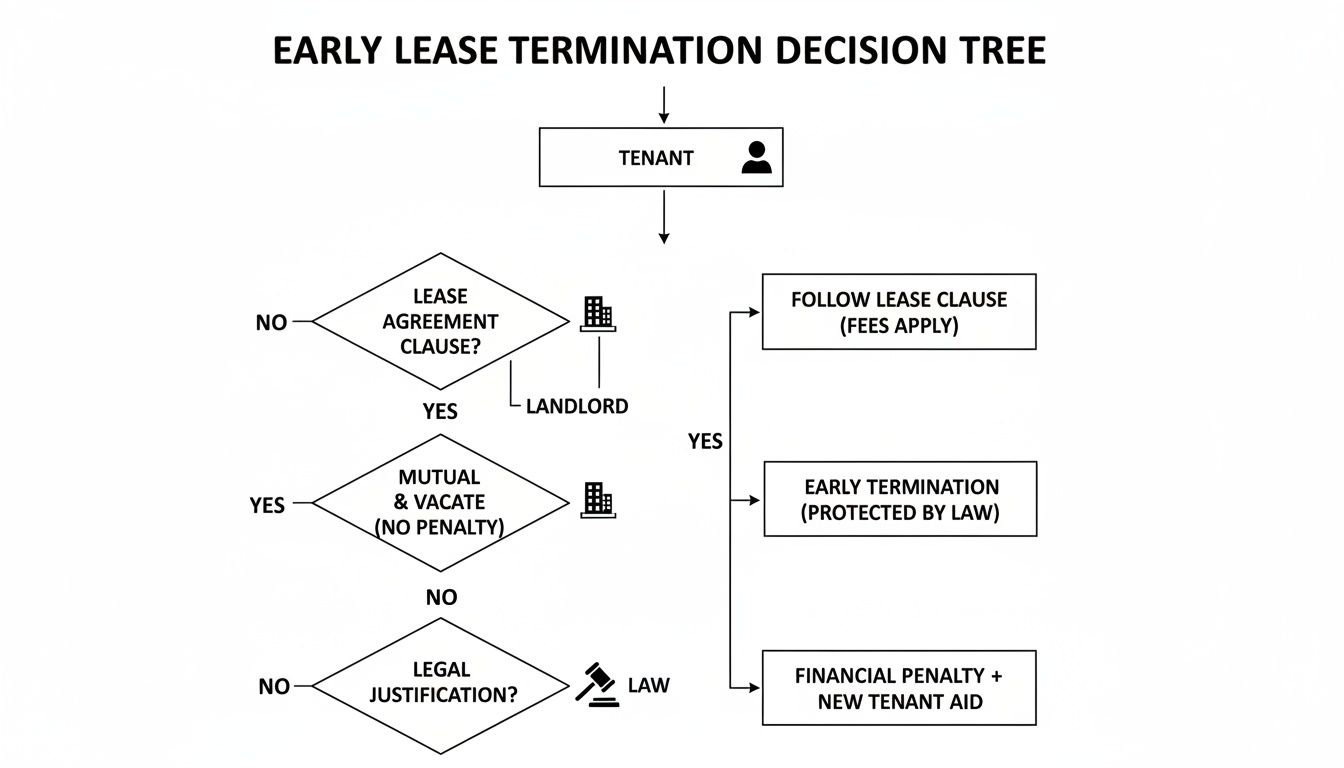
As the flowchart shows, having legally sound reasons is the foundation for a successful lease break. From there, following the correct legal procedure is what seals the deal.
Active Military Duty
For active-duty servicemembers, this is one of the most straightforward ways to terminate a lease without penalty. The Servicemembers Civil Relief Act (SCRA), a powerful federal law, provides these protections for military personnel.
If you get orders for a permanent change of station (PCS) or are deployed for 90 days or more, the SCRA gives you the right to break your lease.
To do it by the book, you absolutely must:
Give your landlord proper written notice.
Attach a copy of your official military orders to that notice.
Remember that the lease officially ends 30 days after your next rent payment is due. So, if you hand in your notice on August 10th and your rent is due on the 1st, your lease will terminate on September 30th.
Constructive Eviction: When the Property Becomes Uninhabitable
Every tenant has the fundamental right to a safe and habitable home. If your landlord drops the ball on maintaining the property and the problems are serious enough to make it unlivable, you might have a case for what the law calls constructive eviction.
We’re not talking about minor annoyances like a leaky faucet or a squeaky door. This applies to major issues that directly threaten your health and safety.
Real-world examples include things like:
No hot water or major plumbing failures.
A severe, persistent pest infestation (think roaches, rodents) that the landlord has ignored.
Serious structural problems, such as a collapsing roof or dangerously unsafe floors.
A complete failure of the heating or air conditioning systems.
This is critical: You can't just pack up and leave. First, you must deliver a formal written notice to the landlord spelling out the specific problems. Florida law gives them seven days to fix it. If they don't, then you have the right to terminate the lease.
Landlord Harassment or Privacy Violations
Your right to "quiet enjoyment" of your rental is legally protected. While a landlord can enter your home for inspections, repairs, or showings, they have to give you reasonable notice. In Florida, that's typically 12 hours unless there's a true emergency.
If a landlord repeatedly shows up unannounced, changes the locks on you, or otherwise harasses you, they're violating your lease agreement. This behavior can be a valid reason to break your lease. If you find yourself in this situation, document everything. Keep a log with dates, times, and a description of each incident—this paper trail is your best friend.
Breaking a lease has always been a big deal, but the financial stakes are higher now than ever. Between 2020 and 2023, Florida's median gross rent shot up by an astonishing 39%, climbing from $1,238 to $1,719. This massive increase has put a squeeze on many tenants, pushing more people toward early lease terminations and contributing to a rise in evictions. While new 2024 laws give month-to-month tenants 30 days' notice, those on fixed-term leases can still face penalties of up to two months' rent, which makes having a legally sound reason for leaving absolutely essential.
No matter the reason, proper documentation and formal written notice are non-negotiable. To get a better handle on this part of the process, take a look at our landlord’s essential guide to a Notice to Vacate.
A Landlord's Playbook for Unjustified Lease Breaks
It’s a scenario that can throw a wrench in any landlord's plans: a tenant leaves mid-lease without a legally valid reason. This move can mess with your cash flow and pile on unexpected work, but Florida law gives you a solid framework for handling it. How you respond in the immediate aftermath is key to protecting your investment and recovering your losses.
Everything starts with Florida Statute 83.595. This is the part of the law that lays out your options when a tenant vacates early. Getting a handle on these options is the first step, and it boils down to making a critical decision about the property itself.
When a tenant packs up and leaves without a valid reason, Florida law presents landlords with a few distinct paths. The choice you make determines your next steps, the tenant's ongoing liability, and how you can recover lost income. Understanding these remedies, outlined in Florida Statute 83.595, is crucial.
The table below breaks down the three main options available to you.
Landlord Options Under Florida Statute 83.595
Remedy | Landlord Action | Tenant Liability | Best For |
|---|---|---|---|
1. Retake Possession for Tenant's Account | You accept the tenant has left, but you do not terminate the lease. You must make a good-faith effort to re-rent the unit on their behalf. | The original tenant is liable for the rent difference between their lease and the new tenant's lease until their original term expires. | Situations where you want to keep the tenant's liability active but are confident you can re-rent the unit relatively quickly. |
2. Retake Possession for Own Account | You accept the tenant's surrender of the property, which officially terminates the lease. | The tenant is only liable for rent accrued up to the date you retook possession. Their liability for future rent ends. | When you want a clean break and don't want to pursue the former tenant for future rent, or if market conditions are strong for a quick re-rental. |
3. Do Nothing & Hold Tenant Liable | You can stand by and hold the tenant liable for rent as it comes due. This is rare and risky, as the tenant could claim you didn't mitigate damages. | The tenant remains liable for all rent due for the remainder of the lease term. | This is almost never the recommended course of action due to the duty to mitigate damages, which most courts will enforce. |
Each path has significant legal and financial implications. The most common and practical approach for most landlords is the first option: retaking possession for the tenant's account while actively working to find a replacement.
The All-Important Duty to Mitigate Damages
Here’s the part you absolutely cannot ignore: in Florida, you have a duty to mitigate damages. You can't just let the unit sit empty for months and then send the old tenant a massive bill for all the lost rent. The law requires you to make a reasonable, good-faith effort to re-rent the property as quickly as you can.
This is your single most important legal responsibility in this situation. If you end up in court and can't prove you tried to find a new tenant, a judge could drastically reduce or even wipe out any damages you're trying to claim.
So, how do you prove it? Document everything. Your records need to be clean, consistent, and show you were actively trying to fill the vacancy.
Get it Listed, Fast: As soon as you know the unit is vacant, get it on Zillow, Trulia, Apartments.com, and anywhere else you normally advertise. Keep screenshots of the listings with dates.
Price it Right: You have to list the unit at a fair market rent. You can’t jack up the price hoping it won’t get rented so you can charge the old tenant more. That’s not a "good-faith" effort.
Keep a Log: Track every call, email, showing, and application. Note the dates, names, and the outcome. If you reject an applicant, be sure you have a legally sound reason (e.g., they didn't meet your standard income or credit requirements).
Calculating What You're Owed
Once you’ve secured a new, qualified tenant, you can sit down and calculate your actual financial hit. This isn't about penalizing the old tenant; it's about making you whole for the actual, quantifiable losses you suffered.
These damages typically include:
Lost Rent: This is the big one. It's the rent you lost for every day the property was vacant, from the day the old tenant left until the new tenant's lease started.
Advertising Costs: Did you pay for a premium listing or run a social media ad? Those direct marketing costs are recoverable.
Re-Renting Fees: If you use a property manager or agent who charges a fee to find a new tenant, that commission can often be passed on to the former tenant.
Your first tool to cover these losses is the security deposit. Florida law allows you to withhold funds from the deposit for unpaid rent and other damages, but you must follow the rules. You have 30 days from when the tenant vacates to send them a written, itemized notice explaining why you're keeping some or all of the deposit.
It's helpful to remember that a lease break is a distinct process from an eviction. If you're curious about that side of things, you can learn more about the landlord's timeline for an eviction in Florida.
Market trends also play a role. For example, the Florida rental market is seeing some changes, with statewide vacancy rates climbing to 6.9% from 5.8% a year prior, largely due to a boom in new apartment construction. This influx of new units could make re-renting your property a bit easier, which in turn might reduce the total amount of lost rent a former tenant is on the hook for.
Using an Early Termination Clause to Break a Lease
Sometimes, the best way to handle an unexpected breakup is to have planned for it from the start. That's exactly what an early termination clause does in a lease agreement. Think of it as a pre-negotiated exit strategy, written right into the contract.
This clause, also called a liquidated damages clause, provides a clear, predictable buyout option for a tenant who needs to move out before the lease is officially over. If you're looking to break a lease in Florida, finding this clause in your paperwork is like discovering a hidden escape hatch—it's often the simplest and cleanest way out. It takes all the guesswork and potential conflict off the table.
What Does This Clause Typically Involve?
While the exact wording can differ from lease to lease, most early termination clauses in Florida share a couple of key components. Nailing these down is crucial for a smooth and final exit.
Here’s what you’ll almost always find:
A Buyout Fee: This is the heart of the deal. You’ll be on the hook for a specific, predetermined amount, usually equal to one or two months' rent.
A Notice Period: You can't just pack up and leave. The clause will require you to give your landlord formal written notice, typically 30 to 60 days before you plan to move out.
When a tenant meets both of these conditions—pays the fee and gives proper notice—the lease is considered terminated. That’s it. You’re legally free and clear.
A critical note for landlords: If you've included this clause and the tenant follows it to the letter, you can't then turn around and sue for additional lost rent. By accepting the fee, you've accepted your remedy, and the matter is closed.
This pre-agreed fee is legally referred to as liquidated damages. The idea is that it's a fair and reasonable estimate of the costs you'd incur from an unexpected vacancy, covering things like lost rent while you find a new tenant and the costs of advertising.
A Win-Win for Tenants and Landlords
An early termination clause isn't just a life raft for tenants; it also offers some real benefits for landlords. It sets a professional, flexible tone for the rental relationship right from the beginning.
For Tenants, the upsides are obvious:
No Surprises: You know the exact cost to break the lease from the day you sign. No haggling, no mysterious damage calculations.
Peace of Mind: Once you pay up and give notice, your obligation is over. You won't be anxiously watching to see how long it takes the landlord to re-rent the place.
Credit Protection: Using an agreed-upon clause to end your lease won't harm your credit score or rental history, which is a huge difference from simply abandoning the property.
For Landlords, the advantages are just as compelling:
Guaranteed Money: You get a check in hand right away, without the headache of chasing down a former tenant or proving your financial losses in court.
Less Hassle: You don't have to worry about your legal duty to mitigate damages—that is, trying to re-rent the unit as quickly as possible. The clause handles it for you.
Streamlined Turnover: The process is clear and efficient. You can immediately pivot your focus to marketing the property and finding a great new tenant.
How to Create an Enforceable Clause
What if your lease doesn't have one? If both parties are on board, you can always add an early termination clause later on using a lease addendum.
For it to hold up in Florida, the addendum must be crystal clear, fair, and signed by both the landlord and the tenant. It needs to explicitly state the fee and the required notice period. By offering this flexibility, landlords can make their properties more attractive while still protecting their bottom line if a tenant’s life plans suddenly change.
Essential Paperwork for Lease Terminations
When you need to break a lease in Florida, a handshake deal is your worst enemy. I've seen it time and again: verbal agreements go sideways, memories get fuzzy, and suddenly you're in a costly legal dispute. Proper documentation isn't just a good idea; it's your primary defense.
For both tenants and landlords, a clear paper trail is the only way to navigate a lease break successfully. It protects your rights, prevents arguments over the security deposit, and ensures everyone can move on without lingering liabilities.

For Tenants: The Notice of Intent to Vacate
If you're a tenant, your first official move is sending a written Notice of Intent to Vacate. This is the letter that formally tells your landlord you're leaving and gets the legal clock ticking. A quick text or a casual email probably won’t cut it and can be easily dismissed.
Your notice needs to be direct and professional. This isn't the time to list your complaints; it's about stating facts clearly. The best practice? Send it via certified mail with a return receipt. That slip of paper is undeniable proof of when your landlord received the notice.
Make sure your letter includes these key details:
Your full name and the property address, unit number included.
The date the letter is written.
A direct statement that you are terminating your lease agreement early.
The exact date you will be out of the property.
The legal reason you're breaking the lease (e.g., call to active military duty, landlord's failure to maintain the property).
A forwarding address where the landlord can send your security deposit.
Your signature.
Pro Tip: Don't assume your landlord remembers the phone call where you explained everything. The written notice is the only document that holds up legally. Be specific, and if you can, cite the relevant Florida statute or the specific clause in your lease.
For Landlords: The Lease Termination Agreement
Now, let's say the lease break is a negotiated deal, maybe involving a buyout fee. This is where a Lease Termination Agreement becomes absolutely critical. This document is the final handshake, putting the agreement in writing and releasing both you and the tenant from the original lease.
Without it, you open the door to all sorts of problems. A tenant could claim they were forced out, or a landlord might try to claim more damages later. This simple document puts the matter to rest for good.
A solid agreement should always include:
Names of the landlord and all tenants on the lease.
The full property address.
The official termination date of the original lease.
The specific terms, like the amount of the buyout fee.
A release clause stating both parties are free from future claims under the original lease.
Clear details on how the security deposit will be handled.
Signatures from you (the landlord) and every tenant.
Having a good template on hand is a game-changer. If you need a reference for how a comprehensive contract should be structured, you can download our rental lease agreement template to get an idea.
For Landlords: Documenting Your Mitigation Efforts
If a tenant leaves without a valid legal reason and there's no buyout agreement, you have a duty to "mitigate damages." In plain English, you have to make a real effort to re-rent the unit. Your ability to claim any lost rent from the former tenant depends entirely on your ability to prove you did this.
Your proof is your documentation. Start a folder for that specific unit and get meticulous.
Your Mitigation Documentation Checklist:
Advertising Records: Screenshot your online listings on Zillow, Apartments.com, or wherever you post. Make sure the date and rental price are visible. Keep receipts for any paid ads.
Inquiry Log: Keep a simple spreadsheet tracking every call and email. Note the date, the person’s name, and their contact info. This shows you're responsive.
Showing Schedule: Log every tour you schedule and complete. Jot down who showed up and any feedback they gave. If they were a no-show, note that, too.
Application Records: Keep a copy of every application you receive. If you reject someone, document the legitimate, non-discriminatory reason (e.g., failed credit check, income didn't meet requirements). This proves you were actively trying to fill the vacancy.
Expense Receipts: Save receipts for everything related to re-renting the unit—from advertising fees to the cost of background checks.
This might feel like overkill, but trust me, if you end up in small claims court trying to recover thousands in lost rent, this folder will be your best friend.
Common Questions on Breaking a Lease in Florida
Ending a lease early is one of those things that sounds straightforward until you're in the middle of it. Even when you think you know the rules, real-world situations have a way of throwing you a curveball. This is where we get into the nitty-gritty, answering the most common questions we hear from both tenants and landlords in Florida.
Think of this as your field guide for those "what if" moments that aren't always spelled out in a standard lease. Getting these answers straight can save you a world of headache and a lot of money down the road.
What Happens If I Just Leave and Break My Lease?
Just packing up and leaving without a legal reason or proper notice is, frankly, the worst thing you can do. It's often called "skipping out," and the fallout can follow you for years.
When you abandon the property, your landlord can take you to court for every single penny of rent you owe for the rest of the lease term, or until they find a new renter. On top of that, they can bill you for the costs of advertising and preparing the unit for the next tenant.
This path almost always ends with a judgment against you, which devastates your credit score. A judgment makes it incredibly difficult to get approved for another apartment, secure a car loan, or even open a new credit card. A difficult conversation with your landlord is always, always a better option than disappearing.
Can a Landlord Charge a Penalty and the Remaining Rent?
Absolutely not. In Florida, a landlord has to choose one path or the other—they can't have their cake and eat it too.
If your lease has an early termination clause with a set fee (also called liquidated damages), paying that fee settles the score. The landlord agrees to accept that amount as the final resolution.
Once you’ve paid it, they can't come after you for more rent, no matter how long the unit sits empty.
If your lease doesn't have this clause, the landlord can’t just make up a penalty fee. Their only option is to charge you for their actual financial loss, which is the rent they missed while actively and reasonably trying to find a new tenant.
How Much Notice Is Required to Break a Lease?
This is a tricky one because there’s no single, one-size-fits-all answer. The notice you have to give depends entirely on why you're leaving.
Military Orders (SCRA): You'll need to provide written notice and a copy of your deployment or relocation orders. The lease typically ends 30 days after your next rent payment is due.
Uninhabitable Conditions: This isn't an immediate out. First, you must give the landlord a formal written notice describing the issues and give them a reasonable time (usually seven days) to fix them. If they don't, then you can terminate.
Early Termination Clause: The lease itself will tell you exactly what's required. It's common to see a 60-day notice period in addition to paying the fee.
Your lease is your playbook. Always start by reading the terms you agreed to, as they will dictate the specific notice required for any buyout or early termination options.
How Do I Prove I Tried to Re-Rent the Property as a Landlord?
Documentation, documentation, documentation. If you end up in court trying to recover lost rent, the judge will put the burden of proof squarely on you. You have to show that you made a genuine, good-faith effort to mitigate your damages.
Your re-rental file should be your evidence locker. It needs to include:
Dated screenshots of your rental ads on sites like Zillow or Apartments.com.
A log of every inquiry, noting names, dates, and how you followed up.
A schedule of all property showings, including who came and any feedback you got.
Copies of rental applications, with clear, non-discriminatory reasons for any denials (e.g., failed a credit check).
Receipts for any ad spending.
Keeping meticulous records is the only way to safeguard your ability to recover what you're owed when a tenant breaks their lease without a valid reason.
Handling the complexities of a broken lease takes a steady hand and deep expertise. At Keshman Property Management, we’ve spent over 20 years navigating these exact situations, ensuring our clients' investments are always protected. Discover how our transparent, owner-focused approach can make your life easier at https://mypropertymanaged.com.


Comments