
Rental Property Business Plan Template for Landlords

Updated: 4 hours ago
A good rental property business plan isn't just some document you create to get a loan—it's your personal playbook for making real money in real estate. It's what turns a vague idea floating in your head into a concrete, profitable business. This is the tool that gives you the clarity to handle market swings and make decisions with confidence.
Your Business Plan Is Your Most Important Tool
Let's kill the myth that a business plan is some stuffy formality you write once and forget. For a real estate investor, it’s the single most important thing separating a scalable, money-making business from a stressful, cash-draining hobby. Without one, you’re flying blind, making huge financial bets based on gut feelings instead of solid numbers and a clear strategy.
Think of it as the blueprint for your entire investment portfolio. You wouldn't build a house without a detailed plan, right? The same logic applies here. A business plan forces you to get past the exciting part—the idea of owning property—and really dig into what it takes to run it.
Avoid the Common Money Pits
One of the biggest jobs of your business plan is to make you stare reality in the face when it comes to costs. I see new investors all the time who only focus on the mortgage payment. That's a huge mistake, and it's where they get into trouble.
A properly thought-out plan makes you budget for everything:
Vacancy Rates: Your property will not be rented out 100% of the time. It just won't. Planning for a 5-10% vacancy rate means you're prepared for those inevitable gaps between tenants.
Maintenance and Repairs: Things break. Faucets leak, dishwashers die, and tenants call you at the worst times. Your plan needs to set aside a slice of the rent specifically for these surprises.
Capital Expenditures (CapEx): This is the big stuff—a new roof in five years, an HVAC system in ten. You have to save for these major expenses over time, or one big bill can completely wreck your cash flow for the year.
By actually putting these numbers on paper, you get a much clearer, more honest look at your real profit potential.
Your business plan is your first defense against going cash-flow negative. It forces you to swap wishful thinking for conservative math, making sure your investment can actually handle the real world.
Analyze Deals Like a Pro, Not an Amateur
When a great-looking property pops up on the market, the fear of missing out can push you into making a bad, impulsive decision. This is where your business plan becomes your strategic filter. It already has your investment rules written down—your target cash-on-cash return, the cap rate you’re looking for, and the type of property you want to own.
This framework lets you look at any potential deal with a cool head. Does that duplex in a trendy neighborhood actually fit the long-term goals you laid out? Will the projected cash flow meet the minimum you’ve already decided on?
This data-first approach takes emotion out of the picture. It helps you confidently say "no" to deals that seem great at first glance but just don't hit your numbers. That’s how you build a portfolio of winners, not just a random collection of houses.
Your Complete Rental Property Business Plan Template
Alright, let's get into the heart of it. Here you'll find our downloadable rental property business plan template, a tool I've personally used and refined over years of managing properties. It's designed to take the guesswork out of planning.
Before you jump in, I want to walk you through how it’s structured. This isn't just a document to fill out; it's a roadmap. Think of it as a logical flow that helps you move from big-picture analysis right down to the nitty-gritty of making a solid investment decision.
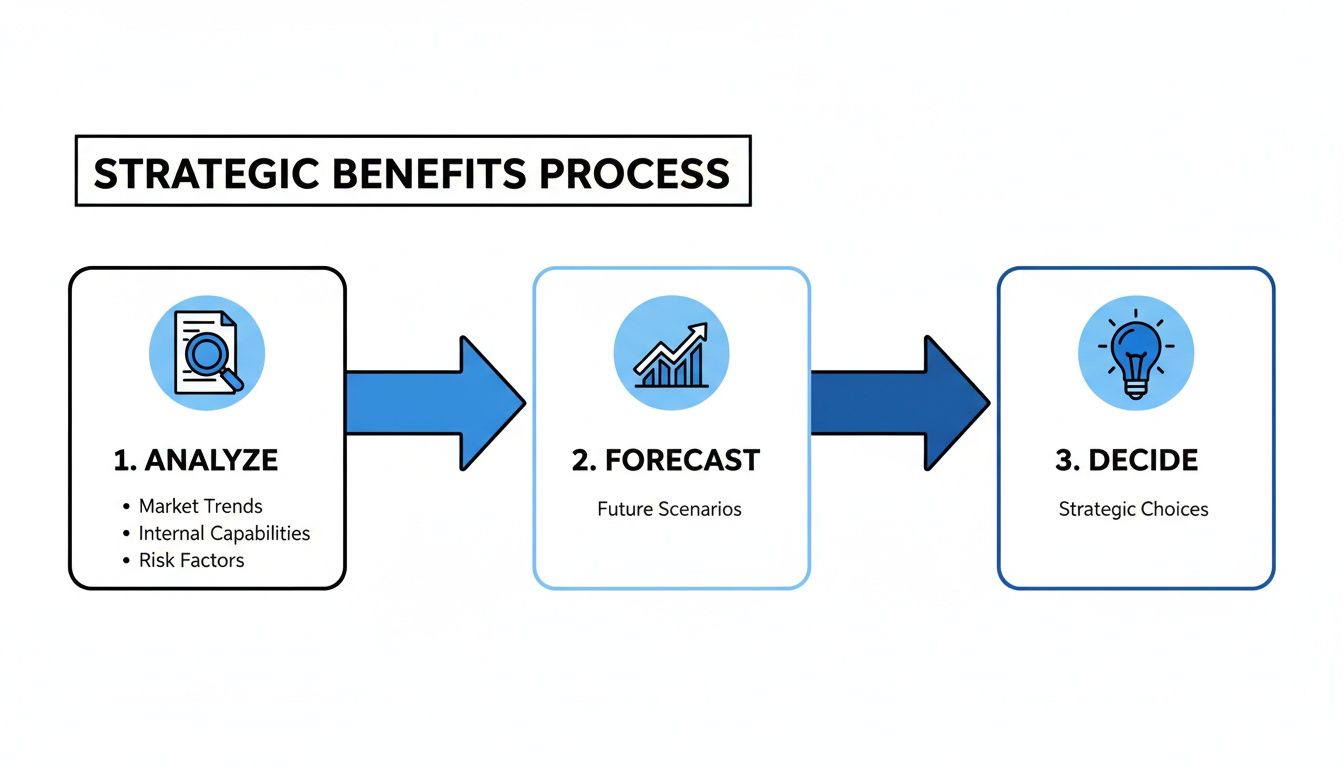
This process is exactly how seasoned investors think: you analyze the opportunity, you forecast the numbers, and then you decide. It keeps emotion out of the equation and puts data in the driver's seat.
Your Rental Property Business Plan At a Glance
To give you a bird's-eye view, the table below breaks down each section of the template. It's your cheat sheet for understanding the "why" behind each part of the plan.
Section | Core Purpose | Key Question It Answers |
|---|---|---|
Executive Summary | A snapshot of your entire strategy, perfect for a lender or partner. | What's my investment thesis, and why is it a winner? |
Market Analysis | Where you prove your idea works with real data on the local rental scene. | Is there real demand and are conditions right in my target area? |
Property Description | A detailed profile of the specific asset you're buying or already own. | What makes this particular property a smart and competitive rental? |
Financials & Projections | The core of your plan, covering startup costs, income, and cash flow. | Will this investment actually make money over the long haul? |
Revenue & Expenses | The assumptions behind your numbers—every income source and cost. | What specific figures are my financial projections built on? |
Tenant Acquisition | Your game plan for finding and screening the best possible tenants. | How will I keep the property filled with people who pay on time? |
Operations Plan | The systems for running the property day-to-day. | How will I handle maintenance, collect rent, and keep things running smoothly? |
Risk Mitigation | Your strategy for identifying threats and dealing with them proactively. | What's the worst that could happen, and what's my plan B? |
Key Performance Indicators | The specific metrics you'll track to gauge your success. | How will I know for sure if my rental business is on track? |
Think of this table as your guide as you work through the template. It will help you stay focused on the most important question each section is designed to answer.
A great business plan isn't something you write once and file away. It’s a living document. You should be revisiting and updating it as your portfolio grows and the market changes. It’s the tool that keeps you making smart decisions and building a truly resilient rental business.
Defining Your Mission and Analyzing the Market
Before you even think about crunching numbers on a specific property, you need to know why you're doing this. This is your mission. It’s more than just a feel-good statement; it’s the strategic compass for every single decision you’ll make.
Think of it as your 30-second pitch to a lender, a potential partner, or even to yourself when you need a reminder of the goal. It should be short, sharp, and clear, laying out your investment strategy, the types of properties you're after, and your ultimate financial objective.
First, Pinpoint Your Investment Strategy
Your strategy defines the kind of landlord you’ll become. Are you playing the long game, banking on appreciation in a neighborhood that’s on the rise? Or are you hunting for immediate monthly cash flow from solid, reliable properties? There’s no single "right" answer, but you absolutely must have one.
Let’s look at a few common paths:
The Appreciation Play: You’re targeting properties in up-and-coming areas, betting that their value will climb significantly over the next 5-10 years.
The Cash Flow Focus: The goal here is to buy multifamily units or single-family homes where the rental income comfortably covers all your expenses from day one.
The BRRRR Method: This is an active strategy of Buying, Rehabbing, Renting, Refinancing, and Repeating. It’s all about scaling your portfolio quickly.
Niche Rentals: You might focus on a very specific tenant base, like student housing near a campus or vacation rentals in a tourist hotspot.
Nailing this down clarifies everything that comes next, from the financing you'll need to the neighborhoods you’ll scout.
Ground Your Mission in Market Reality
Once your mission feels solid, it's time to prove it’s not just a daydream. This is where your market analysis comes in, and it's arguably the most critical piece of research in your entire business plan. Here, you swap gut feelings for hard data.
A thorough analysis shows a lender you've done your homework and aren't just guessing. Your goal is to become an expert on your target area. You need to understand the local economy and the demographic shifts that will affect your investment for years to come.
It also helps to know the bigger picture. The property management industry in the U.S. alone is projected to generate $136.9 billion in revenue in 2025, with over 304,000 businesses in the mix. Understanding this context helps you set realistic goals and see where your operation fits.
Your market analysis is your evidence. It demonstrates that you've identified a genuine opportunity and have a data-backed plan to capitalize on it, rather than just a hunch.
Key Data Points for Your Analysis
A powerful market analysis is about more than a quick glance at Zillow for rental comps. You need to dig much deeper to paint a complete picture of the investment landscape.
Here’s what you absolutely must include:
Rental Demand Drivers: What's bringing people to the area? Look for major employers, universities, hospitals, and big infrastructure projects. A growing population and steady job growth are your best friends here, signaling strong, sustained demand.
Competitor Analysis: Get specific. Identify 3-5 properties that are direct competitors—similar size, condition, and location to what you plan to buy. Find out their current rental rates, what amenities they offer, and, if you can, their vacancy history. This data is gold when it comes to justifying your own rent price.
Neighborhood Trends: What's the vibe of the neighborhood? Is it on an upward swing with new cafes and shops popping up? Or are businesses starting to close down? Check crime rates, school ratings, and walkability scores. These factors have a direct impact on the quality of tenants you'll attract and the rent you can charge. If you need a starting point, check out our guide on the best markets for rental properties in 2025 to see what makes a location attractive.
When you pull all this data together, you’re building a compelling story. You're no longer just saying, "I want to buy a duplex." Instead, you're saying, "I'm targeting duplexes in the Northgate neighborhood to serve the growing number of young professionals at the new tech campus. My proposed rent of $1,800 is 5% below the market average for comparable renovated units, ensuring quick tenant placement."
Now that is a plan that gets people's attention.
From Property to Process: Outlining Your Operations
You've got your vision and you've done the market research. Now it's time to get into the nitty-gritty. This part of your rental property business plan template is where you detail the actual property and, just as importantly, the systems that will keep it running smoothly and profitably.
Think of this as the engine room of your rental business. We'll start by painting a clear picture of the physical asset and then map out the day-to-day playbook for managing it.
Crafting a Compelling Property Description
Your property description needs to be more than just a list of specs. It’s the "why" behind your investment in this particular asset. It should tell a story that justifies your rental price and proves it's a competitive player in your market.
Go beyond the basics. Instead of simply stating "three-bedroom house," bring it to life. For example: "A recently renovated 1,500 sq. ft. three-bedroom, two-bath home featuring a private, fenced backyard. It's ideally suited for young families, located in a safe, walkable neighborhood within the district's top-rated elementary school zone."
See the difference? That level of detail directly supports your rental rate and connects back to the ideal tenant you identified during your market analysis.
Your description should touch on:
Physical Attributes: Get specific with square footage, layout, number of beds/baths, and any major capital improvements or renovations.
Unique Selling Points (USPs): What makes your property special? Highlight the things that command higher rent—think new kitchen appliances, in-unit laundry, dedicated parking, or smart home features.
Neighborhood Context: Connect the property to the lifestyle. Mention its proximity to parks, public transit, great coffee shops, or anything else that appeals to your target renter.
A strong property description proves you understand your asset's place in the market. It demonstrates to a lender or partner that your rental rate isn't a guess—it's a strategic price based on tangible value.
Building Your Day-to-Day Operations Plan
A fantastic property can turn into a nightmare without rock-solid systems in place. Your operations plan is your manual for everything that happens after a tenant signs the lease. This is where you map out how you'll handle the real work of being a landlord.
This plan is all about being proactive instead of reactive, which is the secret to minimizing vacancies and avoiding those dreaded 2 a.m. emergency calls. Spelling these processes out in your business plan shows you've thought through the practical, on-the-ground reality of owning a rental.
If this part starts to feel overwhelming, it's a good time to consider bringing in a professional. Understanding how property management works can help you decide if outsourcing tasks like screening and maintenance is the right move for you.
Key Systems for Your Operations Plan
Your plan should document the exact procedures for a few critical areas. Writing this down ensures you're consistent and efficient, whether you're managing one unit or a growing portfolio.
Tenant Screening and Leasing: What are your non-negotiables? Outline your minimum criteria for applicants, like credit score, income-to-rent ratio (a common standard is 3x the monthly rent), and what your background check covers. A tough but fair screening process is your best defense against future headaches.
Rent Collection: Be crystal clear. Will you use an online portal? Bank transfers? Define your process for handling late fees and the steps you'll follow if a tenant falls behind, making sure you're in full compliance with local landlord-tenant laws.
Maintenance and Repairs: This is a two-pronged strategy. First, create a proactive schedule for routine stuff—think HVAC servicing, gutter cleaning, and checking smoke detectors. Second, establish a reactive protocol for tenant repair requests, including your target response time and a go-to list of trusted vendors (plumber, electrician, HVAC tech).
Emergency Protocols: Things go wrong. Have a plan for after-hours emergencies like a burst pipe or a dead furnace. For example, understanding key insights into emergency water damage prevention and restoration for property managers can save you thousands and keep your tenants safe.
By mapping out these operational workflows, you’re building a real business that can run without you micromanaging every detail. This is how you transition from just owning a property to running a professional, profitable, and scalable rental operation.
Building Financial Projections That Inspire Confidence

This is where the rubber meets the road. Solid financial projections are the beating heart of your rental property business plan template, turning all your market research and operational strategies into a clear financial story. Your goal isn't just to paint a rosy picture; it's to build a set of numbers you can defend, proving your investment is both profitable and built to last.
Before you can crunch any numbers for your property, you need to understand the basics. Getting a handle on mastering the budget for a small business will give you the foundation for creating an accurate, realistic financial model.
Remember, this is the section a lender or partner will scrutinize the most. They want to see that you’ve thought through every possible cost and revenue stream, building a case that holds up under pressure.
Itemizing Your Start-Up Costs
Before you can even think about profits, you have to get an ironclad grip on your initial investment. This goes way beyond the down payment—it's every single dollar needed to get your property rent-ready and your business legally off the ground.
Your start-up summary needs to be exhaustive. Overlooking even a few small items can throw off your entire forecast and put a serious strain on your cash reserves right from the beginning.
Make sure you account for all of these:
Property Acquisition: This covers your down payment, all closing costs (which typically run 2-5% of the purchase price), and fees for appraisals or inspections.
Initial Repairs & Renovations: Be brutally honest with yourself here. What absolutely needs to be fixed before a tenant moves in? Factor in new paint, flooring, appliance repairs, or even basic landscaping.
Legal & Administrative Fees: This includes the cost of setting up an LLC to protect your personal assets, plus any local business licensing or permit fees.
Initial Marketing & Leasing: Budget for professional photos, listing fees on Zillow or Apartments.com, and the cost of running tenant background checks.
Operating Reserve Fund: This is non-negotiable. Aim to have 3-6 months of total operating expenses (mortgage, taxes, insurance, utilities) sitting in a separate account as a cash cushion for the unexpected.
Forecasting Income and Cash Flow
With your start-up costs nailed down, it's time to build your pro forma income statement and cash flow forecast for the next 3-5 years. This is where you model the financial performance of your rental business, month by month and year by year.
The pro forma is your best guess at future profitability. You'll project your total rental income and then subtract all your operating expenses to find your Net Operating Income (NOI)—a metric every investor lives and dies by. Our deep dive into https://www.mypropertymanaged.com/post/a-practical-guide-to-rental-property-cash-flow-analysis is a great resource if you need to get more familiar with these calculations.
A common mistake I see is being overly optimistic. Your projections gain instant credibility when you use conservative estimates. Think small, annual rent increases (2-3%) and a realistic vacancy rate (5-8%). It shows you understand the market and are prepared for reality, not just a best-case scenario.
Demystifying Key Performance Metrics
To prove you have a solid investment on your hands, you need to speak the language of real estate finance. Your business plan should calculate and explain a few key metrics that every serious investor looks for.
Net Operating Income (NOI): This is your property's total income minus all operating expenses. NOI is critical because it shows the property's ability to generate a profit before you even factor in your mortgage payments.
Capitalization Rate (Cap Rate): You get this by dividing NOI / Property Price. The cap rate shows the potential rate of return on an all-cash purchase and is the fastest way to compare the profitability of different properties.
Cash-on-Cash Return: This is your Annual Pre-Tax Cash Flow / Total Cash Invested. It tells you the exact return you're getting on the actual money you pulled out of your pocket, making it one of the most important numbers for building personal wealth.
Modeling Your Long-Term Growth Strategy
Finally, your financial projections should tie directly back to your long-term goals. If you plan to scale from one property to five in the next three years, your financial model needs to reflect that ambition.
Portfolio growth isn’t just a personal goal; it's a major industry focus. Show how you'll acquire new units—will it be through agent referrals, investor partnerships, or direct mail marketing? Your financials should map this out, demonstrating how you’ll fund future down payments and manage increased expenses. This proves your business is built not just for a quick win, but for sustainable, long-term expansion.
Common Questions About Rental Business Plans
As you start filling out your rental property business plan template, you’re going to have questions. That’s a good thing. It shows you're thinking like a real investor and trying to anticipate the bumps in the road.
We've been building rental portfolios and helping others do the same for decades. Here are some of the most common questions that come up, along with our straight-to-the-point answers.
How Often Should I Update My Rental Business Plan?
Think of your business plan as a GPS for your investment journey. It’s not something you set once and then toss in a drawer. It's a living document that needs to adapt as the landscape changes.
At a minimum, you should sit down for a deep dive once a year. This is where you pull up your actual numbers and compare them to what you projected. Did you really hit that cash flow goal? Were your maintenance costs higher than you thought? This annual check-in keeps your strategy honest and based on reality, not just wishful thinking.
But life happens between those annual reviews. You’ll want to pull out the plan anytime a major event occurs:
You buy a new property: Every new asset needs to be folded into your financial models, maintenance schedule, and overall portfolio strategy.
You face a major capital expense: That brand-new roof wasn’t in the original budget, so you need to update your forecasts to see how it impacts your cash reserves and long-term returns.
The market makes a big move: Rents in your area suddenly spike, or a major local employer shuts down. Your market analysis needs to reflect these new conditions right away.
Keeping your plan current turns it from a historical document into a powerful tool for making smart, proactive decisions.
What Is the Biggest Mistake in Financial Projections?
This one is easy, and we see it all the time: wildly underestimating expenses. It's a classic rookie mistake. New investors get so excited about the potential monthly rent and so fixated on the mortgage payment that they gloss over the real costs of owning a rental property.
This kind of optimism is dangerous and can drain your cash flow before you even get started. The secret is to be brutally realistic and budget for the costs that often get ignored.
There are three big ones you absolutely cannot forget:
Vacancy: Your property will sit empty sometimes. It's just a fact of the business. A conservative budget will set aside 5-10% of the gross annual rent to cover months with no tenant.
Routine Maintenance: Things break. Faucets leak, toilets run, and appliances give out. Another 5-10% of gross rent should be earmarked for these day-to-day repairs.
Capital Expenditures (CapEx): This is the big stuff—the roof, the HVAC system, the water heater. They have a long but finite lifespan. Building a separate cash reserve, often another 5-10% of gross rent, is non-negotiable if you want to avoid getting wiped out by a sudden replacement.
A great rule of thumb to keep your projections in check is the "50% Rule." It basically says that, over the long haul, all your operating expenses (everything except the mortgage) will probably eat up about 50% of your gross rent. If your plan shows expenses way below that mark, it’s a red flag that you might be wearing rose-colored glasses.
Can I Use This Business Plan for a Single Property?
Yes, absolutely. In fact, that's one of the best ways to use it. This template is built to grow with you, but the disciplined thinking it requires is most critical when you're buying your very first property.
When you create a full business plan for a single home, you’re forcing yourself to do the kind of deep due diligence that separates successful investors from struggling ones. You’ll prove to yourself (and any lender) that you've analyzed the market, vetted the numbers, and understand the risks before you put any money on the line.
For a single property, your plan will be incredibly focused:
The Market Analysis will drill down into that specific neighborhood, not just the city.
The Property Description will highlight every detail of that one asset.
The Financial Projections will model the precise income and expenses for that unit alone.
Then, as you expand, the plan expands with you. When you buy property number two, you’ll add its details and update the financials to reflect your new, larger portfolio. Starting with this professional approach from day one builds the right habits for scaling your business successfully.
How Detailed Should My Competitor Analysis Be?
It needs to be detailed enough to prove your rent price isn't just a number you pulled out of thin air. A lender or potential partner will see right through vague statements like "rents in the area are strong." You need to back up your pricing with cold, hard data from the street.
The goal is to find 3-5 directly comparable properties, or "comps." These are the actual listings a potential tenant would see and consider right alongside yours.
For each of these comps, you need to become a bit of a detective and gather some key intel:
Data Point | What to Look For | Why It Matters |
|---|---|---|
Current Rent | The advertised monthly asking price. | This is your most important benchmark for setting your own rent. |
Location | Is it on the same street or a few blocks away? | Rents can vary significantly even within the same zip code. |
Size & Layout | Match the square footage, bedrooms, and bathrooms. | You have to compare apples to apples for your numbers to be valid. |
Condition | Is it freshly renovated with stainless steel, or does it have 1980s carpet? | A modern finish can easily justify a higher rent. |
Amenities | Does it offer in-unit laundry, a garage, or a dishwasher? | These features are tangible benefits that tenants will pay more for. |
When you have this level of detail, your rent isn't a guess—it's a strategy. You can confidently show exactly where your property fits in the market and price it to attract the best tenants quickly.
Ready to build a rental business that stands the test of time? The right partner can make all the difference. At Keshman Property Management, we bring over 20 years of hands-on experience to help you maximize your returns and minimize your stress. Learn more about our transparent, owner-focused services at https://mypropertymanaged.com.


Comments