
Landlord Tenant Dispute Resolution Guide

The best way to win a tenant dispute is to prevent it from ever happening. Seriously. Effective landlord-tenant dispute resolution doesn't start with a tense phone call or a formal notice; it begins with laying a rock-solid foundation from day one. Your most powerful tool in this entire process is a clear, comprehensive lease agreement.
This document isn't just a formality—it's your first and best line of defense.
Building Your Foundation for a Peaceful Tenancy

A peaceful tenancy is no accident. It’s the direct result of setting clear expectations right from the start. A meticulously crafted lease is the roadmap for your entire landlord-tenant relationship, eliminating the gray areas where most conflicts tend to fester. I've seen it time and again: a little extra effort upfront saves an incredible amount of stress, money, and time down the road.
Think of your lease as the constitution for your rental property. Every rule, every responsibility, and every procedure needs to be spelled out, leaving as little room for interpretation as possible. When both you and your tenant know exactly what's expected, the chance of a simple misunderstanding spiraling into a major problem drops dramatically.
Essential Clauses That Preempt Common Arguments
Don't just download the first generic lease template you find online. To really bulletproof your agreement, you need to include specific clauses that tackle the most common friction points between landlords and tenants. These are the details that truly matter.
Make sure your lease explicitly covers these areas:
Rent Payment Specifics: Go beyond just listing the due date. Detail the exact payment methods you accept, the precise late fee amount and when it kicks in, and the protocol for handling a bounced check. Be specific.
Maintenance and Repair Responsibilities: Who handles what? Clearly draw the line between tenant duties (like replacing a smoke detector battery) and landlord responsibilities (like fixing a broken furnace). You also need a simple, clear process for how tenants should report maintenance issues.
Property Alterations: What can a tenant actually do to the property? Can they paint the walls a different color? Install shelving? Mount a 75-inch TV? Putting these rules in writing prevents unauthorized "upgrades" that often lead to security deposit fights.
Pet Policies: If you allow pets, a separate pet addendum is a must. It should specify the type, size, and number of pets allowed. Also include any pet-related fees or deposits and lay out the rules for things like noise and waste cleanup.
A well-written lease acts as a neutral third party in a future disagreement. When a question arises, both you and the tenant can refer back to the signed document, turning a potential argument into a simple clarification.
To help you get started, here’s a quick-reference table outlining the key clauses that can make a world of difference in preventing common disputes.
Essential Lease Clauses for Dispute Prevention
Clause Category | Key Details to Include | Why It Prevents Disputes |
|---|---|---|
Rent & Fees | Due date, accepted payment methods, grace period, late fee amount, returned check fee. | Removes all ambiguity about payment obligations and consequences for late or missed payments. |
Maintenance | Tenant vs. landlord duties, emergency repair contact, procedure for non-urgent requests. | Creates a clear process, preventing arguments over who is responsible for fixing what. |
Use of Premises | Occupancy limits, guest policy (e.g., maximum stay length), noise rules, smoking policy. | Sets clear boundaries on how the property can be used, heading off issues with neighbors or property damage. |
Entry by Landlord | Notice period required for entry (e.g., 24 hours), valid reasons for entry (inspections, repairs). | Protects tenant privacy while ensuring you have legal access, avoiding claims of improper entry. |
Pet Policy | Allowed types/breeds, size/weight limits, pet rent or deposit, tenant's cleanup duties. | Avoids unauthorized pets and clarifies rules for pet owners, preventing damage and noise complaints. |
Having these clauses clearly defined turns your lease from a simple contract into a proactive dispute-prevention tool.
The Power of Pairing a Strong Lease with Screening
Of course, even the world's best lease won't help much if you have a tenant who has no intention of following it. This is why a rigorous tenant screening process is absolutely crucial. By conducting thorough background and credit checks, you’re not just picking a tenant; you're selecting a business partner for the next 12 months.
A good screening process gives you a window into an applicant's financial stability, rental history, and overall reliability. When you combine this level of diligence with an ironclad lease, you create a powerful synergy that fosters a stable, respectful, and conflict-free rental experience.
To really dial in your screening methods, check out our in-depth guide: https://www.mypropertymanaged.com/post/ultimate-guide-to-property-management-tenant-screening. By carefully selecting your tenants and giving them crystal-clear guidelines, you'll find that you’re solving problems before they even start.
Mastering Communication and Meticulous Documentation

A solid lease is your foundation, but what truly determines whether a small issue becomes a full-blown dispute is how you handle the day-to-day. As soon as a problem crops up, your communication style and your record-keeping become your best tools. Many formal disputes don’t start over a huge contract violation; they often begin with something small that spirals because of a breakdown in the landlord-tenant relationship.
That’s why maintaining a professional, calm tone—especially when talking about tough subjects like late rent or property damage—is absolutely essential. It's human to get frustrated, but reacting emotionally only pours fuel on the fire. A calm, business-like approach keeps everyone focused on the real goal: finding a solution.
This isn’t about being cold or distant. It’s about being clear, fair, and consistent. When you treat every interaction with respect, you build a relationship where tenants feel heard, which makes them far more likely to work with you, not against you.
The Power of a Clear Paper Trail
If you take one thing away from this guide, let it be this: if it isn't in writing, it didn't happen. Verbal agreements are a landlord’s worst enemy. They’re easily forgotten, misconstrued, and lead straight to "he said, she said" arguments that are impossible to prove. A detailed paper trail is your lifeline—an objective, factual record that protects everyone involved.
Think of it as the undisputed history of the tenancy. This documentation provides concrete proof of communications, agreements, and the property's condition. Should a disagreement ever escalate, this file becomes the backbone of your case, replacing fuzzy memories with cold, hard facts.
The key is consistency. Your documentation needs to be a habit, not an afterthought. Start from day one and never stop. The goal is to build a complete file for every tenancy that tells the whole story, leaving no room for doubt.
A robust paper trail isn't about mistrust; it's about clarity. It provides a single source of truth that can quickly de-escalate disagreements by replacing subjective memory with objective facts.
Key Documentation Practices for Every Landlord
Building this kind of record isn’t rocket science, but it does demand discipline. Here are the core habits you need to bake into your management routine to stay protected:
Save All Written Correspondence: Every single email and text message matters. These digital exchanges create a timestamped log of requests, notices, and agreements. Never, ever rely on a phone call for important issues without sending a written follow-up.
Log Every Phone Call: If you do need to talk on the phone, immediately send a quick email summarizing what was discussed. Something as simple as, "Hi Jane, just confirming our call a few minutes ago. You'll be paying the outstanding rent by Friday, and I've scheduled the plumber for Monday morning," creates a written record.
Conduct Thorough Move-In and Move-Out Inspections: This is non-negotiable. Use a detailed checklist and take dozens of date-stamped photos or even a walkthrough video of every single room. Pay close attention to walls, floors, ceilings, and appliances. Having both you and the tenant sign off on this report creates a baseline that makes security deposit discussions a simple comparison, not a fight.
Keep Meticulous Maintenance Records: Document everything. Every repair request, every text about a leaky faucet, every invoice from a contractor, and every receipt for parts. This trail proves you’re fulfilling your obligations to maintain a habitable home and clearly tracks the source of any tenant-caused damage.
Making these practices an automatic part of your workflow is the single best way to protect your investment. For a more detailed look, our guide on meticulous record-keeping dives deeper into creating an organized system that will save you countless headaches down the road. It's this proactive approach that turns potential blow-ups into simple, resolvable issues.
Navigating Negotiation and Formal Mediation
Even with flawless records, disagreements are a part of being a landlord. But before you even think about court, there are a couple of powerful, less confrontational paths to take. The first, and honestly the most effective, is simple negotiation—a direct conversation aimed at finding a solution that works for everyone.
This is where your meticulous record-keeping and clear communication skills truly pay off. They can transform what could be a heated argument into a productive, fact-based discussion. You'd be surprised how many conflicts stem from simple misunderstandings that a quick chat can clear up. The goal here isn't to "win," but to find common ground and, if possible, keep a good tenant.
This infographic lays out the typical path from identifying the problem to bringing in a mediator.
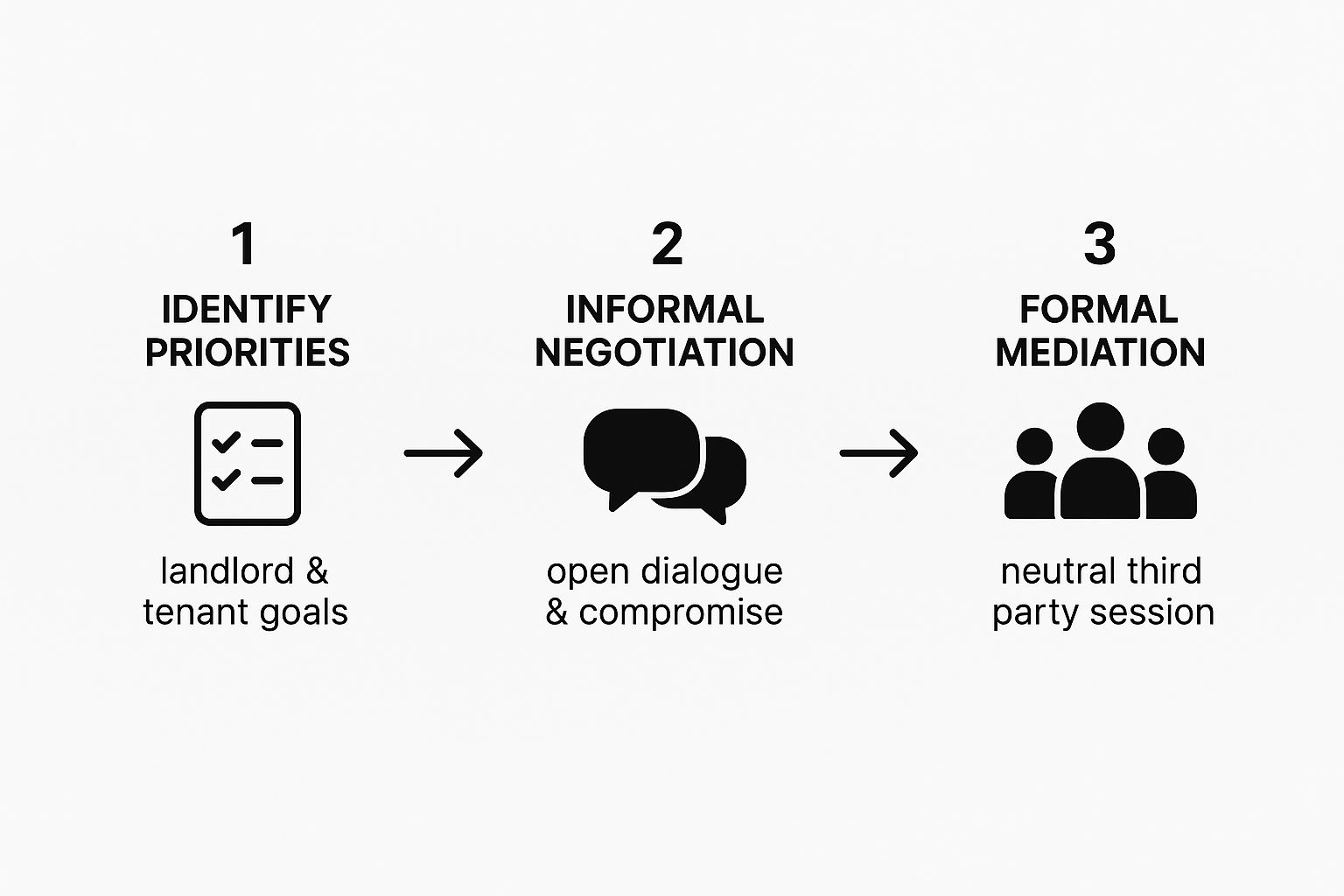
As you can see, formal mediation is a natural next step when direct talks don't work out, not a replacement for them.
Preparing for a Successful Negotiation
Walking into a negotiation cold is a surefire way to lose. Before you even think about picking up the phone, you need to do your homework. This prep work is what sets the stage for a positive outcome.
First things first: know what you want. What does your ideal resolution look like? Even more importantly, what are you willing to give up to get there? Knowing your own bottom line is absolutely critical.
Here’s how to get ready:
Know Your Deal-Breakers: What’s the one thing you absolutely must have? If it's a dispute over damage, maybe your non-negotiable is that the cost of professional repairs is fully covered.
Find Your Flex Points: Where can you give a little? Perhaps you can offer a payment plan for those repair costs or agree to waive a late fee if the tenant commits to a solution.
Get Your Ducks in a Row: Pull together your lease, all communication logs, photos, and any relevant receipts. Having everything organized keeps the conversation objective and based on facts, not feelings.
Walk a Mile in Their Shoes: Seriously, try to see the situation from their perspective. What are their biggest concerns? What arguments will they likely make? Anticipating their point of view helps you stay calm and respond constructively instead of reactively.
When to Bring in a Neutral Third Party
Sometimes, you just hit a wall. Emotions get in the way, or both of you are dug in so deep that there’s no middle ground in sight. When that happens, formal mediation is an excellent next step.
Mediation is a confidential, structured process where a neutral third party—the mediator—helps guide the conversation between you and your tenant. A mediator doesn’t pick sides or make rulings. Their only job is to get both of you talking and help you find a solution you can both agree on. It's almost always faster and cheaper than court.
The court system is still dealing with backlogs, making litigation slower and more expensive than ever. This has made mediation an even more appealing option. You can read more about how recent events have shaped the landscape for mediating landlord-tenant disputes on advocatemagazine.com.
A successful mediation doesn't just end with a handshake. It ends with a legally binding written agreement that both parties sign. This document closes the book on the dispute and prevents the issue from popping up again down the road.
What to Expect During a Mediation Session
If you’re picturing a stuffy courtroom, relax. Mediation is designed to be informal, with the entire focus on solving the problem together. While every mediator has their own style, most sessions follow a pretty standard flow.
The Opener: The mediator kicks things off by explaining how the process works, reminding everyone they’re neutral, and setting some ground rules (like no interrupting).
Telling Your Story: You and the tenant will each get a chance to explain the situation from your side, without being interrupted. This is your time to lay out the facts as you see them.
Guided Conversation: The mediator will then lead a joint discussion, asking clarifying questions to pinpoint the real issues and find any slivers of agreement.
Private Chats: The mediator might talk to each of you separately in what’s called a "caucus." This is a chance for everyone to speak more freely and explore solutions you might be hesitant to mention in a joint session.
Putting it in Writing: If you reach a resolution, the mediator helps draft a formal agreement. You both review it, sign it, and it becomes an enforceable contract.
Navigating these later stages can feel overwhelming. For landlords who want a professional in their corner, understanding what to expect from a property management company can shed light on the kind of expert support available. Mediation is a fantastic tool for ending conflicts without the enormous cost and stress of a court battle.
When It's Time to Go to Small Claims Court
Sometimes, you do everything right. You communicate clearly, you try to negotiate, you even offer mediation—and you still hit a wall. When all other avenues are exhausted, small claims court is often the final, necessary step.
The thought of "going to court" can sound scary and expensive, but that's not what small claims is about. It's a system designed for everyday people to resolve disputes without needing a high-priced attorney. Think of it as a more structured, formal way to settle a disagreement, with a judge making the final call.
For landlords, this is typically the end of the road for recovering unpaid rent or covering damages that went way beyond the security deposit. It’s not about winning a battle; it’s about concluding a process. This is the moment where all that diligent record-keeping and professional communication you’ve been doing finally pays off.
Is Small Claims Court the Right Place for Your Dispute?
Before you even touch a single form, you need to be certain your case actually belongs in small claims. The single biggest factor is the monetary limit—the maximum amount of money you can sue for.
This number isn't universal; it changes dramatically depending on where you live. Some states cap it as low as $2,500, while others go all the way up to $25,000. You absolutely must check the rules for your specific city or county. If your claim is for more than the limit, you'll be forced into a higher civil court, which is a whole different (and much more expensive) ballgame.
Most common landlord-tenant financial disputes are a perfect fit for small claims, like:
Unpaid Rent: This is far and away the most common reason landlords end up here.
Security Deposit Issues: You need to recover costs for damages that the security deposit didn't fully cover.
Unpaid Utilities: The lease said the tenant was responsible, but they skipped out and left you holding the bill.
Lease-Breaking Costs: You incurred real financial losses trying to re-rent the unit after a tenant broke their lease.
One crucial point: small claims court is for money. You can't use it to evict a tenant. The eviction process, often called an "unlawful detainer" action, is a completely separate legal proceeding with its own set of rules and courtroom.
Filing the Lawsuit and Serving the Papers
Once you've confirmed small claims is the right venue, it's time to get the ball rolling. This means filling out some paperwork, usually called a "Plaintiff's Claim" or a "Complaint," and filing it with the court clerk. You’ll have to pay a small filing fee. On the form, you’ll state who you are (the plaintiff), who you're suing (the defendant), how much you're asking for, and a brief reason why.
After you file, you have to tackle the most critical step: serving the papers. This is the formal, legal notification to the tenant that they're being sued. And no, you can't just hand them the documents yourself. It has to be done by a neutral third party to be valid.
Typically, your options are:
The Sheriff's Department: For a fee, a local sheriff or marshal will handle the service.
A Professional Process Server: These are specialists who do this for a living, and they know the rules inside and out.
Another Adult: Any adult who isn't involved in the lawsuit can technically serve the papers, but this can get messy if not done perfectly.
Don't cut corners here. If you fail to serve the papers correctly, the judge can throw your case out on a technicality, and you’ll have to start all over from square one.
Building Your Case with Solid Evidence
This is your moment to shine. All that meticulous documentation you’ve kept is about to become the star of the show. Winning in small claims court isn't about being a great public speaker; it's about presenting clear, organized proof that backs up your financial claim.
Judges are busy people. They need you to get straight to the point. The best way to do that is to let your evidence tell the story.
Get a binder and create a neatly organized package of your proof. Make at least three copies of everything: one for you, one for the tenant (the defendant), and one for the judge.
Your evidence binder should be your case in a nutshell:
The signed lease agreement.
A simple, one-page summary and timeline of what happened.
Copies of every email and text message.
The move-in and move-out inspection reports, complete with all those photos and videos you took.
Every single invoice and receipt for repairs.
A rent ledger showing what was paid and what is still owed.
Any official notices you sent, like a "pay or quit" notice or letters regarding damages.
When you present your case, stay calm and stick to the facts. Walk the judge through your evidence. This level of preparation transforms a potentially nerve-wracking experience into a straightforward process, giving you the best possible chance to get the resolution you deserve.
Knowing When to Get Professional Legal Help
You don't have to go it alone. While it's smart to handle minor hiccups directly with your tenant, one of the most important skills a landlord can develop is knowing when a situation is over their head. Trying to play lawyer in a complex dispute is a recipe for disaster—one that can cost you far more than an attorney's fee.
Calling in a professional isn't admitting defeat; it's a strategic business decision. Some conflicts just have stakes that are too high to gamble on. These situations demand a nuanced understanding of state and local landlord-tenant laws, which, let's be honest, most property owners simply don't have.
Red Flags That Signal You Need an Attorney
So, when is it time to make that call? A few scenarios should have you reaching for the phone immediately. If you see any of these red flags, the risk of going it alone is just too great.
Get a professional on your side if you're facing:
A Formal Eviction: This is more than just telling a tenant they have to leave. A legal eviction is a court process with strict, unbending rules. One tiny mistake—a misfiled form or an improper notice—can get your case thrown out, forcing you to start from scratch while the tenant lives rent-free for months.
Significant Financial Stakes: Is the dispute about thousands in unpaid rent or extensive property damage that goes way beyond the security deposit? Once the dollar amount climbs past small claims court limits, you need proper legal representation to protect your assets.
Accusations of Discrimination: If a tenant alleges you've violated Fair Housing laws, you are in serious legal territory. These claims can result in massive penalties and require an expert defense from day one. Don't wait.
The Tenant Hires a Lawyer: This one's simple. If they lawyer up, you lawyer up. Walking into a legal battle against a trained professional by yourself puts you at an immediate and profound disadvantage.
The legal world for landlords is a minefield of statutes, ordinances, and case law. A good attorney isn't just a fighter; they're your guide, making sure you navigate the process correctly and build the strongest case possible.
Understanding the Representation Imbalance
It's a hard truth, but not everyone walks into a courtroom on equal footing. There's a well-documented and stark difference in legal representation between landlords and tenants, and this gap can have a huge impact on how a case turns out.
The numbers are pretty revealing. In many jurisdictions, landlord legal representation can be as high as 83%, while tenant representation sometimes dips as low as 4%. This "justice gap" often leads to tougher outcomes for those without a lawyer in their corner. You can dig deeper into these eviction representation statistics to see the national landscape.
This isn't just a tenant issue—it highlights why landlords must be prepared. When things get serious enough for court, having professional guidance is critical to navigating the system and ensuring the process is fair.
Accessible Support and Legal Resources
Fortunately, "getting help" doesn't always mean shelling out for a high-priced attorney. There are many programs and organizations designed to provide support, often at a low cost or even for free.
For landlords, knowing about these resources can open the door to faster, more collaborative solutions that keep everyone out of court. For tenants, they are a lifeline for protecting their rights.
Take a look at what might be available in your area:
Legal Aid Societies: These non-profits offer free legal help to low-income individuals. While they mainly serve tenants, they can be a source of information or referrals for landlords, too.
Tenant Unions: These groups advocate for tenants' rights and can be a good source of information on common local issues. Knowing what the unions in your area are focused on can give you valuable insight.
Eviction Diversion Programs: More and more cities are creating these programs to head off evictions before they happen. They connect tenants with rental assistance and mediation, giving you a way to get paid without the time and expense of a formal court process. It’s often a true win-win.
Looking Ahead: A Smarter Way to Handle Disputes
The old way of handling landlord-tenant issues is officially on its way out. For too long, the model has been reactive—wait for a problem to explode, then deal with the fallout. This approach is costly, stressful, and honestly, just bad for business. The entire landscape is shifting toward a much smarter, more proactive way of thinking.
It's all about catching potential problems before they escalate into full-blown disputes. The reality is, most conflicts don't just appear out of nowhere when an eviction notice gets posted. They simmer for a while, often starting with a small communication breakdown or a shift in a tenant's financial situation. The goal now is to spot those early warning signs and step in with support, not threats.
Ultimately, this is a move from a confrontational mindset to a collaborative one. The new question is: how do we keep good tenants in their homes while ensuring landlords are paid? It’s not just a kinder way to operate; it’s a more profitable one that slashes turnover costs, legal bills, and lost rent.
The Power of Eviction Diversion Programs
One of the most exciting trends I've seen in my career is the rise of eviction diversion programs. These aren't just another government initiative; they represent a fundamental rethinking of how we approach tenancy problems. Instead of a one-way street to the courthouse, they create a community-based safety net.
Think of these programs as a central hub that brings together all the necessary resources. They operate on the understanding that a tenant who's behind on rent is often dealing with more than just a single late payment.
Typically, they pull together three critical services:
Emergency Rental Assistance: This gives tenants a lifeline, providing immediate funds to cover rent arrears and get them back on solid ground.
Legal Aid Services: Access to free legal advice helps tenants understand their rights and responsibilities, ensuring they can navigate the process fairly.
Mediation Services: A neutral third party helps open up communication between the landlord and tenant, guiding them toward a practical solution that works for everyone—without ever stepping into a courtroom.
By bundling these resources, diversion programs tackle the root cause of the problem instead of just slapping a bandage on the symptom. For landlords, this means getting the rent you're owed without the headache and expense of a formal eviction. For tenants, it's the difference between stability and the chaos that an eviction can cause.
A proactive approach fundamentally changes the question from "How do we win this dispute?" to "How do we solve this problem together so it doesn't become a dispute?" This shift benefits the entire housing ecosystem.
Using Data to Predict and Prevent Problems
What really makes these modern strategies work is the smart use of data. By tracking and analyzing the outcomes of thousands of cases, cities and organizations are learning what actually works. This data-driven approach means we can stop guessing and start providing targeted support that gets the best results for both landlords and tenants.
For example, early results from eviction diversion programs are incredibly promising. The data clearly shows that a coordinated effort—combining rental assistance, legal aid, and mediation—is far more effective than just offering one of these services in isolation. These kinds of insights are gold, helping communities build smarter, more efficient systems. You can dig deeper into how data is shaping these efforts by exploring eviction diversion strategies and their outcomes on evictioninnovation.org.
This forward-thinking model offers a real path forward. It’s about moving landlord-tenant resolution out of the adversarial courtroom and into a more supportive, community-focused space. The future isn't about getting better at fighting; it's about building systems that make fighting unnecessary in the first place.
Navigating the complexities of property ownership can be challenging, but you don't have to do it alone. At Keshman Property Management, we bring over 20 years of hands-on experience to make your journey as a landlord less daunting and more rewarding. We handle the day-to-day, from tenant screening to dispute resolution, so you can enjoy the benefits of your investment without the stress. Learn how our transparent, professional services can help you by visiting us at https://mypropertymanaged.com.


Comments