
Condominium Property Management Services: Protect and Streamline Your Community
- Sarah Porter

- Dec 20, 2025
- 16 min read
Think of a condominium community as a small, self-contained town. It has its own infrastructure (roofs, pools, hallways), its own budget funded by residents (dues), and its own set of laws everyone agrees to follow (bylaws). So, what are condominium property management services? Simply put, they are the professional "town managers" hired by the elected officials—your condo board—to make sure everything runs smoothly.
Instead of a volunteer board trying to juggle everything from leaky pipes to budget shortfalls, a professional firm steps in to handle the day-to-day grind. This ensures the community functions efficiently and, just as importantly, protects the long-term value of every owner's investment.
What Are Condominium Property Management Services

Managing a condo isn't like managing a single-family rental. A rental manager answers to one owner. A condo manager, on the other hand, serves an entire community of individual owners, each with their own perspective and stake in the property. They navigate a complex web of legal documents, shared expenses, and community dynamics, making it a uniquely challenging and specialized field.
The Operational Backbone of Your Community
A great property manager acts as the operational backbone for the condo association. This frees up the board members—who are residents volunteering their time—to focus on the big picture. They can concentrate on strategic decisions and community leadership instead of getting bogged down in administrative tasks.
This work really stands on three core pillars:
Financial Stewardship: This is more than just collecting dues. It’s about meticulous budget creation, timely vendor payments, and, most critically, long-term financial planning for major repairs like a new roof or elevator modernization.
Administrative Governance: This pillar involves the consistent and fair enforcement of bylaws, maintaining official records, organizing board meetings, and acting as the central point of communication between the board and the residents.
Physical Asset Management: From routine landscaping of common areas to overseeing major renovation projects, this is all about keeping the property safe, functional, and looking its best. It involves vetting contractors, conducting regular inspections, and proactively addressing maintenance issues.
To give you a clearer picture, here's a quick breakdown of what a manager handles.
Key Responsibilities of a Condominium Property Manager
This table outlines the core functions of condo management, showing how these services benefit both individual owners and the association as a whole.
Service Pillar | Description of Responsibilities | Primary Beneficiary |
|---|---|---|
Financial Management | Handles budgeting, dues collection, vendor payments, financial reporting, and reserve fund planning. | The Association |
Administrative & Governance | Enforces bylaws, manages communications, facilitates meetings, and maintains official records. | The Board & Residents |
Maintenance & Operations | Coordinates routine upkeep, manages vendor contracts, oversees repairs, and conducts property inspections. | Residents & Owners |
Community Relations | Acts as a neutral third-party to resolve resident disputes and ensures clear communication. | The Community |
As you can see, the role is comprehensive, blending financial acumen with hands-on operational know-how.
The core value of professional condominium management lies in shifting the board's role from reactive problem-solving to proactive, strategic oversight. It’s about preventing crises rather than just managing them.
This specialized expertise is in high demand. The global property management market was valued at roughly USD 23.0 billion in 2025 and is on track to hit USD 38.5 billion by 2034. The segment for condos and apartments alone was estimated at USD 6.72 billion in 2025, underscoring the growing need for skilled management.
Ultimately, these services aren't just about paying bills and fixing things. They're about cultivating a well-run, harmonious community where property values are secure. By understanding the full range of these duties, it becomes much clearer what to expect from a property management company and the incredible value they can bring to your association.
Of course. Here is the rewritten section, focusing on a natural, expert tone while preserving the original information and structure.
The Three Pillars of Professional Condo Management
When you really get down to it, professional condo management isn’t just a collection of tasks. It’s a complete system built on three core pillars. Think of it like a three-legged stool: if one leg is wobbly, the whole thing topples over. For a condo association, these pillars are Financial Stewardship, Administrative Governance, and Physical Asset Management.
A great manager doesn't just check boxes in these three areas; they weave them together. The community's financial health directly impacts the building's condition, and both are held together by the rules everyone agrees to live by. Let's break down how an expert management partner strengthens each of these pillars to build a stable, well-run community.
Financial Stewardship: The Lifeblood of the Community
Managing the money is so much more than just collecting dues and paying the bills. It's about strategic oversight—the kind that secures the association's future and protects the investment every single owner has made. This is where a seasoned manager really proves their worth, shifting the focus from simply reacting to bills to proactively planning for the future.
It starts with diligent fee collection, of course. A manager puts professional, consistent systems in place to handle late payments, which keeps cash flowing and makes sure the burden is shared fairly. That steady cash flow is the lifeblood that pays for everything from landscaping to the master insurance policy.
But the real game-changer is the forward-thinking financial strategy.
Budgets Built on Reality: An expert manager doesn't just copy and paste last year's budget. They dig into historical data, project future cost increases, and build a realistic financial plan that helps avoid those dreaded surprise special assessments.
Smart Reserve Fund Planning: They work with specialists to conduct a reserve study, ensuring the association's long-term savings account is healthy enough to cover major future projects like a new roof or elevator upgrades.
Vendor Negotiation Power: Using their network and the buying power of their entire portfolio, managers can often negotiate better rates on everything from waste removal to insurance, frequently saving the community thousands of dollars each year.
This strategic approach means the community isn’t just surviving day-to-day; it's financially prepared for whatever comes next.
Administrative Governance: Upholding Order and Harmony
The administrative side of things is the framework that keeps the community from falling into chaos. It’s all about applying the association's governing documents—the bylaws and CC&Rs—fairly and consistently for everyone. Without this, you get confusion, disputes, and a lot of headaches.
A professional manager steps in as a neutral third party, which is incredibly valuable. They can skillfully handle sensitive issues like bylaw violations (think unapproved renovations or noise complaints) that are often awkward for volunteer board members to address with their own neighbors.
The goal of good governance isn't to be a police force. It’s about protecting the collective rights and property values of all owners by making sure the rules are clear and applied evenly to everyone.
This pillar also covers the less glamorous but critical work: meticulous record-keeping, organizing efficient board meetings, and making sure the association is compliant with all state and local condo laws. This professional oversight shields the board from liability and helps create a place where everyone knows what to expect.
Physical Asset Management: Protecting What You Can See and Touch
Finally, we get to the most visible pillar: taking care of the physical property itself. This is the hands-on management of all the shared spaces and systems that make up the community. The common areas—from the lobby and pool to the roof and parking garage—are the association's biggest assets, and their condition has a direct line to your property value.
A manager’s job is to shift maintenance from a reactive, "break-fix" cycle to a proactive, preventative schedule. Catching a small leak during a routine roof inspection is infinitely better—and cheaper—than dealing with a catastrophic failure during a storm. This approach alone can save an association tens of thousands of dollars over the years.
Let's walk through a real-world example, like a major roof replacement:
Finding the Right Pros: The manager gets bids from multiple licensed and insured roofers who specialize in large, multi-family buildings—a completely different ballgame than a single-family home.
Contract Deep-Dive: They scrutinize contracts to ensure the scope of work, materials, and warranties are locked down, protecting the association from loopholes and future problems.
On-the-Ground Supervision: The manager becomes the go-to contact, coordinating with the crew, sending updates to residents, and making sure the project doesn't go off the rails on schedule or budget.
Final Walk-Through: Before that last check is cut, they conduct a detailed inspection to confirm the work was done to spec and meets all standards.
This kind of professional project management ensures big-ticket items are handled correctly and efficiently, protecting both the building and the association's bank account. By mastering these three core areas, condominium property management services give a board the foundation it needs to guide a truly thriving community.
Understanding Management Fees and True ROI
It’s easy to look at a property management fee and see it as just another line item on the budget. That’s a common trap. The monthly fee is obvious, but the real return on that investment is what often goes unnoticed. The trick is to stop thinking about it as a cost and start seeing it as a strategic investment in your community's long-term financial health.
Management fees typically come in two flavors: a straightforward flat monthly fee or a percentage of the dues collected. While the structure matters, the real value is in how a great manager uses that fee to create massive savings and head off catastrophic expenses before they ever happen. This is where the magic of real ROI kicks in.
This diagram helps visualize the three core areas where a manager delivers that value.
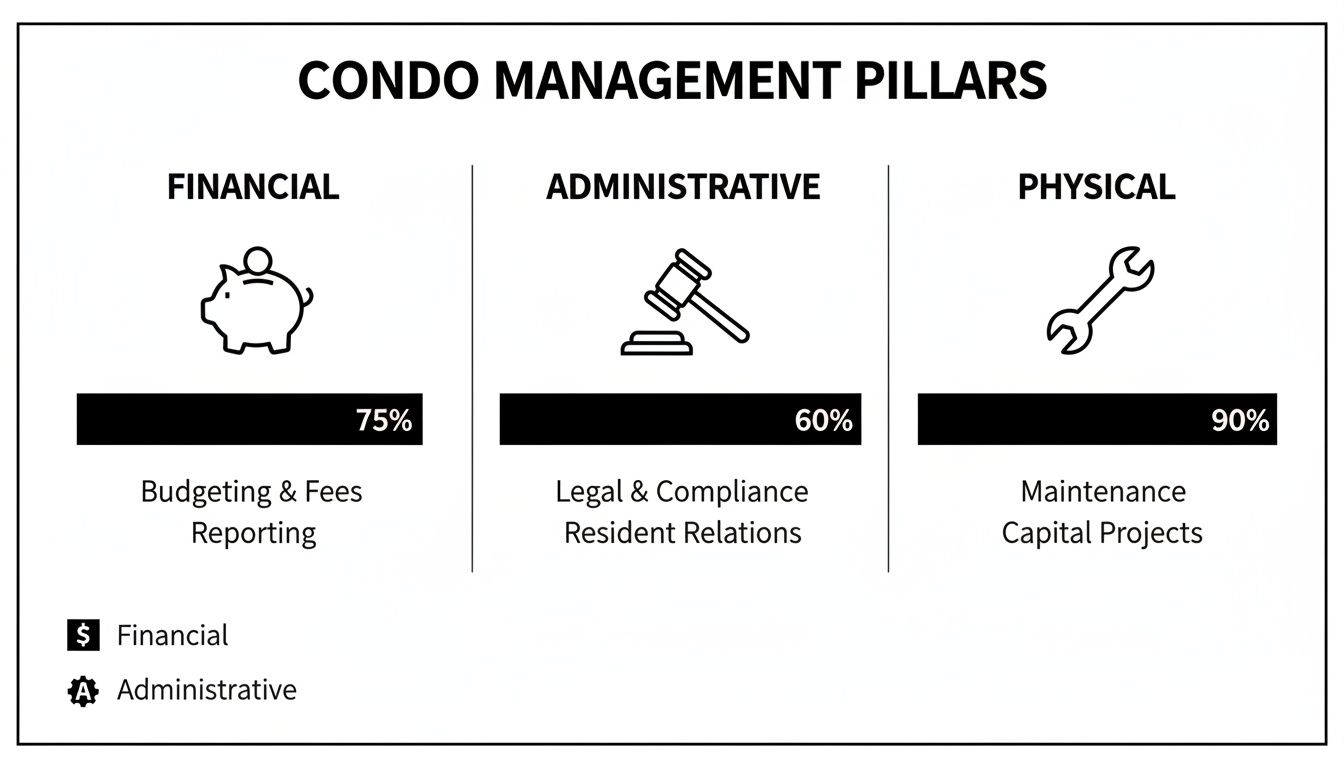
As you can see, a manager's work touches everything—the finances, the day-to-day admin, and the physical upkeep of the property. Each piece contributes directly to your bottom line.
Calculating the Tangible ROI
The most powerful ROI comes from being proactive instead of reactive. It's a simple but crucial difference. A self-managed board might skip a roof inspection to save a few hundred dollars now, only to get slammed with a $20,000 emergency repair bill when the next big storm hits.
A professional manager, on the other hand, puts a $1,500 annual preventative maintenance plan in place. That plan catches and fixes small issues long before they turn into budget-breaking disasters. The real win isn't the small fee you saved; it's the massive emergency expense you completely avoided.
Think about another common headache: delinquent dues. It's incredibly awkward for a volunteer board member to chase down a neighbor for late payments. A professional firm takes the emotion out of it, implementing a systematic and legally sound collections process. This can recover thousands in lost revenue—money that can then be put toward community upgrades or beefing up the reserve funds.
To really see how the numbers stack up, let's look at a hypothetical 100-unit condominium association over the course of a year.
Cost vs. Value: A Real-World ROI Example
Area of Impact | Cost without Management | Benefit with Management | Net Financial Gain |
|---|---|---|---|
Maintenance & Repairs | $20,000 emergency roof leak (reactive) | $1,500 preventative plan (proactive) | $18,500 saved |
Vendor Contracts | $15,000 for landscaping (unnegotiated) | $12,000 negotiated rate (leveraged) | $3,000 saved |
Delinquent Dues | $8,000 in uncollected dues (inconsistent) | $7,000 recovered (systematic) | $7,000 gained |
Insurance Premiums | $25,000 standard premium | $22,500 with risk management discount | $2,500 saved |
Total Annual Impact | $68,000 in costs/losses | $43,000 in proactive spend/recovery | $31,000 Net Gain |
As the table shows, even after paying management fees, the association comes out way ahead financially. The manager doesn't just spend money; they invest it wisely to generate a significant positive return.
The Hidden Value of Soft ROI
Not every return shows up on a balance sheet. There's a huge "soft ROI" that's just as important: the time and peace of mind you give back to your volunteer board members.
Professional management gives board members back their most valuable asset: their time. Instead of spending nights and weekends fielding maintenance calls or chasing vendor invoices, they can focus on their primary role of strategic governance.
This is huge. It prevents board burnout, which is a very real problem. It leads to better, more thoughtful long-term decisions and, ultimately, a happier, more functional community for everyone. You can't put a price on that, but every single resident feels the benefit.
Navigating Rising Industry Costs
It's also important to have some market context when looking at fees. A recent industry survey found that 63% of third-party property management firms were planning to raise their fees to keep up with their own rising operational costs. This isn't just one company; it's a trend across the board.
That’s why it's so critical for condo boards to look at the total value, not just the sticker price. Smart management companies are finding ways to be more efficient to deliver more for your money. For example, some are exploring how to get a better Maximizing ROI by Switching to AI Voice Agents in Property Management. These kinds of operational improvements mean better service without skyrocketing costs.
By understanding all the layers of value—from avoiding costly repairs to giving board members their lives back—you can make a much smarter decision. For a deeper dive into how fees are structured, check out our guide on understanding property management company costs. It’ll help you see that fee not as an expense, but as a high-yield investment in your community’s future.
How to Select the Right Management Partner
Picking a management company is one of the biggest calls a condo board will ever make. This isn’t just hiring someone to fix leaky faucets; you're choosing a long-term partner who will protect your community’s financial health and overall harmony. It’s critical to look past the slick sales pitch and find a firm that actually gets what your community is all about.
First thing's first: cover your bases. Any company you consider must be properly licensed, bonded, and insured. Don't be shy about asking for proof—get copies of their general liability insurance and workers' compensation policies. This simple check protects your community from huge financial and legal headaches if an accident happens on your property.
Once the paperwork checks out, the real digging begins. You're looking for a partner who is the right fit for your community's unique culture and challenges. After all, a downtown high-rise has completely different needs than a quiet townhouse development, and the right manager will have hands-on experience with properties just like yours.
Vetting Credentials and Experience
The best way to know how someone will perform is to look at their track record. Don't just take a company’s word for it; ask them to prove it. The most honest feedback will come from the people who have already worked with them.
That means checking references is a non-negotiable step, but you have to be smart about it. Ask for contacts from both current and former clients, making sure they’re from properties similar in size and scope to yours. A glowing review from a 20-unit building doesn’t tell you much if you’re a 200-unit complex with a pool and a gym.
When you call those references, ask pointed questions that get to the heart of the matter:
How quickly does the manager respond when you or other residents have an issue?
Can you share a story about how they handled a tough situation, like a resident dispute or a major flood?
Are their financial reports easy to understand, accurate, and always on time?
This kind of direct feedback gives you a real-world glimpse into what day-to-day life with that company looks like.
Asking Insightful Interview Questions
The interview is your chance to go beyond the glossy brochure. Come prepared with questions that force candidates to show you how they think and solve problems. Getting past "What are your fees?" is how you uncover their real value.
The best questions aren’t about what a management company does, but how they do it. Focus on their process, communication style, and strategic approach to see if they’re the right fit.
Here are a few powerful questions to get you started:
Emergency Preparedness: "Walk me through your exact process for a major after-hours emergency, like a burst pipe. Who’s on call, what can they authorize, and how do you keep the board and residents in the loop?"
Long-Term Planning: "How do you help boards plan for major capital projects down the road? What’s your role in the reserve study and making sure it’s properly funded?"
Vendor Management: "Tell us about your process for hiring a contractor for a big job. How do you make sure you’re getting quality work at a fair price?"
Technology Integration: "What software do you use for communicating with owners, tracking maintenance, and financial reporting? Can you give us a quick demo of the owner portal?"
Their answers will paint a clear picture of their operational skills and whether their style meshes with your board's. For a more complete checklist on what to ask, you can find property managers with this practical guide to choosing the right partner. It's a great resource for structuring your entire selection process from beginning to end.
Why Specialized Condo Experience Is Non-Negotiable
Managing a condominium isn't just another type of property management—it's a whole different ballgame. Think about it: a standard apartment manager answers to one person, the landlord. A condo manager, on the other hand, serves an entire community of individual owners, each with a serious financial and emotional stake in how things are run.
This world is governed by complex HOA laws, shared ownership structures, and delicate community politics that require a very specific skill set. This is exactly where deep, focused experience makes all the difference. Generalist property managers often learn expensive lessons on a condo board's dime, stumbling through the nuances of bylaw enforcement or reserve fund planning. A seasoned specialist has already been down that road countless times, bringing a level of foresight that protects your association from financial and legal headaches.

The Keshman Difference: A 20-Year Advantage
With two decades of dedicated experience, we at Keshman Property Management bring a depth of knowledge that translates directly into real-world benefits for your community. We’ve always understood that a condo isn't just a building; it's a complex ecosystem of owners, residents, and governing documents. Our expertise isn't just about managing properties—it's about leading communities.
This experience shows up in a few key areas that generic managers often get wrong:
Accurate Reserve Fund Studies: We don’t guess. We use historical data and industry benchmarks to help boards properly conduct and interpret reserve studies. This ensures your community is financially prepared for future capital projects without having to levy painful special assessments.
Smoother Capital Projects: Overseeing a roof replacement or an elevator modernization in a multi-owner building requires surgical precision in both communication and logistics. Our proven processes minimize disruption to residents and keep projects on schedule and on budget.
Effective Conflict Resolution: When disputes pop up between neighbors, or between an owner and the board, we step in as a neutral, experienced mediator. This approach calms tensions and shields the volunteer board from personal liability and awkward confrontations.
This deep expertise is the foundation of effective condominium property management services, turning reactive problem-solving into proactive, strategic leadership.
Transparent Pricing in an Opaque Industry
Let’s be honest—one of the biggest frustrations for condo boards is the jungle of hidden fees in the management industry. So many firms lure you in with a low base rate, only to nickel-and-dime you with extra charges for everything from photocopies and postage to just showing up at a board meeting. This lack of transparency destroys trust and makes budgeting a nightmare.
We believe in doing things differently. Keshman Property Management operates on a transparent, all-inclusive pricing model. The fee we quote is the fee you pay. This straightforward approach allows your board to budget with absolute confidence, knowing there won’t be any unpleasant surprises at the end of the month.
The right management partner doesn’t create financial surprises; they prevent them. True value isn't found in the cheapest price, but in the clearest, most predictable partnership that protects the association's bottom line.
This commitment to clarity is a cornerstone of our service. It allows us to build a relationship based on mutual trust and respect right from the start.
Interpreting Market Data for Smarter Decisions
An experienced management firm also brings critical market intelligence to the table, helping boards make much smarter decisions. For instance, recent industry tracking in the U.S. multifamily sector showed that roughly 637,100 market-rate units were absorbed over a year, with national occupancy holding strong at 95.4%.
An expert manager knows these aren't just abstract numbers. They directly influence everything from your community's short-term rental policies and amenity usage forecasts to the delinquency assumptions you use in your annual budget. You can find more of this kind of multifamily data and its implications on RealPage.com.
At the end of the day, choosing a management partner without specialized condo experience is like hiring a family doctor to perform heart surgery. They might understand the basics, but they lack the focused expertise needed for such a high-stakes environment. Our 20-year history is your assurance that we don't just manage condominiums—we master them.
Common Questions About Condominium Management
Stepping into the world of professional management always kicks up a few questions. Whether you're on the condo board or you're an owner, getting clear, straightforward answers is the only way to feel good about your decision. Let's walk through some of the things people ask us most often.
What Is the Difference Between an HOA Manager and a Unit Property Manager?
This is a big one, and it's easy to get them mixed up. Think of it this way: an HOA manager works for the entire community, like a city manager. A unit property manager works for a single landlord.
Our focus, condominium property management services, is on the whole association. We’re hired by the board to manage the things that benefit everyone—keeping the pool clean, making sure the shared budget is healthy, and enforcing the community rules. We’re looking after the collective investment.
A unit property manager, on the other hand, is hired by an individual owner who rents out their condo. That manager’s job is all about that one unit: finding a great tenant, collecting their rent, and fixing the leaky faucet inside their four walls. The two roles are distinct, but a good management firm knows how to work with both sides seamlessly.
How Involved Will Our Condo Board Need to Be?
Let’s be clear: the board is always in charge. A management company doesn't replace you; we work for you. We become your hands-on operational partner, handling the daily grind so you don't have to. We take the late-night calls about a broken gate and coordinate with vendors for repairs.
The whole point is to free up the board to focus on the big picture. Your role shifts from putting out fires to making strategic decisions that will guide the community’s future.
We’ll work with you to find the right rhythm. Some boards want a quick daily email, others prefer a detailed monthly report. The level of day-to-day interaction is up to you, but the big decisions? Those always stay with the board.
Can Hiring a Management Company Really Save Our Association Money?
It’s a fair question. You see a management fee on the budget and wonder if it's worth it. In almost every case, the answer is a resounding yes. The savings aren't always obvious, but they add up quickly and create a real return on your investment.
Here’s where that money comes from:
Vendor Negotiation: We have long-standing relationships and manage multiple properties. That gives us buying power to get better deals on everything from landscaping to insurance policies.
Preventative Maintenance: We don't wait for things to break. By setting up smart maintenance schedules, we fix the small, cheap problems before they turn into huge, budget-destroying emergencies.
Improved Collections: Chasing down dues can be awkward and ineffective. We bring a professional, consistent process to collections, which drastically improves cash flow and reduces delinquencies.
Risk Mitigation: So many associations stumble into expensive legal trouble without realizing it. We know the laws and governance requirements inside and out, helping you sidestep costly mistakes and lawsuits.
When you add it all up, these savings often more than cover the management fee, leaving the community in a much stronger financial position.
What Technology Do You Use to Improve Communication?
Good communication is everything in a well-run community. We use a modern, cloud-based management platform that gives everyone—board members and residents—a secure online portal. It’s a total game-changer for keeping everyone in the loop.
Board members get a real-time dashboard. You can log in anytime to see up-to-the-minute financial reports, check the status of a maintenance ticket, or access important documents. No more waiting for a meeting to get the information you need.
For residents, it’s all about convenience. They can pay dues online, submit a maintenance request with a photo from their phone, and get community-wide announcements instantly. This central hub cuts down on confusion, saves everyone time, and helps create a more connected and informed neighborhood.
Ready to see how professional management can protect your investment and free up your board’s valuable time? Keshman Property Management has spent 20 years mastering the complexities of condo communities just like yours. Discover our transparent, all-inclusive services by visiting us at https://mypropertymanaged.com.


Comments