
A Renter's Guide to Resetting Circuit Breakers Safely
- Sarah Porter

- Feb 9
- 10 min read
Updated: Feb 14
When the lights suddenly go out in one room but stay on everywhere else, your first thought might be to panic. Don't. It's almost certainly just a tripped circuit breaker doing exactly what it's designed to do: protect you and your home.
The first thing to do is grab a flashlight. Take a quick walk through your rental to see which rooms are dark, then start unplugging any big appliances in that area before you even think about touching the electrical panel.
Your First Steps After A Power Outage
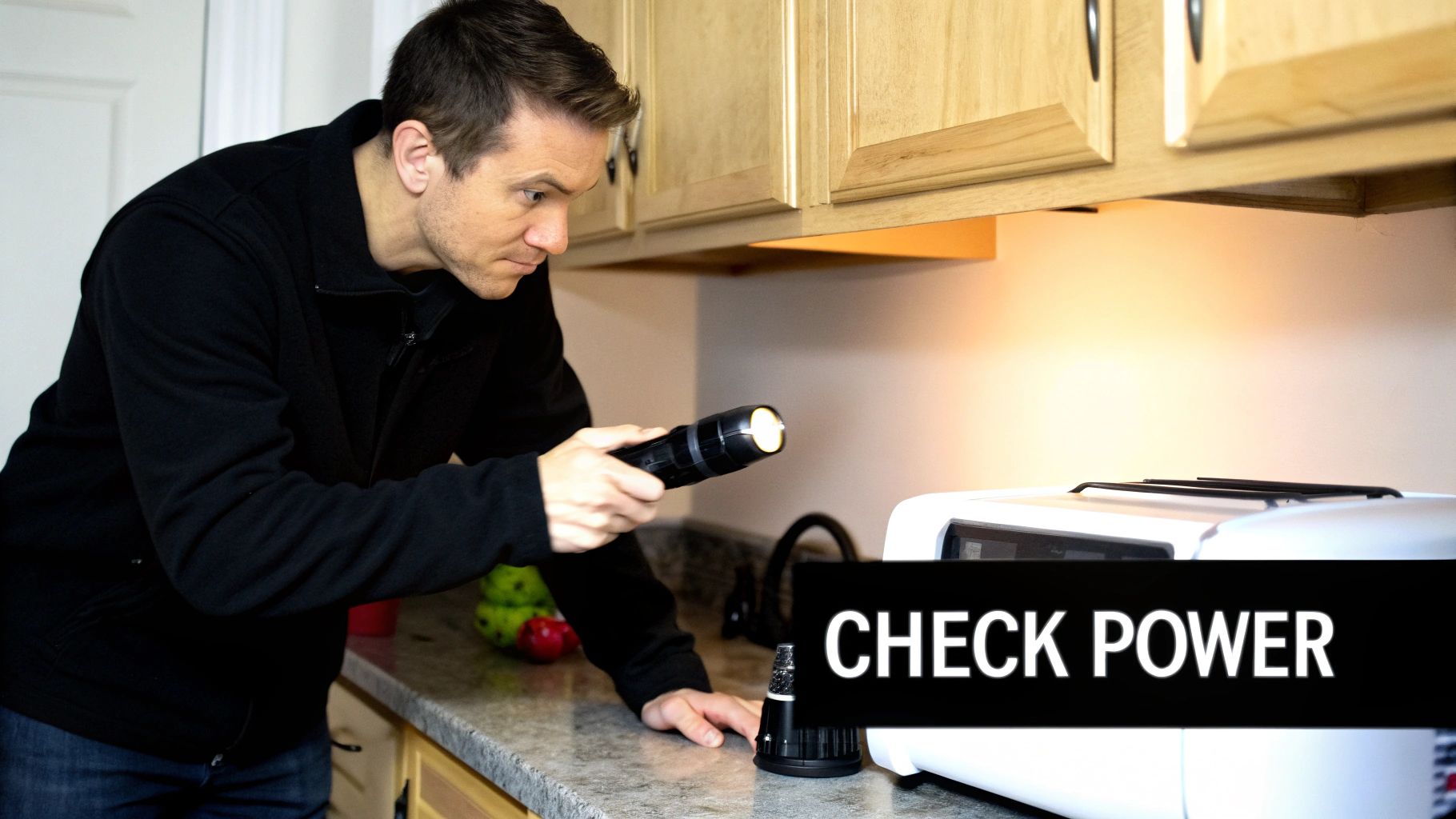
That sudden, jarring silence when the power cuts off can be unnerving, but it rarely points to a serious issue. For renters, the cause is usually a simple circuit overload.
Think back to what was running right before it happened. Were you making toast while the microwave was on, with a space heater plugged into the same kitchen circuit? That's a classic scenario and the most common reason for a trip.
Before you go hunting for the breaker box, a few quick actions will make the reset process safer and more successful.
Check the scope. Is it just your apartment? A quick peek out the window to see if your neighbors have lights is the easiest way to tell. If they do, the issue is inside your unit.
Save your phone battery. Grab a real flashlight or a headlamp instead of using your phone. You might need that phone later to call your landlord or property manager.
Unplug everything. This is the most important step. Go to the area that lost power and unplug every single device from the outlets. This prevents the circuit from getting overloaded again the second you flip the breaker back on.
The Breaker Is Your Friend
It helps to think of a circuit breaker as a little guardian for your home's electrical wiring. It's constantly watching the flow of electricity. The moment it senses a dangerous surge—either from too many appliances running at once (an overload) or a fault in an appliance (a short circuit)—it cuts the power.
This immediate shutdown stops the wires in your walls from overheating, which is a major fire hazard. It's a fundamental safety feature in any modern home.
From a property management perspective, maintaining these electrical systems is non-negotiable. It's a huge market, too. The global circuit breaker industry, which includes the residential kind, was valued at USD 24.41 billion in 2023 and is expected to hit USD 50.44 billion by 2032, according to Fortune Business Insights. This just shows how critical these components are, and why good apartment maintenance services always include electrical system check-ups.
How To Safely Reset Your Circuit Breaker
Alright, you’ve unplugged the devices you suspect caused the overload. Now it's time to head to the electrical panel and get the power back on. While resetting a breaker is usually simple, you absolutely must do it with safety as your top priority.
First things first, you need to find the panel itself. In rental properties, these gray metal boxes are often tucked away in a hallway, laundry room, basement, garage, or sometimes even a closet. If you're new to the property, figuring this out ahead of time is a smart move—just ask your landlord.
Once you find the panel, swing open the door. You’ll be looking at rows of black switches.
Identifying The Tripped Breaker
Your mission is to find the one switch that doesn't look like the others. Most of them will be pointing to the ON position. The one that’s tripped will be in one of two states: either it's flipped all the way to the OFF position, or it's stuck in a neutral, middle position.
That rogue switch is the one we need to address. Some modern breaker panels even have a handy visual indicator, like a small red or orange window that shows up when a breaker trips. Before you even think about touching anything inside that panel, double-check that your hands are completely dry and you aren't standing in any water.
The Correct Reset Procedure
This is where most people get it wrong. You can't just shove a breaker from that middle position back to ON. It simply won't engage because the internal mechanism needs to be reset first.
To do it right, you need to push the tripped breaker all the way to the OFF position first. You should feel and maybe even hear a solid "click." That sound is your confirmation that the internal spring is ready to go.
After you've pushed it fully off, give it a second. Then, firmly flip the switch back to the ON position. It should now feel just as firm as the others and line up perfectly. Go ahead and test a lamp in the room to make sure the power is back.
Crucial Safety Takeaway: If the breaker immediately trips again or won't stay in the ON position, stop. Do not force it or keep trying to reset it. This is a clear signal of a deeper problem that needs a professional electrician. Call your property manager right away and let them know what's happening.
Troubleshooting A Breaker That Trips Repeatedly
So you've reset the breaker, but it clicks off again almost immediately. This is your electrical system's big red flag, and it's telling you there's a deeper problem that needs to be solved. A breaker that keeps tripping isn't just a nuisance; it's a serious safety signal.
Usually, this points to one of two things in a rental property. The most common culprit is a simple circuit overload. This is just a fancy way of saying you've got too many power-hungry appliances plugged into one circuit, all trying to draw more electricity than it's designed to handle.
The second, and more concerning, issue is a short circuit. This is a much bigger deal. It means there's faulty wiring—either in one of your appliances or in the wall itself—creating a dangerous path for the electrical current.
Finding The Overload Culprit
If you suspect an overload, you can play detective. It's a straightforward process of elimination. The first thing you'll want to do is unplug everything from the outlets on that circuit. I mean everything—lamps, chargers, the TV, all of it.
With everything unplugged, head back to the panel and try resetting the breaker one more time. If it stays in the "ON" position, you've likely found your problem: an overload. Now, start plugging things back in one at a time, pausing for a few seconds after each one. The moment the breaker trips, you've found the appliance that's pushing the circuit over its limit.
Identifying this yourself can save a ton of back-and-forth with your landlord. For property owners, getting on top of these issues is non-negotiable. Old or faulty breakers are a factor in over 51,000 home electrical fires each year in the U.S. alone. Considering the indoor segment makes up 57.8% of the circuit breaker market, it’s clear that most of these situations happen right inside managed properties, where quick, safe action is key. You can learn more about these global circuit breaker trends and what they mean for property management.
This flowchart walks you through the decision-making process for a safe reset and when to get help.
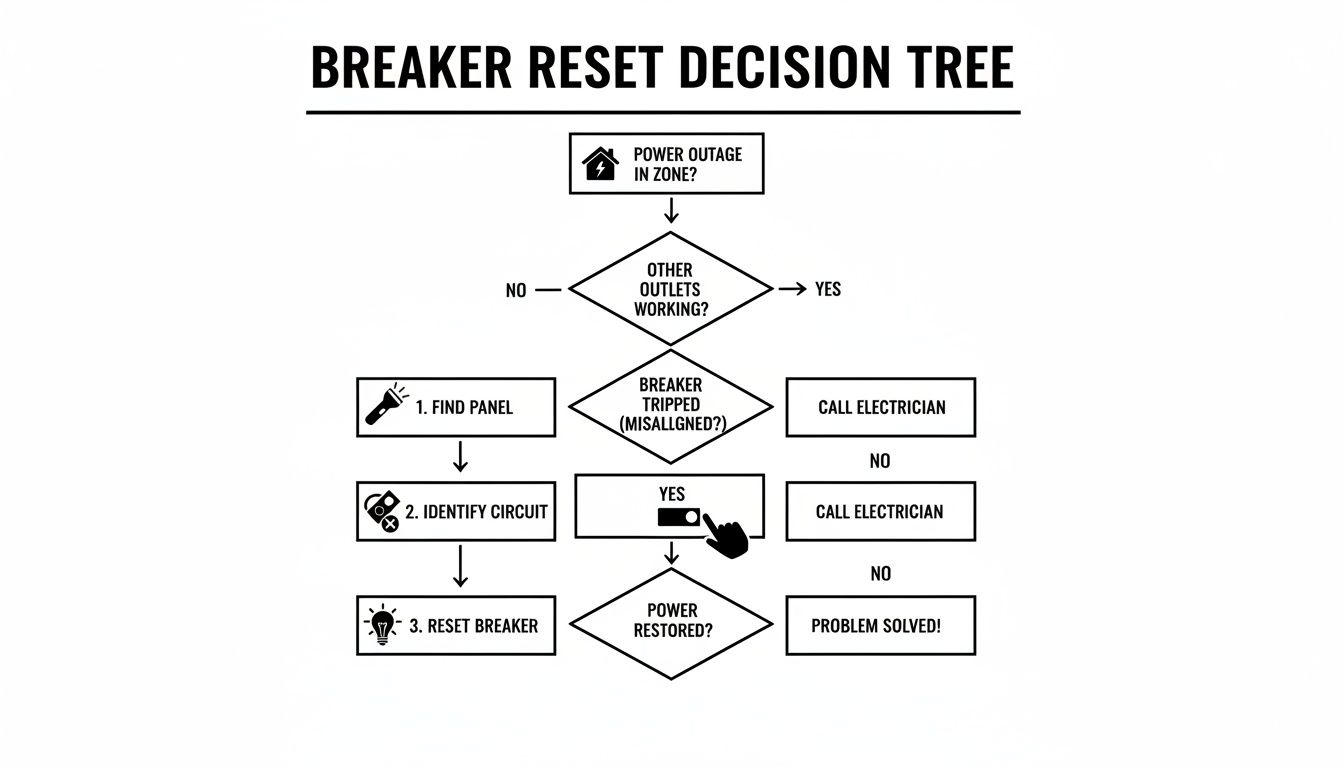
This guide visually breaks down the key actions: locate the panel, find the tripped breaker, and flip it the right way.
When to Stop and Call Your Landlord If the breaker trips again instantly—even when everything is unplugged—your work is done. This is a classic sign of a short circuit in the building's wiring, and it's a serious fire risk. Don't touch it again. Call your landlord or property manager immediately and let them know.
Common Causes of a Tripped Breaker
Sometimes the cause is obvious, but other times it's a bit of a mystery. This table breaks down the most common reasons a breaker trips, what to look for, and what your next move should be.
Potential Cause | What It Looks Like | What To Do Next |
|---|---|---|
Circuit Overload | Power cuts out when using multiple high-power items at once (e.g., microwave and toaster). | Unplug some devices and move one to a different circuit. Avoid using them simultaneously. |
Short Circuit | The breaker trips instantly, even with nothing plugged in. You may see sparks or smell burning. | STOP. Do not touch the panel again. Call your landlord or an electrician immediately. |
Faulty Appliance | The breaker trips as soon as you plug in or turn on a specific appliance. | Unplug the device and try it in an outlet on a different circuit. If it trips that breaker too, the appliance is the problem. |
Ground Fault | Common in kitchens/bathrooms. A GFCI outlet or breaker trips due to moisture or an electrical leak. | Press the "Reset" button on the GFCI outlet first. If that doesn't work, call your landlord. |
Remember, this is about quick diagnostics. If you're ever in doubt, the safest move is always to stop what you're doing and contact your property manager.
Landlord Responsibilities And Tenant Communication
When you're renting, dealing with electrical problems can be tricky. It's all about clear communication and knowing who's responsible for what. As a tenant, your job is to use the electrical system responsibly and let someone know right away if something’s wrong.
Your landlord’s biggest responsibility? Providing you with a safe, habitable home. That absolutely includes a properly functioning electrical system that’s up to code.
While it's on you to avoid plugging too many power-hungry gadgets into one outlet, it's your landlord's duty to fix the bigger problems. Think faulty wiring, a circuit breaker that’s given up the ghost, or an old electrical panel that just can't keep up with modern life. For a deeper dive, check out our complete guide to landlord responsibilities for repairs.
Reporting a Breaker That Won't Behave
So, you've got a breaker that keeps tripping, even after you've unplugged everything and tried to troubleshoot. It's time to call in the landlord or property manager.
My advice? Always put it in writing. An email is perfect because it creates a paper trail and lets you lay out all the important details clearly. This helps them understand the urgency and get things moving.
Here’s a simple, effective email you can use:
Subject: Ongoing Circuit Breaker Problem in Unit [Your Unit Number] Hi [Landlord/Property Manager Name], I'm having a persistent issue with a circuit breaker. The one for the [e.g., kitchen, second bedroom] has tripped [e.g., three times in the last week]. I've made sure to unplug everything on that circuit before resetting it, but it keeps tripping whenever I use the [mention a specific appliance, e.g., microwave]. It definitely seems to be happening more often. Would it be possible to have an electrician take a look? Please let me know when would be a good time to schedule a visit. Thanks, [Your Name] [Your Phone Number]
This email works well because it shows you’ve already done your part to troubleshoot. It gives them specific information to work with and clearly asks for the next step: a professional inspection.
When to Stop and Call a Professional Electrician
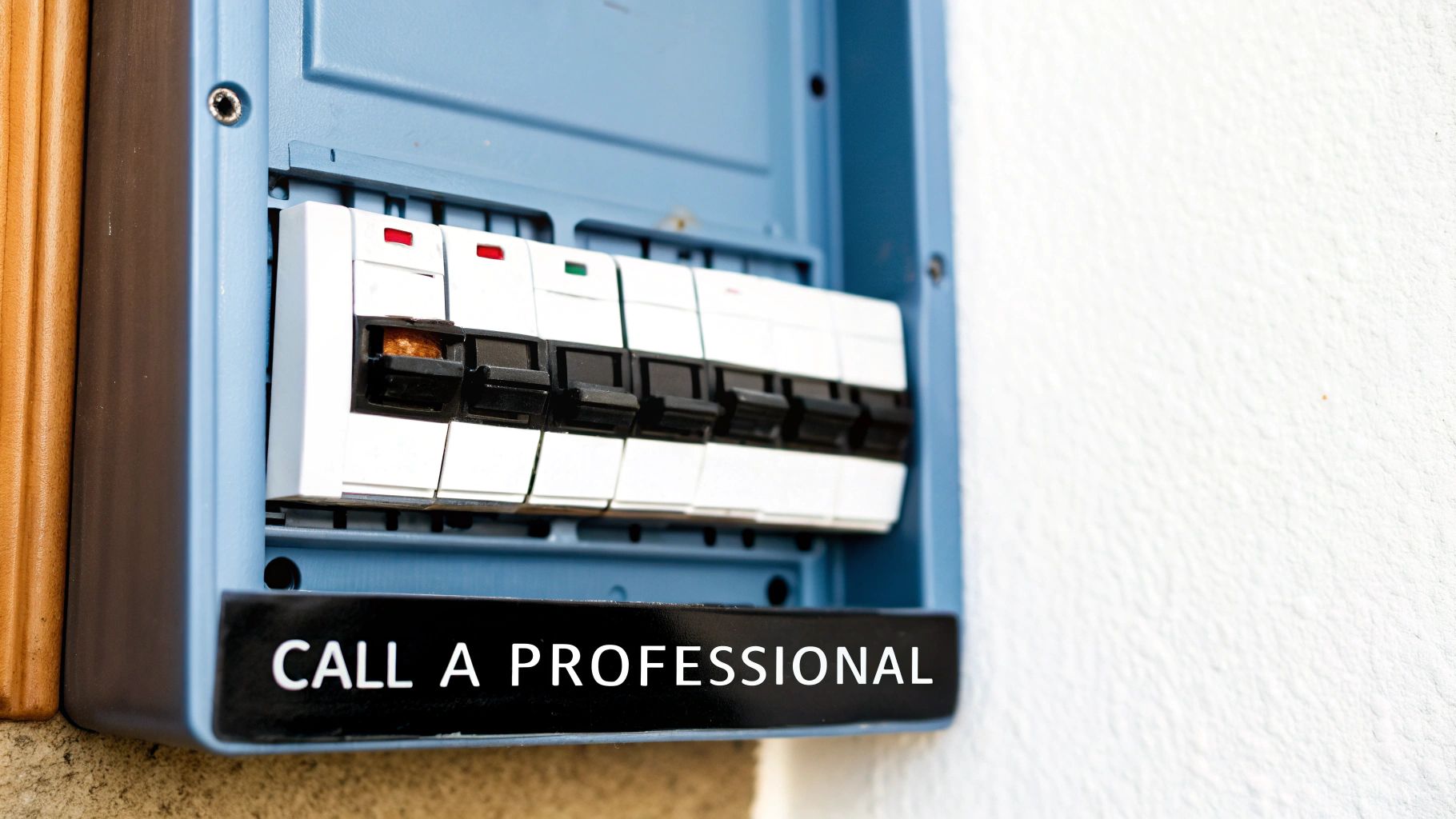
While flipping a tripped breaker is usually a quick fix, it's not always the right move. Your senses—smell, sight, touch, and hearing—are your best defense against a serious electrical hazard. If something feels off, trust that instinct.
There are a few non-negotiable signs that you're dealing with something more dangerous than an overloaded circuit. If you encounter any of these red flags, do not touch the panel. Just back away and call for help.
Burning Smells: A distinct, acrid smell coming from the panel or an outlet is a massive warning sign.
Scorch Marks: Do you see any black, brown, or discolored spots on or around a breaker or outlet?
Hot to the Touch: The breaker itself feels noticeably warm or hot.
Strange Noises: Any buzzing, sizzling, or crackling sounds from the electrical panel are bad news.
These symptoms often point to an immediate risk of fire or electrocution, which is far beyond a simple DIY task. This isn't just about convenience; it's about safety.
Given that the global circuit breaker market is expected to grow from USD 22.70 billion in 2025 to USD 30.32 billion by 2030, the technology and safety standards are constantly evolving. The low-voltage breakers found in most homes made up 66.7% of this market in 2024, which just shows how critical these small devices are for protecting properties. If you're interested in the market trends, you can explore detailed market analysis on circuit breakers.
If you're a tenant and notice any of these warning signs, your first and only step should be to contact your landlord or property manager immediately. Your safety is paramount, and these problems require a licensed electrician to handle the necessary maintenance and repairs.
Got Questions About Circuit Breakers? We’ve Got Answers.
Even with the basics down, a few questions always pop up. Let's tackle some of the most common things renters ask about their electrical system so you can feel more confident the next time the lights go out.
Are All Circuit Breaker Panels The Same?
Not at all. You'll find a pretty wide variety depending on the age and style of your building. Most modern places have a panel with simple, clearly labeled rocker switches. They're designed to be straightforward.
However, if you're in an older property, you might come face-to-face with a fuse box. These are a different beast entirely, as they use fuses that burn out and need to be completely replaced, not just reset. A great tip? During your move-in walkthrough, ask your landlord to give you a quick tour of your specific panel. It takes two minutes and saves a ton of guesswork later.
What’s The Difference Between A GFCI Outlet And A Breaker?
Think of it like this: the circuit breaker in your main panel is the security guard for an entire area—protecting a whole circuit of lights and outlets. A GFCI (Ground Fault Circuit Interrupter) outlet, on the other hand, is a personal bodyguard.
You'll usually find these special safety outlets in bathrooms, kitchens, or laundry rooms—anywhere water is nearby. They're designed to shut off power instantly at that single spot to prevent electric shock. If a GFCI trips, you won't reset it at the main panel. Instead, you'll press the small "RESET" button right on the outlet itself.
A GFCI protects you from shock in a specific wet area. The main breaker protects the entire circuit from an overload. Both are crucial safety features, just working on different scales.
Can I Replace A Faulty Circuit Breaker Myself?
In a word: no. Messing around inside an electrical panel is incredibly dangerous and is absolutely a job for a licensed professional. There's a serious risk of electrocution, and it's not something anyone without extensive training should ever attempt.
If you think a breaker is broken—maybe it feels loose, looks burnt, or just won't stay reset—don't touch it again. Contact your landlord or property manager right away. It's their responsibility to call in a qualified electrician to get it fixed safely.
Navigating electrical issues in a rental property requires clear communication and a reliable property management team. With over 20 years of experience, Keshman Property Management ensures properties are safe, functional, and profitable for owners. Learn more about our comprehensive services at https://mypropertymanaged.com.


Comments