
A Landlord's Guide to Prorated Rent Calculation
- Sarah Porter

- Jan 13
- 12 min read
Updated: Jan 28
So, what exactly is prorated rent? It’s simply the process of charging a tenant for only the days they actually live in a property during a partial month.
If a new tenant moves in on the 15th, for example, they shouldn't have to pay for the full month. They only pay for the days they're there. This is a cornerstone of fair and transparent property management, and it’s something you need to get right every time.
Why Prorating Rent Is a Non-Negotiable
When a lease start date doesn't land neatly on the first of the month, charging the full rent just doesn't make sense. This is where prorated rent comes into play. It’s the tool you use to adjust the rent amount to match the exact number of days a tenant is in the unit, whether they're moving in mid-month or moving out early.
Getting this calculation right is about more than just the money; it’s one of the first and most important steps in building a solid landlord-tenant relationship. A fair and clearly explained proration shows you’re a professional and builds trust from the get-go. After managing properties for over two decades, I can tell you that a transparent approach here prevents countless headaches and sets a cooperative tone for the entire tenancy.
The Foundation of Fair Billing
Think of it as a gesture of goodwill that also happens to be smart business. An accurate prorated rent figure keeps your accounting clean and ensures tenants feel they're being treated fairly. If you miscalculate or skip it altogether, you’re inviting friction and confusion right from the start.
If you want to dig a bit deeper into the basics, our quick guide on what is prorated rent is a great place to start.
Ultimately, this isn't just a math problem. It’s about following fair business practices that protect both your income and your professional reputation. Landlords and property managers typically use one of two main methods to figure this out:
The Daily Rate Method: This involves calculating a daily rent cost based on the actual number of days in that specific month.
The "Banker's Month" Method: This approach uses a standard 30-day month for every calculation, no matter if it's a short February or a long August.
Each method has its pros and cons. Understanding how they both work is crucial before we jump into the formulas, as it allows you to pick one and apply it consistently across all your properties.
Choosing Your Prorated Rent Calculation Method
When a tenant moves in on any day other than the first, you’ll need to figure out their prorated rent. There isn't one single way to do this, but two methods are standard in the industry. Your choice really comes down to whether you prefer pinpoint accuracy or streamlined simplicity.
Whatever you decide, the most important thing is to stick with it. Consistency is your best friend when it comes to fair and transparent bookkeeping.
Prorating by the Actual Number of Days
The first approach, and arguably the most precise, is to calculate the daily rent based on the actual number of days in the current month.
This method feels the most fair to many landlords and tenants because it reflects the real-world cost for that specific month. A day in a 31-day July will cost a bit less than a day in a 28-day February, and this calculation accounts for that difference.
The 30-Day "Banker's Month" Method
The other common option is what’s often called the "banker's month" or 30-day method.
As the name suggests, this one simplifies things by treating every single month as if it has exactly 30 days. While it's not as mathematically exact as the first method, its major advantage is consistency. You're always dividing by 30, which makes accounting predictable and uniform across your portfolio.
Prorated Rent Calculation Methods Compared
So, how much of a difference does it really make? Let's walk through a common scenario to see these two methods in action.
Imagine a new tenant is moving in on May 10th. Their full monthly rent is $2,100. Since May has 31 days, they will be living in the unit for 22 days of that first month (from the 10th to the 31st).
Here’s a side-by-side breakdown of the math:
Calculation Method | Formula | Example Calculation | Prorated Rent Due |
|---|---|---|---|
Actual Days in Month | (Monthly Rent / Days in Month) x Days Occupied | ($2,100 / 31) x 22 | $1,490.28 |
30-Day "Banker's" Month | (Monthly Rent / 30) x Days Occupied | ($2,100 / 30) x 22 | $1,540.00 |
As you can see, the 30-day method results in a slightly higher rent for a 31-day month. On the flip side, it would lead to a lower prorated amount in a shorter month like February. Neither is wrong, they're just different ways of getting to a fair number.
This decision tree gives you a quick visual on when you need to prorate in the first place.
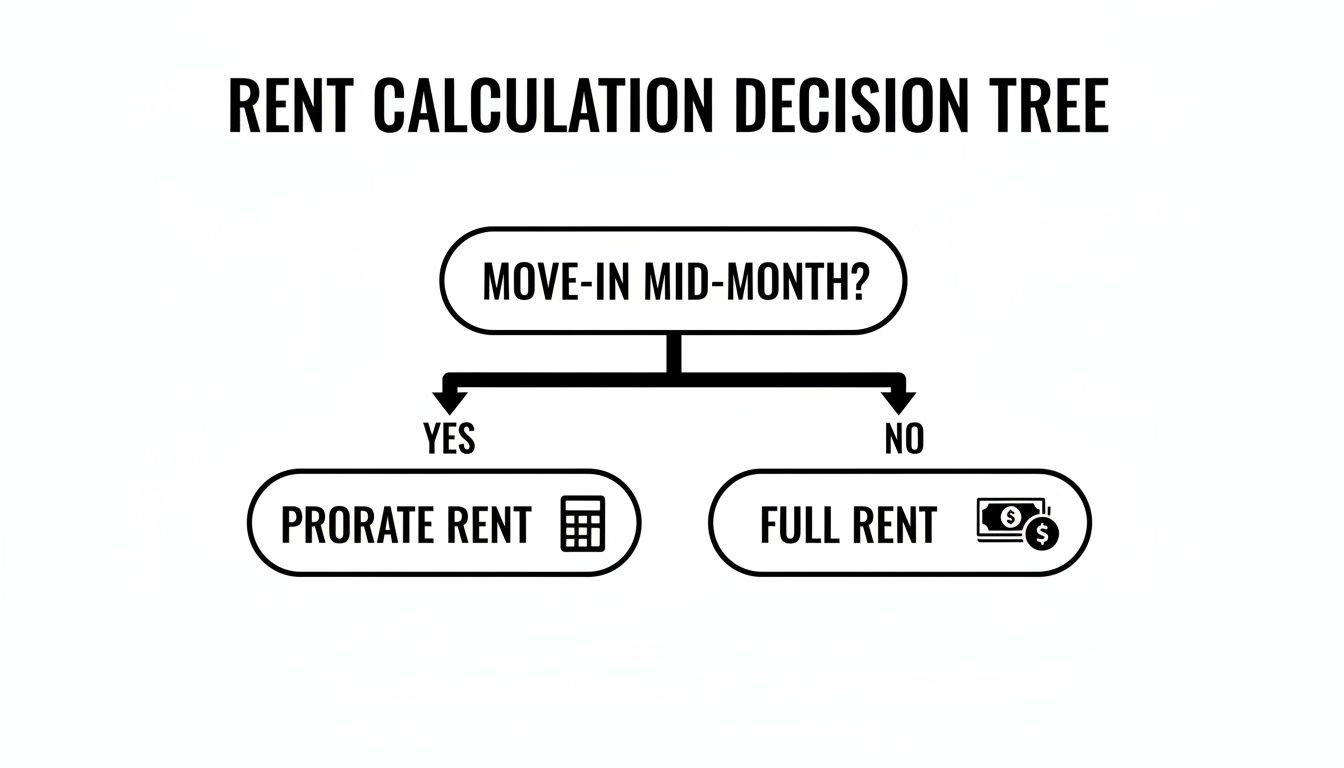
Essentially, if the lease doesn't start on the first, prorating is the way to go. It’s the professional standard for ensuring a tenant only pays for the days they actually have the keys.
Which Calculation Is Right for You?
So, how do you pick? There’s a good argument for both.
The "actual days" method is often seen as the most transparent and is very easy to defend if questioned, since it’s based on the calendar.
The 30-day method’s simplicity is a huge plus for landlords who want a uniform process month after month, making bookkeeping a breeze.
My Pro Tip: Whichever method you choose, make sure you spell it out clearly in your lease agreement. A simple clause stating how you calculate prorated rent can prevent a lot of confusion and potential disputes down the road.
Take a busy market like Santa Cruz, for instance. For a property with $2,400 monthly rent, a tenant moving in on the 15th of a 30-day month would owe $1,280. The math is straightforward: $2,400 divided by 30 days equals $80 per day. Multiply that by the 16 days they’ll be in the unit, and you have your number. Getting this calculation right is a core part of effective property management, something you can learn more about by reviewing insights for Santa Cruz property management.
Ultimately, check your local landlord-tenant laws first—some areas might require a specific method. If there are no rules, pick the approach that works best for your business, write it into your lease, and apply it consistently for every tenant.
Putting Prorated Rent Calculation Into Practice

Knowing the formulas is one thing, but running the numbers on real-life move-ins is where you really get the hang of it. Let’s walk through the exact situations you’ll encounter as a landlord, from tenants arriving mid-month to those leaving before their lease is up.
Seeing the math laid out step-by-step will demystify the prorated rent calculation process for good. You'll quickly see how something as simple as the number of days in a month can change the final amount a tenant owes.
Example One: A Mid-Month Move-In During A Long Month
Let's start with a classic scenario. You have a new tenant moving into an apartment with a monthly rent of $1,800. Their move-in date is set for July 20th.
July has 31 days, which means the tenant will be living in the unit for 12 days that first month (counting from the 20th through the 31st).
Using the "actual days in the month" method, here’s how the calculation breaks down:
Find the Daily Rent: First, figure out the cost per day for July. * $1,800 (Monthly Rent) ÷ 31 (Days in July) = $58.06 per day.
Calculate the Prorated Total: Now, just multiply that daily rate by the number of days they'll be there. * $58.06 (Daily Rate) x 12 (Days Occupied) = $696.72
So, the tenant’s first rent payment is $696.72. This straightforward math ensures they are only paying for the days they actually have access to the property.
Example Two: A Move-In During A Short Month
Now, let's see what happens when the month is shorter. Imagine a different tenant is moving in, also with an $1,800 monthly rent, but their move-in date is February 15th (in a non-leap year).
This time, the math is based on February's 28 days. The tenant will be in the unit for 14 days (from the 15th to the 28th).
Find the Daily Rent: Because the month is shorter, the daily rate will be higher. * $1,800 (Monthly Rent) ÷ 28 (Days in February) = $64.29 per day.
Calculate the Prorated Total: Apply this new daily rate to their occupancy period. * $64.29 (Daily Rate) x 14 (Days Occupied) = $899.99 (or $900.00 if you round).
You can see how the shorter month leads to a higher daily rate and a completely different prorated amount, even for a similar number of days. This is exactly why using the actual days in the month is widely seen as the most accurate and fair method.
A consistent and transparent process is your best friend. When you can show a tenant the exact math behind their first payment, it builds trust from day one and sets a professional tone for the rest of their tenancy.
Example Three: Handling A Mid-Month Move-Out
Prorating isn't just for move-ins; it’s also essential when a tenant moves out before the end of the month. Let's say a tenant in a $2,200 per month unit is vacating on April 10th.
April has 30 days, and they will have occupied the property for 10 of them. The calculation is just as simple.
Daily Rent for April: $2,200 ÷ 30 days = $73.33 per day
Final Prorated Rent: $73.33 x 10 days = $733.30
Their final rent payment would be $733.30, covering only the portion of the month they were still living there.
For more hands-on tools and guidance, you can learn how to calculate prorated rent with confidence using our detailed walkthrough. These examples prove that once you settle on a clear method, the process becomes simple, fair, and easy to repeat for any scenario.
Handling Complex Scenarios and Edge Cases

While a standard mid-month move-in is pretty straightforward, property management is never that simple. You're bound to run into some odd situations that can throw a wrench in your calculations if you aren't ready for them.
The key is thinking through these scenarios before they pop up. A solid prorated rent calculation strategy has to account for the weird stuff—leap years, deciding which fees to prorate, and more. Getting these details right from the start prevents a lot of headaches and confusion down the road.
Accounting for Leap Years
Every four years, February throws us a curveball with an extra day. It might seem like a tiny detail, but it directly impacts your math if you use the daily rate method based on the actual number of days in the month.
During a leap year, you'll need to divide by 29 instead of the usual 28. Let's say rent is $2,000.
In a normal February, the daily rate is $71.43 ($2,000 / 28).
In a leap year, it drops to $68.97 ($2,000 / 29).
It's a small difference, sure, but getting it right shows tenants you’re meticulous and fair. Of course, if you stick to the "banker's month" method, none of this matters—your denominator is always 30.
What Should and Should Not Be Prorated
This is a big one. Not every line item on a lease gets prorated, and tenants can get confused about what they owe at move-in. It's crucial to draw a clear line between recurring rent and one-time fees.
Here’s a quick breakdown of how I handle it:
Prorate These: * Base Rent: This is always prorated for a partial month. No question. * Recurring Monthly Fees: Things like pet rent, a reserved parking spot, or a recurring utility bundle should be prorated right along with the rent. If they pay for it monthly, it makes sense to prorate it.
Do NOT Prorate These: * Security Deposits: Never, ever prorate a security deposit. This is a one-time, refundable fee you hold as collateral for damages. It has nothing to do with monthly occupancy and must be collected in full before move-in. * One-Time Fees: Non-refundable charges like application fees, lease administration fees, or one-time pet fees are due in full. They cover a specific service or cost and aren't tied to the length of occupancy.
Being crystal clear on this point is non-negotiable. Your lease agreement needs to spell out exactly which charges get prorated and which are due in their entirety, no matter the move-in date.
Your lease agreement is your single most important tool for preventing disputes. A clause that clearly defines your prorated rent calculation method and specifies how you handle fees is not just a suggestion—it's your best defense against future conflicts.
The Power of Clear Lease Clauses
Proactive communication is the name of the game in property management. Don't wait for a tenant to get confused or question a charge. Build your entire proration policy directly into your lease agreement. This creates a transparent, legally binding document that everyone agrees to from day one.
A rock-solid proration clause should specify a few key things:
The Calculation Method: Clearly state whether you use the "actual days in the month" or the "30-day banker's month" formula.
Rounding Rules: A quick note on whether you round to two decimal places is always a good idea.
Prorated Fees: Explicitly list any other recurring charges (like pet rent or parking) that will also be prorated.
By getting this in writing upfront, you set clear expectations and give yourself a document to point back to if questions ever come up. It’s a simple, professional step that protects your interests and helps every tenancy start on the right foot.
Legal Considerations and Best Practices for Landlords
Getting your prorated rent calculation right is more than just good bookkeeping—it's often a legal necessity. While you might have some flexibility, many state or local landlord-tenant laws can actually specify which calculation method you have to use. The first thing you should always do is check your local regulations to stay compliant.
Flying blind without a clear, consistent policy is asking for trouble. It's a fast track to tenant disputes, which are a drain on your time and can hurt your reputation. The best approach I've found is to pick one fair method and apply it across the board for every single tenant, every single time. No exceptions.
Document Everything in the Lease
Your lease agreement is your best friend when it comes to preventing misunderstandings. Including a clear clause that spells out your proration policy isn't just a suggestion; it’s a cornerstone of professional property management.
This clause needs to state exactly how you calculate prorated rent. By doing so, you create a transparent and legally binding record that everyone agrees to before a key is ever handed over. If a question pops up down the road, you can both refer back to the signed lease. To get started, you can download a reliable rental lease agreement template and customize it with your specific proration details.
Maintain Consistency and Transparency
Using the same calculation method for every single tenant is absolutely crucial. If you start making exceptions, it could be seen as discriminatory, even if that was never your intention. Just pick one method—whether it's based on the actual number of days in the month or the 30-day "banker's month"—and stick with it.
Pro Tip: Always give tenants a written breakdown of their prorated rent calculation. It’s a simple gesture that builds a massive amount of trust. Show them the full monthly rent, the daily rate you calculated, the exact number of days they're being charged for, and the final amount due. This level of transparency makes the process feel professional, not confusing.
Think about a mid-month move-in. Let's say a lease runs from August 20th to September 15th with a $1,000 monthly rent. The math would be ($1,000 / 31 days) x 12 days = $387.10 for August, plus ($1,000 / 30 days) x 14 days = $466.67 for September. This detailed approach is fair and protects your financial interests.
Of course, being a landlord involves more than just collecting rent. You also have to manage your finances effectively, which includes understanding what you can claim. Knowing about eligible property tax deductions on rental property is key to staying compliant and maximizing your returns.
Answering Common Prorated Rent Questions
Even with the formulas down, real life always throws a few curveballs. Over the years, I've seen just about every quirky situation you can imagine when it comes to prorated rent. This section tackles some of the most frequent questions that pop up.
Think of this as the expert advice you'd get over a cup of coffee—practical answers to help you handle those tricky, but common, scenarios with confidence.
What If a Tenant’s Move-In Date Changes?
This happens all the time. A tenant calls a week before move-in and asks if they can get the keys a few days early, or maybe their movers got delayed and they need to push it back. The key here is to be flexible but firm with your process.
All you have to do is rerun your prorated rent calculation with the new number of days. Once you have that new amount, draw up a quick lease addendum. It just needs to state the new move-in date and the updated prorated rent. Have both you and the tenant sign it, and you're covered. This keeps everything official and avoids any confusion down the road.
Should I Round Up or Down?
So your daily rent calculation comes out to something messy like $58.0645. What do you do? The most important thing is to be consistent. Pick a rule and stick to it for every tenant, every time.
We’ve always found that following standard accounting practice is the easiest and most defensible method.
The Standard Rule: Round to the nearest cent. If the third decimal is 5 or higher, round up. If it's 4 or lower, round down.
A Quick Example: A daily rate of $58.064 becomes $58.06. A rate of $58.065 becomes $58.07.
It seems like a tiny detail, but handling it professionally reinforces that you're a fair and detail-oriented landlord.
How Do I Handle a Lease Starting on the Last Day of the Month?
This is a great question that stumps a lot of new landlords. A tenant wants to move in on the 31st. Do you really make them pay for just one day?
Technically, yes, they owe rent for that one day of occupancy. The cleanest way to handle this is to calculate the prorated rent for that single day and simply add it to their first full month's rent payment.
For instance, if the daily rate is $60, you would just add that $60 to the next month's total rent in the lease agreement. This way, you avoid the awkwardness of collecting a tiny, separate payment, but your accounting stays perfectly accurate. It's a simple, professional fix that makes life easier for everyone.
At Keshman Property Management, we handle every last detail of the rental cycle, from pinpoint-accurate rent calculations to full-service tenant management. If you want to make owning property less of a headache and more of a rewarding investment, let our 20 years of experience go to work for you. See how our transparent, owner-focused services can help.


Comments