
Prorated Rent Meaning A Simple Guide for Landlords
- Sarah Porter

- Dec 28, 2025
- 12 min read
What Prorated Rent Actually Means for Your Business
Let's cut through the jargon. Prorated rent is simply charging a tenant only for the days they actually live in the property during a partial month.
Think of it this way: if a new tenant moves in on the 20th, it doesn't make much sense to charge them for the first 19 days of the month when the unit was empty. Instead, you calculate a fair price for the days they’re actually there. It’s a simple concept, but it’s a powerful tool for your business.
This approach isn't just a small courtesy; it's a smart business move. Offering to prorate rent can make your property instantly more appealing to renters whose schedules don't line up perfectly with the first of the month. That bit of flexibility can be the very thing that gets your lease signed instead of a competitor's.
A Tool for Filling Vacancies Faster
Picture this: a fantastic applicant is ready to sign, but they can't move in until the 15th. They’re hesitant to pay for a full month they won’t be using. If you stick to a rigid "full month's rent or nothing" policy, you might watch that perfect tenant walk away.
Now your unit sits empty, and you've lost 15 days of income you'll never get back.
Prorating the rent turns this into a win-win. You accommodate their move-in date, they feel they're being treated fairly, and you get a signed lease and start collecting rent right away. This directly tackles one of the biggest profit killers for any landlord: vacancy days.
Setting the Stage for a Great Landlord-Tenant Relationship
Beyond the bottom line, offering prorated rent starts your relationship off on the right foot. It immediately shows that you're a reasonable and professional landlord who operates with fairness and transparency.
This single positive interaction can set the tone for the entire lease, often leading to better communication and fewer headaches down the road. It demonstrates your professional integrity, which helps in:
Building Tenant Loyalty: A tenant who feels respected from day one is far more likely to renew their lease, which saves you a ton in turnover costs.
Encouraging Good Faith: A fair start often inspires tenants to be more cooperative and take better care of the property.
Avoiding Early Disputes: It resolves one of the most common points of friction before the tenant has even unpacked a single box.
How to Calculate Prorated Rent Without Mistakes
Figuring out prorated rent can feel like a headache, but it’s really just about applying a simple, fair formula. Once you get the hang of it, you’ll be able to calculate it quickly, keep your tenants happy, and avoid those little financial arguments that can get a landlord-tenant relationship off on the wrong foot.
Let’s walk through the three most common ways to calculate the right amount. Each one gives a slightly different number, which is exactly why your lease agreement needs to spell out which method you use. Consistency is everything when you're managing properties professionally.
Method 1: The Actual Days in the Month
This approach is my personal favorite because it’s the most precise and, frankly, the fairest to everyone involved. It works by calculating a daily rent rate based on the actual number of days in that specific month—whether it’s a short February or a long August.
The formula couldn't be simpler: (Monthly Rent ÷ Total Days in the Month) × Number of Days Occupied = Prorated Rent.
Let's run through a quick example:
Monthly Rent: $1,500
Move-In Date: August 20th
Days in August: 31
Days Occupied: 12 (counting from August 20th through August 31st)
So, the math looks like this: ($1,500 ÷ 31) = $48.39 per day. Then, you just multiply that by the number of days the tenant is there: $48.39 × 12 days = $580.68. That’s the exact amount due.
Method 2: The Banker's Month
If you're juggling a lot of properties and want to keep your bookkeeping as simple as possible, the "Banker's Month" method is a solid choice. This shortcut assumes every single month has 30 days. No exceptions.
This standardization definitely speeds things up, especially when you're onboarding multiple tenants at once.
The formula is: (Monthly Rent ÷ 30) × Number of Days Occupied = Prorated Rent.
Let’s use the same scenario:
Monthly Rent: $1,500
Days Occupied: 12
Here's the calculation: ($1,500 ÷ 30) = a nice, round $50.00 per day. Multiply that by 12 days, and you get $600.00. As you can see, this is a bit higher than the first method because August actually has 31 days.
Method 3: The Annual Calculation
This last method is a bit less common, but it's another perfectly valid way to do it. Here, you calculate a daily rent rate based on the entire year. It effectively averages out the cost across all 12 months, giving you one daily rate you can use for any move-in, any time of year.
The formula for this one is: ((Monthly Rent × 12) ÷ 365) × Number of Days Occupied = Prorated Rent.
Let's plug in our numbers one last time:
Monthly Rent: $1,500
Days Occupied: 12
First, get the annual rent: $1,500 × 12 = $18,000. Next, find the daily rate: $18,000 ÷ 365 = $49.32 per day. Finally, calculate the total: $49.32 × 12 days = $591.84.
Prorated Rent Calculation Method Comparison
To really see the difference side-by-side, let's look at how each method impacts the final amount for a $1,500/month apartment with a move-in on August 20th (12 days of occupancy).
Calculation Method | Formula | Daily Rate | Total Prorated Rent |
|---|---|---|---|
Actual Days | ($1,500 ÷ 31) × 12 | $48.39 | $580.68 |
Banker's Month | ($1,500 ÷ 30) × 12 | $50.00 | $600.00 |
Annual Calculation | (($1,500 × 12) ÷ 365) × 12 | $49.32 | $591.84 |
While the differences might seem small—just under $20 between the highest and lowest—being clear about which one you use prevents any confusion or claims of unfairness down the road.
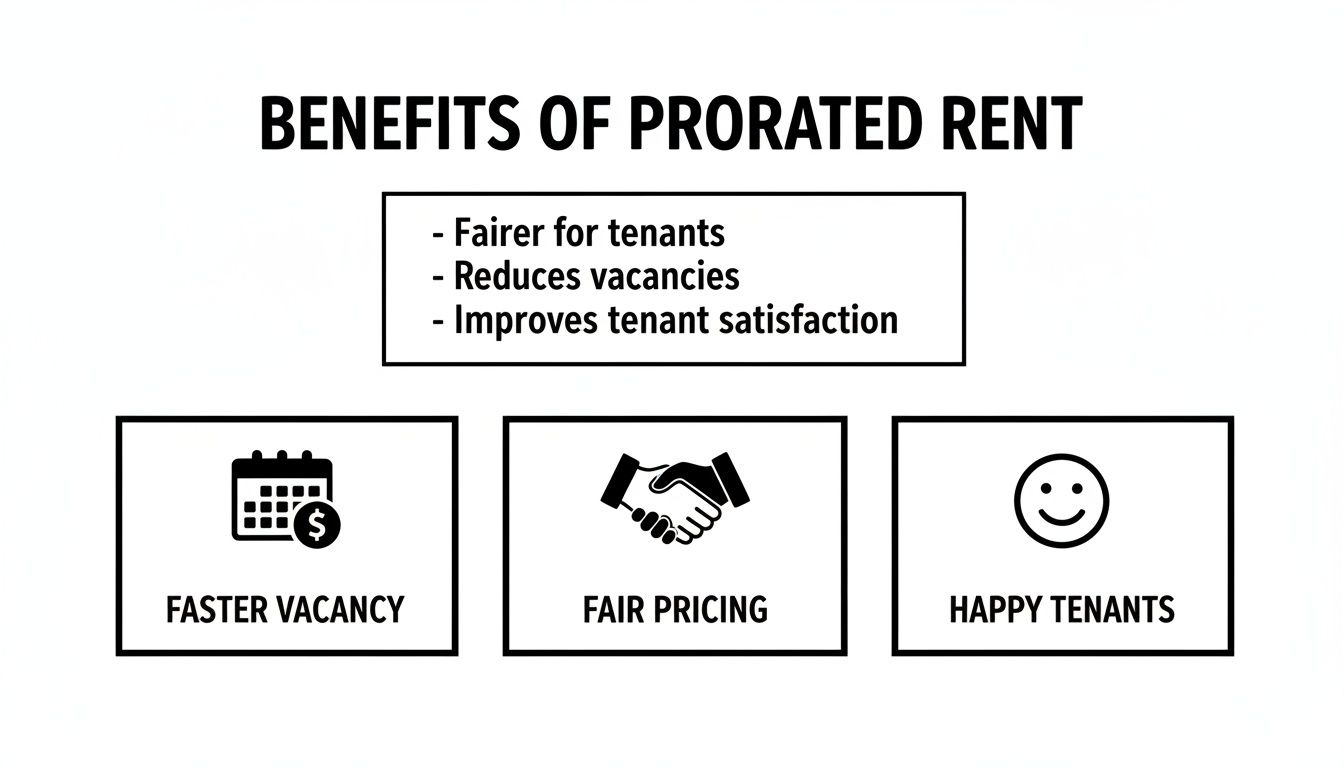
Ultimately, offering prorated rent is just good business. It helps you fill vacancies faster, shows tenants you're a fair and reasonable landlord, and starts the relationship off on a positive note. For an even deeper dive into these formulas, check out our guide to calculate prorated rent with confidence.
The Real Financial Impact of Prorating Rent
When you really get down to it, prorating rent is about more than just fairness—it's a smart financial move. This isn't just some administrative task; it’s a powerful strategy that directly links a flexible move-in policy to your bottom line and long-term profitability.

Think about what a vacant unit truly costs you. Every single day your property sits empty, that's lost income you can never get back. Sticking to a rigid "first of the month only" policy can force a perfectly good unit to stay vacant for weeks, all while you wait for the calendar to flip over.
Turning Vacancy Loss into Immediate Income
Offering to prorate rent flips this script entirely. It lets you capture income for those partial months that would otherwise be a total loss, giving a nice little boost to your short-term cash flow and cutting down your vacancy rate.
Let's put some real numbers to it. Say you have a unit that rents for $1,500 a month. Allowing a mid-month move-in can claw back roughly $50–$75 for every week it would have sat empty. If a tenant moves in on August 16th, they'd pay you approximately $774 for the 16 days left in the month. That’s $774 in your pocket instead of being chalked up to vacancy loss. As anyone following rental market trends knows, keeping your units filled is the name of the game.
Now, imagine that effect across your entire portfolio. If you get just 10 mid-month move-ins a year, and each one brings in an average of $750 in prorated rent, you’ve just added $7,500 to your annual revenue. That’s serious money that could cover management fees or a major repair.
The key takeaway is this: prorating rent isn’t a cost—it’s a revenue recovery tool. It turns potential vacancy days into real, spendable income, directly improving your property's financial health.
Gaining a Competitive Edge in the Market
In a crowded rental market, flexibility can be your secret weapon. When a great applicant is looking at two similar properties, the landlord who is willing to work with their moving schedule is often the one who gets the signed lease.
By offering to prorate, you’re doing a few key things:
Widen Your Applicant Pool: You suddenly appeal to all the qualified tenants whose moving dates don't line up perfectly with the first of the month.
Reduce Turnaround Time: You can get a lease signed and a new tenant moved in days—or even weeks—sooner, slashing the time your unit sits empty between tenants.
Boost Occupancy Rates: And at the end of the day, higher occupancy is the single best way to maximize your rental income year after year.
Ultimately, understanding the true impact of prorating rent means seeing it for what it is: a proactive business decision. It minimizes your biggest financial headache—vacancy—while building goodwill with your new tenants from day one. It’s a simple policy tweak that pays off in both your bank account and your reputation.
Crafting Your Ironclad Prorated Rent Lease Clause
Your lease agreement is the bedrock of your relationship with a tenant. When it comes to something like prorated rent, a handshake deal or a vague "we'll figure it out" approach is a recipe for disaster. Putting your policy down in black and white isn't just a good idea—it's essential for professional property management.
Think of this clause as your official rulebook. It sets clear, upfront expectations and eliminates any gray areas about how rent for a partial month will be handled. This single paragraph protects both you and your tenant from future confusion and potential disputes. When they sign on that dotted line, they’re agreeing to your specific terms.
Key Components of a Strong Clause
A solid prorated rent clause doesn't need to be filled with legal jargon, but it absolutely must be specific. Your goal is to proactively answer any questions before they're even asked.
To be truly effective, your clause must clearly state:
The Calculation Method: Be direct. State whether you calculate rent based on the actual days in the month, a standard 30-day month, or an annual daily rate. This is the number one source of mix-ups, so spell it out.
When It Applies: Specify if your policy is for move-ins only, or if it also covers move-outs. This prevents tenants from assuming they can get a prorated refund if they decide to leave a few days early.
The Due Date: Make it clear that the prorated rent is due on or before the move-in date, right along with the security deposit and other upfront funds.
When drafting this clause, it's also wise to consider the broader legal landscape, like the specifics of Dutch tenancy law, to ensure your agreement is fully compliant and enforceable, particularly for properties in relevant areas.
Sample Prorated Rent Lease Clause
Let's make this practical. Here’s a sample clause you can adapt for your own lease. You can tweak the language to fit your needs, and for a comprehensive legal foundation, consider downloading our rental lease agreement template to ensure you've covered all your bases.
Prorated Rent for Partial Month OccupancyIf the Lease Term begins on a day other than the first of the month, the Tenant will pay a prorated rent amount for that first partial month. This prorated rent is calculated by dividing the total monthly rent of [Monthly Rent Amount] by the actual number of days in that specific month to get a daily rental rate. We then multiply this daily rate by the number of days the Tenant will occupy the property during that month. The full prorated rent payment is due on or before the official move-in date. This policy applies only to the move-in period and does not apply upon move-out unless explicitly agreed to in writing by the Landlord.
This language is simple, direct, and covers all the critical points. It leaves no room for interpretation, ensuring a smooth and professional start for you and your new tenant.
How to Explain Prorated Rent to New Tenants
A strong landlord-tenant relationship starts with clear, honest communication. This is especially true when it comes to the move-in costs. Taking the time to clearly explain prorated rent right from the beginning builds immediate trust and shows your new tenant that you're a fair and organized professional. It nips potential confusion in the bud.

The trick is to be proactive. Instead of waiting for them to ask why their first rent payment is an odd number, get ahead of it. Provide an itemized breakdown of all their move-in costs—think of it as a "First Month Summary"—and include it in your welcome email or with the lease documents. Transparency here is everything.
Breaking Down the First Payment
When you present the lease for signing, a simple, clean summary that separates each charge can make a world of difference. This visual breakdown helps tenants immediately understand exactly where their money is going, making the numbers much less intimidating.
Here’s an easy-to-follow template for a move-in cost summary:
Prorated First Month's Rent: Show them the simple math you used. For example: "($1,500 monthly rent / 31 days in August) x 12 days of occupancy = $580.65."
Security Deposit: List the full, standard amount as stated in the lease.
Pet Fee (if applicable): Clearly label this as a one-time, non-refundable fee.
Total Due Before Move-In: Add it all up for one clear, final number.
Laying it out this way transforms a potentially confusing calculation into a simple checklist. This one small step can save you countless back-and-forth emails and phone calls, freeing up your valuable time.
Answering Questions with Confidence
Even with a perfect breakdown, your new tenant might still have questions. That’s perfectly normal. Being ready to answer them patiently and professionally just reinforces your credibility. Be prepared to explain how you calculated the daily rate or why the prorated amount for February might be different from October.
Proactively explaining prorated rent isn't just good customer service; it's a strategic move that sets a positive tone for the entire tenancy, reducing friction and building a foundation of mutual respect from day one.
A tenant who feels they're being treated fairly from the get-go is far more likely to be a great, long-term resident. If they want to dig deeper, you can even share resources that explain how prorated rent works from a tenant's perspective. Ultimately, this early investment in clear communication pays off by helping create a smoother, more profitable rental experience for everyone involved.
Common Questions About Prorated Rent
Even with a crystal-clear policy, prorated rent can throw some curveballs. As a landlord, being ready for these fringe cases shows you're a pro and helps you manage every tenancy with consistency and confidence. This quick guide tackles the questions we see pop up most often.
Having your answers locked and loaded prevents minor confusion from snowballing into a major headache. It’s all about managing expectations and being fair—the foundation of good property management. Let's dig into the scenarios you're bound to run into.
Am I Legally Required to Offer Prorated Rent?
This is a big one, and the answer comes down to your state and local laws. Many places don't have a specific law that forces you to prorate rent for move-ins. However, some do have rules that kick in for move-outs, particularly when it's tied to returning a security deposit.
Legal mandates aside, offering prorated rent is just good business. It’s a standard industry practice for a few very practical reasons:
It’s fair. Tenants really appreciate not paying for days they aren’t even living in the unit. It starts the relationship on the right foot.
It makes you competitive. That kind of flexibility can be the tipping point for a great applicant choosing your unit over another.
It heads off disputes. A clear prorating policy means no arguments over that first month’s check.
At the end of the day, your lease is the law of the land. A solid clause that spells out your policy is your best friend, ensuring everyone knows the deal from day one.
Should I Prorate for Both Move-Ins and Move-Outs?
That’s up to you, but whatever you choose, you have to be consistent to stay compliant with fair housing laws. Most landlords prorate for move-ins because it’s a great way to fill a unit faster. Why let a place sit empty until the 1st when you can get someone in on the 20th and turn that vacancy loss into income?
Prorating for move-outs, on the other hand, is usually more situational.
For instance, if a tenant bails on their lease early without a valid reason, you're typically entitled to the full month's rent as the lease dictates. But if you both mutually agree to end the lease mid-month, prorating that final payment is a fair and professional way to part ways.
Your lease needs to explicitly define how both situations are handled. Leave no room for interpretation, and you’ll avoid problems later.
Which Calculation Method Is the Best to Use?
There really isn't a single "best" method. It’s about picking the one that works for your business and then writing it into your lease. Each of the common methods has its own logic.
Actual Days in the Month: Many consider this the fairest approach because it's the most precise. The only real drawback is that the daily rate changes slightly from month to month.
Banker's Month (30-Day): This one makes the bookkeeping easier by using the same number (30) every time. It’s a bit less accurate for a short month like February, but it's consistent.
Annual Method (365 Days): You won't see this one as often in residential leases, but it gives you one single daily rate that never changes all year.
The trick is to pick one method, spell it out in your lease, and stick to it for every single tenant. That consistency is your best defense against any claims of unfair or discriminatory treatment.
How Does a Leap Year Affect Prorated Rent?
Now this is a detail that shows you know your stuff. The impact of a leap year depends entirely on which calculation method you use. If you use the "Actual Days in the Month" method, your math will naturally and correctly account for a 29-day February. No extra work needed.
If you’re using the less common "Annual" method, you should adjust your denominator to 366 during a leap year to be perfectly accurate. The "Banker's Month" method? It's completely unaffected, since it always just assumes 30 days. If you're looking for more answers to frequently asked landlord questions, check out these common property management FAQs.
At Keshman Property Management, we sweat these details so you don't have to. With 20 years of experience, we've navigated every scenario imaginable, ensuring your properties are managed professionally and profitably. Learn how we can make your life as a landlord easier.


Comments