
How to Set Rental Price for Maximum Profit and Low Vacancy

To set the right rental price, you have to start with a reality check. You need to understand what local renters can actually afford and what similar properties are renting for. It’s a delicate balance, but getting it right means attracting qualified, long-term tenants while still hitting your own financial goals. Think of it as finding the sweet spot between what the market will bear and what your ideal tenant can realistically pay.
Understanding Your Local Rental Market

Setting your rent in a vacuum is one of the quickest ways to lose money as a landlord. Sure, national headlines give you a bird's-eye view, but the real story is happening on your street and in your neighborhood. From experience, I can tell you that rents far outpacing local wages lead to one thing: high vacancy and the headache of constant tenant turnover.
The very first thing you need to do is get granular with local data. This means going deeper than just looking at what other landlords are asking for. You need to figure out what tenants in your city can genuinely pay. The goal is to price your property competitively enough to get a steady stream of great applicants without leaving cash on the table.
Ground Your Price in Local Economics
Before you even start looking for comps, take a hard look at the economic health of your area. The most important metric here is the wage-to-rent ratio. This simple figure tells you how much of the average local income is being eaten up by housing costs.
This context is more crucial now than ever. Since 2019, rent prices have climbed at a rate 1.5 times that of wages, creating a massive affordability crunch. In 2023, a staggering 22.6 million households were paying what’s considered unaffordable rent—an all-time high. For landlords, this means you have to be strategic. Pricing has to be based on a careful analysis of local income levels, or you’ll simply price your ideal tenants right out of the market.
A price that looks fantastic on paper but doesn't align with local wages is a recipe for a vacant unit. Your ideal rent has to be sustainable for both you and your tenant.
It’s also smart to keep an eye on the short-term market, as it can have a ripple effect on long-term pricing. Staying updated with the latest Airbnb rental market analysis trends can give you a more complete picture of demand in your area.
Where to Find Local Market Data
The good news is, you don't have to guess. Getting your hands on this information is easier than you might think. Here are a few solid places to start your research:
U.S. Census Bureau: This is a goldmine for detailed data. You can find median household income, population stats, and employment numbers right down to your specific zip code.
Bureau of Labor Statistics (BLS): The BLS puts out regular reports on local wage growth and employment trends, which is exactly the kind of info you need.
Local Real Estate and Property Management Sites: These companies often publish their own market reports for major metro areas. They’re on the ground and have great insights.
Once you dig into this data, you'll have a solid foundation. For example, if you see that local wages are flat but rental listings are climbing, that’s a red flag for a potential market imbalance. Pricing your property just a hair below the peak could give you a huge competitive advantage in that scenario.
To help you put all this together, here’s a quick overview of the initial pricing process.
Quick Guide to Setting Your Initial Rental Price
This table summarizes the core steps to take when you're first establishing your rental price, from research to those final, crucial adjustments.
Phase | Action | Key Metric |
|---|---|---|
Market Research | Analyze local wages and comparable rental listings. | Wage-to-Rent Ratio & Average Rent for Comps |
Baseline Calculation | Tally all your property-related expenses (PITI, insurance, etc.). | Total Monthly Ownership Cost |
Profit Margin | Add your desired monthly profit or cash flow. | Your Target Return on Investment (ROI) |
Feature Adjustment | Adjust the price up or down based on unique property features. | Added Value (e.g., renovated kitchen, new HVAC) |
Following this framework ensures you're not just picking a number out of thin air but are making a data-driven decision that sets you up for success.
For a deeper dive into this, you can learn more in our guide to using a fair market rent calculator.
Get to Know the Competition on Your Block
While big-picture market trends give you a decent starting point, what really matters is what the landlord down the street is charging. This is where a hyper-local competitive analysis—often called a CMA or "running comps"—becomes your most powerful tool. It's an absolute must-do.
We're moving beyond a quick browse on Zillow here. The goal is to find the real competition, the properties that a prospective tenant would be looking at right alongside yours. This is how you nail that pricing sweet spot: high enough to maximize your return, but competitive enough to get applications flooding in the first week.
How to Find Your Property's Real-Life Doppelgangers
Your mission is to find three to five recently rented properties that are as similar to yours as possible. Forget about that new building on the other side of town. You need to think small. Your best comps are within a half-mile radius, or even just a few blocks if you're in a dense city.
Here’s what you should be laser-focused on when hunting for comps:
Location: Same neighborhood is non-negotiable. Ideally, you want properties in the same school district, as that's a huge driver for families.
Property Type: Don't compare your single-family home to a condo. Apples to apples is the name of the game.
Size & Layout: The number of bedrooms and bathrooms has to match. A 2-bed, 1-bath unit is a completely different beast than a 2-bed, 2-bath, and tenants see them that way. Square footage should also be in the same ballpark.
Age & Condition: A gut-renovated apartment with brand-new everything can easily get a few hundred dollars more than a dated unit from the 1980s. Be honest about where your property falls on this spectrum.
The key is to look for listings that are already rented or just came off the market. That's the real market price—what a tenant actually signed a lease for, not just what a landlord was hoping to get.
Making Adjustments for the Finer Details
Let's be real: no two properties are identical. Once you've got your handful of comps, it's time to play detective and adjust for the differences. This is where you can truly justify a premium price or see where you might need to be more competitive.
One of the biggest mistakes I see landlords make is getting sentimental about their property's "unique charm" while completely dismissing a competitor's brand-new HVAC system. You have to take off your owner hat and put on your renter hat.
Think about it in terms of real dollars. How much more would you pay for certain features?
Feature/Amenity | Your Property | Comp Property | Price Adjustment |
|---|---|---|---|
Kitchen Condition | Fully renovated (2024) | Original (1990s) | +$75-$125/month |
Outdoor Space | Private balcony | Shared courtyard | +$50/month |
Laundry | In-unit washer/dryer | Coin-op in basement | +$50-$75/month |
Parking | One assigned spot | Street parking only | +$100-$200/month |
Pet Policy | Pet-friendly | No pets allowed | +$50/month (pet rent) |
Let’s put this into practice. Say a nearly identical unit down the street just rented for $2,100, but it doesn't have a balcony. You know from experience that a private balcony in your area is a huge plus. You can reasonably add $50 to your asking price based on that feature alone, bringing your target to $2,150.
Suddenly, you’re not just pulling a number out of thin air. You're building a data-driven price based on what the market is actually paying for.
Figuring Out Your Bottom Line: Costs and Profit
Market research tells you what the neighborhood will bear, but your own numbers tell you the absolute minimum you have to charge to stay in the black. Think of this as your financial floor—the price point below which you're literally paying for someone else to live in your property. It's a non-negotiable part of the equation.
Before setting rent, it’s a smart move to get a handle on your property’s overall value. Knowing how to calculate property value like a pro gives you the bigger picture, especially when you use methods designed for income properties. This context is crucial for building a pricing strategy that actually works.
Tallying Your Fixed Monthly Expenses
First up, let's get a handle on the predictable costs. These are the bills that hit your account every month, whether you have a tenant or not. For most landlords with a mortgage, this is all wrapped up in a neat little acronym: PITI.
Principal: The part of your mortgage payment that actually chips away at your loan balance.
Interest: The bank’s cut for lending you the money. This is a big chunk of your payment in the early years.
Taxes: Your property taxes, usually paid out monthly from an escrow account your lender manages.
Insurance: Your landlord or hazard insurance policy premium, also typically handled through escrow.
These four are the usual suspects. If your rental is a condo or in a planned community, don't forget to add your monthly HOA fees to this list. That's a fixed cost, too.
Accounting for the Costs That Sneak Up on You
This is where so many landlords trip up. Just covering your mortgage payment isn't nearly enough. You've got to plan for all the other expenses—the variable ones and the big-ticket items that pop up down the road.
You might have heard of the 50% Rule, a rough guideline suggesting that about half your rent will be eaten up by operating expenses (everything except the mortgage). While it's a decent starting point, a more disciplined approach is to budget specific percentages of your rent for these future hits:
Maintenance & Repairs (5-10%): This is your fund for the inevitable—the leaky faucet, the running toilet, the tenant service calls.
Vacancy (5-10%): Your property won't be occupied 100% of the time. You need to set cash aside to cover your PITI when there's no rent coming in.
Capital Expenditures (CapEx) (5-10%): This is the big stuff. A new roof, an HVAC system, a water heater. These aren't monthly costs, but you have to save for them monthly.
Getting these numbers right is the key to understanding your property's real performance. For a deeper dive into this, our guide on how to boost your property profits with Net Operating Income is a must-read.
Setting Your Minimum Rent and Desired Profit
Okay, once you've tallied up all your expenses (PITI + HOA + all those reserve funds), you've found your break-even point. Now for the good part: adding your profit.
Your profit margin isn't just wishful thinking; it's the reward for your risk and effort. A common target for cash flow is anywhere from $200 to $500 per month per door, or as a percentage, 6-8% of the total rent.
Let's Run the Numbers: A Quick Example* PITI + HOA = $1,600* Maintenance Reserve (7% of target rent) = $140* Vacancy Reserve (5%) = $100* CapEx Reserve (8%) = $160* Total Break-Even Rent = $2,000* Desired Monthly Profit = $300* Your Financial Floor (Minimum Rent) = $2,300
That final number, $2,300, is your anchor. It’s the lowest rent you can possibly accept without losing money. Going through this exercise ensures you're not just chasing higher rent figures on paper while letting real-world costs eat away at your actual returns.
Adjusting Your Rent for Amenities and Seasonality
Once you have that cost-plus number crunched, it’s time to step away from the spreadsheet and look at your property through a renter’s eyes. This is the art behind the science of pricing—tweaking your baseline based on what makes your unit special and what’s happening in the rental market right now.
Two of the biggest levers you can pull are the property’s unique features and the time of year you list it.
Valuing Your Property’s Best Features
Let's be honest, not all square footage is created equal. A unit with a dated 1990s kitchen just can't compete with one boasting brand-new appliances and quartz countertops. That kind of upgrade can easily justify a $100 to $200 monthly rent increase in many areas. Renters absolutely pay a premium for features that make their lives better or more convenient.
So, what do renters really want? Put yourself in their shoes. What would make them pick your place over the one down the street? While there isn't a magic formula, you can get a good sense of value by looking at what similar units with these features are renting for.
Here are a few common amenities that consistently add value:
In-unit laundry: This is a game-changer. Not having to haul laundry to a shared basement or laundromat can easily add $50 to $100 a month.
Private outdoor space: A balcony, patio, or small yard is a huge draw, often justifying an extra $50 to $150.
Central air conditioning: In most warmer climates, this is a must-have and commands a real premium over clunky window units.
Dedicated parking: In cities where parking is a nightmare, an off-street spot or garage can be worth $100 to $300+ per month.
The key is to be objective here. Your personal attachment to that quirky backsplash doesn't translate to market value. Focus on practical upgrades that solve real problems for renters—things like storage, comfort, and convenience.
Timing the Market with Seasonal Pricing
Just as important as what you’re offering is when you’re offering it. The rental market has a predictable pulse, and timing your listing can make a huge difference in your bottom line.
Demand almost always peaks in the summer and bottoms out during the winter holidays.
Listing a vacancy in June or July puts you in the driver’s seat. You’ll likely get more applications, find a great tenant faster, and can often set a higher price. If you’re trying to fill that same unit in December, you might have to price it more competitively or throw in a concession to get it rented. This is a fundamental part of setting a rent price that reflects real-time demand.
It also pays to zoom out and look at the bigger picture. For instance, in Q2 2025, the Midwest saw annual rent growth of 3.7%, while nearly 39% of major U.S. markets actually saw rents go down. Knowing whether you're in a landlord's or a renter's market will shape every pricing decision you make. You can dig into more of these apartment market trends to stay ahead of the curve.
Setting and Testing Your Final Rental Price
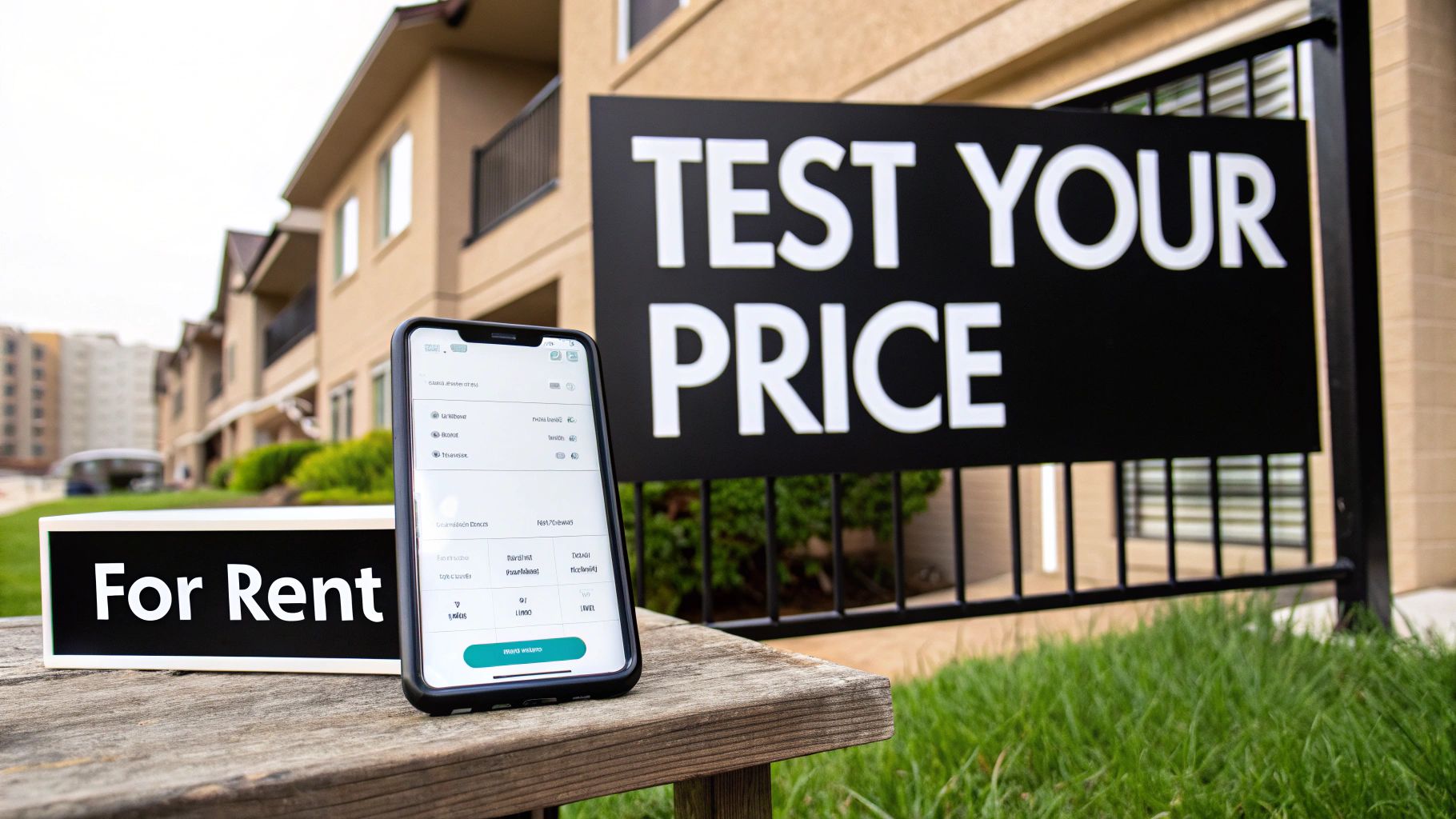
Alright, you've done the legwork. You’ve scouted the local market, crunched your own numbers, and put a value on those shiny new countertops. Now it’s time to land on that final, magic number.
This isn't just about picking a price out of thin air. It's a careful blend of everything you've learned. You have a solid floor—the absolute minimum you need to cover your costs—and a clear ceiling set by what comparable units are renting for. Your sweet spot is somewhere in the middle.
Here’s a small but powerful tip from the world of retail that works wonders for rentals: consider a little pricing psychology. Listing your two-bedroom apartment at $1,975 instead of a flat $2,000 can make a real difference. This is called charm pricing, and it works because our brains tend to anchor on the first digit, making the rent feel substantially lower. It’s a subtle move, but it’s effective.
Reading the Market’s Response
Once you hit "publish" on your listing, the real test begins. The market will give you feedback, and it will give it to you fast. Pay very close attention during the first 48-72 hours.
Is your phone buzzing with inquiries from people who sound like great potential tenants? That’s a fantastic sign you’ve priced it just right. But what if you're met with radio silence after a few days? That's the market telling you you've aimed too high.
Don't get emotionally attached to your initial price. The goal isn't to be "right"—it's to get a great tenant paying rent as quickly as possible. Every week your property sits empty, you lose money.
If the response is slow, you need to act decisively. A modest price drop of 3-5% is usually enough to get the phone ringing again. Hesitating for a week or two is a costly mistake that can easily wipe out the extra income you were hoping to get from that higher price point.
Knowing When to Adjust vs. Hold Firm
Learning to read the market’s signals is a skill every landlord needs. Not all silence is a bad omen, and not every inquiry is a green light. Here’s a quick rundown to help you figure out your next move:
Lots of inquiries, but few applications? This often means your price is in the right ballpark, but something else—like your photos, the listing description, or your screening criteria—is putting people off.
Plenty of inquiries, but from unqualified tenants? If you’re attracting applicants who don't meet your income or credit standards, your price might actually be too low. You could be attracting a different pool of renters than you intended.
A flood of qualified applicants? Perfect. You've nailed the price. Now you have the luxury of choosing the absolute best tenant for your property.
Knowing how vacancy impacts your bottom line is a huge piece of this puzzle. For a deeper dive, check out our guide on how to calculate vacancy rate to maximize rental profit. Ultimately, this final phase of testing and adjusting is what turns a good rental investment into a great one.
Common Questions About Setting Rental Prices
Even with a solid strategy, it's natural to have a few lingering questions when it's time to put a final number on your rental. Pricing a property isn't a "set it and forget it" task; it's a living part of your investment strategy that needs regular attention. Based on our years in the trenches managing properties, here are the questions that come up time and time again.
How Often Should I Re-evaluate My Rent?
The simple answer? At least once a year. But you should absolutely be running the numbers every single time a lease is up for renewal or when a tenant moves out. Rental markets can change on a dime, and a price that felt competitive twelve months ago could be leaving serious money on the table today.
A good habit to get into is performing a quick market analysis about 90 days before a lease is set to expire. This gives you a comfortable window to see what similar units are going for and decide if a rent adjustment makes sense. More importantly, it ensures you have enough time to give your tenant proper legal notice if you do decide on an increase.
What if My Property is Nicer Than the Comps?
That's a fantastic problem to have, but it's important to stay grounded in reality. A beautifully renovated kitchen or high-end flooring definitely allows you to command a premium, but every market has a ceiling. A solid rule of thumb is to price your upgraded unit no more than 10-15% above the very top of the comparable market.
Let's say the nicest comps in the area are consistently renting for $2,000 a month. Pricing your superior unit around $2,200 is ambitious but justifiable. Trying to push it to $2,500, however, might put you in a completely different pricing bracket, leading to a long and expensive vacancy.
Your renovation adds value, but it doesn't create an entirely new market. Aim to be the king of the current hill, not on a hill of your own.
The key is to show potential tenants why it's worth the extra money. Invest in professional photos that make your premium features pop. Your listing needs to scream quality and justify that higher price tag from the very first glance.
Should I Include Utilities in the Rent?
This is a strategic call that really depends on your property type and what's standard in your local area.
In multifamily buildings, it’s pretty common to see water, sewer, and trash rolled into the rent since those bills often come to the building as a whole. Landlords just bake that expected cost into their pricing.
For single-family homes, the script is usually flipped. Tenants fully expect to set up and pay for their own utilities—electricity, gas, water, internet, you name it.
Including some utilities can be a savvy marketing move. An ad that highlights "gas and water included" simplifies the math for a prospective tenant and can make your property feel like a better deal. If you go this route, just be absolutely sure you’ve accurately forecast those costs and built them into your bottom line.
Is it Better to Price High or Price Low?
It’s tempting to list high with the idea that you can always come down later. In my experience, this strategy usually does more harm than good. An overpriced property just sits there, racking up vacancy days that eat away at any potential profit you hoped to gain from that higher price.
We’ve found it’s far more effective to price competitively—or even a hair below market rate—right out of the gate. This creates buzz and a sense of urgency, often leading to a flood of well-qualified applicants. You get to pick the best of the best, which drastically reduces your risk of future headaches and turnover. A slightly lower rent paid on time, every time, by a great tenant is almost always more profitable than a higher rent from someone who causes problems or leaves after a year.
We've covered some of the most common pricing questions we hear from property owners, but every property and market is unique. Here are a few more quick-fire answers to questions that pop up.
Question and Answer
Question | Answer |
|---|---|
What's the biggest pricing mistake landlords make? | Overvaluing their own property due to emotional attachment. You have to be objective and let the data and market comps guide you, not your personal feelings about the new backsplash you installed. |
Should I offer a discount for a longer lease? | It can be a smart move. Offering a small discount, maybe $50/month, for an 18- or 24-month lease can lock in a great tenant and save you the significant costs and risks of turnover. |
How do I handle pricing for a furnished rental? | You can typically charge 20-30% more for a furnished unit, but this varies wildly by location and target renter (e.g., corporate housing vs. student housing). Be sure your furnishings are high-quality and well-photographed. |
Is it okay to charge different rents for identical units? | Yes, it's both legal and common. A top-floor unit with a better view will command a higher price than a ground-floor unit, even if the floor plans are identical. Factor in view, noise, and accessibility. |
Getting the price right is a blend of art and science, and hopefully, these answers provide a clearer path forward.
Navigating the complexities of rental pricing is one of the most critical jobs for a property owner. At Keshman Property Management, we use our two decades of on-the-ground experience to ensure your property is priced for maximum profit and minimal vacancy. If you’re ready to take the guesswork out of managing your investment, find out how we can help at mypropertymanaged.com.


Comments