
How Much Do Property Managers Charge A Complete Guide

Updated: 2 days ago
So, how much do property managers really charge? The short answer is that most companies will take a monthly cut somewhere between 7% and 10% of the collected rent.
If your property rents for $2,000 a month, you can expect that fee to land between $140 and $200. While that percentage is the main, recurring expense you'll see, it's really just the tip of the iceberg.
A Quick Look At What Property Managers Charge
Figuring out property management fees can feel like trying to decipher a new language. You have the main monthly fee, but then a handful of other charges can pop up, each tied to a specific and necessary service.
Think of it like choosing a cable package. Some companies offer an all-inclusive bundle, while others let you pick and choose services "à la carte." Understanding the most common fees is the key to comparing apples to apples and making sure you don't get hit with unexpected costs later on.
This infographic breaks down the big three fees you’ll almost always run into.
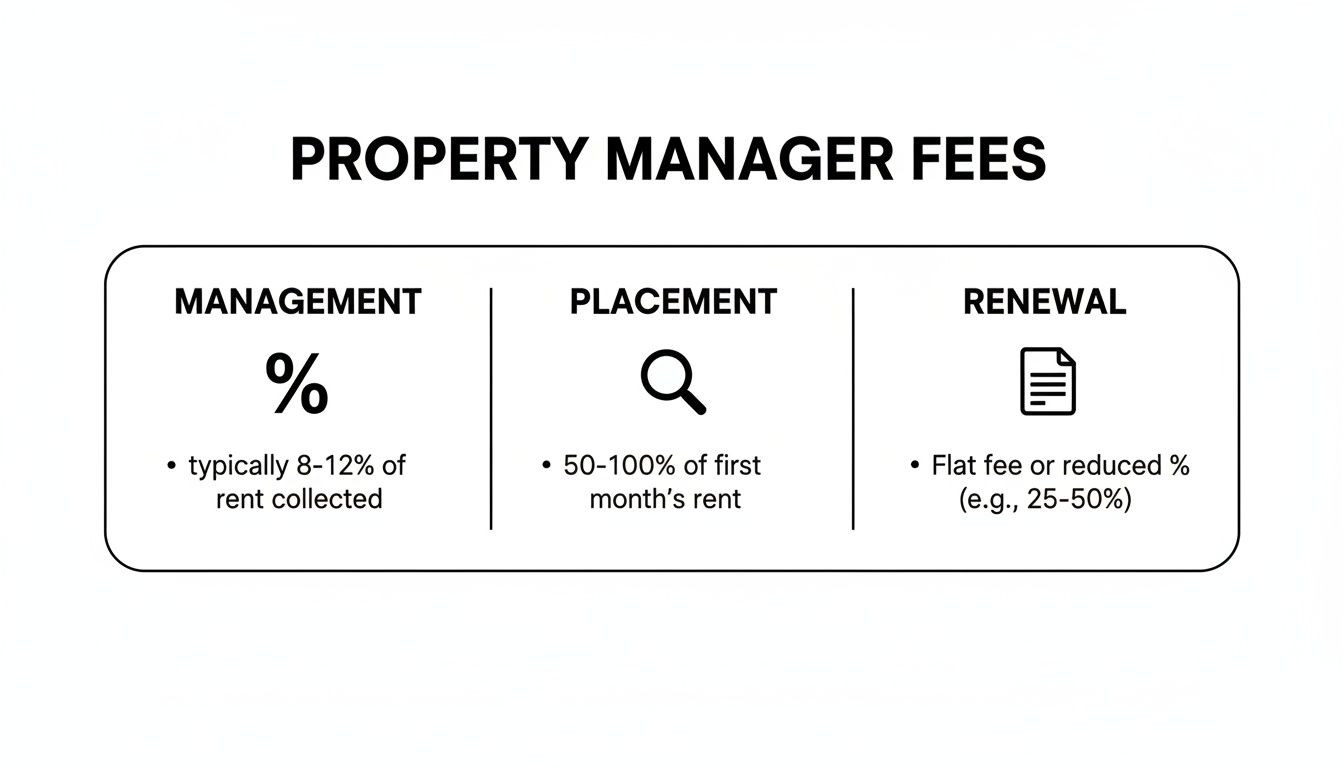
As you can see, the core of your agreement is built around ongoing management, finding new tenants, and keeping the good ones in place.
The Most Common Fees Explained
While that monthly management fee is the one you'll see every month, other charges cover the major events that happen throughout a property's rental cycle. To give you a clearer picture, we've broken down the most common property management fees you're likely to encounter.
Typical Property Management Fee Structure
Fee Type | Common Market Rate | What It Covers |
|---|---|---|
Monthly Management Fee | 7% - 10% of monthly rent | The day-to-day work: collecting rent, handling tenant communication, coordinating routine maintenance, and managing financial reporting. |
Tenant Placement Fee | 50% - 100% of one month's rent | The heavy lifting of finding a new tenant. This includes marketing your property, conducting showings, and running comprehensive background checks. |
Lease Renewal Fee | $100 - $300 (or a small percentage) | A fee for when a tenant renews their lease. It covers the administrative work and incentivizes the manager to keep good tenants happy. |
Maintenance Markup | 5% - 10% of the vendor's invoice | An administrative fee for coordinating repairs. This compensates the manager for their time spent finding, scheduling, and overseeing vendors. |
This table covers the fundamentals, but always remember to read the fine print in any management agreement. The goal is to find a partner whose fee structure aligns with your financial goals and the level of service you expect.
The monthly management fee of 7-10% is the core ongoing cost for owners of rentals like condos, townhouses, or multifamily dwellings. In high-rent markets such as San Diego, where monthly rents can be $2,200-$3,000, this fee alone can range from $210 to $300 per month. You can discover more insights about multi-family property management trends to see how these costs apply in different markets.
Deconstructing The Monthly Management Fee
Let's start with the most common charge you'll see: the monthly management fee. This is the core expense of hiring a property manager, covering all the day-to-day work of keeping your investment running. Think of it as the engine room of your rental property business—it pays for rent collection, tenant calls, maintenance coordination, and monthly financial reports.
Essentially, you're paying for the ongoing, hands-on management that frees up your time and protects your asset. It’s what allows you to step back from being a landlord and focus on being an investor.

Percentage-Based Fees
By far, the most popular model is the percentage-based fee. Most managers charge between 7% and 10% of the monthly rent they collect. I personally like this structure because it creates a true partnership—if your property is vacant or the tenant doesn't pay, your manager doesn't get paid either. Their income is directly tied to your success.
For a real-world example on a property that rents for $2,500 a month:
An 8% fee comes out to $200 per month.
A 10% fee would be $250 per month.
One critical detail to confirm: make sure the fee is based on rent collected, not rent scheduled. Any reputable company will only charge you on money that's actually in the bank, protecting you from paying fees on a vacant unit.
Flat-Fee Management
The alternative is the flat-fee model. Here, you pay a fixed dollar amount every month, no matter what the rent is. A company might charge a flat $150 per month for any single-family home they manage, for instance.
The big draw of a flat fee is its predictability. You know exactly what you’ll pay every single month, which makes budgeting a breeze. It's particularly appealing for owners with higher-rent properties, where a percentage-based fee could get pretty steep.
Deciding between the two really boils down to your personal preference. Do you want a fee that scales with performance, or one that offers unwavering consistency? To dig deeper into which model is right for you, check out this guide to property management fee structures.
Calculating Your True Monthly Cost
To see how this plays out in the real world, let's run the numbers. Imagine you own a townhouse renting for $2,200 per month.
Assuming the property is occupied all year, here’s how the two models stack up:
Fee Model | Monthly Calculation | Annual Cost |
|---|---|---|
Percentage Fee (at 9%) | $2,200 x 0.09 = $198 | $198 x 12 = $2,376 |
Flat Fee | Fixed rate = $175 | $175 x 12 = $2,100 |
In this scenario, the flat-fee model would save you $276 over the year. But remember, the cheapest option isn't always the best value. The quality of service, how long they keep good tenants, and how efficiently they handle repairs all have a much bigger impact on your bottom line. The monthly fee is just one piece of the puzzle, but understanding it is the first step to making a smart investment.
A Closer Look at Additional Service Fees
Beyond that predictable monthly management fee, you'll find a handful of other charges. These are often called "à la carte" or situational fees, and they only pop up when a specific event happens or you need a particular service. It’s absolutely critical to understand these because they can really affect your bottom line and are often where unexpected costs hide.
Think of it this way: your monthly fee is like paying for routine car maintenance—the oil changes and tire rotations. These extra fees are for the bigger, less frequent jobs, like replacing the transmission or getting a whole new set of tires. They aren't everyday expenses, but you definitely need to know they exist and budget for them.
These fees are how property managers get compensated for major, time-consuming tasks that fall outside the day-to-day routine. Let’s pull back the curtain on the most common ones so you know exactly what to look for in a management agreement.
The Tenant Placement Fee
This is usually the biggest one-time charge you'll face. The tenant placement fee, sometimes called a leasing fee, covers the entire A-to-Z process of getting a high-quality tenant into your empty property.
And trust me, it’s a heavy lift. Here’s a quick rundown of what goes into it:
Marketing Your Property: This isn't just a sign in the yard. It involves professional photos, writing persuasive ad copy, and posting the listing across dozens of rental websites.
Handling Inquiries and Showings: The manager becomes the single point of contact, fielding all the calls, texts, and emails, and then coordinating their schedule to show the property to interested people.
Comprehensive Tenant Screening: This is the most important part—running background checks, pulling credit reports, verifying income and employment, and checking in with past landlords.
Lease Preparation and Signing: Once a great applicant is found, the manager handles all the legal paperwork to lock in a binding lease.
The going rate for this service typically falls somewhere between 50% to 100% of one full month's rent. So, on a house that rents for $2,500 a month, you can expect to pay between $1,250 and $2,500 each time a new tenant moves in. It's a significant cost, but it's a direct investment in preventing the much, much higher cost of a bad tenant.
Lease Renewal And Other Administrative Fees
So what happens when you’ve got a fantastic tenant who wants to stay put? Most management companies charge a lease renewal fee to handle the paperwork for extending their tenancy. This is a much smaller fee than a full placement, often just a flat rate between $100 and $300.
This fee is really a win-win. For you, it's a small price to pay to keep a reliable tenant who pays on time. It also gives the manager a good reason to provide great service, encouraging tenants to stick around longer—and high retention is the key to maximizing your rental income.
Beyond renewals, keep an eye out for a few other potential administrative charges:
Setup Fee: A one-time charge ($100 - $500) when you first sign on, covering the administrative work of getting your property set up in their system.
Eviction Fee: A fee that covers the manager's time and administrative hassle involved in the legal process of removing a tenant who isn't paying.
Bill Pay Fee: Some managers offer an optional service to pay recurring bills for you, like HOA dues or property taxes, for a small fee.
The goal isn't to find a company with zero fees, but to find one that's transparent. A good property manager will lay out every single potential charge in their agreement so you have a complete financial picture before you sign anything.
Maintenance Coordination Markups
Finally, let's talk about repairs. When a faucet starts leaking or the AC goes out, your property manager jumps into action to coordinate the fix. To cover their time finding and vetting vendors, scheduling the work, and making sure the job is done right, many companies add a maintenance markup or coordination fee.
This is usually a small percentage, typically 5% to 10%, added on top of the contractor's invoice. For instance, if a plumber's bill is $400, a 10% markup would add $40 to your statement, for a total of $440. This fee covers the manager's administrative overhead for handling that repair from start to finish. Always make sure you ask how maintenance is billed so you’re never surprised by your monthly statement.
Why Property Management Costs Vary
Ever get a couple of quotes from property managers and scratch your head at the difference? One might offer 7%, while another comes in at 10%. That gap isn't just a random number; it's a calculated figure based on several key factors that directly impact the work, risk, and resources needed to manage your investment well.
Think of it like getting a quote for car insurance. The final premium depends on the car you drive, where you live, and your chosen coverage. Property management pricing works the same way. Understanding these variables is the key to decoding any price sheet and knowing you're getting a fair deal.

The Influence Of Property Type
The kind of property you own is one of the biggest drivers of your management fee. A single-family home is a completely different ballgame than a four-plex or a condo, and the price reflects that.
Single-Family Homes: These are usually the most straightforward. You have one lease, one family, and no shared amenities to worry about, which often translates to a lower management percentage.
Multifamily Buildings: A duplex or small apartment building means more of everything—more leases, more tenant communications, and more maintenance of shared spaces. The added complexity often means a higher fee, though having more units under one roof can sometimes create efficiencies.
Condos and Townhouses: These properties throw a curveball into the mix: the Homeowners Association (HOA). The manager has to communicate with the HOA, enforce its rules, and handle dues, which is extra work.
The property's age and condition are also a big deal. A brand-new build will probably need far less maintenance than an older home with creaky plumbing, and the management fee will reflect that expected workload.
Location, Location, And Market Dynamics
Where your property is located has a massive impact on the cost to manage it. A rental in a bustling downtown core operates in a totally different world than one in a quiet suburb.
The market rent itself is a huge piece of the puzzle. A manager charging 8% on a $3,000/month urban apartment earns $240. That same 8% on a $1,500/month suburban home only brings in $120. To make the numbers work, managers in lower-rent areas often have to charge a higher percentage.
A property's location also dictates the level of competition and regulatory complexity. Densely populated areas may have more stringent local landlord-tenant laws, requiring more expertise and administrative oversight from the manager, which can influence their pricing.
Another behind-the-scenes factor is the manager's own overhead. The professional liability insurance costs that protect them from claims of errors or negligence are a significant expense. If your property is in a higher-risk area, the management company's insurance premiums go up, and that cost is naturally factored into their fees.
Scope Of Services And Economies Of Scale
What are you actually asking the manager to do? This is the most direct influence on the price. A basic "rent collection and nothing else" service will be far cheaper than a full-service package that handles marketing, tenant screening, maintenance, bill pay, and even renovation projects.
Here's how the service levels might break down:
Basic Service: Usually just rent collection and essential tenant communication.
Full Service: Adds maintenance coordination, regular inspections, and financial reporting.
Premium Service: Could include paying your mortgage, HOA dues, and property taxes, plus overseeing major capital improvements.
The size of your portfolio matters, too. If you own ten properties, you have leverage. A manager can often offer a lower per-unit rate because managing ten of your units is more efficient than managing ten units for ten different owners. It's the classic principle of economies of scale at work.
When you add it all up, the average annual property management cost typically lands between $2,000 and $3,000 per property for a full range of services. For a property renting at $2,500/month with an 8% management fee ($2,400/year), plus the occasional leasing fee, the total cost fits right into that industry average. You can discover more about average property management costs and how they are calculated.
Putting It All Together: What Will Management Actually Cost?
Fee percentages and lists are one thing, but the real question on every landlord's mind is, "What's the bottom line for my property?" The answer really clicks when you start plugging those numbers into real-world situations. Let's walk through a few common landlord scenarios to see how these fees stack up over the course of a year.
Think of these as short stories. They show how the monthly fees, one-off charges, and your property’s specifics all weave together to create your total annual investment. By looking at tangible examples, you can start building a realistic budget for your own rental.
First-Year Cost Estimate For A Single-Family Home
Before we jump into our scenarios, let's look at a quick breakdown of how fees can add up in the first year for a typical single-family home. This is often the most expensive year because it includes finding that first tenant.
Cost Item | Calculation Example | Estimated Cost |
|---|---|---|
Monthly Management Fees | $2,500 rent x 8% = $200/month | $2,400 (for 12 months) |
Tenant Placement Fee | $2,500 rent x 100% | $2,500 |
Maintenance Markup | 10% on a $500 appliance repair | $50 |
Lease Renewal Fee | N/A in the first year | $0 |
Total First-Year Cost | $4,950 |
As you can see, the initial leasing fee makes up a significant chunk of the first year's cost. In subsequent years, this cost would hopefully be replaced by a much smaller lease renewal fee.
Scenario One: The Accidental Landlord
Meet Sarah. She recently inherited a condo and, just like that, became a first-time landlord. The condo is in a pretty good neighborhood and brings in $1,800 per month in rent. Understandably, she’s a bit nervous about all the legal ins and outs and wants a full-service manager to handle absolutely everything.
She finds a solid, reputable company that charges an 8% monthly management fee. Since the unit is empty, she’ll also need them to find a great tenant, which comes with a placement fee of 75% of one month's rent. Let's assume just one minor repair call pops up during the year.
Here’s a snapshot of her estimated first-year costs:
Monthly Management Fees: ($1,800 x 8%) x 12 months = $1,728
Tenant Placement Fee: $1,800 x 75% = $1,350
Maintenance Markup: A 10% markup on a $300 plumbing fix = $30
For Sarah, the total cost of $3,108 is more than just an expense—it's the price of complete peace of mind. She knows her new asset is being handled by pros while she gets her feet under her.
Scenario Two: The Growing Investor
Next up is David, an investor who owns a small portfolio of four identical townhouses in the suburbs. Each one rents for $2,200 per month. Because he’s bringing them more business, he was able to negotiate a slightly lower management fee of 7% per unit.
In his first year, one unit needs a new tenant, which costs him a placement fee equal to 100% of one month's rent. In another unit, the existing tenant decides to stay, triggering a flat $250 lease renewal fee.
Let's do the math for his entire portfolio:
Total Annual Management Fees: ($2,200 x 4 units x 7%) x 12 months = $7,392
One-Time Fees: $2,200 (placement) + $250 (renewal) = $2,450
David's estimated first-year management cost for all four properties comes to $9,842. While that number might seem high at first glance, his total annual rental income is $105,600. This means his management costs are just a little over 9% of his gross income—a reasonable cost for managing four separate properties.
Scenario Three: The Seasoned Pro
Finally, let’s look at Maria, who owns a 12-unit apartment building. With a larger portfolio, she has much more negotiating leverage and locks in a 6% flat management fee for the whole building. The average rent is $1,400 per unit, generating $16,800 in total monthly rent.
She projects that three tenants will move out over the year, requiring three new placements at a discounted rate of $700 each. She also expects four other tenants to renew their leases, which will cost $150 per renewal.
Here’s how Maria’s annual costs shape up:
Annual Management Fees: ($16,800/month x 6%) x 12 months = $12,096
Tenant Placement Fees: 3 tenants x $700 = $2,100
Lease Renewal Fees: 4 tenants x $150 = $600
As these stories show, the real answer to "how much do property managers charge?" is always "it depends." For a more precise estimate based on your specific properties, playing around with a property management cost calculator can give you a much clearer financial picture.
Finding Value Beyond The Price Tag

When you're comparing property management proposals, it’s all too easy to let your eyes jump straight to the lowest percentage. We get it. But from our experience, the cheapest option on paper is rarely the best deal for your investment. Real value isn’t just about a low initial price; it’s found in the services that actively protect your asset and boost your long-term earnings.
Think of it this way: a service-first approach directly leads to better financial outcomes. This means catching small maintenance issues before they become expensive emergencies, giving tenants the kind of personalized attention that makes them want to stay, and knowing the local market inside and out to keep your property rented. These factors have a much bigger impact on your wallet than saving one or two percent on a monthly fee.
The Power of Transparent Pricing
A suspiciously low monthly management fee can be a red flag. Often, it's just the tip of the iceberg, hiding a whole mess of hidden charges underneath. Vague fee structures with extra costs for inspections, administrative tasks, or even just coordinating a simple repair can nickel-and-dime you, completely wiping out any initial savings. That’s why a clear, transparent pricing model is so important—it protects you and your profits.
At Keshman Property Management, we built our model around this very idea. As landlords ourselves with over 20 years of experience, we’ve felt the sting of surprise fees and vowed to do things differently. Our pricing is simple and straightforward, with no hidden charges. You'll always know exactly what you’re paying for.
True value isn't found in the lowest quote, but in the highest net return. A manager who keeps your property occupied with a great tenant and handles issues efficiently will always outperform a cheaper, less effective alternative.
Maximizing Earnings and Minimizing Stress
At the end of the day, every property owner wants two things: more income and less stress. The right property manager delivers on both. A company that’s only focused on being the cheapest might cut corners on the little things that keep tenants happy, which almost always leads to higher turnover—the single biggest profit-killer in the rental game.
Great tenant retention isn’t a service you’ll see listed on a fee schedule, but its value is immense. When a manager communicates well and handles maintenance requests quickly, tenants are far more likely to renew their lease. This directly saves you from the massive costs of:
Vacancy: Every month your property is empty, you're losing income.
Turnover Costs: Think of the expenses for cleaning, painting, and minor repairs between tenants.
Placement Fees: Finding and screening a new, qualified tenant carries a significant one-time cost.
Choosing a manager is about finding a partner, not just a vendor. To get a better handle on this, digging into a detailed breakdown of whether property management is worth it for landlords can offer some really helpful perspective.
Burning Questions About Property Management Fees
When you start digging into property management, the fee structures can feel a little overwhelming. It's totally normal to have a lot of questions. As you start comparing different companies, a few key concerns almost always pop up.
Let's cut through the jargon and get straight to the practical answers you need. My goal here is to help you see the real value behind the numbers so you can find a management partner you genuinely trust.
Is It Really Worth Paying a Property Manager 10 Percent?
Seeing 10% come off your gross rent can feel like a big hit, I get it. But the smart way to look at it is through the lens of return on investment, not just cost. A truly great property manager can actually put more money in your pocket at the end of the year.
Think about it: they find and screen high-quality tenants faster, which slashes the time your property sits empty and bleeding money. They have a roster of trusted maintenance folks who give them better rates, and they know the law inside and out, preventing one small legal misstep from wiping out years of your profits. For most owners, the financial gains—not to mention the sheer relief from stress—make a professional management fee one of the best investments they can make.
Can I Negotiate Property Management Fees?
Absolutely. Most property management fees have some wiggle room. You’ll have the most leverage if you're bringing multiple properties to the table; managers will almost always offer a volume discount for a larger portfolio. But even if you only have one rental, it doesn't hurt to ask about one-time fees, like setup or lease renewal charges.
A quick word of advice, though: be careful with managers who are too quick to slash their prices. A race to the bottom on fees often means they're cutting corners somewhere else, usually in the quality of service you receive. You're looking for a fair price that reflects real, sustainable value.
What Are the Red Flags in a Fee Structure?
Spotting red flags in a fee schedule now can save you from a world of frustration later. Here are the big ones to watch out for:
Vague Language: If you see a fee listed but have no idea what it's for, press for details. Ambiguity is not your friend.
Death by a Thousand Cuts: Watch out for fee schedules that look like a laundry list of tiny add-on charges for every little thing. This is often a way to make the total cost seem lower than it really is.
Suspiciously Low Monthly Fee: This is the classic "bait-and-switch." A manager might offer a rock-bottom monthly rate, only to make up for it with huge markups on every repair or a dozen hidden administrative fees.
A transparent, trustworthy manager will give you a clear, easy-to-understand fee schedule from day one. If their pricing feels like a puzzle, that's your cue to walk away.
At Keshman Property Management, we built our business on 100% transparency. That means no hidden charges, no surprise add-ons, and no confusing fine print. Ever. Discover how our service-first approach can boost your bottom line and give you back your peace of mind by visiting us at https://mypropertymanaged.com.


Comments