
Hiring a Property Manager Cost: A Clear Look at hiring a property manager cost
- Sarah Porter

- Dec 22, 2025
- 16 min read
Updated: Dec 24, 2025
So, you're thinking about hiring a property manager and want to know the bottom line. Let's get straight to it.
On the surface, you'll see a lot of companies advertising a monthly management fee that falls somewhere between 8% and 12% of the collected rent. That seems simple enough, right? But thinking of that percentage as the total cost is like looking at a car’s sticker price and ignoring taxes, title, and destination fees. It’s just the starting point.
What Does It Really Cost to Hire a Property Manager?
To get a true picture of what you'll be paying, you have to look beyond that headline number. The day-to-day work—collecting rent, answering tenant calls, and sending you financial statements—is covered by that monthly percentage. But what about all the other things that inevitably pop up? That’s where the additional fees come into play.

These extra charges aren’t necessarily hidden, but they cover specific, time-consuming tasks that aren't part of the regular monthly grind. To avoid any surprises, it’s crucial to understand what that 8% to 12% covers and, more importantly, what it doesn't.
To help clarify, here’s a quick breakdown of the fees you're most likely to encounter.
Quick Overview of Common Property Management Fees
This table sums up the typical fees landlords run into. It's a great cheat sheet for understanding how different services are priced.
Fee Type | Common Cost Structure | Typical Range |
|---|---|---|
Monthly Management Fee | Percentage of collected monthly rent | 8% - 12% |
Tenant Placement Fee | Percentage of first month's rent | 70% - 100% |
Lease Renewal Fee | Flat fee or small percentage of rent | $200 - $500 or 25% of one month's rent |
Maintenance Markup | Percentage added to vendor invoices | 10% - 20% |
Eviction Fee | Flat fee plus court costs | $500 - $700 + legal fees |
Setup Fee | One-time fee for new accounts | $250 - $500 |
Understanding these individual components is the first step to really grasping the total cost of professional management.
The Baseline Management Fee Explained
Let’s start with that core monthly fee. It's usually a percentage of the rent that's actually collected, which is a good thing. It aligns your property manager's interests with yours—they don’t get paid unless you do. This model incentivizes them to find great tenants, keep them happy, and ensure your property doesn't sit empty.
Typically, this fee covers the routine operational tasks, including:
Collecting rent payments each month.
Acting as the main point of contact for your tenants.
Coordinating standard maintenance and repair jobs.
Providing you with monthly financial reports.
Think of the monthly percentage as the retainer for ongoing services. The real cost variation comes from situational fees for major events like placing a new tenant, renewing a lease, or, in a worst-case scenario, handling an eviction. These are almost always billed separately.
A Look at the National Averages
Don’t just take my word for it—the industry data backs this up. The national average for a full-service residential management fee is a very specific 8.49%. But that's just one piece of the puzzle. Most property owners also pay tenant placement fees, which can run anywhere from 70% to 100% of the first month's rent, plus one-time setup fees in the $250 to $500 range.
This is exactly why you need to read every line of a management agreement. A company advertising a low monthly percentage might look tempting, but they could make up for it with higher fees for everything else. The best way to get a clear forecast is to use a detailed property management cost calculator for rental owners.
Ultimately, knowing every potential charge is the only way to accurately calculate your return on investment and avoid any nasty financial surprises down the line.
Decoding Property Management Fee Structures
When you first look into the cost of hiring a property manager, you'll quickly see there’s no one-size-fits-all price tag. The monthly management fee is your biggest recurring expense, and it usually takes one of two forms: a percentage of the monthly rent or a flat-rate fee. Getting a handle on the difference is key to figuring out your real costs and making sure your manager's goals line up with yours.
Each model has its own logic, and the right one for you really boils down to your property, your market, and what you’re trying to achieve as an investor. Let's dig into how they actually play out.
The Percentage-Based Fee Model
By far, the most common setup you'll find is the percentage-based fee. Here, your property manager earns a slice of the monthly rent they collect, typically somewhere between 8% and 12%. A huge plus for owners is that if the property is empty, you usually don't pay a dime.
Think of it like a sales commission. This structure gives your manager a direct financial stake in maximizing your rental income. When the rent is higher, they get a bigger check. When the unit is vacant, their income stream dries up, too. This naturally aligns their interests with yours, pushing them to:
Set the highest competitive rent that the market will bear, attracting great tenants without leaving cash on the table.
Keep vacancies to an absolute minimum by marketing aggressively and turning units around fast.
Work hard to keep good tenants happy and renewing their leases, which keeps the income flowing for everyone.
This model works especially well for single-family homes in hot neighborhoods or high-end condos where rental rates can be quite high. The manager’s reward grows right alongside your property’s performance.
The Flat-Fee Model
On the other hand, some management companies offer a flat-fee model. Instead of a percentage, you pay the same fixed amount every month, no matter what the rent is. For instance, a manager might charge $150 per month for each unit they handle.
The big appeal here is predictability—it's like a subscription service. You know exactly what your management cost will be month in and month out, which makes budgeting a breeze. No surprises when you raise the rent.
The potential downside, though, is that the manager's incentive to push for top-dollar rent isn't as strong. Since their pay is the same whether your unit rents for $1,500 or $1,700, they might not be as motivated to maximize your revenue. This structure can be a solid choice for owners of multi-family properties where all the units have similar rental values and predictable budgeting is the number one priority.
Key Takeaway: Choosing between a percentage and a flat fee is a strategic decision. Percentage fees are designed to drive performance and maximize your income, while flat fees give you predictable, stable costs. Think about which one aligns better with your property and your financial goals.
Which Fee Structure is Right for You?
So, how do you decide? It really comes down to your specific investment.
A high-rent urban condo will almost certainly do better with a percentage-based fee. You want a manager who is hungry to get that top-dollar rent.
An owner with a 10-unit apartment building with modest rents might prefer the simple, predictable math of a flat-fee structure to keep their budget tight across all units.
Ultimately, you have to weigh the pros and cons for your situation. For a more detailed breakdown, take a look at our complete guide to property management fee structures. If you want to see how a company might price out different services à la carte, checking out Showdigs' pricing page offers a good real-world example.
Uncovering The Hidden Costs Beyond The Monthly Fee
That monthly management percentage is the number everyone focuses on, but it rarely tells the whole story of what you'll actually spend. Think of it like a base subscription fee; the real cost often comes from the à la carte services that pop up during major events in your property's life cycle. These ancillary charges are where the costs can add up, sometimes catching owners by surprise.
While these fees aren't necessarily "hidden" in a malicious way, they are situational. You only pay for them when a specific service is needed, like placing a new tenant or handling a lease renewal. Getting a handle on these potential costs upfront is critical for forecasting your real-world expenses and avoiding that sticker-shock moment when the monthly statement arrives.
The Tenant Placement or Leasing Fee
One of the biggest ancillary costs you'll encounter is the tenant placement fee, sometimes called a leasing fee. This is a one-time charge for all the legwork that goes into finding and screening a quality tenant for your vacant rental. It's a massive undertaking that goes far beyond just sticking a "For Rent" sign in the yard.
This fee covers a whole host of essential services:
Professional Marketing: This means creating a compelling listing with great photos and getting it in front of as many eyes as possible on all the major rental sites.
Property Showings: Coordinating and conducting tours for every single interested renter, which is a huge time commitment.
Application Processing: Sifting through applications and running comprehensive background, credit, and eviction history checks to find the best fit.
Lease Preparation: Drafting and executing a rock-solid, legally compliant lease agreement designed to protect you.
The industry standard for this fee typically lands somewhere between 70% and 100% of the first month's rent. So, on a property that rents for $2,000 a month, you can expect a one-time placement fee of $1,400 to $2,000 whenever a new tenant moves in.
Real-World Impact: A single tenant turnover can easily trigger a placement fee that costs more than several months of your regular management fees combined. This is precisely why keeping good tenants happy and in place is one of the single most effective ways to control your property management costs.
Lease Renewal Fees
When you have a fantastic tenant and their lease is coming up for renewal, the goal is to keep them. While renewing a lease is less work than finding a brand-new tenant, it still requires your property manager to handle negotiations, draft the new legal documents, and get everything properly signed and filed.
To cover this effort, many firms charge a lease renewal fee. This is usually a flat fee, often in the $200 to $500 range, though some might charge a small percentage of a month's rent instead. It’s much less than a full placement fee, but it's a cost you should anticipate for each unit, each year.
Maintenance and Repair Markups
Maintenance is just part of the game when you own a rental property. When a pipe springs a leak or a dishwasher gives out, your property manager is the one who fields the call and coordinates the fix. They lean on their network of trusted, vetted vendors to get the job done right.
To compensate for their time in diagnosing the problem, scheduling the work, overseeing the repair, and handling the invoice, many management companies add a maintenance markup. This coordination fee is usually 10% to 20% of the vendor's total bill. So, if a plumbing repair costs $500, your final bill from the manager might be $550.
The following chart breaks down the two most common management fee models, showing the fundamental difference between a percentage-based fee and a flat-rate structure.
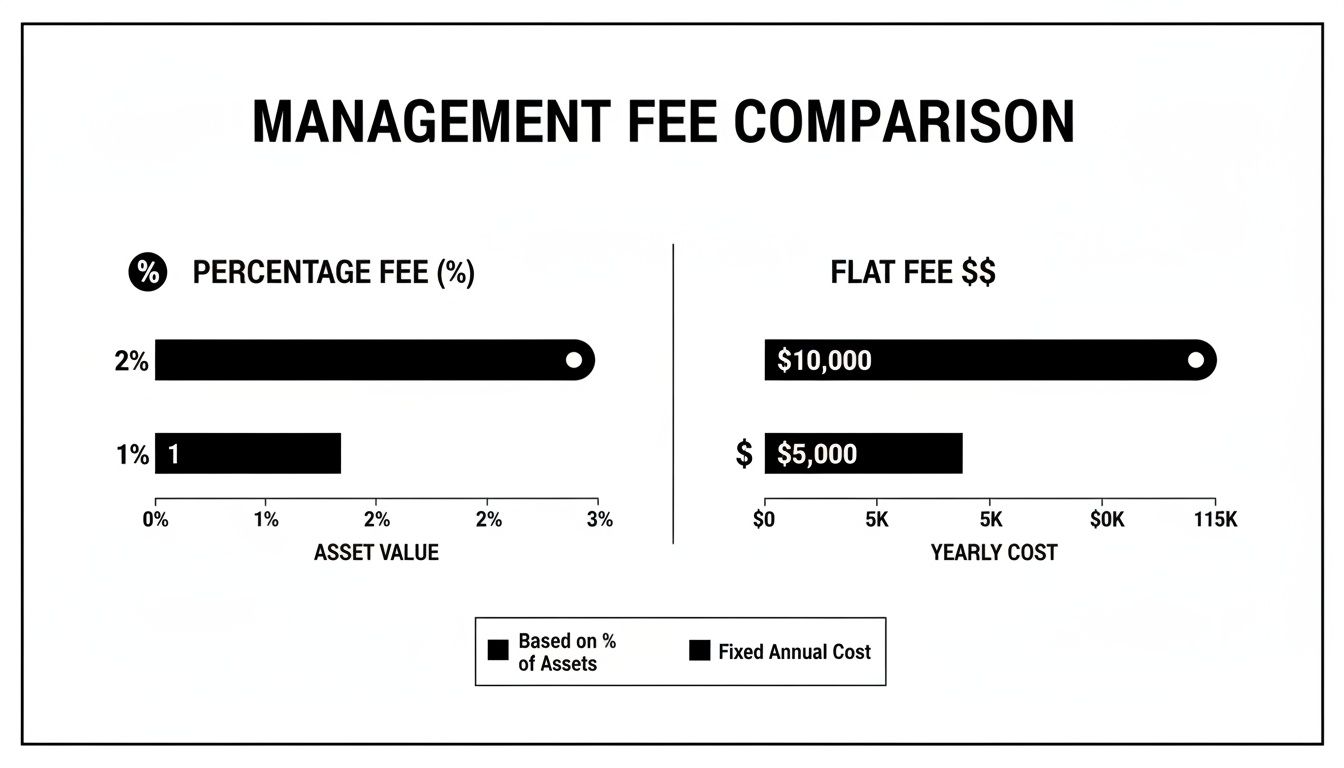
As you can see, a percentage fee moves up and down with your rental income, which can incentivize performance. A flat fee, on the other hand, offers predictable budgeting, highlighting the core trade-off between the two approaches.
Eviction and Other Miscellaneous Fees
Finally, a few other situational fees can pop up. They're less common, but you absolutely need to know they exist. Beyond the major fees, you might see a few other one-time or situational charges that can impact your total cost.
The table below breaks down some of these common ancillary charges you might find in a management agreement.
Typical Ancillary Property Management Charges
Fee Type | Description of Service | Industry Standard Cost |
|---|---|---|
Eviction Fee | Handling the entire legal eviction process, from serving notices to court representation. | $500 - $700 + court costs |
Setup Fee | A one-time charge for onboarding your property into their system, including initial inspection and document transfer. | $250 - $500 |
Advertising Fee | Sometimes charged separately from the placement fee to cover upfront marketing expenses. | Often included, but can be a separate charge. |
Bill Pay Fee | A small monthly fee for the service of paying property-related bills on your behalf (e.g., HOA, mortgage). | $5 - $15 per bill |
Vacancy Fee | A monthly fee charged while the property is empty to cover showings and basic oversight. | $50 - $100 or a flat rate |
When you start adding these potential charges to the monthly management fee, the financial picture becomes much clearer. A single tenant turnover in a given year could easily lead to total fees that rival what you pay for a full year of basic management. That’s why it's so important to read every line of a management agreement before you sign on the dotted line.
How Your Property’s Location and Type Affect Management Costs
Ever wonder why your property management quote seems so different from a friend's? You might be quoted 10% for your downtown condo, while they pay just 8% for a house in the suburbs. This isn't arbitrary—it's a direct reflection of the risk, effort, and market realities tied to your specific investment.
Think of it like car insurance. A policy for a high-performance sports car in a busy city is going to cost more than one for a minivan in a quiet town. In the same way, property managers adjust their fees based on two key variables: where your property is and what kind of property it is.
Location, Location, Management Fees
A property's address is more than just a dot on a map; it tells a manager how much time, effort, and resources they'll need to dedicate to it. A rental in a safe, high-demand neighborhood is simply less work to manage than one in a challenging or remote area.
Here's what managers are looking at:
The Local Rental Scene: In a hot market with tenants lining up, filling a vacancy is quick and easy. But if your property is in a less desirable area, a manager has to hustle—spending more on ads and conducting countless showings, which justifies a higher fee.
Red Tape and Regulations: Some cities have a maze of landlord-tenant laws. Managing a property there requires more legal know-how and paperwork to stay compliant, which naturally increases the manager's operational costs.
Drive Time and Logistics: If a manager has to drive 45 minutes each way for inspections, maintenance calls, and showings, that time adds up. Properties clustered in their core service area are more efficient to manage and might earn you a slightly lower rate.
How the Building Itself Drives the Price
Beyond the zip code, the physical characteristics of your property are a huge part of the equation. There's a world of difference between managing a brand-new, single-family home and a 50-year-old fourplex, and the pricing will reflect that.
A manager will assess the property based on:
Property Type: A single-family home is usually the most straightforward. Once you move into multi-family buildings like duplexes or fourplexes, the complexity multiplies with more tenants, more leases, and common areas to maintain. This extra work means a higher fee.
Age and Condition: A newly constructed home is a manager's dream—fewer things break. An older property, on the other hand, often means a steady stream of maintenance calls, vendor wrangling, and tenant headaches, which requires a much more hands-on approach.
The Rent Amount: Percentage-based fees can be tricky for properties with very low rent. To make it worth their while, some firms will charge a higher percentage or set a minimum flat fee (like $100 per month) to ensure their effort is covered.
Try looking at your property from a manager's perspective. Consider its location, age, and type. A modern, single-family home in a great neighborhood will almost always cost less to manage than an older, multi-unit building in a tricky rental market. Understanding this helps you see why the numbers come in the way they do.
Is a Property Manager Worth the Cost?
After running through all the different fees, you're probably asking the million-dollar question: is hiring a property manager actually worth the money? It's natural to look at that 8% to 12% monthly fee and see it as just another line item eating into your profits.
But here’s a shift in perspective: seasoned investors don’t see it as a cost. They see it as an investment in a smoother, more profitable, and better-protected rental business. A top-notch property manager does far more than just collect rent—they’re a strategic partner. Their real value shines through in how they boost your income, eliminate operational headaches, and protect your asset from expensive mistakes.
Maximize Your Revenue and Minimize Vacancy
Let’s talk about the biggest profit killer for any landlord: vacancy. An empty property isn't just sitting there; it's actively draining your bank account every single day. This is where a great manager immediately proves their worth. They have the marketing firepower, industry connections, and fine-tuned processes to get your property rented—fast.
How do they pull this off?
Strategic Pricing: They dive into market data to set a rent that’s the perfect sweet spot—high enough to maximize your return but attractive enough to get qualified tenants in the door quickly.
Aggressive Marketing: Forget a blurry cell phone picture and a sign in the yard. They create professional listings with high-quality photos and blast them across dozens of rental platforms where tenants are actually looking.
Efficient Showings: Inquiries are answered almost instantly, and tours are scheduled efficiently to turn curious lookers into signed applicants before they can move on.
Think about it. If a manager can turn a potential two-month vacancy into just a few weeks, they’ve just saved you thousands of dollars. That one move alone can often cover their entire annual fee.
Secure Higher-Quality Tenants for the Long Haul
Filling a vacancy quickly is one thing, but filling it with the right person is another. A manager's rigorous tenant screening is one of the most powerful forms of asset protection you can have. They’re running comprehensive background checks, credit reports, and eviction histories to find reliable people who pay on time and treat your property with respect.
This pays off in a huge way. You get lower turnover, fewer damages to repair, and a far more predictable income stream.
A high-quality tenant who renews their lease is pure gold. You completely avoid the tenant placement fee, the cost of deep cleaning and repairs between occupants, and any potential income lost from another vacancy. This long-term stability is where a manager’s expertise truly pays for itself.
Unlock Savings on Maintenance and Repairs
That dreaded 2 AM call—the water heater just burst. Instead of frantically searching for a plumber who’s available and won’t rip you off, a property manager just makes a call. They have a go-to list of vetted, licensed, and insured vendors they trust.
Because they send a steady stream of business to these contractors, they often get better pricing and priority service. Those are savings and conveniences that get passed directly on to you. Plus, using a dedicated property management answering service means those after-hours emergencies are handled professionally without ever waking you up.
Navigate the Minefield of Legal Compliance
Let's be blunt: landlord-tenant law is a minefield. It's a tangled web of federal, state, and local regulations that are constantly changing. One small misstep—like mishandling a security deposit, using an outdated lease, or starting an eviction incorrectly—can land you in legal hot water with massive financial penalties.
A professional manager lives and breathes this stuff. They ensure every form, every notice, and every action is fully compliant, shielding you from lawsuits that could easily cost more than a decade’s worth of management fees.
In the end, deciding if a manager is a good investment means looking far beyond that monthly percentage. It's about calculating the value of your time, your peace of mind, and the financial risks they help you avoid. For a deeper dive into this calculation, check out our guide on whether property management is worth it for landlords.
How Keshman Delivers Transparent Value

Trying to make sense of property management fees can feel like navigating a maze. After you’ve waded through all the different charges that can drive up the cost of hiring a property manager, a simple, honest answer is what you really want. At Keshman Property Management, we’ve built our entire approach around getting rid of the guesswork and delivering real, predictable value.
We get it. Hidden fees and vague pricing models don't just mess with your budget; they break down trust and eat into your profits. That's why our pricing is completely transparent. We believe our success is tied directly to yours, and our fee structure shows that commitment right from the start.
What Our All-Inclusive Fee Covers
Instead of hitting you with a dozen different add-on charges, our management fee is truly comprehensive. It's designed to cover all the essential, day-to-day work that keeps your investment profitable and running like a well-oiled machine. You shouldn't have to pay extra for the basics.
Our straightforward fee includes:
Proactive Communication: You’ll never have to wonder what’s going on. We keep you in the loop with regular updates and are always here to take your call.
Rigorous Tenant Screening: We do the legwork—thorough background, credit, and rental history checks—to find high-quality tenants who pay their rent and respect your property.
Efficient Rent Collection: Our systems are built to ensure rent comes in on time, every time, giving you a steady and reliable cash flow.
Detailed Financial Reporting: You'll receive clear, easy-to-read monthly statements that spell out every dollar of income and expense.
With our model, the price you’re quoted is the price you pay for complete, everyday management. No surprises.
At Keshman, we are landlords ourselves. With over 20 years of experience, we’ve designed a service that we would want for our own properties—one that prioritizes clear communication, maximum earnings, and zero hidden fees.
A Clear Structure For Additional Services
While our monthly fee covers all the day-to-day management, big-ticket items like placing a new tenant or handling a major repair naturally require more resources. Even then, our commitment to transparency doesn't change. We have a clear, upfront fee structure for any of these additional services, so you’ll know exactly what to expect before we move forward.
You won't find any hidden maintenance markups or surprise administrative charges on our statements. Our entire goal is to turn what is normally a necessary expense into a smart investment. By tying our success to your financial health, we give you peace of mind and help you get the absolute best return from your property.
Answering Your Top Questions About Manager Costs
Even after running the numbers, a few common questions always pop up when landlords start thinking about bringing on a property manager. Getting straight answers to these practical concerns is the final step in making a smart decision for your investment.
Let’s tackle some of the most frequent questions I hear from property owners.
Can I Negotiate Property Management Fees?
In many cases, yes. The key to a successful negotiation is leverage, and the biggest leverage you can have is volume. If you’re bringing a portfolio of several properties to the table, a management company has a real incentive to work with you on pricing.
For instance, a landlord with a single property might pay the standard 10% monthly fee, but an owner with five or six doors could realistically negotiate that down to 8%. It’s simple economies of scale—more business for them means a better rate for you. You can also negotiate on specific charges, like asking for a lower tenant placement fee or putting a cap on maintenance markups. It never hurts to ask.
Are There Cheaper Alternatives to Full-Service Management?
Absolutely. If full-service management feels like too much for your budget or your needs, you’ve got options. Many companies offer "à la carte" services to bridge the gap.
Lease-Only Services: This is a popular one. For a one-time fee (often equal to one month’s rent), a manager will handle the entire leasing process: advertising, showing the unit, screening tenants, and getting the lease signed. Once the tenant is in, you take back the day-to-day management.
Property Management Software: If you're tech-savvy and don't mind being hands-on, platforms like TenantCloud or Buildium can be a huge help. For a monthly subscription, they give you the tools to automate rent collection, track maintenance requests, and manage your books.
Do I Pay Management Fees if My Property Is Vacant?
This is a fantastic and crucial question. The answer should be a firm "no," but it all comes down to what's written in your management agreement.
The industry standard for percentage-based fees is that managers only charge on "rent collected." This is the model you want. It means their incentives are perfectly aligned with yours—if you're not making money, neither are they.
Be wary of any contract that deviates from this. Some flat-fee models might try to charge you whether the property is occupied or not. A great property manager is a partner in your success, and they should only get paid when you get paid. Period.
Ready to see how a transparent, straightforward approach can boost your property's profitability? At Keshman Property Management, we eliminate hidden fees and focus on maximizing your earnings. Learn more about our services at mypropertymanaged.com.


Comments