
Best Insurance for Rental Properties a Landlord Guide
- Sarah Porter

- Nov 20, 2025
- 16 min read
Updated: Nov 21, 2025
The best insurance for your rental isn't just one policy. It’s a carefully assembled package with a Dwelling Policy (DP-3) at its core. This is your foundation—it protects the building itself and gives you the broad liability coverage every landlord needs.
Building Your Rental Property Insurance Plan
Getting the right insurance is one of the most important things you can do to protect your real estate investment. A lot of new landlords make the mistake of thinking their old homeowner's policy will do the job. It won't. In fact, most standard homeowner's policies become void the moment a tenant moves in because they're designed for owner-occupied homes, not rentals with their unique set of risks.
Think of your insurance strategy like building a shield. The dwelling policy is the main plate, but the real strength comes from layering on other coverages that match your specific property and situation. Finding the "best" insurance means knowing what those layers are and how they fit together.
This guide will walk you through the essential pieces of a solid landlord insurance plan. We'll start by comparing the foundational policies and then dive into the add-ons that protect your assets and keep your income flowing.
We'll be covering:
Foundational Coverage: Breaking down the differences between basic (DP-1), broad (DP-2), and special (DP-3) dwelling policies.
Essential Add-Ons: Looking at liability, loss of rent, and umbrella policies.
Risk-Specific Protection: Figuring out if you need special coverage for things like floods or earthquakes.
Cost and Savings: Pinpointing what drives your premium costs and how you can keep them in check.
If you're looking for a deeper dive into property protection strategies, these additional landlord insurance guides are a great resource.
Why Your Homeowner's Policy Just Won't Cut It
It's an easy and expensive mistake to make: assuming your homeowner's insurance will cover you once you start renting out your property. The reality is, the risks are fundamentally different, and so is the coverage. Switching to a landlord policy isn't just a good idea—it's non-negotiable.
Here’s a straightforward breakdown of what each policy is built for.
Feature | Homeowner's Insurance (HO-3) | Landlord Insurance (DP-3) |
|---|---|---|
Primary Purpose | To protect the home you live in. | To protect a property you own but rent out to others. |
Property Coverage | Covers the house and your personal belongings inside it. | Covers the house and any property you own, like appliances. |
Liability Protection | Covers you if a guest is injured or you cause damage to their property. | Covers you if a tenant or their guest is injured on the property; includes legal fees. |
Tenant Belongings | Not covered. | Not covered. This is why you require tenants to get renter's insurance. |
Loss of Use/Rent | Covers your extra living expenses if a fire forces you to move out temporarily. | Covers the rental income you lose while the property is being repaired and is uninhabitable. |
Comparing Core Landlord Insurance Policies
When you’re looking for the best insurance for your rental property, everything starts with the core dwelling policy. This isn’t a one-size-fits-all deal; you’ll typically encounter three main flavors: the DP-1, DP-2, and DP-3. Each offers a different tier of protection for the physical structure, and picking the right one is the first, and arguably most important, step in shielding your investment.
The global home insurance market, which includes these rental property policies, was valued at around USD 234.6 billion in 2024. That number alone tells you how critical this protection is for real estate investors. For landlords, a solid policy is your first line of defense against everything from tenant-caused damage and liability claims to unexpected vacancies.
The DP-1 Policy: Basic, Bare-Bones Coverage
First up is the DP-1, or "Basic Form." This is the most stripped-down coverage you can get. It’s a “named peril” policy, meaning it only pays out if the damage is caused by one of the specific events—or perils—listed in the policy document.
Think of it as a very limited, à la carte menu of protection. The usual suspects covered include:
Fire and lightning
Internal and external explosions
Windstorm and hail
Riot or civil commotion
Damage from aircraft and vehicles
Smoke
Volcanic eruption
Key Insight: A huge downside with the DP-1 is that it almost always pays claims on an Actual Cash Value (ACV) basis. The insurance company deducts depreciation from the payout, leaving you to foot the rest of the bill to make your property whole again.
For instance, if a fire ruins the 15-year-old kitchen cabinets in your rental, a DP-1 policy pays you for the value of 15-year-old cabinets—not what it costs to buy new ones. This gap can be massive, which is why the DP-1 is usually only a fit for vacant properties under renovation where you just need to cover the basics.
This decision tree gives a good visual of that first fork in the road when choosing your insurance.
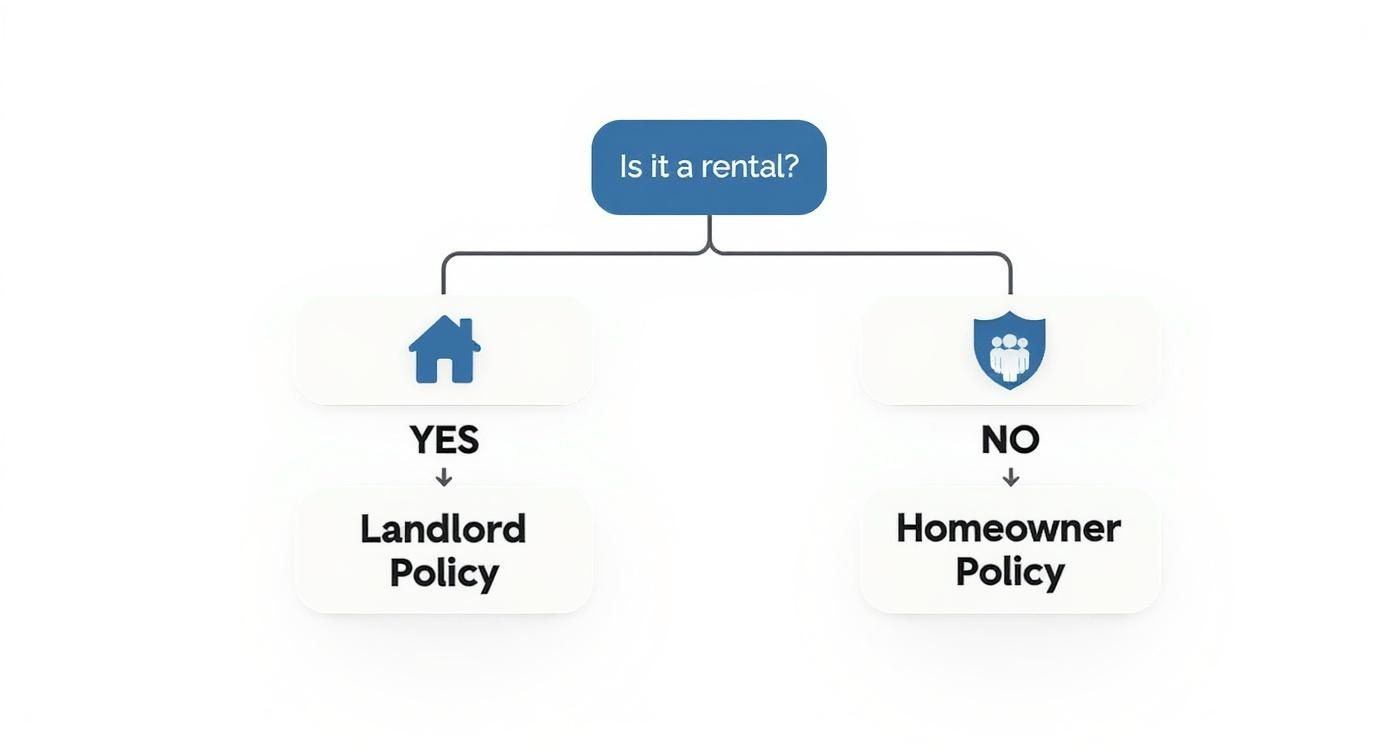
As you can see, the moment a property becomes a rental, your standard homeowner's policy is out. You've officially entered the world of specialized landlord insurance.
The DP-2 Policy: A Solid Middle Ground
Taking a step up, we have the DP-2, or "Broad Form." It’s also a "named peril" policy like its little brother, but the list of covered events is much longer and includes many of the common headaches landlords actually face.
A DP-2 policy typically adds coverage for things like:
Vandalism and malicious mischief
Damage from a burglary
Falling objects (like a neighbor's tree branch)
The weight of ice and snow
Frozen plumbing systems
Accidental water discharge or overflow
One of the most important concepts to get your head around is the difference between Actual Cash Value (ACV) vs. Replacement Cost Value (RCV), because it dramatically changes your claim payout. The DP-2 makes a huge leap here; it usually covers the main dwelling at Replacement Cost Value (RCV). That means the policy pays to rebuild or repair with new, similar materials without factoring in depreciation. This is a game-changer for landlords.
The DP-3 Policy: The Gold Standard
Finally, we arrive at the DP-3, or "Special Form." This is hands-down the best insurance for most rental properties and what I almost always recommend. Unlike the other two, the DP-3 is an “open peril” (sometimes called "all-risk") policy for the building itself. This completely flips the script.
Instead of listing what is covered, an open peril policy covers damage from any cause unless it is specifically excluded. The exclusion list is pretty standard—think war, nuclear events, floods, and earthquakes, which you’d need separate coverage for anyway.
Let's look at how the DP policies stack up side-by-side.
Landlord Dwelling Policy (DP) Coverage Comparison
This table breaks down the key differences between the three main policy types to help you see where each one shines—and where it falls short.
Policy Type | Structure Coverage | Personal Property Coverage | Covered Perils | Best For |
|---|---|---|---|---|
DP-1 | Actual Cash Value | Actual Cash Value | Named Peril (very limited list) | Vacant properties, often during renovations or between tenants. |
DP-2 | Replacement Cost | Actual Cash Value | Named Peril (broader list than DP-1) | Landlords seeking a balance of cost and better-than-basic coverage. |
DP-3 | Replacement Cost | Actual Cash Value | Open Peril (covers all perils except those excluded) | Most landlords; offers the most comprehensive protection. |
As you can see, the jump from a DP-1 to a DP-3 is significant, especially in how the structure is protected.
Scenario Comparison: DP-1 vs. DP-3
Imagine a pipe bursts inside a wall, flooding the unit and causing thousands in damage to the drywall, flooring, and subfloor.
With a DP-1 policy: You’re likely out of luck. A burst pipe isn't on that short list of named perils, so the landlord would be paying for the entire repair out-of-pocket.
With a DP-3 policy: This is covered. Since water damage from a plumbing failure isn't on the exclusion list, the policy would pay to fix the damage at its full replacement cost.
This is exactly why the DP-3 is the go-to choice. It protects you from the countless curveballs that property ownership throws your way—the things a named peril policy would leave you exposed to. Yes, the premium is higher, but the peace of mind is priceless. For a deeper dive, you can check out our full landlord insurance comparison to see how these policies perform in other real-world situations.
Building a Comprehensive Insurance Shield with Add-Ons
Think of a standard DP-3 policy as the foundation of your protection. It’s strong, but it’s not the whole house. To truly protect your investment, you need to build a complete shield by layering on specific endorsements—add-ons—that cover the risks unique to your property.
A basic dwelling policy does a great job of protecting the physical structure, but it leaves some serious gaps. What about a tenant lawsuit? What happens to your cash flow if the property is vacant for months during a major repair? These add-ons are designed to plug those exact holes, safeguarding both your asset and your income.
Liability Insurance: The First Line of Defense
If you only get one endorsement, make it this one. Liability coverage is arguably the most critical add-on for any landlord. It’s what protects you financially if a tenant or their guest gets hurt on your property and holds you legally responsible. A simple slip-and-fall can quickly escalate into a lawsuit that threatens not just the rental property, but your personal assets, too.
Most landlord policies come with some liability coverage, but the standard limits—often just $100,000 to $300,000—are dangerously low in today's world. Considering the soaring costs of legal defense and medical care, that amount can disappear fast. Bumping your limit to $500,000 or even $1,000,000 is a surprisingly affordable upgrade that delivers massive peace of mind.
Real-World Scenario: Imagine a tenant's guest trips on a cracked sidewalk you've been meaning to fix. They break a leg, and a lawsuit follows. Your liability coverage would step in to handle their medical bills and your legal fees, right up to your policy limit.
Loss of Rent Coverage: Your Financial Safety Net
Let’s say a kitchen fire makes your rental uninhabitable. Repairs will take three months. How do you cover the mortgage and taxes without any rent coming in? This is precisely where Loss of Rent coverage (sometimes called "fair rental value" coverage) saves the day. It reimburses you for the rental income you lose while the property is being fixed after a covered disaster.
It's important to be clear: this isn't for a tenant who skips out on rent. This coverage is for vacancies caused by a covered event, like a fire, a major storm, or a burst pipe. It ensures a temporary disaster doesn’t become a full-blown financial crisis. Most DP-3 policies include some form of it, but you absolutely need to check the limits and the duration of the coverage.
Umbrella Policy: The Ultimate Asset Protection
For landlords with a growing portfolio or substantial personal assets, even a high-limit liability policy might not be enough. An Umbrella Policy is that extra layer of security. It sits on top of your other policies (like landlord and auto) and kicks in only after their liability limits have been completely exhausted.
Think of it as your failsafe for a catastrophic claim. If you're sued for $2 million, but your landlord policy's liability maxes out at $500,000, your umbrella policy could cover the remaining $1.5 million. This is essential for investors who own properties in their own name, but it’s a smart move even if you use an LLC. It’s an inexpensive way to get millions in protection.
Specialized Add-Ons For Specific Risks
The best insurance plan is one that's tailored to your property’s specific location and vulnerabilities. Insurers are very clear about what they don't cover in a standard policy, so you need to fill those gaps with specialized endorsements.
Flood Insurance: This is a big one. Standard landlord policies do not cover flood damage. If your property is in or near a designated flood zone, getting a separate policy through the National Flood Insurance Program (NFIP) or a private carrier isn't just a good idea—it's non-negotiable.
Earthquake Insurance: Just like floods, damage from earthquakes is a standard exclusion. For any property in a seismically active region like California, this add-on is a must-have to protect against potentially catastrophic structural damage.
Rent Guarantee Insurance: This is a different beast from Loss of Rent coverage. This unique policy protects you when a tenant simply stops paying. It covers your lost income during the eviction process, which can be painfully long. Premiums are usually 5% to 7% of the annual rent, but it’s a powerful tool for landlords who can't afford any interruptions to their cash flow.
Water Backup Coverage: A backed-up sewer or drain can cause a huge, messy, and expensive problem. Because this is often excluded from a base policy, this low-cost endorsement can save you thousands in cleanup and repairs.
By carefully choosing the right add-ons, you can elevate your coverage from a basic safety net to a truly robust plan that protects your investment from every angle.
Decoding Insurance Costs and Market Trends
Ever looked at an insurance quote and wondered how they came up with that number? It can feel like a black box, but there's a definite logic behind it. Insurers are essentially pricing risk, and understanding what they see as risky is the key to getting a handle on your premiums.
The best insurance for your rental isn't just about finding the cheapest policy; it's about striking a smart balance between solid protection and a price that fits your budget. Let's pull back the curtain on what really drives those costs.
Key Factors That Influence Your Premium
A handful of core elements do the heavy lifting when an underwriter calculates your premium. Some you're stuck with, but others you can influence.
Property Location: This is a big one. A rental in an area known for high crime or natural disasters like hurricanes or wildfires will always cost more to insure. On the flip side, being close to a fire station can sometimes shave a little off the top.
Construction Type: What your property is made of really matters. A solid brick building is simply less of a fire risk than a wood-frame structure, and that difference is reflected in the premium.
Property Age and Condition: An older property with aging electrical, questionable plumbing, or a roof that's seen better days is a red flag for an insurer. It signals a higher chance of fire or water damage claims. In contrast, new builds or recently renovated homes often get better rates.
The Bottom Line: Insurers are in the business of calculating risk. Everything from the age of your hot water heater to your personal claims history is a data point in their formula. If you want to lower your costs, you have to lower your risk profile.
Your Choices and Their Cost Impact
Beyond the physical building, the choices you make as the owner play a huge part in what you'll pay.
Your personal claims history is front and center. If you've filed a lot of claims in the past, insurers will see you as a higher risk and charge you accordingly. This is exactly why it often makes more sense to pay for small repairs out of pocket instead of filing a claim that could haunt your rates for years.
Of course, the coverage limits and deductibles you choose are direct levers on your premium.
Higher Coverage Limits: Want more liability protection or a higher rebuilding cost limit? It will cost more.
Lower Deductible: If you want the insurer to pay more on a claim (by having a low deductible), you'll have to pay a higher premium. Simply increasing your deductible from $1,000 to $2,500 can create a noticeable drop in your annual cost.
Market Forces and How They Affect You
Sometimes, factors completely outside your control can swing your insurance bill. The rising frequency of severe weather, for example, has driven up costs for insurance companies, and they inevitably pass that along to policyholders.
But the market can also work in your favor. According to global insurance market trends from Aon, the property insurance sector is seeing a significant softening in prices through early 2025. Thanks to more competition, some key markets are seeing double-digit rate drops—great news for landlords looking for the best insurance for rental properties.
Actionable Steps to Reduce Your Insurance Costs
While you can't pick up your property and move it, there are plenty of practical things you can do to make it a more attractive risk to insurers.
Install Safety and Security Devices: Think monitored security systems, smoke detectors, smart water shut-off valves, and solid deadbolt locks. These can often earn you some nice discounts.
Maintain Your Property: Stay on top of your roof, plumbing, and electrical systems. Proactive maintenance is one of the best ways to prevent claims and can lead to better rates at renewal.
Bundle Your Policies: Ask your agent about bundling your landlord policy with your personal home or auto insurance. It's one of the easiest discounts to get.
Work with a Professional: A great property manager can be your secret weapon. They mitigate risk through regular inspections and rigorous tenant screening, which reduces the likelihood of claims. This professional oversight is something insurers love to see. Understanding the average property management costs can show you how this valuable service fits into your overall financial picture.
Your Rental Property Insurance Checklist
Moving from theory to practice is where the rubber meets the road. When it comes to choosing the best insurance for your rental, a clear, actionable checklist is your best friend. Instead of drowning in policy jargon, this framework will help you zero in on your specific needs, compare quotes like a pro, and make a decision that actually protects your investment.

Assess Your Property and Risk Profile
Before you even think about calling an agent, you need to get a firm handle on what you’re insuring. A good self-assessment is the bedrock of a solid insurance strategy.
Start by getting answers to these core questions:
What is the Replacement Cost Value (RCV)? Forget the market value. You need to know what it would cost to rebuild the entire property from the ground up, today, with similar materials. A professional appraiser is your best bet here, but your insurance agent can also help you nail down this critical number.
What are my location-specific risks? Is your property sitting in a flood zone? An area known for wildfires? A region that gets hammered by hailstorms every spring? Standard policies often exclude these "acts of God," so you have to know if you need to bolt on specialized coverage.
What’s the condition of the major systems? Make a note of the age and current state of the roof, HVAC, electrical, and plumbing. Newer, well-maintained systems can mean lower premiums because insurers see less risk. Older ones? They're a red flag.
Compare Quotes Beyond the Price Tag
Once you have your risk profile dialed in, it's time to gather quotes. But please, don't make the classic rookie mistake of just picking the cheapest option. Your goal is to find the best value, and that means digging into the details of what each policy actually offers.
Use this simple framework to compare your quotes effectively:
Verify Dwelling Coverage: Make sure every quote is based on the full RCV you calculated earlier. If you're underinsured, a total loss could become a financial catastrophe.
Scrutinize Liability Limits: A $300,000 liability limit might sound like a lot, but it can get eaten up frighteningly fast in a serious lawsuit. Ask for quotes at both the $500,000 and $1,000,000 levels—you might be surprised how little it costs to significantly boost this crucial protection.
Check Key Endorsements: Does the policy include Loss of Rent coverage? What about endorsements for things like water backup or building code upgrades? Line up the add-ons side-by-side to see where one policy truly outshines another.
Review Exclusions and Deductibles: Get comfortable with the fine print. One policy might have a sneaky wind and hail exclusion that makes it a terrible choice for your area. At the same time, see how different deductible amounts ($1,000 vs. $2,500) affect your premium.
A professional property manager can be a key partner in this process. They excel at risk mitigation, conducting regular inspections that identify potential hazards before they become claims. For a detailed look at what these inspections cover, explore our checklist for rental property inspections.
Make an Informed Decision
With all your research and analysis complete, you’re finally ready to pull the trigger. Choose the policy that provides the most comprehensive protection for your specific risks at a competitive price.
Ultimately, the best insurance for your rental property is the one that lets you sleep at night, confident that your investment is secure from whatever might come its way.
A Few Common Questions I Hear from Landlords
When it comes to insuring a rental property, a lot of questions pop up. It's a confusing world, and getting straight answers is the only way to avoid a costly mistake. Let's clear the air on some of the most critical questions I get asked all the time.
Getting the right insurance really boils down to understanding these key details.
Does My Landlord Policy Cover My Tenant's Stuff?
Absolutely not. This is probably the biggest and most dangerous assumption I see landlords make. Your landlord policy is built to protect your financial interest in the property—the building itself and anything you own inside it, like the stove or refrigerator. It does nothing for your tenant's personal belongings.
Think about it: if a fire guts the apartment, your policy will help you rebuild the walls and replace the appliances. But your tenant's furniture, clothes, and electronics? They’re on their own. That’s precisely why you should make renter's insurance (an HO-4 policy) a non-negotiable term in your lease agreement.
A Pro Tip from Experience: Requiring renter's insurance is one of the smartest risk management moves you can make. It doesn't just protect your tenant; it protects you. If their overloaded power strip starts a fire, their liability coverage can help pay for the damage to your building, creating a crucial financial buffer for everyone.
This one simple clause in your lease can head off so many headaches, legal battles, and financial messes. Just do it.
What's the Real Difference Between ACV and RCV?
This one is huge. Understanding the distinction here directly affects how much cash you'll get from the insurance company after a claim. We're talking about a difference that can easily run into the tens of thousands of dollars.
Replacement Cost Value (RCV): This is what you want. Period. RCV pays what it actually costs to repair or rebuild your property with new, similar materials at today's prices. There's no deduction for depreciation. If a hailstorm wrecks your 10-year-old roof, RCV gives you the money for a brand-new roof.
Actual Cash Value (ACV): This is the cheaper option, and for good reason. ACV coverage pays the replacement cost minus depreciation. In that same roof scenario, an ACV policy would only pay out the value of a decade-old roof. You'd be stuck covering the massive gap to get a new one installed.
Sure, ACV policies have lower premiums, but that "savings" evaporates the second you have a major claim. For a significant asset like a rental property, RCV is the only option that makes financial sense.
How Can a Property Manager Actually Help with My Insurance?
A great property manager is your partner in risk management, plain and simple. Their work on the ground has a direct and positive effect on your insurance situation. It goes way beyond just collecting rent—they're your eyes and ears, actively working to keep the property safe and claim-free, which is exactly what insurers love to see.
Here’s how they make a real difference:
Spotting Trouble Early: They conduct routine inspections to catch small issues before they become big claims. A wobbly handrail, a small leak under the sink, a cracked sidewalk—these are the things they find and fix before someone gets hurt or major water damage occurs.
Enforcing the Rules: A good manager doesn't just ask for a renter's insurance certificate at move-in. They track it, ensuring the policy never lapses. They enforce the lease to protect you.
Handling the Mess: When something does go wrong, they manage the entire claims process. That means documenting everything, meeting with insurance adjusters, and wrangling contractors to get the work done. This gets your property back in service faster, minimizing your lost rent.
At the end of the day, a property manager’s expertise helps keep your claims history clean, which is the best way to maintain stable and reasonable insurance premiums for years to come.
Should I Bother Putting My Rental in an LLC?
For many investors, putting a rental property into a Limited Liability Company (LLC) is a cornerstone of their asset protection strategy. It builds a legal wall between your business assets (the rental) and your personal assets (your home, car, and savings).
If a tenant slips, falls, and decides to sue, they sue the LLC, not you personally. This means only the assets owned by that LLC are on the line. If you own multiple properties, setting up a separate LLC for each one "firewalls" them from each other. A lawsuit tied to Property A can't touch the equity in Property B.
But it’s not a magic wand. If you have a mortgage, you'll need your lender's permission to transfer the title to an LLC because of the "due-on-sale" clause. You also have to factor in formation costs and annual state fees. An LLC provides an incredible layer of liability protection, but it’s a partner to your insurance, not a replacement for it. You need both working together.
Navigating insurance rules and building a solid risk management plan takes time and expertise. At Keshman Property Management, we’ve spent over 20 years helping landlords do just that. We manage the day-to-day details, from enforcing renter's insurance to coordinating with adjusters, so your investment is properly protected. Discover how our hands-on approach can make your rental safer and more profitable at https://mypropertymanaged.com.


Comments